You've spent days perfecting a tiered wedding cake, and now it's waiting in a chilled kitchen while the venue team asks when it will arrive. The destination may be a beachfront resort in Cancún, the road may be busy, and the cake may need to share a vehicle with luggage, flowers, or a wedding planner. Knowing how to transport wedding cake safely means treating the dessert as a temperature-sensitive, shear-sensitive piece of event equipment, not ordinary cargo.
That distinction matters even more for destination weddings. A carefully chosen vehicle layout, a prepared cake box, measurable temperature control, and a chauffeur who understands smooth movement can protect the design from the risks that begin after baking is complete.
Table of Contents
- The Hidden Risks of Moving Tiered Cakes
- Stabilizing and Packing for Transit
- Choosing the Right Vehicle Layout
- Hiring a Professional Car Service
- Mastering Temperature Control
- Coordinating Broader Wedding Logistics
The Hidden Risks of Moving Tiered Cakes
A beachfront wedding in the Riviera Maya can look effortless from the guest's perspective. Behind the scenes, a baker or planner may be moving a tall buttercream cake from a commercial kitchen into a vehicle, across resort grounds, through a service entrance, and into a reception space where heat and foot traffic are waiting.
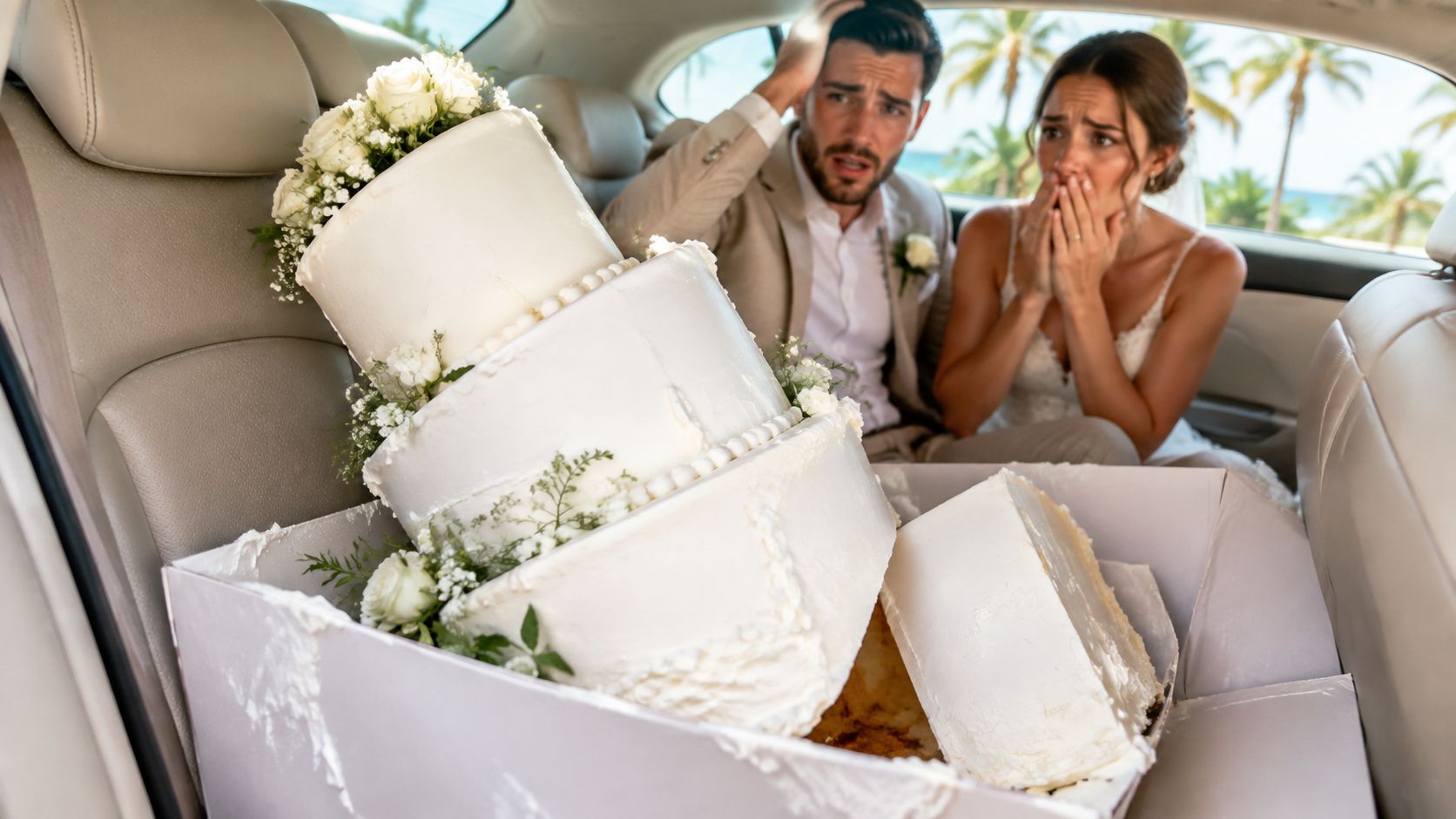
The cake can fail before anyone reaches the venue. A sudden temperature increase softens buttercream and delicate fillings. A hard brake creates forward shear between tiers, boards, supports, and frosting. A rushed lift can tilt the whole structure, while an unsecured box lets the cake slide even when the driver is moving carefully.
Why careful driving isn't enough
A cake's stability depends on more than the recipe. Each tier has weight, height, and a center of gravity. Tall designs are especially sensitive to lateral movement during corners, roundabouts, speed bumps, and braking. When the vehicle turns, the base may remain supported while the upper tiers continue moving, creating the shear force that produces leaning, cracking, or sliding.
The transport environment also changes the cake's material behavior. Chilled frosting offers more resistance to contact and vibration, while softened frosting can smear against packaging or allow decorations to shift. Cream-based fillings add another reason to plan refrigeration rather than relying on ambient conditions.
Practical rule: If the cake would be difficult to carry across a room with one person, it shouldn't be treated like a casual passenger item in a moving car.
Modern cake logistics developed alongside the broader shift from informal delivery to cold-chain handling for bakery and confectionery products. Specialized guidance now emphasizes refrigerated vehicles, pre-chilled interiors, insulated carriers, correctly placed ice packs, and digital thermometers, as outlined in this cold-chain logistics guidance for cakes and wedding desserts. The result is a simple operational principle: plan the vehicle and route before the cake leaves the refrigerator.
Stabilizing and Packing for Transit
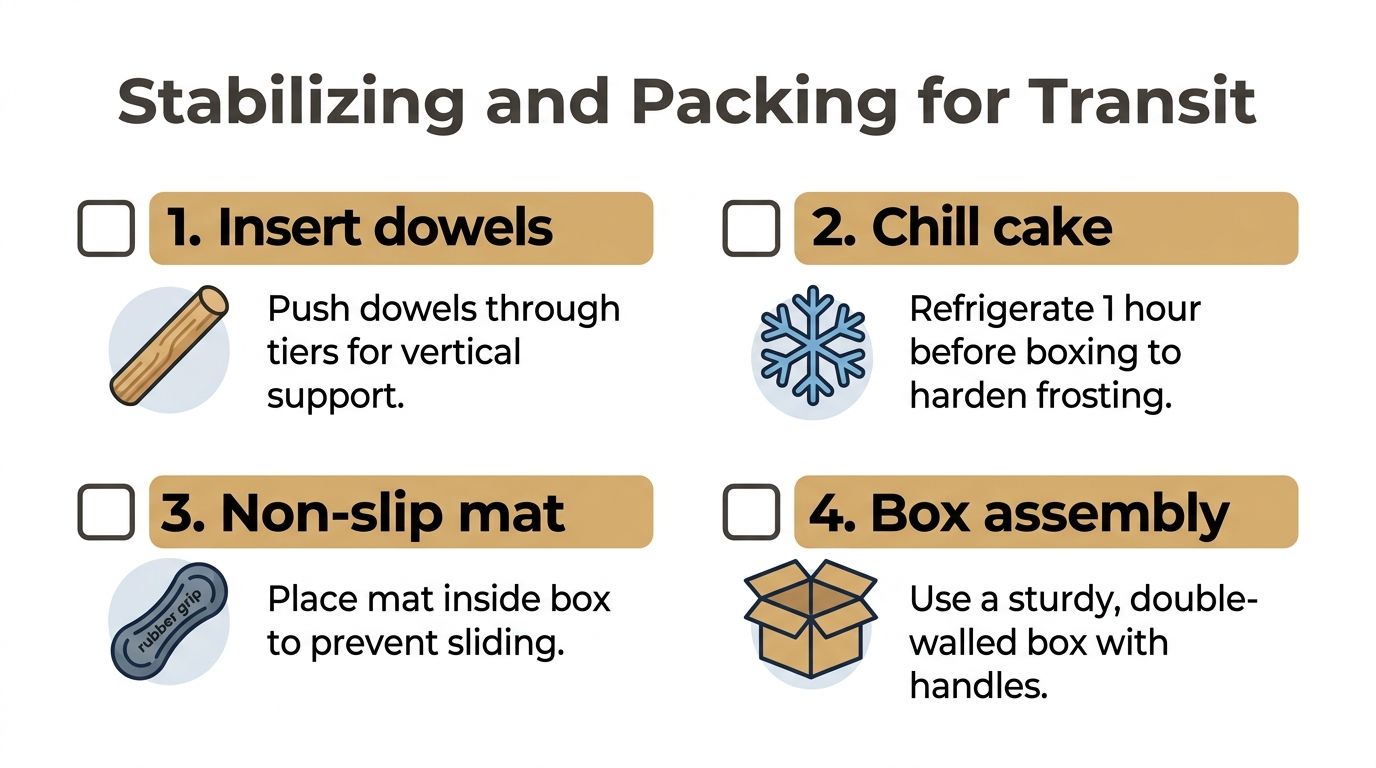
A stable journey starts at the cake board, not at the car door. Use a rigid cake drum that supports the full design, then confirm that every tier has adequate internal support. Dowels or another suitable internal structure transfer the weight vertically, reducing the chance that the upper tiers press directly into the lower frosting.
Prepare the structure
For a stacked cake, inspect the alignment of each tier and make sure the supports are seated securely. Tall or fragile designs should usually travel as separate tiers, with final assembly completed at the venue. Independent cake-transport guidance recommends this approach because a fully assembled tower is harder to lift, maneuver, and protect from shear during cornering and braking. Practical wedding cake transport guidance also recommends chilling the cake until loading, securing the box, and using a flat vehicle surface.
A short, compact design may travel assembled if the box is tall enough, the structure is properly supported, and the vehicle can hold it upright on a level surface. The convenience is real, but it comes with more weight and less maneuverability. Venue assembly takes more time, yet it gives the baker a chance to correct alignment and add delicate flowers or toppers after the most demanding part of the journey.
Build the box around the cake
Chill the finished tiers before boxing so the frosting has more resistance to vibration and incidental contact. Choose a sturdy box that leaves clearance around decorations without allowing the cake board to wander. A non-slip shelf liner beneath the box, or a properly fitted cake drum inside the box, helps stop sliding.
Use a rigid, double-walled box where possible, with carry handles that let two people lift without gripping the sides. Don't allow ice packs to touch the box directly if condensation could affect the packaging or decorations. For packaging teams trying to improve material transparency, this resource on how to implement carbon labels on cake boxes offers useful context for evaluating box choices without sacrificing protection.
Before loading, label the box as upright and identify the front of the design. Pack a small repair kit separately with spare frosting, piping tools, a smoother, extra decorations, dowels, scissors, and any finishing materials used on the cake.
Choosing the Right Vehicle Layout
The safest location is usually the vehicle's flattest usable surface, not the most convenient passenger seat. A sloped seat introduces an angle at the base, and the seat cushion can compress or rebound as the vehicle moves. That combination makes the box more likely to tilt or slide.
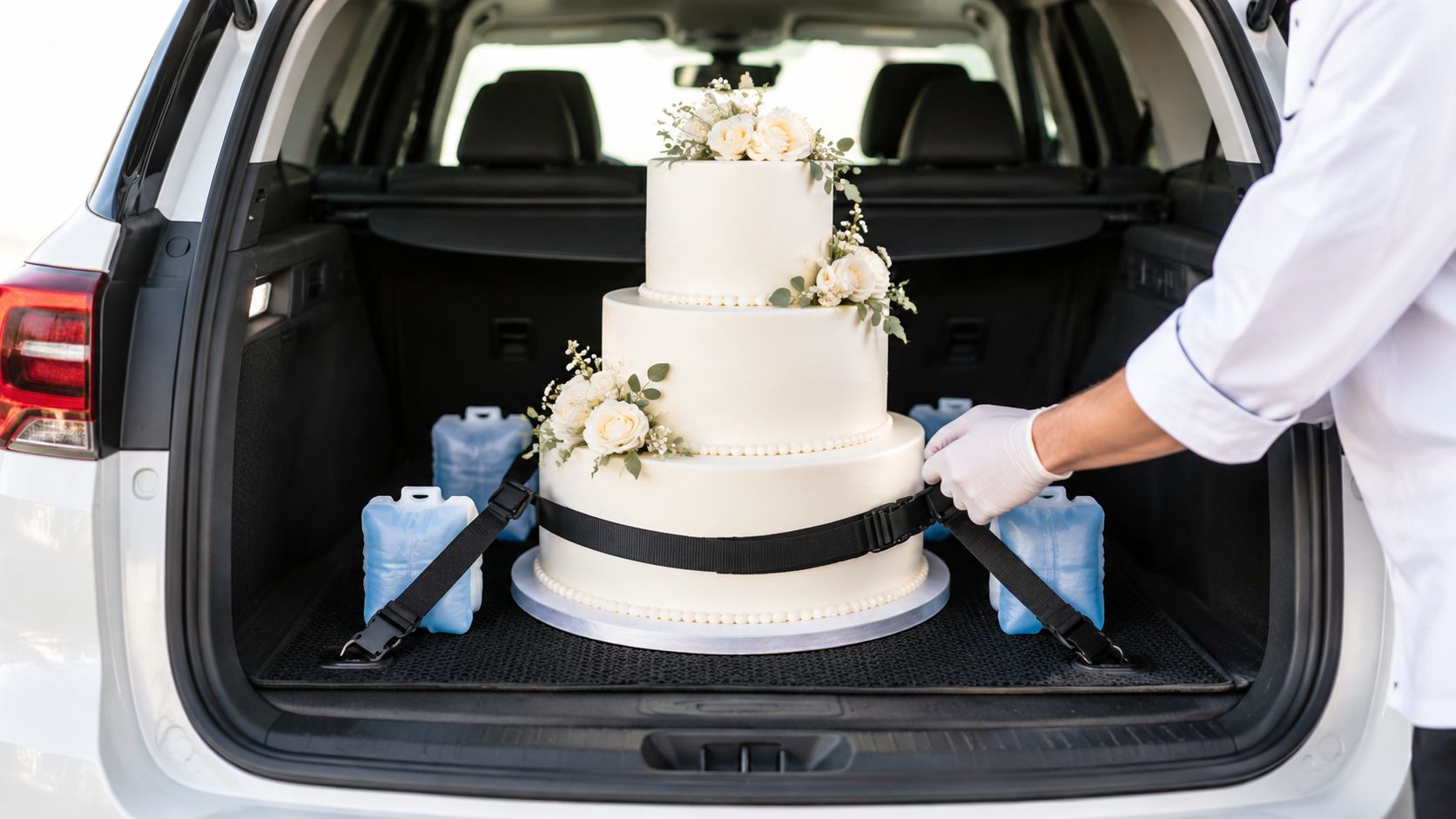
A trunk can work when its floor is level and the opening is tall enough for the box. A flat cargo floor in an SUV, hatchback, or van is often more useful for a tall cake because it provides easier access and more predictable support. The floorboard can also be suitable if it creates a level platform and doesn't interfere with passengers, pedals, or climate-control airflow.
Measure before booking
Measure the boxed cake, including the height of the lid, the width of the handles, and the clearance needed to lift it through the vehicle opening. Then measure the vehicle's cargo height, floor length, and narrowest entry point. A box that fits inside the cabin may still be impossible to load through the hatch.
Clear the cargo area completely. Luggage, coolers, folded seats, and loose equipment can become impact hazards or force the box onto an uneven surface. Place a non-slip mat beneath the box, keep the cake away from direct sunlight, and secure the surrounding area so nothing can press against the packaging.
| Cake configuration | More suitable layout | Main trade-off |
|---|---|---|
| Low, compact design | Level trunk or flat floorboard | Easy loading, limited vertical clearance |
| Tall stacked design | Large SUV or van cargo area | More space, greater need for restraint |
| Fragile or partially assembled design | Separate tier containers | More venue assembly time |
| Multiple cake components | Organized van or SUV cargo zone | Requires careful separation from other items |
When a larger vehicle earns its place
A larger SUV or van materially helps when the cake is too tall for a standard box, when tiers must remain upright in separate containers, or when the vehicle also carries stands, tools, flowers, and refrigeration equipment. More space doesn't automatically create safety. An unrestrained box can still move inside a large cargo area, so the planner must create a flat, dedicated bay.
For destination events, a Cancún car service for wedding and event travel can also be evaluated by cargo dimensions rather than passenger capacity alone. Ask for the vehicle layout, loading height, floor configuration, and whether the driver can wait while the cake is placed and secured.
Hiring a Professional Car Service
A friend's sedan may be free, but it often creates hidden compromises. The driver may not know that a cake must remain level, the seat may be the only available surface, and the vehicle may arrive hot after sitting outside. A professional booking costs more than an informal favor, yet it can provide the space, preparation, and coordination that a high-value cake requires.
Compare the two operating models
DIY transport gives the baker direct control over the box and the route. It can work for a small or short-distance delivery when the vehicle has a flat surface and the person driving understands the handling requirements. The drawback is that the baker or planner becomes responsible for navigation, loading, climate control, parking, and the cake itself.
A professional provider separates those responsibilities. The coordinator can specify that the vehicle must arrive cooled, the cargo area must be empty, and the route should allow gentle acceleration and braking. The chauffeur can focus on smooth movement while the cake team handles placement and venue delivery.
Transport standard: Book the vehicle around the cake's dimensions and handling plan, not around the number of passenger seats.
A premium fleet may offer late-model SUVs with stronger climate control and more adaptable cargo areas. That doesn't remove the need for a cake box, non-slip base, or internal support. It does create a better platform for using those protections correctly.
Give the provider a real brief
Send the boxed dimensions, total number of tiers, whether the cake travels assembled, the pickup location, the venue entrance, and the required arrival window. Explain that the cake cannot ride on a slanted seat and that the cargo area must be free of loose luggage.
Ask how the provider handles delays, loading assistance, parking, and waiting time. For a complex wedding itinerary, a dedicated chauffeur can be more practical than a point-to-point ride because the same driver may need to coordinate with the baker, planner, venue, or floral team. A dedicated chauffeur service for scheduled wedding movements is particularly useful when the cake delivery forms part of a broader sequence of pickups and venue stops.
Unique Private Transportation is one option for this type of arrangement. Its Cancun-based service provides private airport transfers, point-to-point travel, dedicated chauffeur bookings, and wedding transportation coordination using premium vehicles, with flight monitoring and bilingual communication available for the wider event plan.
Mastering Temperature Control
Heat changes the cake while the vehicle changes its position. Buttercream can soften, cream-based fillings can become less stable, and fondant or sugar decorations can react poorly to abrupt environmental changes. A cold-chain approach replaces guesswork with preparation, insulation, and measurement.
Food-safety and logistics guidance increasingly uses measurable control points such as 4°C, 5°C, 8°C, and 60°C, rather than relying only on the phrase “keep it cool,” as described in the temperature-control reference for cake transport. The correct threshold depends on the ingredient and the applicable food-safety requirement, so the baker should follow the recipe, venue, and local handling rules for the specific filling.
Set the cold chain before loading
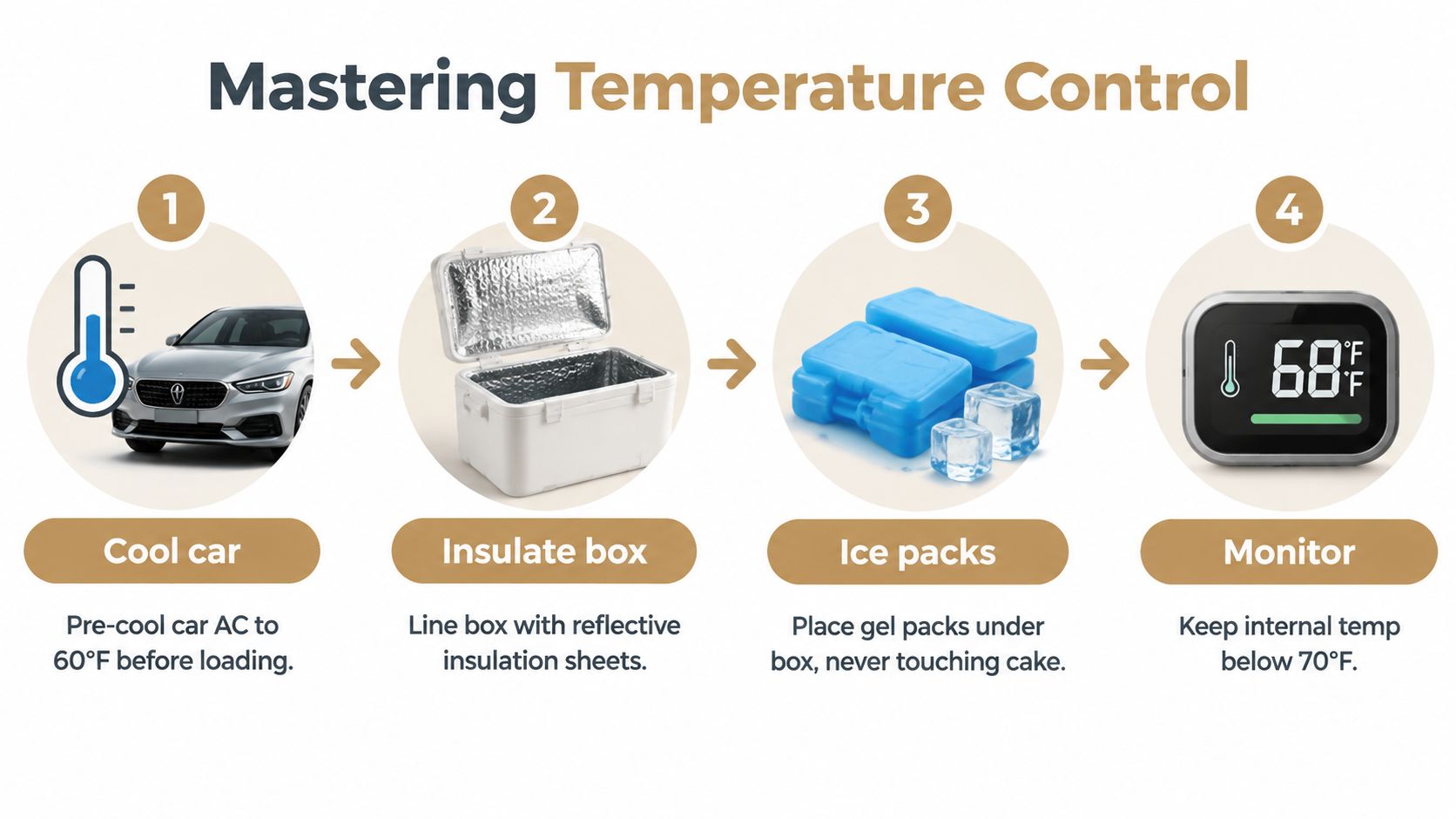
Keep the cake refrigerated until the vehicle is ready. Pre-cool the enclosed cabin or cargo space, then use a digital thermometer to check the condition before loading and during the journey. A thermometer doesn't stabilize the cake by itself, but it tells the coordinator whether the plan is working.
Insulated carriers help reduce temperature swings. If gel packs or ice packs are needed, place them around the outside of the cake box, not directly against the box or cake. Direct contact can create cold spots and condensation, which may damage cardboard, frosting, fondant, or sugar work.
Match the method to the filling
A fondant-covered cake may tolerate movement differently from a buttercream design, but neither should be left exposed to heat or sunlight. Fresh cream and cream-cheese style fillings deserve particular attention. Guidance recommends keeping these cakes refrigerated for journeys longer than about 1 to 2 hours, as explained in this cake transport and refrigeration guide.
For a longer or unusually hot transfer, planners may need a dedicated chilled carrier or mobile refrigeration rather than improvised coolers. If equipment must be hired, compare pricing for mobile fridge units as part of the event budget. Whatever equipment you choose, confirm that it fits the boxed cake, maintains airflow, and can be accessed without repeatedly exposing the cake to outdoor heat.
Don't open the box during the drive. Record the starting temperature, secure the lid, and inspect the cake only after the vehicle is parked in a shaded or controlled area. The venue team should already know where the cake will be stored and how quickly it must move from the vehicle into refrigeration or final setup.
Coordinating Broader Wedding Logistics
Cake delivery rarely happens in isolation. The baker may be arriving from another country, the planner may be moving between a resort and ceremony site, and VIP guests may land at Cancún International Airport while the cake is being collected from a kitchen elsewhere in the Riviera Maya.
Airport procedures need to be part of the plan. Cancún International Airport doesn't allow passengers to hail a taxi directly at the terminal. Travelers are directed toward official airport transportation or pre-arranged services, and the airport's guidance states that private service is available 24 hours for locations in Cancún, the Riviera Maya, and Tulum, according to the airport transportation information.
Use one communication structure
A planner can reduce confusion by assigning one transport coordinator and sharing a single movement sheet with the baker, chauffeur, venue, and airport representative. Include:
- Cake details: Box dimensions, assembled or separated tiers, refrigeration needs, and repair kit location.
- Vehicle details: Cargo layout, loading instructions, pickup contact, and driver communication channel.
- Venue details: Service entrance, parking point, storage location, assembly area, and a named receiver.
- Guest movements: Airport arrivals, resort transfers, rehearsal dinner travel, and ceremony-day vehicle assignments.
Published fare guides list one-way private-transfer examples such as US$24 to Cancún's Hotel Zone and downtown, US$60 to Akumal, and US$70 to Tulum, with higher round-trip prices for those routes, as shown in this Cancún airport transfer fare guide. Another airport taxi guide describes prepaid, zone-based fares, with typical examples of MXN 750 to 1,100 for the Hotel Zone and MXN 1,800 to 2,500 for Tulum, purchased at the official desk inside arrivals, as detailed in this Cancún airport taxi guidance.
Private transfers are commonly arranged in advance using the flight number, with the driver monitoring the arrival and meeting travelers at the international arrivals exit with signage, as described in this Cancún airport transportation planning guide. The same planning discipline works for the cake. Confirm the vehicle, monitor the route, and give every person one clear point of contact.
A shared transportation partner can also support guest experience beyond the cake. If guests need an organized way to contribute reception images, a wedding guest photo sharing solution can keep those memories connected to the event without adding another physical delivery task. For planners building the budget, this guide to wedding transportation costs can help frame vehicle planning alongside the cake, guest, and vendor movements.
Unique Private Transportation coordinates private airport transfers, dedicated chauffeurs, premium vehicle bookings, and wedding transportation across Cancún and the Riviera Maya. Visit Unique Private Transportation to discuss a cake-safe vehicle layout, airport pickup, and a coordinated event-day movement plan.