

You've just landed at Cancún International Airport. Your phone is buzzing, the luggage carousel is crowded, and outside, several transportation options appear to be waiting for you. You know your resort may be in the Hotel Zone, Playa del Carmen, or Tulum, but you don't yet know who's meeting you, where to walk, or whether the quoted fare will change.
That arrival is exactly where point to point transportation services earn their place. Instead of treating your airport ride as a random vehicle pickup, this model connects one confirmed origin with one confirmed destination, supported by scheduled dispatch, direct routing, and clear communication. For Riviera Maya travelers, that turns a complicated first hour into a managed part of the itinerary.
Table of Contents
- What Point to Point Transportation Really Means for Travelers
- How Point to Point Differs From Shuttles Taxis and Hourly Chauffeurs
- Understanding Pricing and Booking Models in the Riviera Maya
- What Makes a Premium Point to Point Experience Reliable
- Best Use Cases for Point to Point Travel Across Cancun and Riviera Maya
- Common Misconceptions About Private Transportation in Cancun
- Planning Your Next Point to Point Transfer With Confidence
What Point to Point Transportation Really Means for Travelers
Point-to-point transportation moves you directly from a specific starting location to a specific destination, without transferring through a hub or sharing the route with unrelated passengers. In a Cancun airport context, that can mean a private vehicle from your terminal to a resort in Cancún, a hotel in Playa del Carmen, or a vacation rental in Tulum.
The easiest analogy is a nonstop flight compared with a connecting flight. A nonstop flight keeps your journey on one route. A connecting flight introduces another airport, another boarding process, and another opportunity for a delay or misplaced bag. Ground transportation works in a similar way. A direct vehicle avoids the extra handoffs and intermediate stops that make a shared journey harder to predict. Transport Geography explains the point-to-point model as a network that connects origins and destinations directly, without an intermediate hub.
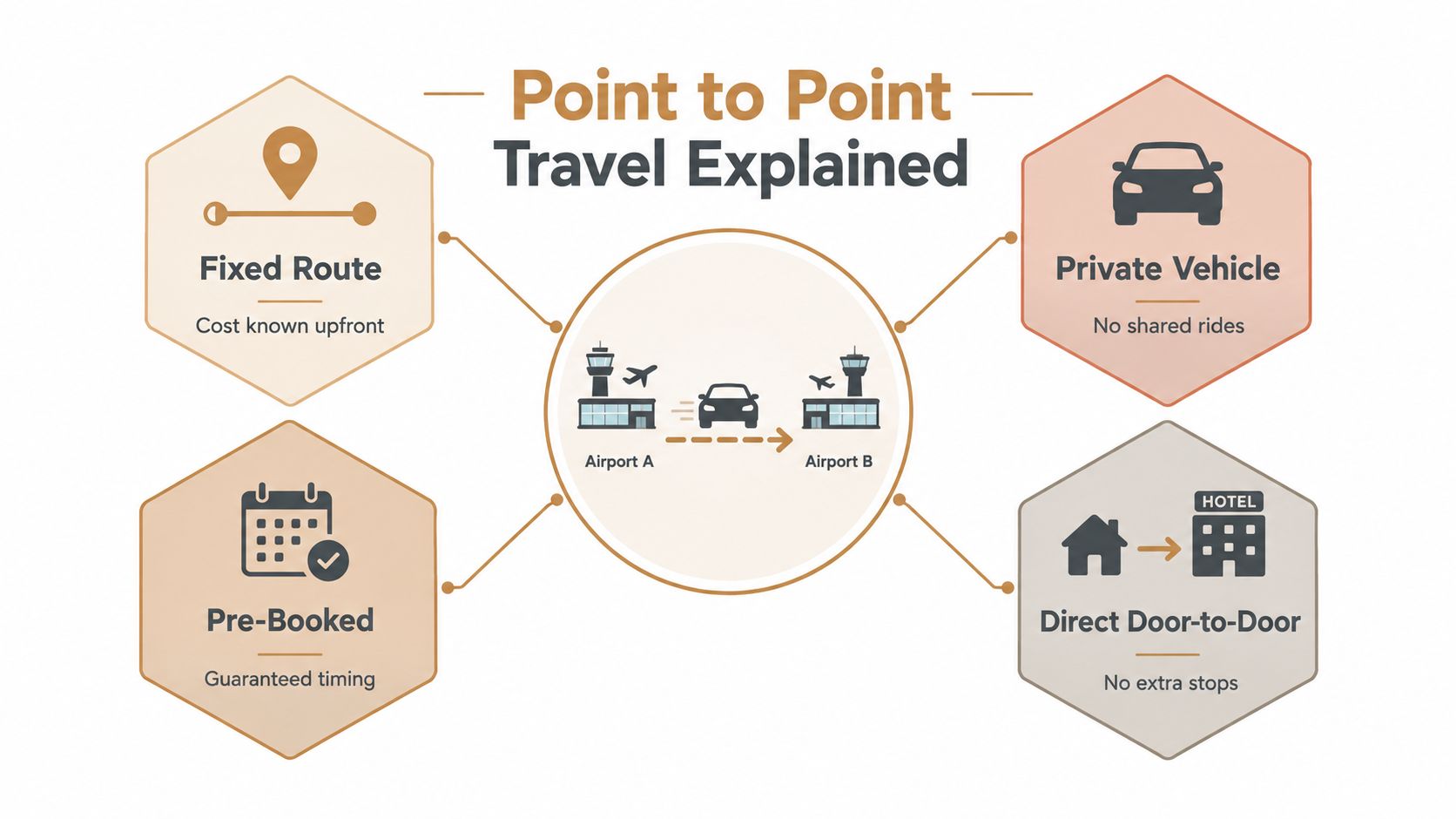
The direct-service promise
A well-organized transfer has four connected parts:
- One route: The driver takes your party from the airport to the address you supplied.
- One vehicle: You aren't waiting for other travelers to arrive or sharing space with unknown passengers.
- One scheduled movement: The reservation gives the dispatch team a clear pickup point and destination.
- One handoff: You go from the terminal to the vehicle, then from the vehicle to your hotel, resort, villa, or ferry connection.
That structure matters because Riviera Maya itineraries often include luggage, children, unfamiliar roads, and tight arrival plans. Direct service reduces transfer handling and lets the provider focus on pickup timing, route execution, and communication rather than assembling multiple passenger journeys.
Point-to-point doesn't mean the driver can remove traffic or guarantee a particular arrival time. It means the transportation plan itself has fewer moving parts. The driver isn't circling through several resorts, and you aren't changing vehicles midway through the trip.
Practical rule: If your priority is reaching one destination with as few interruptions as possible, ask for a direct private transfer rather than assuming every airport ride works the same way.
This is the foundation of private transportation Cancun airport travelers often seek. The value isn't only a comfortable seat. It's the continuity between landing, meeting the driver, loading bags, and arriving at the correct door.
How Point to Point Differs From Shuttles Taxis and Hourly Chauffeurs
The three alternatives most often confused with private point-to-point service are shared shuttles, street taxis or app rides, and hourly chauffeur bookings. They can all be useful, but they solve different problems.
A shared shuttle consolidates passengers and stops. That can be practical for travelers who are flexible about the length of the journey and want a lower-complexity booking. A taxi or app ride offers flexibility at the moment of travel, but the pickup process, vehicle availability, fare structure, and airport access can vary. An hourly chauffeur is designed for movement across several places during a period of time, not necessarily for one direct airport-to-resort journey.
| Feature | Point to Point Private Transfer | Shared Shuttle | Street Taxi / App Ride | Hourly Chauffeur |
|---|---|---|---|---|
| Routing | Direct from your origin to your destination | Multiple passenger stops may be combined | Direct route when available, subject to pickup conditions | Flexible route across several stops |
| Privacy | Private vehicle for your booking | Shared with other travelers | Usually private, but availability varies | Private vehicle and chauffeur |
| Timing | Reserved in advance with planned pickup details | Built around shared departures and stops | Requested at or near travel time | Reserved for a block of service |
| Price structure | Often fixed by destination, vehicle, and party details | Usually based on the shared route | May depend on provider and fare method | Based on the reserved service period |
| Best fit | Airport-to-hotel and other single-leg rides | Flexible travelers comfortable with stops | Short-notice or simple local movement | Meetings, errands, tours, and multi-stop days |
| Main trade-off | Less useful when you need repeated stops | Less control over departure and route | Pickup rules and fare clarity require checking | Can be unnecessary for one direct transfer |
Use the network analogy
Think of a shared shuttle as a small hub-and-spoke system. Travelers arrive at a common airport, then the operator combines them into a route serving several destinations. Point-to-point service is closer to a private road between two addresses. The operator still has to manage traffic and airport procedures, but the route isn't built around collecting additional passengers.
A taxi can be the right choice for a traveler who understands the local pickup process and is comfortable making a decision after landing. For a family with tired children, bulky bags, or a prearranged resort schedule, advance coordination usually removes more uncertainty. A private Cancun car service can also provide a named meeting process instead of leaving you to identify a vehicle in a busy pickup area.
Hourly service is different again. If you're visiting several resorts, attending a wedding rehearsal, or combining meetings with dinner, a dedicated chauffeur by the hour may be more suitable. For a single airport ride, paying for ongoing availability can be more service than you need. For a detailed explanation of dedicated chauffeur arrangements, see this dedicated chauffeur service guide.
Understanding Pricing and Booking Models in the Riviera Maya
A family arriving after a delayed flight needs a price and route they can understand before leaving the terminal. In Cancún airport transportation, quotes commonly depend on destination zone, vehicle category, and passenger requirements, rather than a running meter. For a defined airport journey, that model gives the provider a route to price in advance and lets travelers compare regular private vehicles with premium or luxury options without guessing how traffic will affect a meter.
Published examples show why the details matter. The official Cancún Airport taxi table lists one-way online rates of US$24.85 or more to the Hotel Zone, US$24.43 or more to Downtown Cancún, US$44.14 or more to Playa del Carmen, and US$64.63 or more to Tulum. It also lists route bands including 28 km and 30 or more minutes to the Hotel Zone and 120 km and 100 or more minutes to Tulum. Cancún Airport publishes these destination-based taxi rates and route bands.
Another guide gives different flat-rate examples for official airport taxis in 2026, including US$55 to US$75 to the Hotel Zone, US$95 to US$120 to Playa del Carmen, and US$180 to US$220 to Tulum. The difference is a reminder to confirm the provider, service category, destination zone, and inclusions before payment. This Cancun airport transportation guide explains the zone-based flat-rate model.
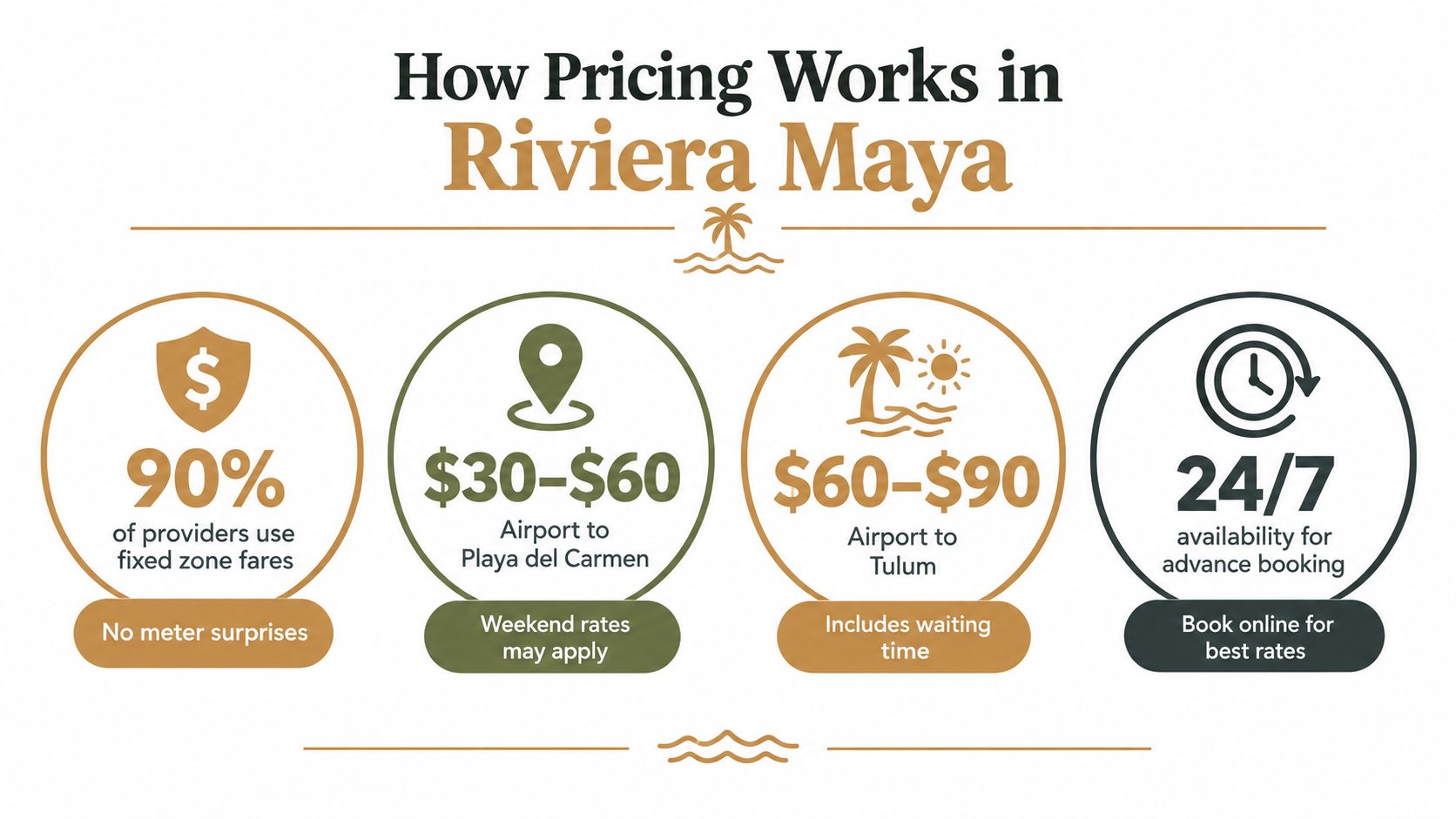
Read the quote like a route plan
A clear quote should let you trace the journey from pickup to drop-off. Check these points before booking:
- Route definition: Confirm the exact airport, hotel, resort, villa, ferry terminal, or attraction.
- Vehicle class: Ask whether the price covers a sedan, SUV, van, or luxury category.
- Passenger and luggage capacity: A vehicle may fit the group but not every suitcase, stroller, or sports item.
- Waiting terms: Confirm what happens if the flight arrives early, late, or after a schedule change.
- Extra services: Ask about child seats, additional stops, beverages, tolls, parking, and special pickup arrangements.
Cancún Airport also lists private taxi service for hotels, resorts, and vacation homes, with online rate viewing and private transfers among its airport ground-transport options. Cancún Airport describes its transportation offerings for hotel, resort, and vacation-home travel.
Vehicle category can change the fare substantially. Independent Cancun airport listings separate a Luxury Taxi category for one to five passengers, with one-way prices of US$76 to Cancún, US$145 to Playa del Carmen, and US$306 to Tulum. This Cancun airport transportation listing shows how luxury fares vary by vehicle category, passenger capacity, and destination.
For comparison, this chauffeur hire London prices guide shows why base service, vehicle type, timing, and extras should appear as separate considerations. Travelers arranging a Cancun transfer can also review this Cancun car service resource for booking details.
What Makes a Premium Point to Point Experience Reliable
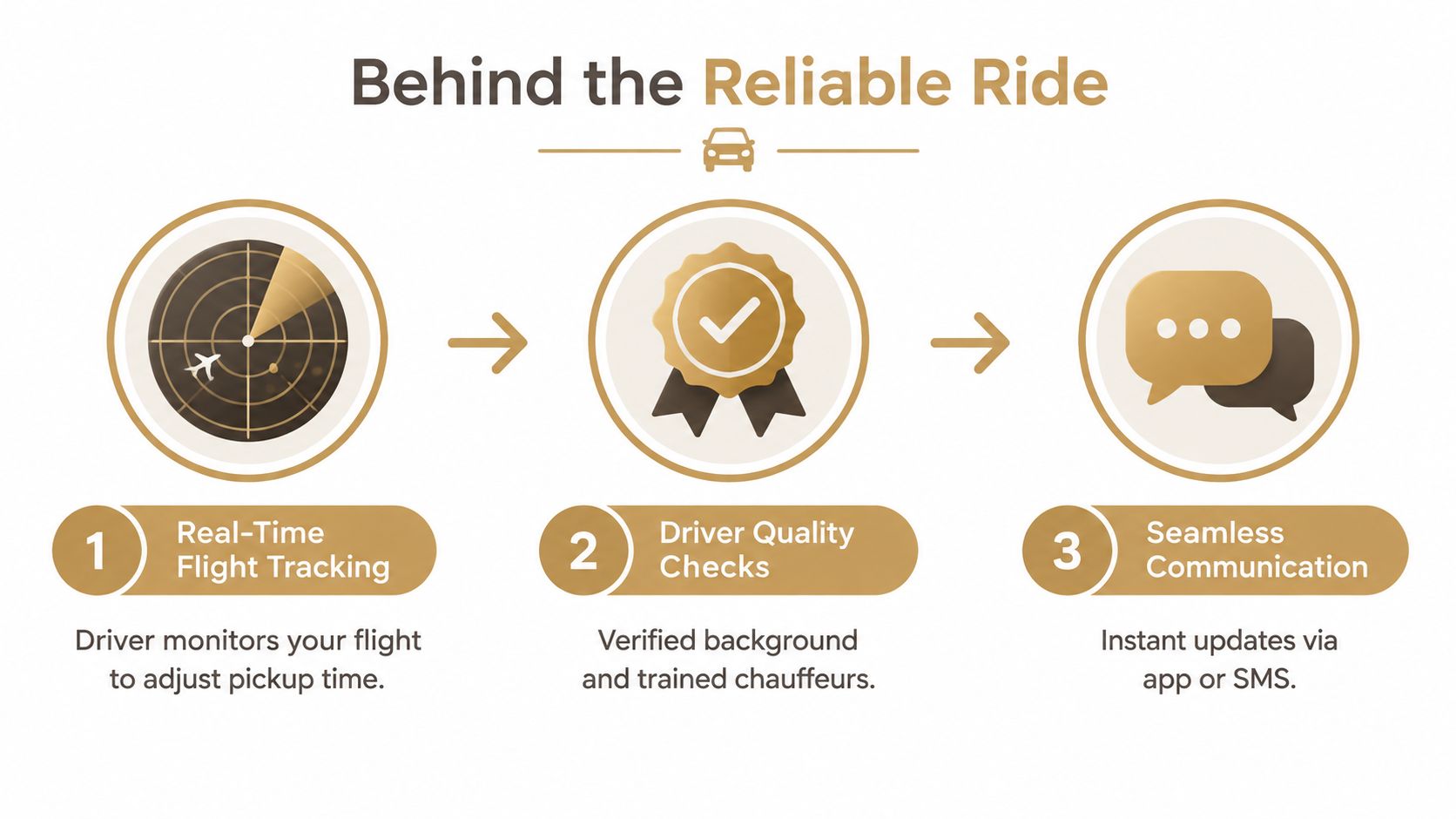
A flight arrives early, bags take longer than expected, or the terminal meeting point changes. A reliable point to point transportation service has a plan for each situation, so the ride works as a coordinated system rather than a vehicle waiting at a scheduled time.
Flight-number monitoring is one of the clearest examples. The provider checks the actual flight status and adjusts dispatch when the aircraft arrives early, runs late, or diverts. Airport chauffeur guidance commonly describes complimentary waiting time as starting at wheels-down, with policies often set around 30 to 60 minutes, depending on the flight type and provider. Detailed Drivers explains flight monitoring, automatic pickup adjustment, and airport waiting-time practices.
Examine the operating plan
Vehicle photos show appearance. The booking process shows reliability. Before reserving, ask:
- Flight changes: Is your flight number attached to the reservation, and does dispatch monitor it?
- Arrival guidance: Will someone explain where to walk and how to recognize the meeting point?
- Communication: Can you receive instructions in English or Spanish before and after landing?
- Vehicle readiness: Has the provider confirmed the vehicle for your passenger count, luggage, and child-seat needs?
- Contingencies: What happens if baggage is delayed, terminal instructions change, or the pickup area becomes difficult to access?
Meet-and-greet service should make the terminal exit easier to understand. A coordinator or chauffeur can guide you from arrivals to the vehicle, assist with luggage, and confirm the destination on the reservation. For a first-time visitor to Cancún, that guidance can feel like having a local host at the airport after a long international flight.
Comfort features support the service when they solve a practical need. Late-model SUVs, refreshments, cold towels, baby seats on request, pet-friendly options, and passenger insurance may help families and travelers booking luxury transportation. They cannot replace accurate dispatch, clear instructions, or a driver who knows the agreed meeting point.
What to compare: Ask not only “What car will arrive?” but also “What happens if my flight, baggage, or pickup location changes?”
Technology supports these human steps. Deloitte's transportation outlook describes AI-enabled operations moving from pilot activity toward production use, while transportation systems face increased cybersecurity and infrastructure pressure. Deloitte's transportation trends outlook discusses operational technology, AI adoption, and cybersecurity pressures. For travelers, the practical questions are straightforward: Does the provider use secure payment workflows, handle personal data carefully, update dispatch in real time, and respond when plans change? An overview of premium resort transportation technology shows why coordination tools matter alongside the vehicle itself.
Best Use Cases for Point to Point Travel Across Cancun and Riviera Maya
A smooth Riviera Maya arrival often comes down to one decision: whether the vehicle follows your route directly or collects other passengers first. A family landing in Cancún with a stroller, car seat needs, and several bags may prefer a private transfer to Playa del Carmen. The driver meets them once, loads everything once, and continues to the resort entrance. No extra shuttle stops, no repeated destination explanation, and no vehicle negotiation after a long flight.

The same logic helps with other travel plans:
- Airport to resort: Choose direct service when the trip has one clear destination, such as a hotel, villa, or resort. The booking stays tied to that arrival rather than to a shared route.
- Airport to ferry connection: Travelers going toward Isla Mujeres need the land portion to fit their planned crossing. A prearranged vehicle can coordinate the airport pickup with the ferry schedule.
- Regional attraction: A transfer to Chichén Itzá or another Yucatán destination suits travelers who need transportation between defined points. A private tour is a better fit when the day includes guiding, sightseeing, or flexible stops.
- Wedding logistics: Guests may arrive on different flights and stay at different properties. A coordinator can arrange separate airport arrivals, group movements, rehearsal-dinner transportation, and ceremony-day departures.
- Corporate travel: Meeting and event groups may need vehicles matched to passenger counts, luggage, and scheduled movements. Centralized confirmations give the planner one system to manage instead of many separate arrangements.
- Multi-stop travel: An airport-to-hotel ride usually does not require a chauffeur waiting all day. Several resorts, restaurants, or appointments may justify hourly service or a custom tour.
The category depends on the itinerary. Point-to-point covers one direct leg. Hourly chauffeur service keeps a vehicle available over a period of time. Private touring adds destination planning and concierge support. Treating these as separate tools helps travelers avoid paying for unused availability or expecting one transfer to function like a full-day service.
For flights, direct routing works best when paired with operational follow-through. Flight monitoring can help the provider adjust for arrival changes, while a fixed price gives the traveler a clear cost before pickup. Together, those features address two common airport concerns, uncertainty about timing and uncertainty about the final fare.
Travelers comparing routes across the region can use this Cancun destination guide to match airport arrivals, resort movements, and regional excursions with the appropriate service format.
Common Misconceptions About Private Transportation in Cancun
A traveler may assume every airport taxi works like a city taxi. That assumption causes confusion because airport fares can be destination-based and fixed rather than metered. The published Cancún Airport fare table uses destination categories and online rates, so the important question isn't only “Is this a taxi?” It's “Which operator, destination zone, vehicle category, and rate apply to this booking?”
Another common mistake is assuming a ride-hailing app has the same airport access as a licensed private transfer. Pickup rights, vehicle restrictions, terminal procedures, and designated zones can differ by airport and jurisdiction. Recent regulatory developments show that the market isn't moving toward one universal rulebook. Hong Kong passed a ride-hailing legal framework in 2025 and moved to subsidiary rules in 2026, while Heathrow tightened taxi and private-hire compliance and airport operating rules in 2025. Thailand and Sri Lanka also introduced airport-specific controls separating app-based vehicles, taxis, and pickup zones. This regulatory overview discusses how pre-booked ride services face localized transport requirements.
Three assumptions worth correcting
- “Luxury only means a nicer vehicle.” A premium vehicle can improve comfort, but the more meaningful difference may be live flight monitoring, bilingual coordination, meet-and-greet guidance, secure payment, and a clear contingency process.
- “A confirmed request always means a confirmed ride.” Travelers should look for a formal confirmation containing the route, pickup details, vehicle information, passenger details, and price or pricing conditions.
- “Booking early removes every risk.” Advance booking helps organize the trip, but travelers still need to provide the correct flight number, hotel name, arrival terminal, and contact details. Good information gives dispatch something useful to monitor.
The same principle applies to pickup locations. An airport may direct private vehicles, taxis, and app-based cars to different areas. A provider that sends only a vehicle description without clear walking instructions leaves the hardest part to the traveler.
For first-time visitors, licensed operations, written confirmation, responsive support, and transparent pickup coordination deserve as much attention as the car model. That is what makes a unique private transportation experience operationally useful rather than merely decorative.
Planning Your Next Point to Point Transfer With Confidence
Start with the route, not the vehicle photo. Write down the airport, terminal if known, exact accommodation, number of travelers, luggage requirements, and whether you need a ferry connection or another time-sensitive stop.
Then review the quote for the details that affect the actual experience:
- Confirm the destination: Use the exact resort, villa, hotel, or ferry location.
- Add the flight number: This gives dispatch a basis for tracking actual arrival changes.
- Match the vehicle: Check passenger seating, luggage room, child seats, and accessibility needs.
- Ask about waiting: Confirm when complimentary airport waiting begins and what happens after that period.
- Verify communication: Make sure you know how the provider will send meeting instructions.
- Clarify inclusions: Ask about refreshments, cold towels, insurance, tolls, parking, extra stops, and payment terms.
- Choose the right format: Use point-to-point for a direct leg, hourly chauffeur service for ongoing availability, and a private tour for guided sightseeing.
Travelers who prioritize time, privacy, and reliability will usually find that direct airport transportation is easier to manage than making a curbside decision after a long flight. Travelers with complex plans should ask whether the provider can coordinate multiple vehicles, wedding schedules, corporate movements, or a custom day across Cancun and the Riviera Maya.
Unique Private Transportation offers private airport transfers, regional point-to-point rides, dedicated chauffeur service, bespoke tours, wedding coordination, and corporate ground transport with live flight monitoring and concierge communication. Visit Unique Private Transportation to request a Cancun airport transfer or discuss a Riviera Maya itinerary.