
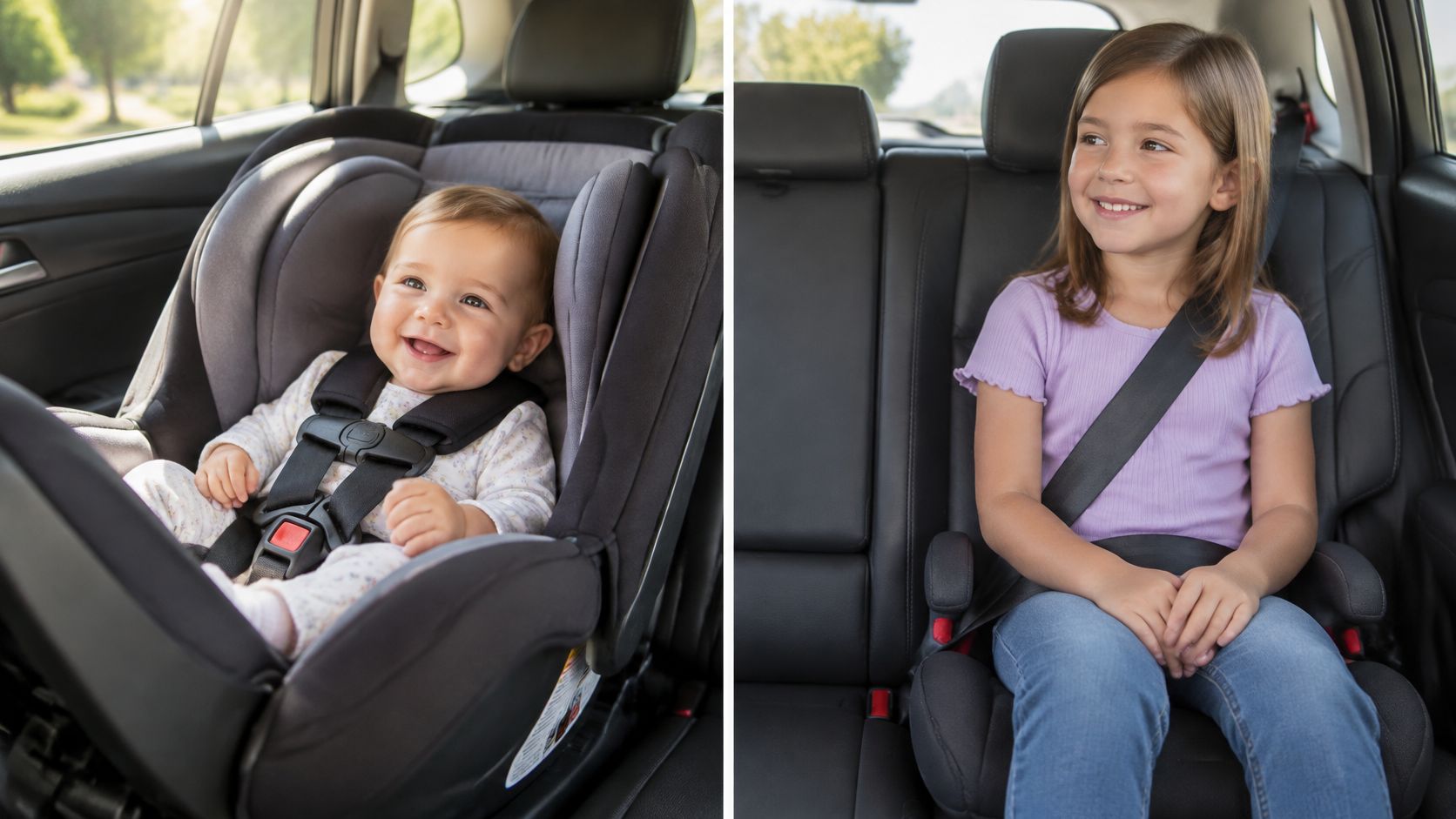
Which seat does a four-year-old belong in, a booster or a convertible? Most parents answer with the birthday, because the birthday is the one fact every pediatric visit, preschool form and grandmother asks for. It is also the least useful fact in the decision. What decides the answer is how tall and heavy the child is today, how the seat belt lands on that child's body in that specific vehicle, and what the manufacturer printed on the label.
Booster seat vs convertible car seat gets framed as a shelf comparison, two products side by side with a winner. For almost every family it's a sequence instead. The convertible seat arrives first and does two jobs. The booster arrives later and does one job that depends entirely on the adult belt, a belt the booster doesn't control.
Two details trip up careful parents. First, a convertible seat's limits change with the direction it faces, so a seat that fits a child rear-facing may stop fitting that same child forward-facing months later. Second, a booster does nothing by itself. It borrows the vehicle's belt, and if that belt sits on the belly or against the neck, the child is sitting on a cushion rather than riding in a safety device.
Table of Contents
- Booster and Convertible Seats Side by Side
- Which Seat Fits Each Growth Stage
- Why Harness Protection and Belt Positioning Differ
- Checking Installation and Belt Fit on Every Ride
- Travel Use from Cancun Airport to Your Destination
- When Each Seat Makes Sense in Real Life
- Pre-Trip Checklist and Final Verdict
Booster and Convertible Seats Side by Side
A convertible car seat restrains the child with its own five-point harness. A booster seat restrains nobody: it raises the child so the vehicle's lap-and-shoulder belt crosses the right bones. Everything else about the two products follows from that one distinction.
Direction of travel splits them next. A convertible seat is built to face rearward for an infant or young toddler, then to be turned forward once the child reaches the rear-facing height or weight limit. A booster has no rear-facing mode and never will. It only ever faces forward, and it only works with a lap-and-shoulder belt behind it.
The products also serve different children. Convertible seats cover the years when a child still fits inside a harness, from the first ride home through the preschool years and often well beyond. Boosters are for the child who has used up the forward-facing harness by height or weight and still can't get a good fit from an adult belt, the child whose belt rides on the belly instead of the hip bones or cuts across the neck instead of the shoulder.
| Criterion | Convertible car seat | Booster seat |
|---|---|---|
| Restraint method | Built-in five-point harness and top tether | Vehicle lap-and-shoulder belt, child raised |
| Direction of travel | Rear-facing first, then forward-facing | Forward-facing only |
| Best for | Infants and children who have not outgrown the harness | Children who have outgrown the harness but cannot fit an adult belt |
| Installation in a rental or rideshare car | Needs LATCH or belt installation, plus top tether when forward-facing | Belt-only, no anchor or tether required |
Installation is the row that matters most on holiday. A convertible seat has to be attached to the vehicle, with LATCH anchors or the seat belt, plus a top tether once it faces forward. A booster just sits on the cushion and uses the belt that's already there. Nothing to anchor, nothing to tension, nothing to get wrong at 11 p.m. outside a resort gate.
Both are mainstream purchases rather than niche products. Dataintelo's car seat products market report projected convertible car seats at 29.3% of the global car seat products market for 2025, with booster seats at 22.1%. Families comparing them are usually choosing a stage, not a category.
Getting the vehicle and the seats sorted together is often the harder half of a family trip, and the case for a full-size SUV with room behind the third row is set out in this guide to why the Suburban is a comfortable choice for family travel.
To identify which category a child belongs in today, ignore the birthday entirely. Read the label on the seat you already own, find the maximum forward-facing harness height and weight, and measure the child against both numbers. Inside those limits, the convertible still has work to do. Past them, the harness has retired and the booster stage begins.
Which Seat Fits Each Growth Stage
The order is fixed. The timing isn't. A child moves from rear-facing to forward-facing to a booster to the adult belt, and each handoff happens at a number printed on a label rather than at a birthday party.
A convertible seat does the first two jobs in a single product: rear-facing for infants and toddlers, then forward-facing with the internal harness and top tether once the child outgrows the rear-facing limits. NHTSA's guide to installing a convertible car seat forward-facing makes the sequence explicit. Keep the child rear-facing until the seat's maximum permitted height or weight, then use the forward-facing harness for as long as the manufacturer allows. A booster can't do either job, because it has no harness to hold anybody.
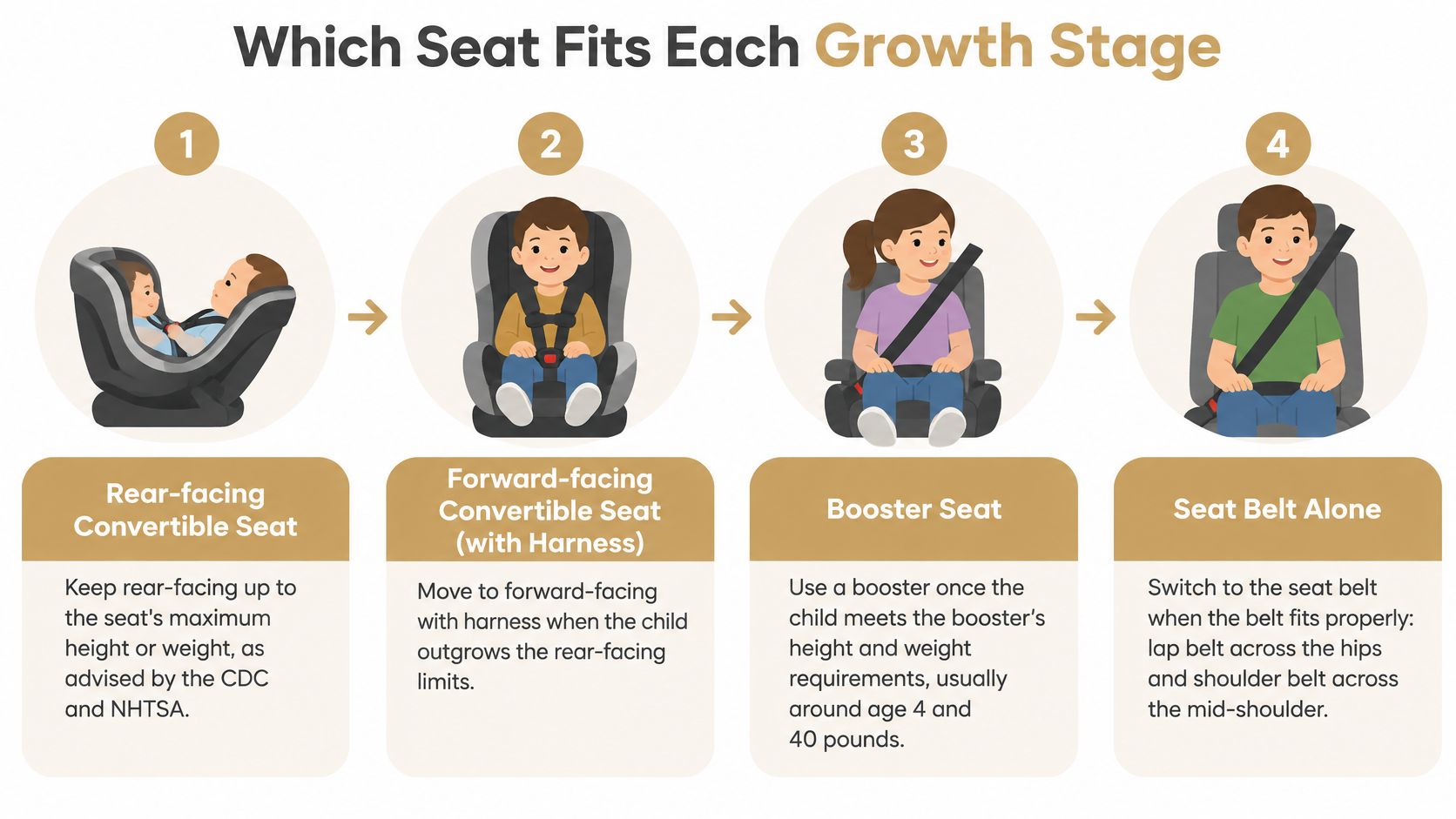
The four stages, in one picture. The timeline below shows the whole ladder, from the first rear-facing ride to the day the belt alone does the work.
What changes at each handoff
- Rear-facing convertible. The child rides against the seat back with the harness snug and the chest clip at armpit level. This stage ends at the seat's rear-facing height or weight limit, whichever comes first, and the head must stay below the line the manual specifies.
- Forward-facing harness. The same seat, turned around, now with the top tether hooked to its designated anchor. This stage ends at the harness height or weight limit, not at the point the child looks cramped in the legroom.
- Belt-positioning booster. The harness retires and the vehicle belt takes over, guided by the booster's shoulder-belt path. A child is ready when the harness limits are used up, typically somewhere near 40 lb and four years old, and stays in a booster until the adult belt fits without it.
- Adult seat belt. According to the NHTSA National Child Restraint Use Special Study, the belt usually fits properly somewhere between ages 9 and 12. The test is geometric, not numeric: back against the seat back, knees bent over the edge, lap belt on the thighs, shoulder belt across the middle of the chest.
| Stage | Seat type | Child size guide | What to check before moving on |
|---|---|---|---|
| Rear-facing | Convertible seat, rear-facing | Infants and toddlers up to the seat's rear-facing height or weight limit | Rear-facing height and weight labels on the seat |
| Forward-facing harness | Convertible seat, forward-facing with top tether | Past rear-facing limits, up to the harness height or weight limit | Top tether anchored and harness straps at or above the shoulders |
| Belt-positioning booster | High-back or backless booster | Past the harness limit, roughly 40 lb and about 4 years old, until the belt fits | Child sits all the way back with knees bent at the seat edge |
| Adult seat belt | No seat | Typically around ages 9 to 12, when the belt fits without a booster | Lap belt low on thighs and shoulder belt across the chest, not the neck |
Write it down now: the current harness limit and the date you plan to recheck it. Tape the note inside the car door. A limit nobody remembers is a limit somebody guesses at, and guessing is how a child spends six months in the wrong seat.
Why Harness Protection and Belt Positioning Differ
What changes when a child moves from a harness to a booster? The harness restrains the child directly; a booster positions the vehicle belt to fit the child's body. These are different stages of protection, not interchangeable product choices.
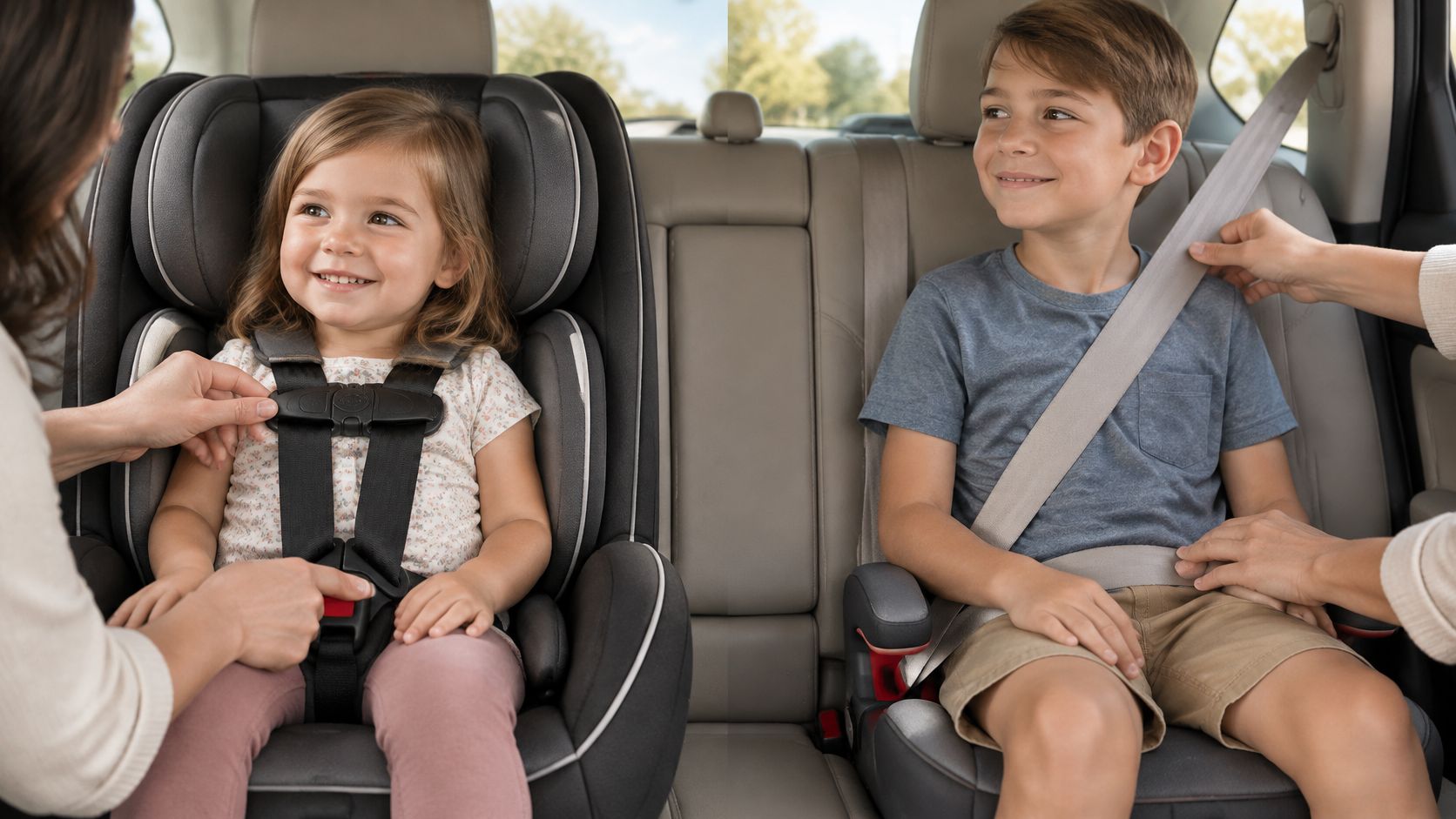
Where the protection actually comes from
A harness holds the child against the seat shell and spreads crash forces across the shoulders, chest, and hips. The child moves with the seat, while the shell helps manage the force.
A booster does not restrain the child by itself. It raises the child so the vehicle belt can sit in the right places: the lap section over the hip bones and the shoulder section across the chest. If the belt sits on the abdomen or neck, it can load areas it is meant to avoid. The booster works only while the child stays upright and correctly positioned.
What the measured benefits look like
NHTSA's published child passenger safety research reports that car seat use reduces crash-injury risk by 71% to 82% for children compared with seat-belt use alone. It also reports that booster use reduces the risk of serious injury by 45% for children ages 4 to 8 compared with seat belts alone.
These figures describe the benefit of using an appropriate restraint instead of a seat belt alone. They do not mean one seat type is always safer than another. A harness suits a child who remains within its limits; a booster is for a child ready to sit correctly while the vehicle belt does the restraining.
Misuse is the variable that swamps the product choice
Installation and fit matter alongside seat type. A loose harness or incorrect recline can undermine a convertible seat's protection, just as a poorly positioned belt can undermine a booster's. A two-year-old belongs in an appropriate harnessed seat, not a booster, but the label alone cannot make an incorrectly set up seat protective.
The pattern worth memorizing: harness first, belt second. Each move to the next stage depends on the child being ready to use it correctly, not on a birthday or a product label.
Checking Installation and Belt Fit on Every Ride
Does the seat stay secure, and does the belt fit the child's body? Check both before every ride. A few minutes with the vehicle parked can reveal a poor fit before the journey begins.
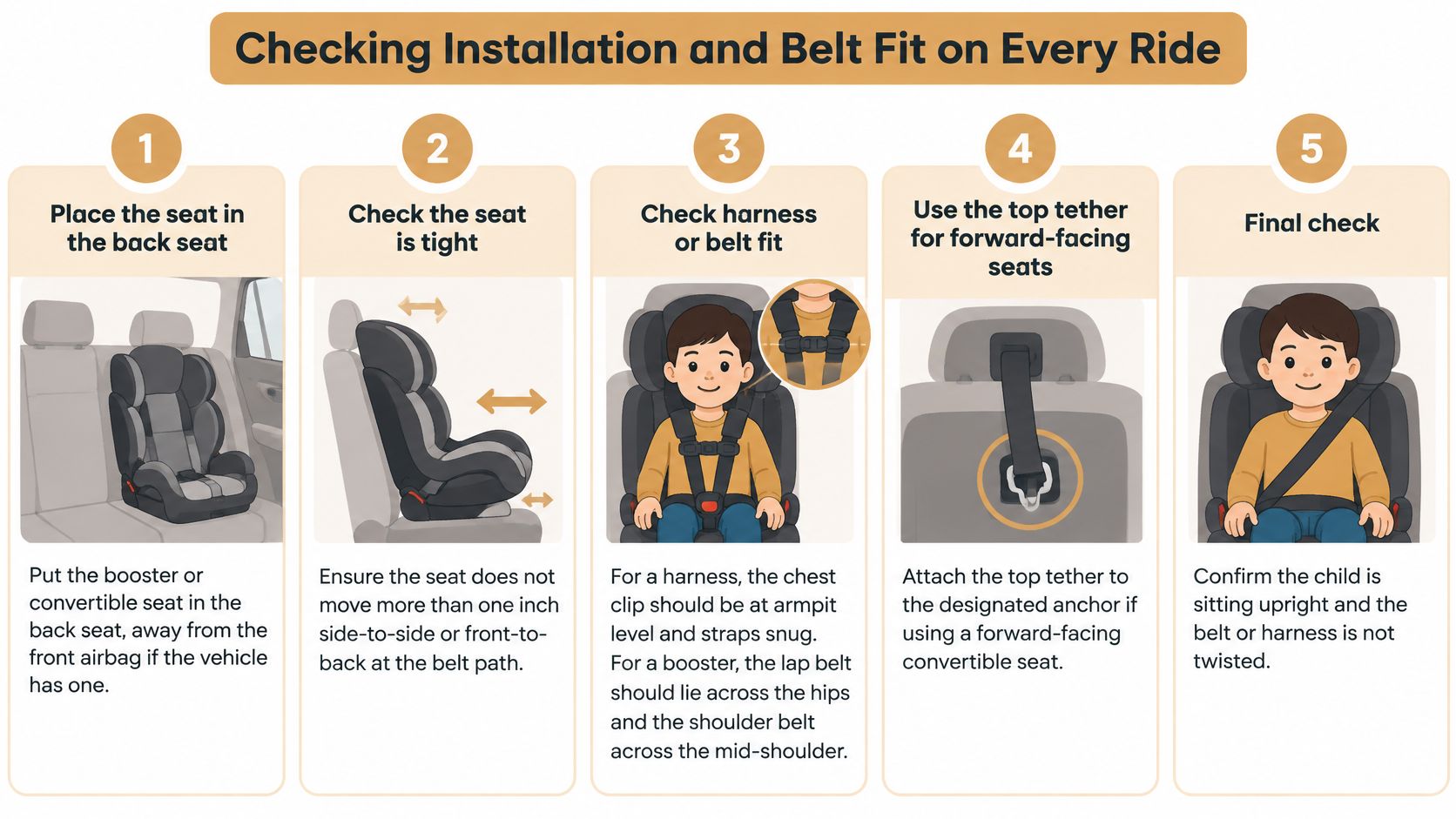
Six checks, run in order. Follow the sequence in the infographic when setting up a seat in an unfamiliar vehicle.
The checks that decide whether the setup works
Choose an approved back-seat position. Check both manuals for the vehicle's permitted seating positions. Some vehicles do not allow LATCH in the center, or allow it only in certain positions.
Secure the convertible seat. Use LATCH or the vehicle belt as directed, then test movement at the belt path. It should move less than an inch from side to side and front to back. For a forward-facing seat, attach the top tether before checking tightness.
Check the child's posture. Have the child sit with their hips against the seat back, knees bending at the cushion edge, and feet flat on the floor. Slouching can shift the belt away from the hip bones, even when the seat itself is correctly positioned.
Check the lap belt. NHTSA's car seats and booster seats guidance says it should lie snugly across the upper thighs, not the abdomen. The belt needs to sit low, where the child's body can better manage crash forces.
Check the shoulder belt. It should cross the middle of the shoulder and chest, not touch the neck or face, or slip off the shoulder's edge. A high-back booster's belt guide helps keep the belt in position; the child should not have to pull it into place.
Watch posture throughout the ride. Low-stiffness boosters make submarining, when a child slides under the lap belt, more likely. Slouching can increase that risk, even in a stiffer booster. A seat's label alone cannot guarantee a good fit if the child's posture changes.
A booster requires a lap-and-shoulder belt. A lap-only belt provides no shoulder strap for the booster to position, so that seating position cannot be used with a belt-positioning booster.
Repeat the checks if the seat moves to another vehicle, the child wears a bulky coat, a different adult buckles them in, or the child has grown. A small change in height or posture can alter belt fit, so use the child's position and the belt's path, not age alone, to judge whether the setup still works.
Travel Use from Cancun Airport to Your Destination
A car seat is portable. A car seat plus a stroller plus four suitcases is a logistics problem, and the airport is where it bites hardest.
The flight decides what you can bring
A convertible seat can be used in the cabin only if it carries the aircraft-approval statement on its label, so check that label before you pack. Most boosters can't be used on a plane at all, because there's no lap-and-shoulder belt for them to position, which makes a booster checked baggage. Decide before departure whether the seat flies with you or rides in the hold, and pack accordingly.
Terminals, shuttles, and the bus that skips Terminal 1
Cancún International Airport has four passenger terminals and a complimentary shuttle connecting them, but the shuttle runs terminal to terminal only and isn't a way to reach a hotel. The Cancún airport terminal guide warns that the wait can reach 20 minutes.
ADO's airport service reaches Terminals 2, 3 and 4, while Terminal 1 has no ADO departure at all, according to the airport's ground transportation overview. A family landing at Terminal 1 has to move terminals with the seats and bags before any bus, which turns a simple arrival into a two-transfer morning.
Luggage adds its own arithmetic. On the Cancún Airport to Playa del Carmen run, each passenger can generally check up to 25 kg free plus one carry-on, children under five travel free only while sharing an accompanying adult's seat, and children over five usually need their own ticket, per ADO's route information. Two adults, two children and two car seats become a math problem in a bus aisle.
Booking a transfer around the seats instead
A prearranged private transportation Cancun airport pickup takes the terminal shuttle out of the plan: the driver meets you inside the terminal and walks you to the vehicle. Unique Private Transportation provides free infant gear on board and fits child seats on request, and its Suburban SUVs are the usual choice for families who want the seats and the luggage traveling in one vehicle. Confirm the seat type at booking rather than at the curb, and give the company each child's height, weight and current stage. A chauffeured Cancun car service also handles the late arrivals, when the shuttle queue and the taxi line are at their longest, and the same vehicle can manage point-to-point travel between resorts, cenotes and the airport on days when nobody wants to reinstall a seat twice.
When Each Seat Makes Sense in Real Life
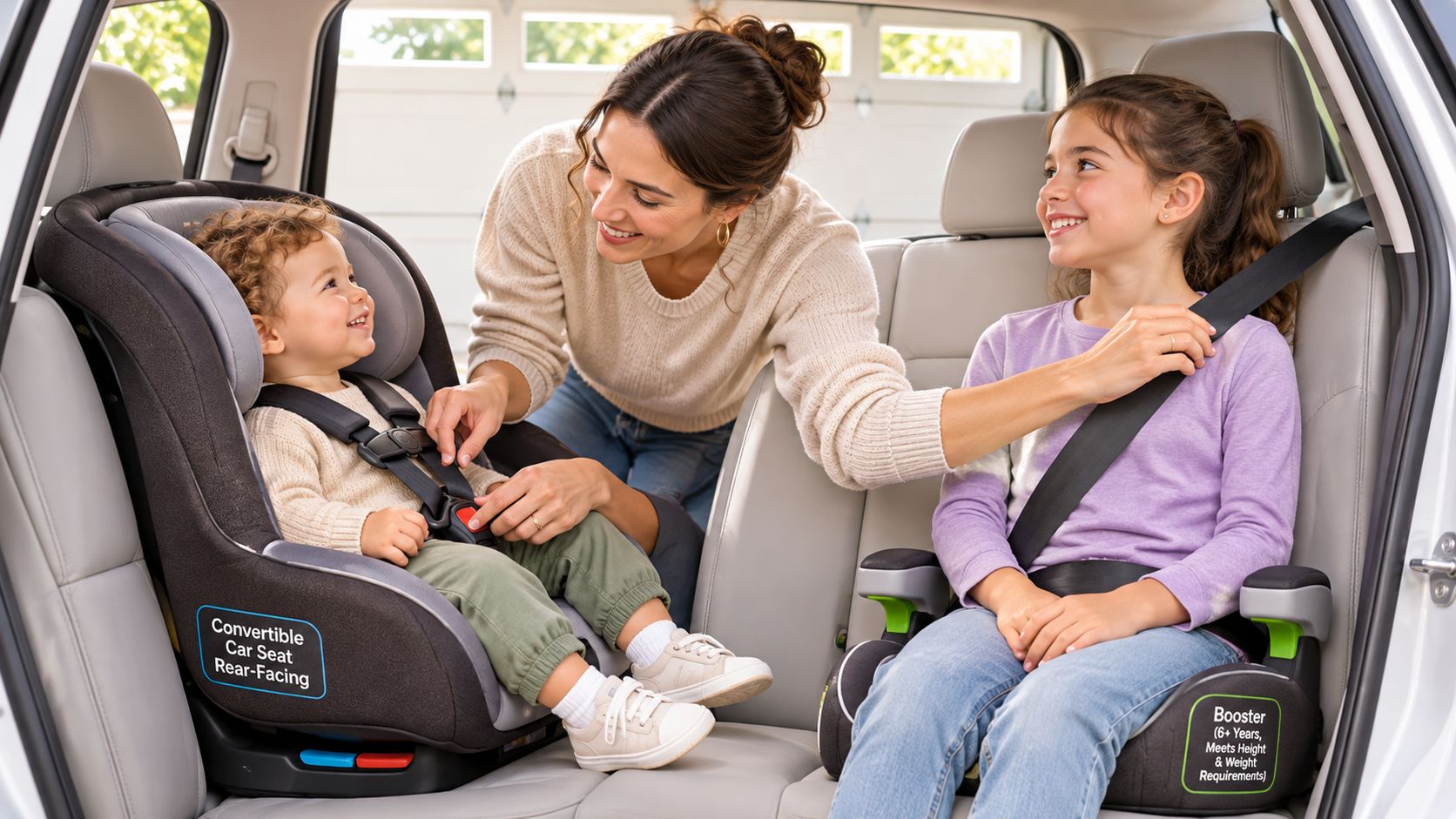
Five households, five different answers from the same two products.
A two-year-old and a six-year-old on the same trip. The toddler stays in a convertible, rear-facing if the seat still allows it at that height and weight, forward-facing with the tether if it doesn't. The six-year-old moves to a booster only after clearing the harness limit. The check that makes the whole arrangement work is a belt-fit test in the actual vehicle, done in the driveway rather than in the shop.
The child who has just outgrown the harness. A high-back booster guides the shoulder belt and gives some head and torso support, which makes it the better first booster for most children. A backless booster works once the vehicle seat has a head restraint behind the child's head and the belt routes cleanly across the chest. Check the head support in your own car before you take the back off.
A grandparent's car with no LATCH anchors. A booster is the easy fit here, since it needs only the vehicle belt and a seating position with a lap-and-shoulder belt and head support. A convertible seat can still be installed with the belt, but it must be locked and hand-checked, and someone should walk the grandparent through the install before the first school pickup rather than over the phone.
A rideshare or a carpool afternoon. A light backless booster that a child can carry in a backpack and set up in any three-point belt is the practical answer. The child also has to be mature enough to sit upright the entire ride, because in someone else's car nobody is monitoring the belt but you.
Two children of very different sizes. Keep the convertible in the car that does the school run and a booster in the second car, so nobody is swapping seats in a parking lot at seven in the morning. Recheck both setups as each child grows.
The principle that settles every case: the right seat fits the child's current size and the vehicle's belt. It isn't the one that matches the birthday.
Families who arrange a chauffeured day around the Riviera Maya can book luxury private transportation in Cancun with the seats already fitted, which removes the swap entirely.
Pre-Trip Checklist and Final Verdict
Run this before any journey with a child, whether the car is yours, a rental, or a chauffeured vehicle.
- Match the seat to the stage. Read the harness or booster limits printed on the seat label and compare them with the child's height and weight today, not last spring.
- Don't graduate early. If the child is still inside the convertible's harness limits, keep the convertible. A booster isn't an upgrade, it's a different system with less restraint built in.
- Run the belt-fit test in the vehicle you'll ride in if the child is booster age. Back against the seat, knees bent, lap belt on the thighs, shoulder belt on the chest.
- Confirm the hardware in writing for a rental, rideshare or private transfer. The vehicle needs the anchors or the three-point belt the seat requires, and the provider should confirm which seat type it carries rather than promising "a child seat."
- Check the aircraft-approval label on a convertible seat before you plan to use it in the cabin.
- Count seats and luggage together. One seat per child, plus the boot space those seats consume, changes which vehicle works for the trip.
The verdict. Convertible seats protect younger children with a harness built into the seat itself. Boosters protect older children by fitting them to the belt the vehicle already has. What decides between them is the child's height and weight, the limits printed on the seat, and the belt in the car you'll ride in. The birthday is the last thing on the list, not the first.
Unique Private Transportation runs private airport transfers, point-to-point travel and bespoke tours across Cancun and the Riviera Maya, and we fit child seats on request so the right seat is in the vehicle before you land. Send us each child's height, weight and current seat stage when you book, and we'll match the seat type and the vehicle to your family, with free infant gear on board and Suburban SUVs for the luggage that comes with them. Visit Unique Private Transportation to plan your transfer.