
You land in Cancun at 11 am, have one free day ahead of you, and Isla Mujeres looks close enough to squeeze in. The question isn't whether you can reach the island. It's whether you can get from arrivals to the beach, enjoy yourself, and return without spending the day watching the clock. If your free day is tomorrow, that's a straightforward planning exercise. If it's today, you need a shorter itinerary and a firm return plan.
Table of Contents
- Is a Day Trip from Cancun Realistic
- Work Backward From Your Ferry Time
- Getting From Cancun Airport to the Pier
- Choose Your Arrival Time for the Best Beach Hours
- Three Island Itineraries to Choose From
- Weather Checks and When to Shorten the Day
- Confirm Your Transfer and Return Ferry Before You Go
Is a Day Trip from Cancun Realistic
An Isla Mujeres day trip from Cancun works well when you have a full day, a confirmed hotel or airport pickup, and a return sailing you can comfortably reach. It's a poor fit for an international flight that same evening without a substantial contingency window.
The geography helps. Wikipedia's Isla Mujeres overview places the island approximately 13 kilometers northeast of Cancun, measuring about 7 kilometers long and 0.65 kilometers wide. Beach time, snorkeling, downtown shops, and Punta Sur are close enough to combine, but fitting them all in isn't always the best use of your day.
Protect these parts of the plan:
- Outbound pickup: Know where you're meeting and which pier you're using.
- Return sailing: Choose it before adding optional sightseeing.
- First two beach hours: Don't spend your best swimming window organizing a rental.
Travel light enough to move easily between vehicle, terminal, and sand. Urban Totes' guide to what to pack for a day trip is useful for organizing essentials without bringing your entire holiday wardrobe.
The island is small. Transit and queues, not distance alone, determine how much you'll enjoy it.
Work Backward From Your Ferry Time
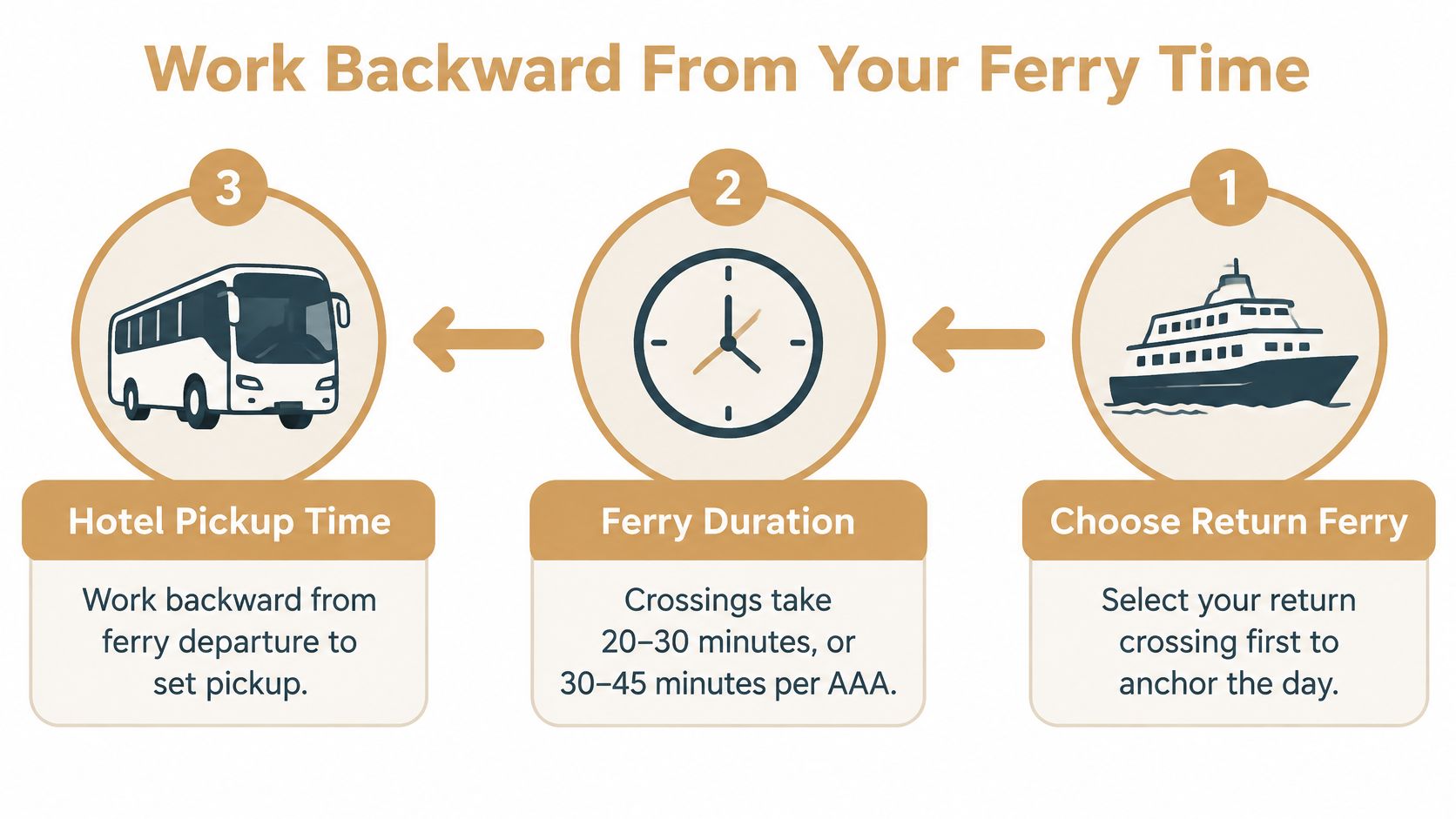
Choose the return ferry first, then build the outbound journey around the beach time you want. Your return sets the deadline for lunch, rental returns, shopping, and getting back to the island terminal.
The Cancun Airport ferry guide describes crossings of approximately 20–30 minutes and Puerto Juárez departures roughly every 30–60 minutes, with service from early morning into the evening. Hotel Zone piers generally have fewer, more structured departures. Meanwhile, AAA's round-trip ferry listing advertises 30–45 minutes for the crossing, so use the longer allowance when testing your plan.
Neither crossing estimate includes the road transfer, ticketing, boarding, or getting from the island dock to your beach.
Build the journey in separate legs
Start with your preferred island-to-Cancun return, then reserve time for reaching the terminal and boarding. Next, choose an outbound ferry that leaves enough usable island time. Only then calculate your Cancun-side hotel pickup.
Backward planning timeline for one island day
These are planning starting points, not guaranteed journey times. The road, terminal, walking, and pickup allowances are estimates to adjust for your travel date and starting address.
| Leg | Time to allow | Why it matters |
|---|---|---|
| Ferry crossing | 20–30 min published; plan 30–45 min using AAA's longer allowance | Use the longer figure when setting the pickup |
| Terminal check-in and boarding | 30–45 min, planning estimate | Queues grow in high season and differ by pier |
| Cancun road leg to the pier | 45–60 min, planning estimate | Traffic is the most variable step |
| Island pier to beach | 10–20 min walk or cart wait, planning estimate | Golf carts and distance add time before the beach |
| Pickup buffer | 15 min, planning estimate | Absorbs delays before the car leaves |
Compare your hotel location with the Puerto Juárez transfer destination before choosing a pier because it appears closer on a map. A shorter road journey isn't automatically better if it leaves you waiting for an infrequent sailing.
Copy the timing method, not the ferry direction
For a hypothetical 4:00 pm return from Isla Mujeres, plan check-in and boarding from 3:15 pm, with arrival at the island pier by 2:45 pm. Work backward from that island-side deadline to decide when to leave the beach or Punta Sur.
The mainland pickup calculation is separate. For example, if a 4:00 pm outbound ferry were appropriate for a late visit, the same conservative method would mean reaching the Cancun pier by 2:45 pm, leaving the hotel by 1:45 pm for an assumed 60-minute road leg, and setting pickup at 1:30 pm for a 15-minute buffer.
Practical rule: A hotel pickup in Cancun cannot connect directly to a return ferry departing Isla Mujeres. Label every booking with its direction and pier.
For a beach-first day, apply that mainland calculation to an early outbound sailing instead.
Getting From Cancun Airport to the Pier
Your arrival terminal can change the ground journey before you've even left the airport. The ADO Cancun Airport bus guide lists departures from Terminals 2, 3, and 4, but none from Terminal 1, where passengers must take the airport shuttle to Terminal 2 first.
That distinction matters when comparing Cancun airport transportation. A bus fare and a private-transfer quote don't describe equivalent journeys if one requires a terminal change and another road connection before you reach the ferry.
Ways to reach the ferry from Cancun Airport
| Option | Best for | Terminal coverage | Main trade-off |
|---|---|---|---|
| ADO airport bus | Solo travelers on a tight budget | Terminals 2, 3, and 4 | No ADO departures from Terminal 1; plan the onward pier connection |
| Airport shuttle to Terminal 2, then ADO | Terminal 1 arrivals on a budget | Terminal 1 via shuttle | Extra transfer adds time |
| Authorized airport taxi | Short, flexible trips with few bags | All terminals, using the authorized pickup arrangement | Verify the permit badge; reject unsolicited curbside offers |
| Pre-booked private transfer | Families, groups, and tight ferry times | All terminals, with the terminal confirmed in advance | Advance booking needed; cost is quoted for the route and vehicle |
Verify authorization before convenience
According to the Cancun Airport FAQ, ordinary taxis and unapproved vehicles cannot pick up arriving passengers; authorized airport vehicles display a permit badge on the windshield, and airport taxi drivers must display identification and wear a uniform. Don't treat someone approaching you with an unsolicited ride offer as equivalent to an authorized pickup.
Keep the provider's meeting instructions available before leaving arrivals. Your confirmation should identify the passenger, destination pier, and contact method, rather than merely saying “Isla Mujeres,” which could be mistaken for an island hotel destination.
A point-to-point transfer is useful when you want the vehicle leg defined by an exact pickup and drop-off. For the ferry, specify the actual terminal rather than a general waterfront address.
Choose the connection that protects your sailing
For hotel-zone travelers, a taxi or shuttle can be sensible when the selected pier gives you flexible departure options. A less frequent Hotel Zone service requires closer coordination and a confirmed return arrangement.
Choose the option that protects your ferry, not the cheapest fare. ADO suits a budget traveler who has slack and can manage the onward connection. A pre-booked transfer is the more controllable option with children, bulky luggage, or a narrow departure window.
When comparing private transportation from Cancun Airport, luxury transportation, and a standard authorized taxi, prioritize dispatch clarity, luggage capacity, and the actual pier arrival plan. A premium vehicle doesn't compensate for booking the wrong terminal.
Choose Your Arrival Time for the Best Beach Hours
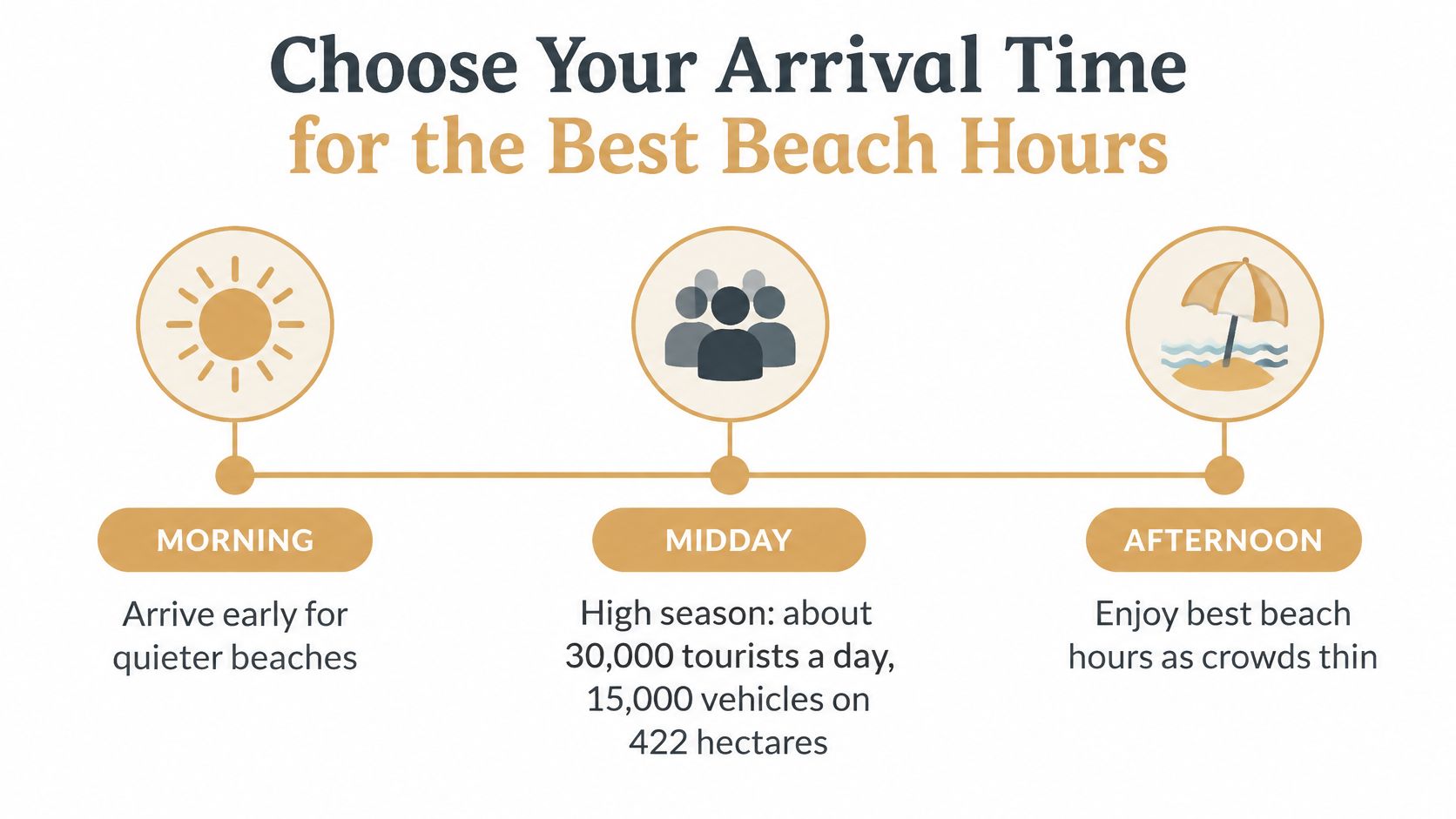
In high season, Isla Mujeres reportedly receives about 30,000 tourists a day, with roughly 15,000 vehicles competing for space on 422 hectares, according to Riviera Maya News' report on island congestion. Those figures explain why a short crossing can still lead to a slow arrival.
Measure door-to-beach time. That means leaving your hotel or airport pickup point, reaching the ferry, crossing, getting off, and finally putting your bag down beside the water. Timing only the boat misses the parts you can improve through planning.
Arrival windows and what each one gives you
These are planning expectations, not promises about a particular day's crowds or weather.
| Arrival window | Crowd level | Beach time | Best for |
|---|---|---|---|
| Early morning, first sailings | Low relative to the midday peak | Longest window before the lunch crowd | Snorkeling, photos, and families |
| Midday | High | Shorter and shared with peak crowds | Groups that cannot start early |
| Late afternoon | Moderate and easing | Short, around sunset | Dinner-focused visits with a pre-selected return |
Early arrival buys usable time
An early crossing is the strongest choice for a beach-led visit. You can head straight to Playa Norte instead of collecting a golf cart, driving around, and arriving at the sand when everyone else does.
For snorkeling, reserve an early boat departure only after checking conditions and the operator's meeting requirements. Don't assume stepping off an early ferry means you can immediately join an excursion with equipment already fitted.
Midday arrivals need a narrower objective. Choose beach and lunch, or downtown and sightseeing, rather than trying to recover an entire morning by rushing between stops.
Don't rent a vehicle by default
More transport supply doesn't remove narrow streets, parking constraints, or queues at rental counters. Over a short downtown journey, walking can beat waiting for a cart, completing paperwork, and finding somewhere to leave it.
Compare the full task, not just driving time:
- Beach and downtown: Walk if the route, heat, and your group's mobility make that comfortable.
- Punta Sur: Arrange a taxi or cart with a return plan, rather than improvising at your departure deadline.
- Families and mobility needs: Check walking distances, boarding assistance, and vehicle access before choosing the arrival arrangement.
- Wedding groups: Keep the group together and agree on a meeting point before anyone starts shopping.
A private arrival may help with coordination, but it doesn't guarantee immediate beach access. Confirm the permitted landing point and onward route before paying for a supposedly more convenient option.
The fastest ferry isn't necessarily the fastest beach day. Remove an unnecessary island-side transfer before paying to upgrade the mainland vehicle.
For a hypothetical early-arrival schedule, spend about 9 am to noon at Playa Norte, eat lunch nearby, browse covered downtown shops, and head to the terminal for your selected return. Treat that beach block as the main event, not spare time between activities.
A late-afternoon arrival works differently. It's a dinner-and-sunset outing, with the evening return confirmed before you leave Cancun, not a compressed substitute for a full beach day.
Three Island Itineraries to Choose From
Choose the version that fits both ferry directions inside your available travel window. Adding every attraction usually produces more vehicle time and less time doing what brought you to the island.
Beach-first with an early arrival
Take an early sailing and go directly to Playa Norte. In a sample schedule, reserve approximately 9 am to noon for swimming and relaxing, then have lunch by the beach and browse downtown before your selected afternoon return.
This is the simplest option for families and travelers who don't want rental logistics. Snorkelers can adapt it only when water conditions and an organized activity support the plan.
Snorkeling and sights with a morning arrival
Book a morning boat excursion with a meeting time you can reach without racing from the ferry. Afterward, eat downtown and decide whether Punta Sur still fits before your return-terminal deadline.
Use a taxi or golf cart for the southern sights, allowing for collection, traffic, parking, and returning the rental. Punta Sur belongs in the plan only if you can enjoy it without turning the journey back into a deadline chase.
Downtown and sunset with a late arrival
Choose this for shopping, a waterfront meal, and an evening walk rather than a long swimming session. Your departure depends on a confirmed evening return, so check the dinner booking against the actual sailing rather than an assumed timetable.
A custom Cancun private tour is worth considering when your mainland stops need coordinating around the island visit.
Selection test: Pick the itinerary whose outbound and return both fit comfortably. If boat activities are unsuitable but ferry service remains safe, switch to the beach-first plan with shore-based activities.
Weather Checks and When to Shorten the Day
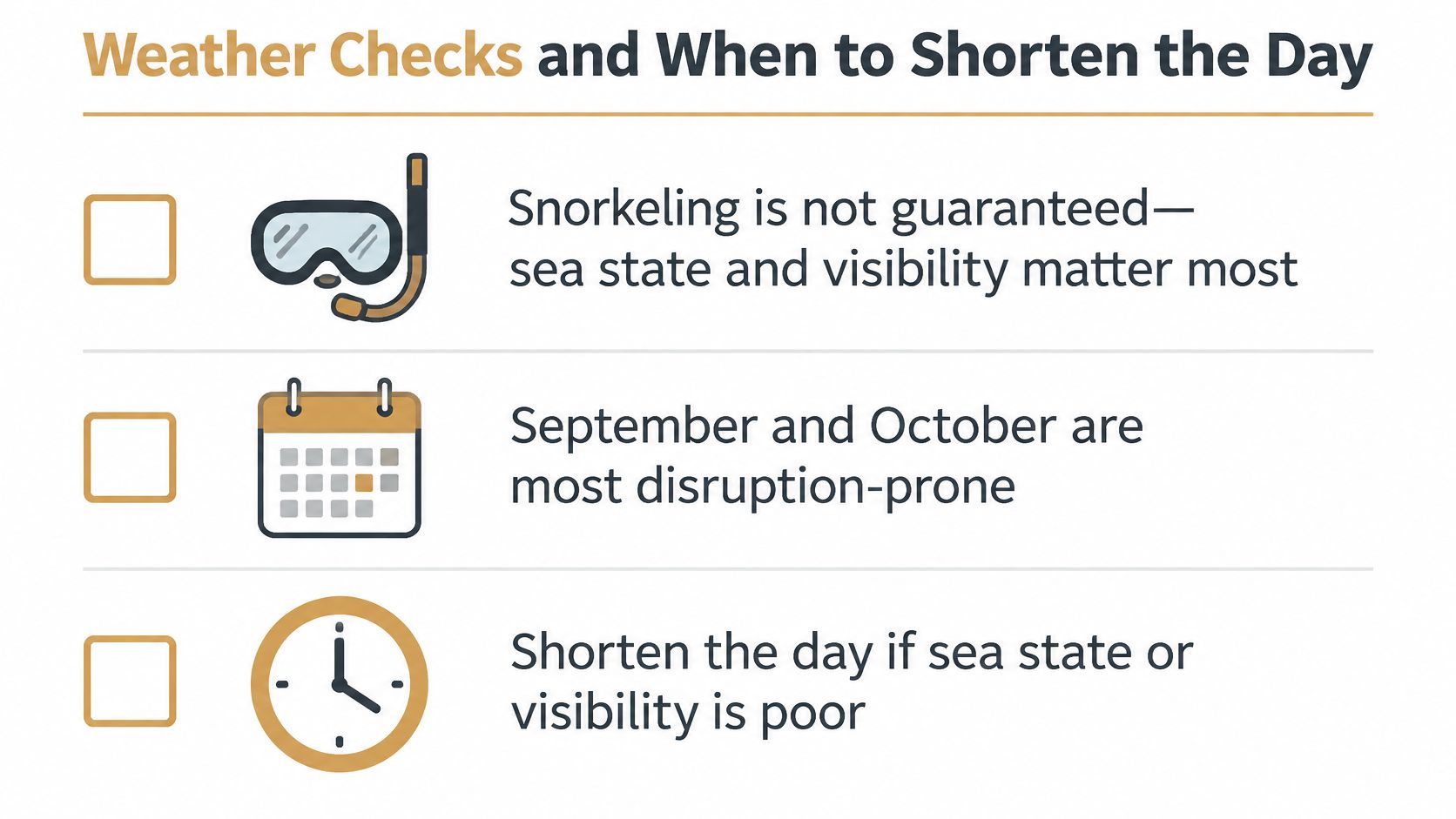
Booking snorkeling doesn't guarantee that snorkeling will be worthwhile or safe. Sea state and visibility matter more than whether the day feels warm, and a bright sky isn't a substitute for marine advice.
The Travel Chronicle's Isla Mujeres climate guide identifies September and October as the most disruption-prone period, reports approximately 15 rainy days in September, and places the Atlantic hurricane season from June 1 through November 30. Use those seasonal patterns to plan flexibility, not to predict conditions for your particular crossing.
Make the decision twice
Use this practical checking schedule rather than making a single decision when you book:
- Before departure: As a planning routine, check conditions 24–48 hours ahead. Review ferry service notices, official weather and marine advisories, and the snorkeling operator's cancellation guidance.
- On the travel morning: Recheck wind, rain, service status, and the operator's decision before committing to a boat activity. Morning is the preferred planning window, not a safety guarantee.
The Xailing ferry schedule explicitly makes service subject to weather conditions and operational capacity. A published departure is therefore something to confirm, not an unconditional promise.
Separate activity decisions from transport decisions. A snorkeling cancellation doesn't automatically mean the ferry is cancelled, while an operating ferry doesn't mean every water activity is appropriate.
Replace the activity before you lose the return
Use a simple fallback: Playa Norte when conditions permit, lunch, covered shopping, and an earlier ferry. If beach conditions are unsuitable, skip swimming too. Don't replace a cancelled boat excursion with another exposed activity merely to keep the schedule full.
For humid-weather preparation around shops, restaurants, and outdoor waiting areas, the Misaj guide to humid-weather bite prevention is a useful packing companion. Keep personal comfort preparation separate from the decision about whether to travel.
Avoid placing a tightly timed flight, wedding commitment, or airport transfer immediately after the island visit. With strollers, infant equipment, mobility aids, or large bags, leave room to change plans without repacking in a terminal queue.
A chauffeur can monitor the agreed pickup window and adjust the Cancun-side journey when ferry plans change. No driver can prevent a marine cancellation.
Your abort rule should be clear before boarding: if the outbound crossing is cancelled, stay on the mainland. If deteriorating conditions put your last realistic return at risk, stop sightseeing and seek the earlier safe service recommended by the operator. If departures are suspended, follow terminal instructions rather than chasing an unofficial crossing.
Confirm Your Transfer and Return Ferry Before You Go
Put the whole transport plan in one saved message. Scattered screenshots, separate group chats, and a vague pickup pin make changes harder when you're wet, tired, or dealing with weak mobile reception.
Save a booking-ready checklist
- Confirm ferry direction, pier, and return sailing. Recheck the travel-date schedule and make sure your outbound and return terminals match the ground arrangements. Save the operator's boarding instructions alongside the ticket.
- Book the Cancun-side vehicle around the selected sailing. Include the hotel entrance or airport meeting point, the intended pier, and the pickup time calculated from your road and terminal allowances. For the return vehicle, specify how you'll communicate a ferry change.
- Provide passenger and baggage details. Send the airport terminal, flight number, bag count, and any child-seat or cargo-space requirements. For groups, consolidate passenger names, terminal, ferry direction, and an emergency contact into one dispatch record.
- Save the fallback and stop rule. Include your shore-based alternative, the earlier return you'd use, and the point at which you'll cancel or shorten the visit. Give the same message to everyone responsible for group decisions.
Keep the mainland arrangements accountable
Unique Private Transportation is one option for the airport leg. We offer private transfers to and from Cancun Airport and beyond, including last-minute bookings, with arrivals meet-and-greet and live flight monitoring so pickup can adjust for early or delayed flights. For travelers comparing a Cancun car service or Cancun luxury airport transfers, the useful distinction is the coordination around the journey, not the vehicle category.
Confirmations can be requested through our business website or customer service by phone at +1 (347) 699 0024, WhatsApp at +52 (998) 5358669, or email at reservations@uniquecancun.com. Send the ferry pier and passenger requirements with your inquiry so the confirmation addresses the journey you need.
A private driver can protect the Cancun side of your day, but can't prevent a ferry cancellation. Keep the fallback even when every mainland arrangement is confirmed.
You should leave with a workable timeline, a transfer choice, a named pier and arrival window, and a clear rule for shortening the trip. That's enough structure to enjoy the island without scheduling every minute.
Unique Private Transportation offers private airport and ferry-terminal transfers to help coordinate the Cancun road portion of your Isla Mujeres day trip. Visit Unique Private Transportation with your arrival details, preferred pier, passenger count, and selected ferry times to arrange the mainland pickup around your plan.