

Your executive lands at Cancún International Airport after a delayed connection. The hotel is somewhere along Highway 307, the meeting starts at a fixed time, two colleagues are arriving on different flights, and nobody wants to negotiate with drivers outside baggage claim. In that situation, a Cancun car service isn't a vehicle waiting at the curb. It's the operating layer that connects flights, people, luggage, hotels, venues, and invoices.
Travel managers, meeting planners, and mobility leads should evaluate the service like any other business-critical vendor. The right provider tracks arrivals, coordinates meet-and-greet, supplies suitable vehicles, manages changes, protects traveler information, and produces usable billing records. The wrong one creates a chain of calls, missed pickups, unclear charges, and avoidable guest frustration.
Table of Contents
- What a Cancun Corporate Car Service Does
- Core Features That Define Corporate Ground Transport
- Why Flight Monitoring and Bilingual Support Matter
- Vehicle Options and Right-Sizing for Groups
- Billing, Confidentiality, and Account Management
- Booking Best Practices for Travel Managers
- Red Flags When Evaluating a Provider
- Putting It Together Your Shortlist Criteria
What a Cancun Corporate Car Service Does
A delayed arrival, a split executive itinerary, or a last-minute venue change can disrupt an entire Cancun program. A corporate car service keeps those details in one operating plan, from flight information and passenger contacts to hotel addresses, vehicle requirements, and scheduled stops. The dispatcher converts the itinerary into assignments drivers can follow without making travelers solve problems at the curb.
Cancún International Airport handles heavy regional traffic, creating steady demand for scheduled pickups, flight monitoring, terminal coordination, and transfers across dispersed resort corridors. Review the airport's Cancún International Airport traffic information when estimating arrival patterns and planning airport coverage.
The service scope travel managers should expect
A corporate program should cover the full movement plan:
- Pre-arrival coordination: The provider records traveler names, mobile numbers, flight details, destinations, and special requirements.
- Terminal meet-and-greet: A representative coordinates arrivals at CUN Terminals 2, 3, and 4, giving passengers a clear contact point after baggage claim. The meet-and-greet service explained resource outlines the airport assistance this arrangement should include.
- Point-to-point movement: Transfers cover hotels, resorts, offices, conference venues, restaurants, ferries, and other scheduled stops.
- Hourly dispatch: A chauffeur remains available for roadshows, executive errands, site inspections, and multi-stop programs.
- Return planning: Departure pickups align with the outbound flight and the traveler's location.
The operating value is consolidation. One provider manages confirmations, itinerary changes, escalation, and billing instead of leaving the travel manager with separate email threads for airport transfers, venue moves, and individual drivers. That structure also gives the account team a single record of who is traveling, where each vehicle should go, and which changes require action.
Prioritize managed coordination over a simple vehicle booking.
Start by reviewing the provider's corporate transportation services against the complete itinerary. Ask how it handles timed stops, changes, terminal assignments, and consolidated billing. If the service description covers only airport rides, the vendor has not demonstrated readiness for a corporate account.
Core Features That Define Corporate Ground Transport
A generic transfer booking answers one question, where should the driver go? Corporate ground transport must answer several more: who is traveling, who approved the ride, which cost center pays, what happens if the flight changes, and who takes ownership when the itinerary moves.
The account layer
The first requirement is account-based booking. Each trip should carry a named passenger, mobile number, flight record, pickup location, destination, vehicle type, and unique trip ID. Those fields create a reliable record that can be matched to an invoice later.
Centralized invoicing should support department or cost-center coding. A monthly statement with trip dates, passenger names, routes, charges, and approval references is far more useful than a folder of driver receipts. Confirm whether the provider accepts corporate card payment, wire terms, or another approved method, and ask how it issues tax-compliant receipts for cross-border travel.
The live operations layer
GPS-tracked vehicles and live dispatch give the coordinator visibility beyond a driver's personal message. The dispatcher should know which vehicle is assigned, whether it has reached the pickup zone, and whether a backup can be activated if the original vehicle develops a problem.
Driver presentation also matters. Corporate standards should cover chauffeur identification, professional appearance, vehicle cleanliness, greeting protocol, luggage assistance, and discreet communication. A client doesn't distinguish between the transportation vendor and the company that arranged the meeting. The ride becomes part of the host's brand.
A practical account example
Suppose a company sends an executive to a resort, schedules a venue inspection, adds a dinner transfer, and arranges a return airport pickup. In a weak setup, the travel manager exchanges separate emails for each ride and asks travelers to confirm driver details individually. In a corporate dashboard, each movement has its own trip ID, assigned vehicle, passenger record, status, and billing code.
That structure reduces receipt chasing and gives the travel manager one place to review completion. It also makes changes auditable. If the executive adds a stop, the coordinator can see the original instruction, the amended route, the approval, and the resulting charge.
Why Flight Monitoring and Bilingual Support Matter
Flight monitoring is a dispatch function, not a luxury amenity. Cancún International Airport handles a large and seasonal flow of passengers. ASUR data recorded 15,604,679 passengers in 2022, including 9,062,268 international travelers, and published 2026 monthly reports continue to show roughly 760,000 to 830,000 passengers per month (ASUR passenger traffic data). That throughput increases the likelihood of overlapping arrivals, baggage queues, aircraft delays, and curbside congestion.
A provider that watches flight status can adjust the pickup window before the traveler calls. That prevents two common failures: sending a driver too early and creating unnecessary idle time, or sending the driver too late and forcing an exhausted traveler to handle airport transportation alone. The dispatcher should also have a clear meeting point, terminal procedure, and escalation route if the passenger exits through an unexpected door.
Bilingual support is equally practical. English and Spanish confirmation documents, dispatch messages, and chauffeur communication remove friction at the exact moment travelers are handling luggage, customs, phones, and hotel directions. For executives and international groups, the service should make the first interaction simple, professional, and unambiguous.
Operational necessities at Cancún International
| Feature | What It Includes | Why It Matters at CUN |
|---|---|---|
| Flight monitoring | Status checks, delay adjustments, dispatcher oversight | Pickup timing reflects the actual arrival rather than the original schedule |
| Meet-and-greet | Named representative, terminal instructions, passenger identification | Travelers can find assistance without negotiating with unsolicited drivers |
| Bilingual support | English and Spanish dispatch, confirmations, and chauffeur communication | Reduces confusion during arrival and route changes |
| Live dispatch | Vehicle status, driver contact, escalation handling | Gives the travel manager an operational owner when plans shift |
| Executive amenities | Water, charging access, quiet-ride preference, luggage assistance | Aligns the transfer with business-travel expectations |
A high-volume airport also requires staged thinking. CUN sits on Highway 307, the main north-south corridor for Riviera Maya transfers. Practical private-car benchmarks put central Playa del Carmen at about 50 to 80 minutes from the airport and Tulum at roughly 1 hour 45 minutes to 3 hours, with Friday evenings and holiday weekends extending those windows (Riviera Maya travel and transfer guidance). For long transfers, a dispatcher needs enough buffer to protect the meeting schedule.
For executive programs, compare a standard airport transfer with a dedicated chauffeur service that can remain available across multiple movements.
Vehicle Options and Right-Sizing for Groups
The most common vehicle mistake is choosing by passenger count alone. A vehicle rated for several passengers may not have enough cargo space for checked bags, golf equipment, trade-show materials, product samples, or presentation cases. Corporate planners should request two separate figures, usable passenger capacity and usable luggage capacity.
A solo executive carrying one compact bag may need a sedan, particularly for a direct transfer with no equipment. Two travelers with checked luggage generally need more cargo flexibility than a sedan provides, even when the passenger count looks small. Three or four passengers often fit more comfortably in a full-size SUV, while a delegation with multiple roll-aboards usually belongs in an executive van.
Vehicle tier comparison for Cancún corporate transfers
| Vehicle Tier | Passenger Capacity | Luggage Capacity | Best Fit |
|---|---|---|---|
| Executive sedan | Limited passenger load | Limited cargo area | Solo executive or short direct transfer with light luggage |
| Mid-size SUV | Small executive party | Moderate cargo area | Two travelers with checked bags and standard business luggage |
| Full-size SUV | Small group | Larger cargo area, subject to seating configuration | Three or four passengers, premium guest handling, or additional equipment |
| Executive van | Delegation format | Flexible group storage, subject to configuration | Five to ten travelers with multiple roll-aboards and coordinated movements |
Treat the table as a planning framework, not a substitute for the provider's actual vehicle specification. Ask for the make and model, seating configuration, cargo photos, and the number of bags the provider considers realistic. “SUV” and “van” are categories, not guarantees.
Requirements to confirm before approval
- Passenger and baggage split: List travelers and bags separately, including golf bags, display cases, and oversized items.
- Brand presentation: Confirm whether the program requires an executive interior, discreet exterior, Wi-Fi, bottled water, or phone chargers.
- Vehicle continuity: Ask whether the same class will be used across airport, hotel, and venue movements.
- Contingency capacity: Confirm how the provider handles a late-added passenger or an unexpectedly large baggage load.
A trade-show group may fit within the passenger limit and still fail the luggage test. Right-sizing prevents the awkward second vehicle, delayed departure, and last-minute fare dispute that follows.
Billing, Confidentiality, and Account Management
A one-off booking is built for a traveler. A corporate account is built for the organization that must approve, pay, reconcile, and protect the movement. Those are different operating requirements.
Start with the invoice. Require itemized statements that identify the traveler, route, service date, vehicle, approved cost center, and any additional waiting or stop charges. Ask whether the provider can issue tax-compliant receipts, support corporate card or wire terms, and separate charges by department. If the accounting team can't match a charge to a trip record, the booking process has failed even if the ride itself went smoothly.
A dedicated account manager should own changes, escalations, and additions. That person becomes the single channel for a revised hotel, an added dinner transfer, a replacement traveler, or an after-hours issue. The benefit isn't just convenience. It prevents several coordinators from giving contradictory instructions to different drivers.
Confidentiality controls deserve written answers
Executive movement data can reveal meetings, clients, negotiations, and sensitive site visits. Ask the provider to explain:
- Chauffeur vetting: Background-check procedures, training, identification, and confidentiality commitments.
- Vehicle discretion: No unnecessary signage, no ride-sharing, and a professional arrival process.
- Booking permissions: Authorized bookers, approval levels, and restrictions on who can view itineraries.
- Audit trails: Records of booking changes, approvals, cancellations, and user access.
- Data handling: Retention practices for passenger names, mobile numbers, flight details, and route history.
These controls matter particularly for finance, pharmaceutical, government, and other regulated organizations. The provider doesn't need to expose private security procedures, but it should give a clear, documented answer.
Review pricing structure alongside operational controls. A luxury transportation rates guide can help your team identify which questions to ask about vehicle class, hourly service, waiting time, and route changes. Set up the account once, then use the same standards for every trip rather than renegotiating the basics during each arrival.
Booking Best Practices for Travel Managers
A repeatable intake process prevents most avoidable errors. Don't send a vague request that says, “Please pick up the team at the airport.” Give the provider enough information to assign the right vehicle, monitor the correct flight, locate the traveler, and bill the right department.
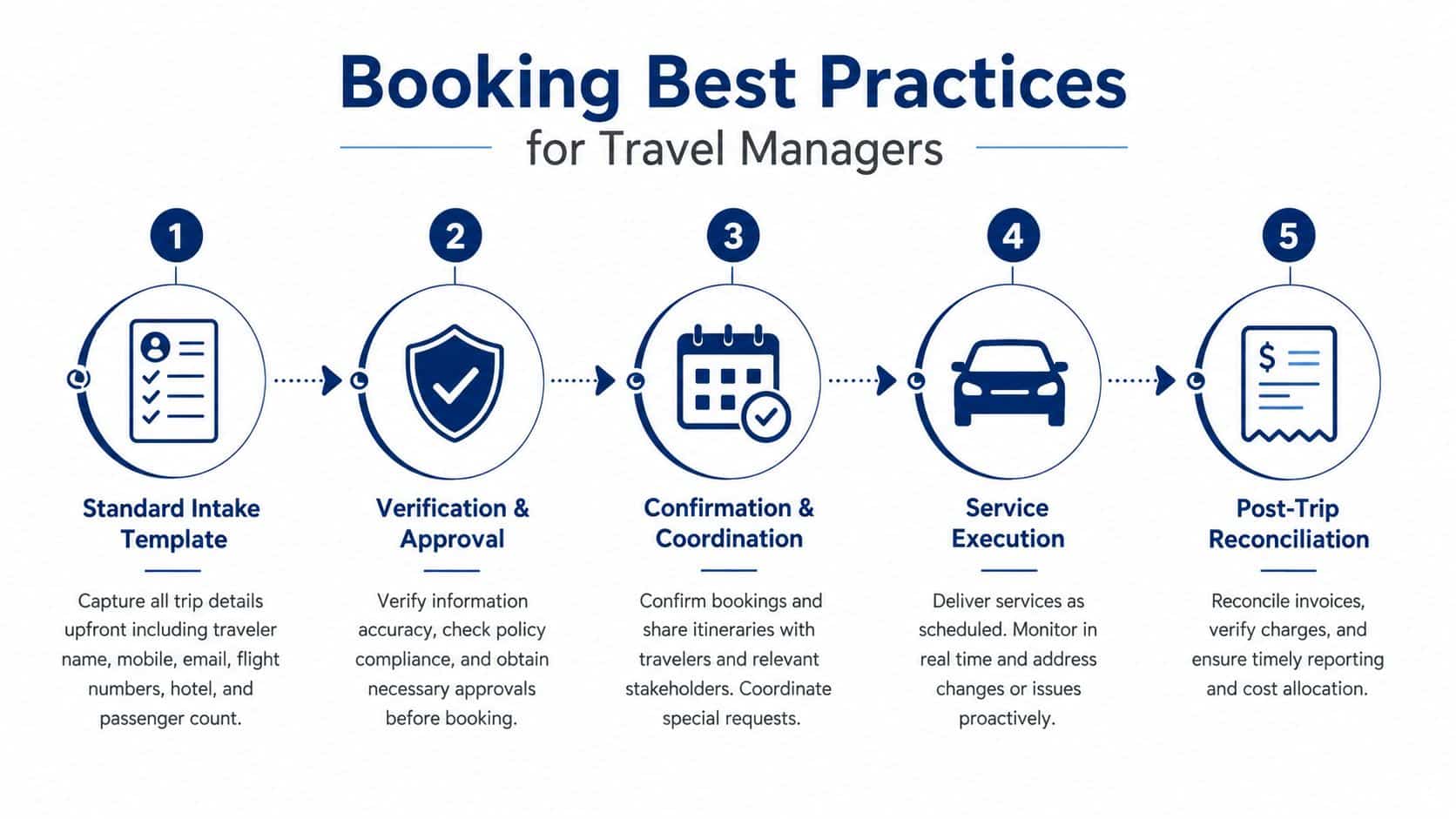
Use one standard intake template
Capture the following fields for every traveler or group:
- Traveler identity: Full name, mobile number, email, and preferred contact method.
- Flight record: Airline, flight number, arrival or departure date, terminal if known, and relevant connection details.
- Destination: Hotel or venue name, complete address, building or tower, and a local contact.
- Load details: Passenger count, luggage count, oversized items, golf bags, equipment, or strollers.
- Itinerary scope: Meeting stops, ferry connections, hourly requirements, return movements, and accessibility needs.
- Commercial data: Approver, department, cost center, purchase order, and invoice recipient.
For a standard transfer, request confirmation 72 hours in advance. Multi-vehicle movements need one to two weeks, while large groups during peak season should be placed with the provider 30 days ahead. These lead times are planning standards, not guarantees. The more vehicles, stops, and guest profiles involved, the earlier the supplier should review the program.
Verify before you release the itinerary
Send the master itinerary, not isolated ride requests. The provider can identify overlapping pickups, unrealistic road timing, duplicate passengers, and staging opportunities. Confirm the free-cancellation cutoff, after-hours contact, weekend escalation process, waiting policy, and the exact location where the representative will meet each arrival.
Families deserve special attention. Independent family-travel guidance notes that child restraints are required for young children in Mexico, while airport taxis and informal transport often don't provide car seats (family airport transportation guidance). Put the child's age or weight, seat type, installation requirement, stroller count, and vehicle space into the intake record. Don't leave that request in a casual message.
Keep the program organized after service execution. Reconcile the digital invoice against the trip IDs, archive confirmation numbers, record exceptions, and collect traveler feedback on a regular review cycle. If you're also coordinating executive downtime, you can find Cancún airport lounges and place that information in the same arrival brief.
Red Flags When Evaluating a Provider
A polished website doesn't prove that an airport transfer vendor can run a corporate program. Travel managers should challenge the provider before signing, especially during busy periods when a company may subcontract vehicles or drivers.
Ask for verifiable local licensing and airport concession credentials. Request commercial insurance documentation and the provider's process for checking and identifying chauffeurs. A vendor that refuses to explain who performs the ride is not ready to carry executive or group responsibility.
Run this quick screening checklist
- Confirm local credentials: Verify the operating business, licensing, and airport permissions rather than relying on a logo.
- Request insurance evidence: Ask for current commercial liability documentation and passenger coverage details.
- Test the payment process: Be cautious when a vendor insists on cash-only payment or can't produce corporate invoices.
- Ask about subcontracting: Require written disclosure of subcontractors, backup suppliers, and who remains accountable.
- Check dispatch ownership: Confirm who monitors flights and who answers after-hours calls.
- Review driver standards: Request the identification, appearance, training, and background-check process.
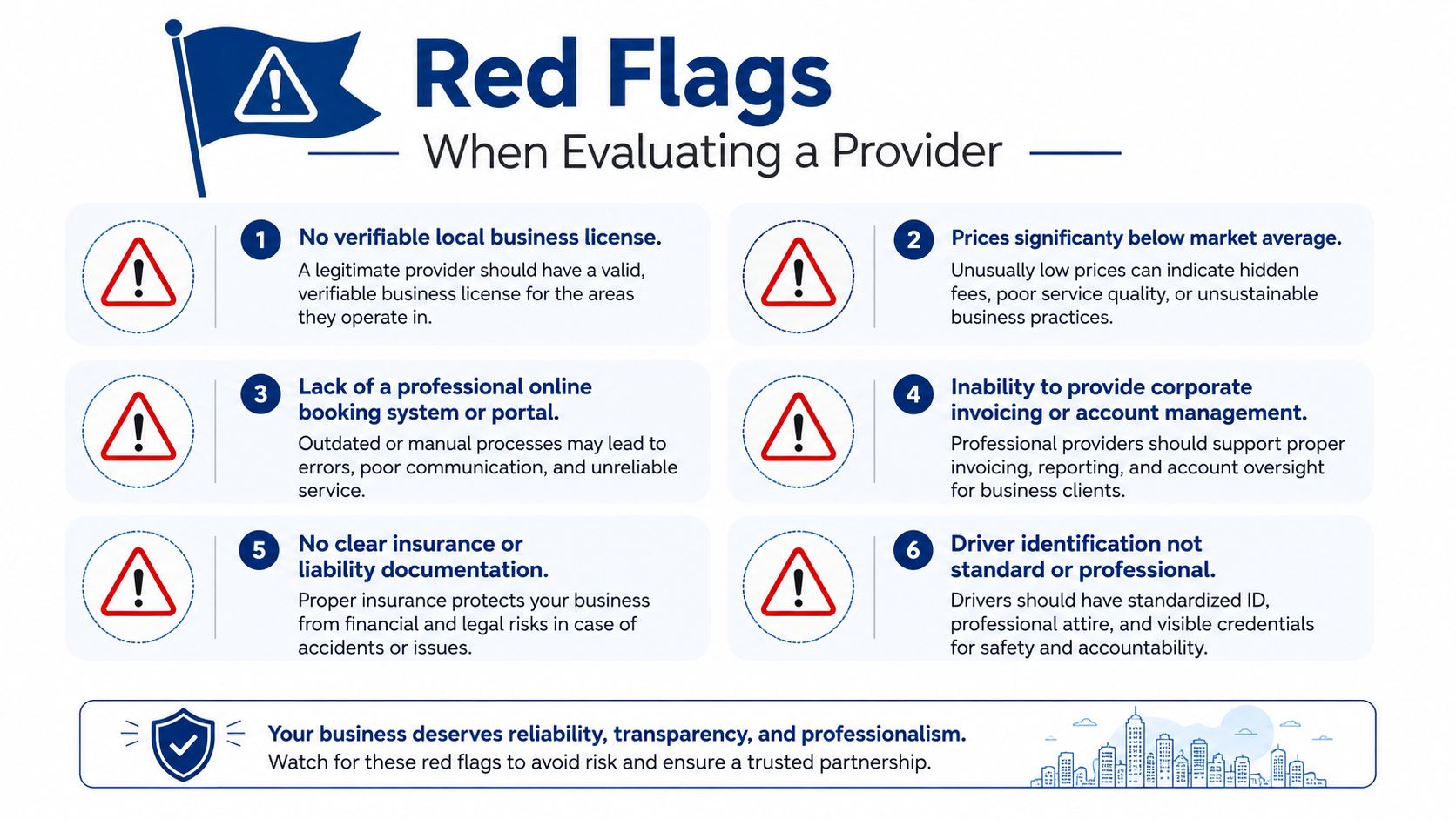
The operational risk is cumulative. A flight delay leaves an unmonitored driver waiting at the wrong time. A vague terminal instruction strands the passenger. An unvetted replacement driver misses the traveler, which then disrupts the hotel transfer and meeting schedule. The provider may call each problem an isolated incident, but the travel manager experiences one connected failure.
Prices that look unusually low deserve questions, not celebration. Ask what is excluded, whether airport fees are included, how waiting time is calculated, and whether the quoted vehicle is guaranteed. Recent Cancun transport coverage describes zone-based airport fares, including published 2026 examples of roughly $55 to $75 for the Hotel Zone and $180 to $220 for Tulum (Cancún airport transportation pricing coverage). Use those figures as a prompt to compare scope, not as a universal market rate.
Putting It Together Your Shortlist Criteria
A shortlist should compare vendors on operating responsibility, financial control, and traveler experience. Don't select a provider because it has the cleanest booking form or the lowest transfer quote. Select the company that can own the complete movement from flight update through invoice reconciliation.
Shortlist criteria for Cancún corporate car service
| Category | Criterion | Why It Matters |
|---|---|---|
| Operational reliability | Flight monitoring and live dispatch | Keeps pickup decisions aligned with actual arrival conditions |
| Operational reliability | Bilingual chauffeurs and support | Reduces curbside confusion for international travelers |
| Operational reliability | Backup vehicle and escalation plan | Limits disruption when a vehicle or driver becomes unavailable |
| Financial control | Centralized invoicing and cost-center coding | Lets finance match charges to approved business activity |
| Financial control | Itemized monthly reconciliation | Exposes route changes, waiting charges, and duplicate entries |
| Financial control | Controlled account permissions | Protects itinerary data and limits unauthorized bookings |
| Guest experience | Verified meet-and-greet procedure | Gives travelers a predictable arrival process |
| Guest experience | Vehicle condition and exact model disclosure | Aligns the ride with luggage, comfort, and brand expectations |
| Guest experience | Named account manager | Gives planners one owner for changes and escalation |
Weight operational reliability first for airport and event programs. Financial controls come next because a smooth ride still creates work if accounting can't reconcile it. Guest experience remains essential for executives, clients, speakers, and delegates who judge the host through every touchpoint.
Request a 90-day pilot with a written service-level agreement. Define the records you'll review, including on-time performance, billing accuracy, traveler feedback, response times, and exception handling. Expand the program only after the pilot shows that the provider can manage the actual itinerary types your organization sends to Cancún and the Riviera Maya.
If your team needs private airport transfers, point-to-point travel, dedicated chauffeur coverage, or coordinated corporate and event transportation, Unique Private Transportation can structure the movement around flight monitoring, bilingual support, vehicle right-sizing, and centralized coordination. Review the available options and contact Unique Private Transportation to discuss your next Cancun ground-transport program.
Refined using the Outrank tool