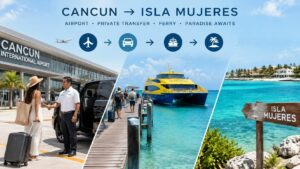
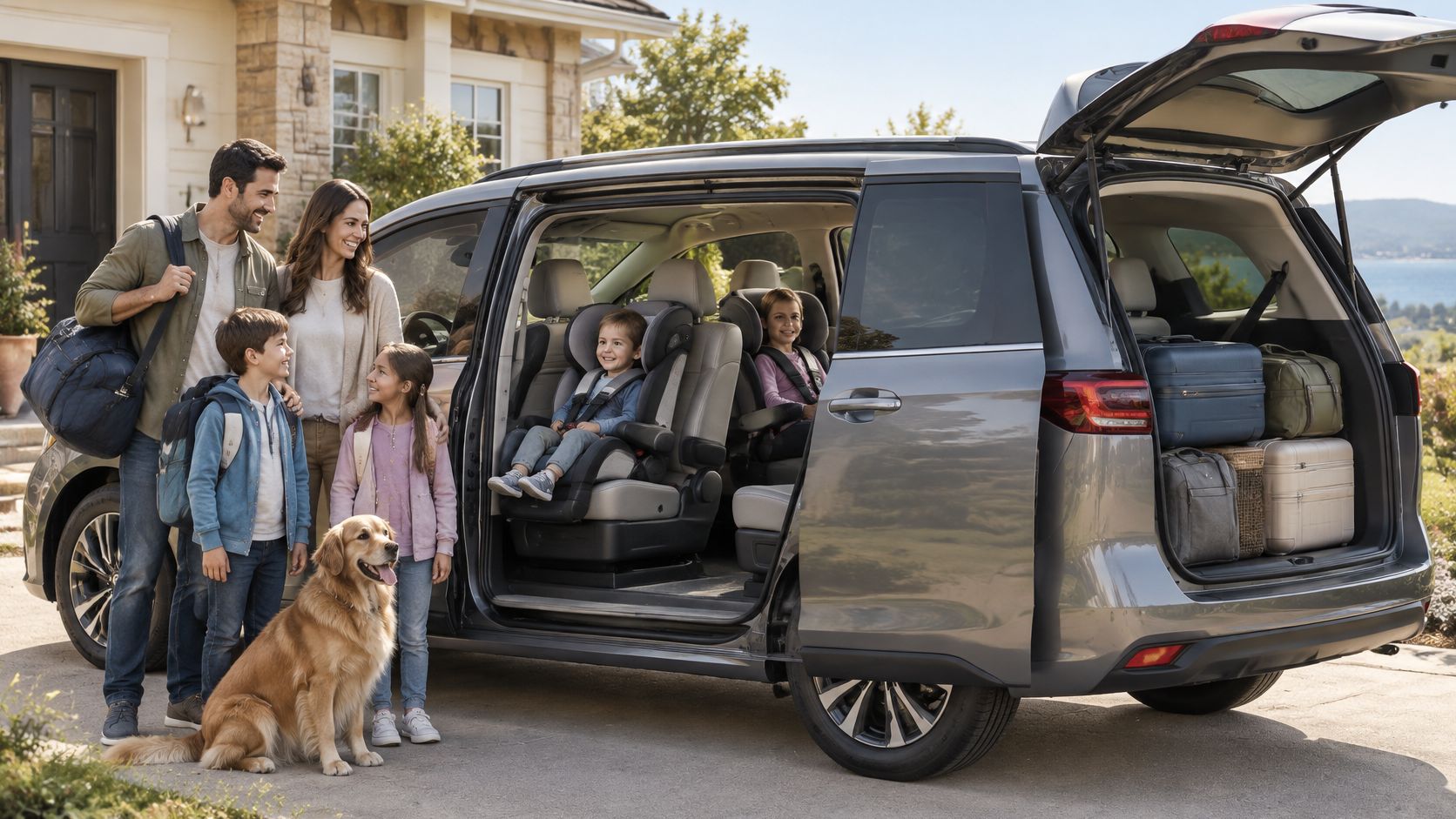
The rental counter had one three-row SUV left. The listing said six seats. Two car seats, four hard-shell bags and a stroller were waiting on the curb, and the third row was already up, which left a well behind it deep enough for one bag.
That gap between the number on the listing and what the vehicle does with real people in it is where six-person trips fall apart. Not on the highway. On the curb, in the first ten minutes.
Judging family cars that seat 6 starts there. Six belts is a starting number. What decides the trip is how many of those belts accept a child restraint, whether anyone can reach the third row once a seat is bolted into row two, and whether the bags fit with every seat occupied.
Table of Contents
- Six-Seat Vehicle Types Compared Side by Side
- Rear Rows and the Child-Seat Check
- Captain's Chairs, Benches and Third-Row Access
- Luggage Loads and the Trip That Decides the Vehicle
- Six-Seat Cancun Airport Transfers
- Confirm Six-Seat Capacity Before You Book
Six-Seat Vehicle Types Compared Side by Side
| Vehicle type | Typical six-seat layout | Third-row access | Cargo with all six seated | Best fit |
|---|---|---|---|---|
| Midsize three-row SUV | Second-row bench or captain's chairs, third-row bench | Moderate, tight for adults | Limited | Mixed use and everyday school runs |
| Full-size three-row SUV | Second-row captain's chairs or bench, third-row bench | Moderate to easy | Moderate | Larger groups and towing |
| Minivan | Second-row captain's chairs or bench, third-row bench | Easy through sliding doors | Largest | Frequent child-seat loading and heavy luggage |
| Large MPV or people mover | Flexible second and third rows, often captain's chairs | Easy | Moderate, depends on layout | Group travel and wedding parties |
Read the rows in that order and the trade-offs line up: access improves as you move down the table, and the compromise shifts from cargo to footprint.
Midsize three-row SUV. This is the default choice, and it earns that position. You get a second-row bench or captain's chairs, a third row that suits two children or two adults on a short hop, and road manners that don't punish you in a resort parking garage. With all six seats filled, cargo is limited, so plan on soft bags.
Full-size three-row SUV. The third row gains genuine adult legroom and the well behind it grows to moderate. You pay in step-in height and turning circle. If your six includes two tall teenagers or you're towing, this is the row to look at first.
Minivan. Sliding doors and a low floor make child-seat installs the easiest of the four, and cargo behind row three is the largest here. For a family loading two children into restraints every morning, this layout costs your back the least.
Large MPV or people mover. Flexible second and third rows, usually captain's chairs, built for group movement. Wedding parties and multi-family trips like them because guests climb in without a demonstration. The large MPV row is the one most North American buyers never shop; browse used Toyota Velfire vans to see how the walk-through aisle changes loading.
These types map onto models already on lots. Kia America reported 796,488 U.S. vehicle sales in 2024, with the three-row Telluride up 4% year over year, according to Kia America's annual sales release. Honda moved 141,245 Pilots in 2024, up from 110,298 in 2023, per HotCars. The Toyota Grand Highlander reached 71,717 U.S. deliveries in 2024, about 49% above its 48,036 in the partial 2023 launch year, per GoodCarBadCar, while the mainstream large three-row crossover segment logged 286,557 deliveries in Q3 2024, up 6.07% on Q3 2023, per GM Authority. Popularity tells you parts and service are easy to find. It doesn't tell you the bags fit.
Shortlist in three moves:
- Write down the luggage you carry, including the stroller and the car seats themselves, which take up seat space, not just cargo space.
- Count how many children need a rear-row install, because that number, not the total headcount, sets the minimum anchor count.
- Pick one or two types that clear both tests, then compare only within those types.
If the shortlist lands on a full-size SUV, comfort in row three is the thing to test on a long transfer, and this breakdown of why the Suburban is very comfortable to travel in covers the distance case.
Rear Rows and the Child-Seat Check
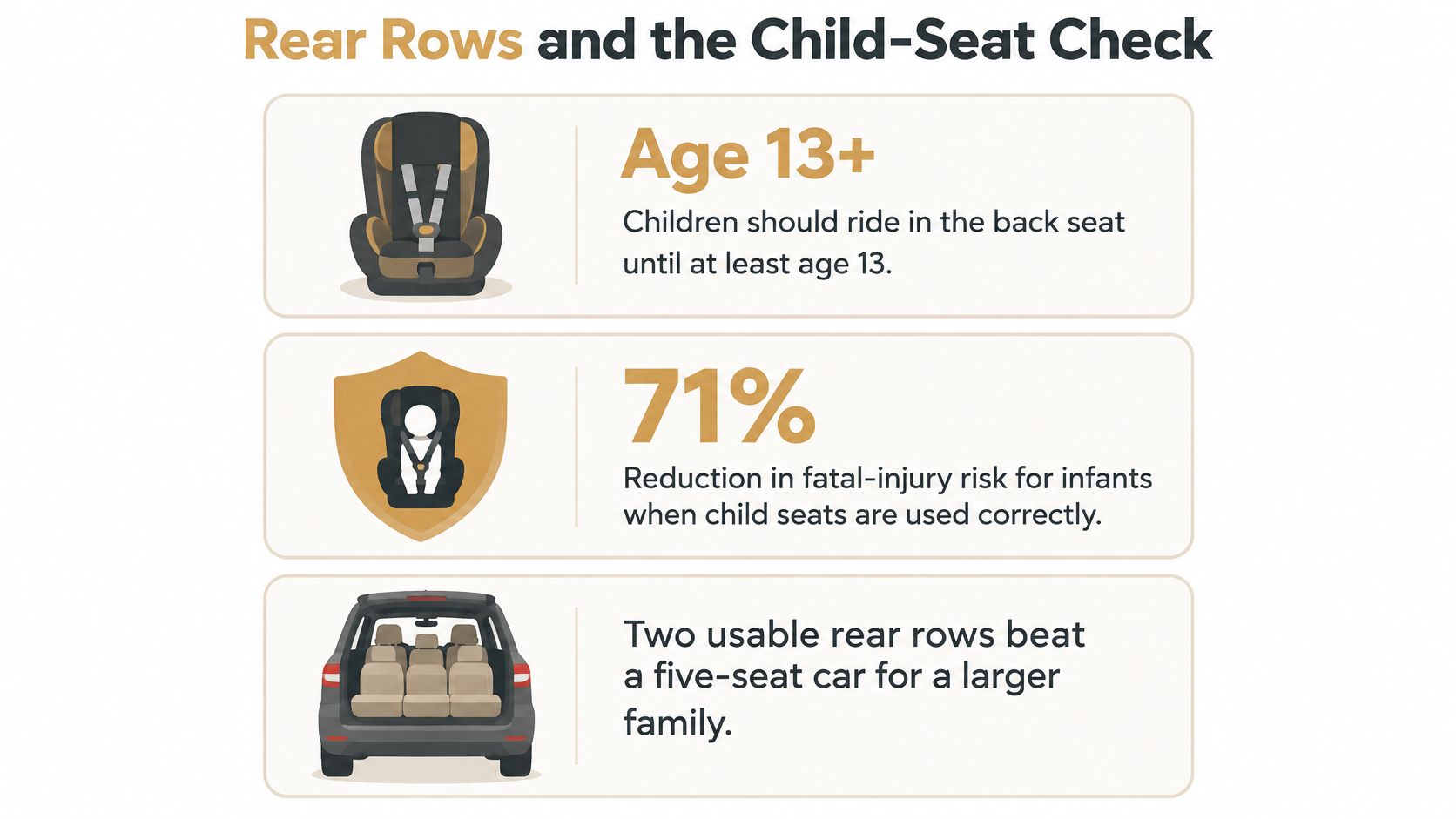
The safety case for two usable rear rows is settled. Children should stay in the back seat until at least age 13, which alone makes a three-row vehicle more practical than a five-seat car for a larger family, and correctly used child seats cut fatal-injury risk by 71% for infants under one and 54% for toddlers aged one to four in passenger cars, according to NHTSA's child restraint data. In light trucks, which includes many three-row SUVs, the estimated reductions are 58% for infants and 59% for toddlers.
Those figures only pay out if the seats physically fit. Passenger count is not a capacity specification. The constraint that decides everything is whether row two and row three accept the restraint geometry while leaving a path to the back.
Anchors, belts and the rule people break
Every child seat gets secured with the vehicle's lower anchors or the seat belt, never both. Lower anchors are provided in at least two rear seating positions, and a forward-facing seat should use a top tether whenever both the vehicle maker and the restraint maker permit it, per NHTSA's car seats and booster seats guidance.
That creates a hard selection rule. A nominal six-passenger SUV with only two compatible child-seat positions can be less useful than a slightly larger vehicle with three well-spaced second-row positions or reachable third-row anchors. Verify the layout, anchor locations, tether access and belt routing before you assign six people to a vehicle.
Rear-facing seats are the sneaky constraint. A bulky infant seat pushed back against the second row eats front-seat legroom and can block the tip-and-slide path into row three. Check the vehicle with your actual restraint models installed, not with the brochure.
The seating requirements by family setup
| Family setup | Seats used | Layout required | What to verify |
|---|---|---|---|
| Six adults | 6 | Six belted seats with reachable third row | Seat belts and third-row entry |
| Four adults plus two children on boosters | 6 | Two rear rows with booster-friendly belt routing | Belt routing and third-row access |
| Two rear-facing infants plus three adults | 5 | Two second-row positions with front-to-back clearance | Clearance and lower anchors |
| Two forward-facing children with tethers | 6 | Anchor and top-tether points in rows two or three | Tether anchor locations |
| Infant, toddler and three adults with luggage | 6 | Full second-row installs plus third-row seating | Cargo space with all seats in use |
Work down that table in order. The six-adult line is the easiest and still fails in vehicles where the third row is reachable only by folding a second-row seat. The booster line catches belt geometry: boosters need a shoulder belt that crosses the collarbone, and some third-row positions sit too close to the pillar.
The rear-facing line is where five people use six seats and the vehicle still doesn't work, because two infant seats in row two can leave no gap for a passenger heading to row three. The forward-facing line is about tether anchors, which are sometimes on the seatback and sometimes on the floor, and a floor anchor behind a folded seat is a different install than one at shoulder height.
Test in the real configuration. Load the actual seats, buckle the actual children, then ask an adult to reach row three without moving anything.
Four checks before you assign six seats
- Six belted positions that an adult can sit in without a knee against the glovebox.
- Two verified lower-anchor spots at minimum, confirmed against the vehicle's own restraint instructions and seat-size limits.
- Reachable tethers for every forward-facing seat, in row two or row three.
- A clear path to row three that a passenger can use while a child seat stays installed.
Keep the labels straight, too. A car seat you move between vehicles and reinstall by hand has a label that warns against voiding the manufacturer's guidance, and if you're marking gear for a trip, labeling gear without voiding warranties is worth ten minutes before you fly.
Captain's Chairs, Benches and Third-Row Access
Six seats can be arranged three ways, and the arrangement changes your morning more than the badge on the tailgate does.
- Second-row captain's chairs plus a third-row bench. A center walk-through gives a child or adult a clear path to row three without touching row two. Loading is fast, passengers stay independent, and second-row comfort is the best of the three. The cost is one seat in row two, so you're committed to using the third row every day, and cargo volume shrinks behind it.
- Second-row bench plus a third-row bench. Three across the middle row is the fastest way to buckle three children in one place. It adds a seat, and it makes mid-row installs harder, because you're reaching over a child to clip a belt and the tether anchor sits behind the seatback.
- Three rows with an aisle or walk-through mechanism. Flexible and good for groups, but the mechanism is a moving part that a car seat can obstruct. Check it with the seats installed.
The failure mode is always the same. A rear-facing seat goes into row two, the second row no longer tips or slides far enough forward, and the third row becomes a cargo shelf for the rest of the trip.
Row-by-row progression matters here. NHTSA recommends keeping children rear-facing until they reach the restraint's height or weight limit, then moving to a forward-facing harness with a tether, then to a booster, as set out in NHTSA's guidance on keeping kids safe on the road. A vehicle that works with three boosters may fail with one rear-facing infant seat in the same position.
Inspect the vehicle fully occupied, never empty. Sit in row three with row two configured the way you'll drive it, then decide.
Captain's chairs buy independence and third-row access. Benches buy a seat. Pick the one that matches how many children you buckle daily.
Luggage Loads and the Trip That Decides the Vehicle
Six seats and six usable places plus luggage are two different tests, and most roundups only run the first one. NHTSA's seating guidance separates second- and third-row positions and keeps children in the rear, which makes cargo planning inseparable from capacity, as NHTSA's parents' guide, Playing It Safe sets out. A vehicle can carry six passengers on paper while its folded-seat mechanism or shrunken cargo area makes the configuration useless for a real trip.
The tightest constraint wins. Find the one thing that fails first, whether it's a tether anchor, a third-row step, or the stroller, and judge the vehicle on that.
What each load actually needs
Six adults with carry-ons. The third row stays up, so only the well behind it counts. A minivan or full-size SUV usually clears this. A midsize three-row often doesn't, and the giveaway is that the carry-ons end up on someone's lap.
Four adults plus two children in car seats with checked bags. The restraints stay installed, which means bags cannot block rear visibility, cover seat belts or tether hardware, or lean against a child seat. Everything heavy goes low and central, soft bags get packed first, and hard cases go only where they can't shift under braking.
Six travelers with full checked luggage. This is the load that ends the conversation, because folding a third-row seat to fit the bags means the advertised six is already gone. If you're at this point, you're shopping for a different vehicle or shipping a bag.
Three trips, three verdicts
An international arrival of six people, two child seats and four checked bags needs same-day third-row access with the bags aboard. A minivan or large MPV wins; a midsize SUV fails the moment a child seat blocks the tip path.
A multi-day trip with four adults, two teenagers and soft luggage, no restraints, suits a three-row SUV with an easy-tip second row. Nothing is installed in row two, so access is a five-second job.
A wedding party of six adults in formal clothes with garment bags fits a large MPV or full-size SUV with the third row kept clear. It fails if garment bags fill the well and the third row has to fold, because then two guests are holding dresses on their laps for an hour.
The contrarian point holds up in practice: a smaller premium vehicle with easier ingress, properly installed restraints and disciplined luggage planning can serve a family better than a larger SUV whose third row is a crawl. If your trip involves camping gear on top of all this, keeping the whole family warm camping is the other packing decision that changes what fits.
Six-Seat Cancun Airport Transfers
Six people arriving at Cancún airport may have very different needs from six people heading home after a beach stay. Child seats and luggage change the vehicle choice, so agree on the passenger and bag count before arranging transport.
ASUR's May 2025 passenger traffic report for Cancún gives a monthly snapshot, not a full-year total. Airport traffic is substantial, which makes it practical to settle your pickup arrangements before landing rather than deciding at the curb with children and bags.
Terminal details matter too. ADO airport buses serve Terminals 2, 3 and 4; Terminal 1 has no ADO departures, so passengers there need the inter-terminal shuttle to Terminal 2. ADO recommends allowing about one hour after a domestic arrival and about two hours after an international arrival before booking a departure, according to its Cancún airport bus guide.
Immigration, customs and baggage can make arrival timing uncertain. A scheduled bus departs on its timetable, while a pre-arranged private pickup can be coordinated around your arrival. Confirm the terminal and pickup arrangements in advance.
The right vehicle depends on the full trip, not just the airport leg. A family of six with child seats and luggage needs to know whether everyone and everything will fit in one vehicle. Unique Private Transportation offers Suburban SUVs for families seeking a smooth travel experience, along with the Cadillac Escalade and Suburban RST for group travel. For the journey beyond the airport, luxury private transportation in Cancun can be arranged around your destination. Check the seat layout and luggage capacity with all seats in use before booking.
Confirm Six-Seat Capacity Before You Book
A booking that lists a vehicle class and a passenger count isn't a confirmation. Five details turn it into one, and every one of them belongs on the record before you fly.
Tell the provider four things when you book: the number of passengers, the number and type of child seats, the number of checked bags, and whether anyone needs third-row access. That last question is the one people skip, and it's the one that decides whether grandma climbs over a car seat or sits behind it.
The fleet has to match those answers. Suburban SUVs are offered as the choice for families seeking a comfortable travel experience, the Suburban RST is offered for groups of up to seven passengers, and the Cadillac Escalade is offered for group travel. Free infant gear is provided on board, which takes a bulky item off your packing list, though you still need to state how many child seats your group uses.
Then run the confirmation in order:
- State total passengers and seats, counting the child seats as occupants of seats, not as luggage.
- Ask for the exact vehicle model and its row layout, including whether row two is captain's chairs or a bench.
- Confirm the child-seat setup and where each one installs, front-facing or rear-facing, row two or row three.
- Confirm luggage space with all six seated, not with the third row folded.
- Confirm pickup time, meet-and-greet point and change deadlines, so a shifted flight doesn't strand the group.
Ask for the confirmed capacity and seat setup in writing. Verbal assurances about a "large SUV" are how a family of six ends up in two cars, and change requests made after 6:00 PM the day before pickup may carry additional fees or availability limits, which is exactly the window when flight changes tend to land.
On a Cancun trip, add three facts to that message: your arrival terminal, whether the flight is international, and the drop-off, whether that's the hotel zone, Playa del Carmen, Tulum or Mérida. Those three determine the pickup plan and the drive time. Pre-arranged service beats a curbside conversation every time, and Cancun car service only works when the vehicle assigned to you is the one that fits the whole group. Book with Unique Private Transportation so the meet-and-greet matches your terminal and one vehicle carries all six people, the child seats and the bags.
Six people, two car seats and four checked bags don't fit into a promise about seating capacity; they fit into a specific vehicle with a named row layout and the restraints already installed. Unique Private Transportation runs late-model full-size SUVs from Cancún International to the hotel zone, Playa del Carmen, Tulum and beyond, with free infant gear on board, a flight tracker that adjusts the pickup when your arrival slips, and a meet-and-greet that starts at your terminal. Send the passenger count, the child-seat count and the bag count when you book, and visit Unique Private Transportation to lock in the vehicle before the trip is decided for you at the curb.