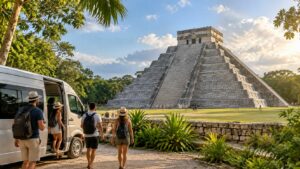
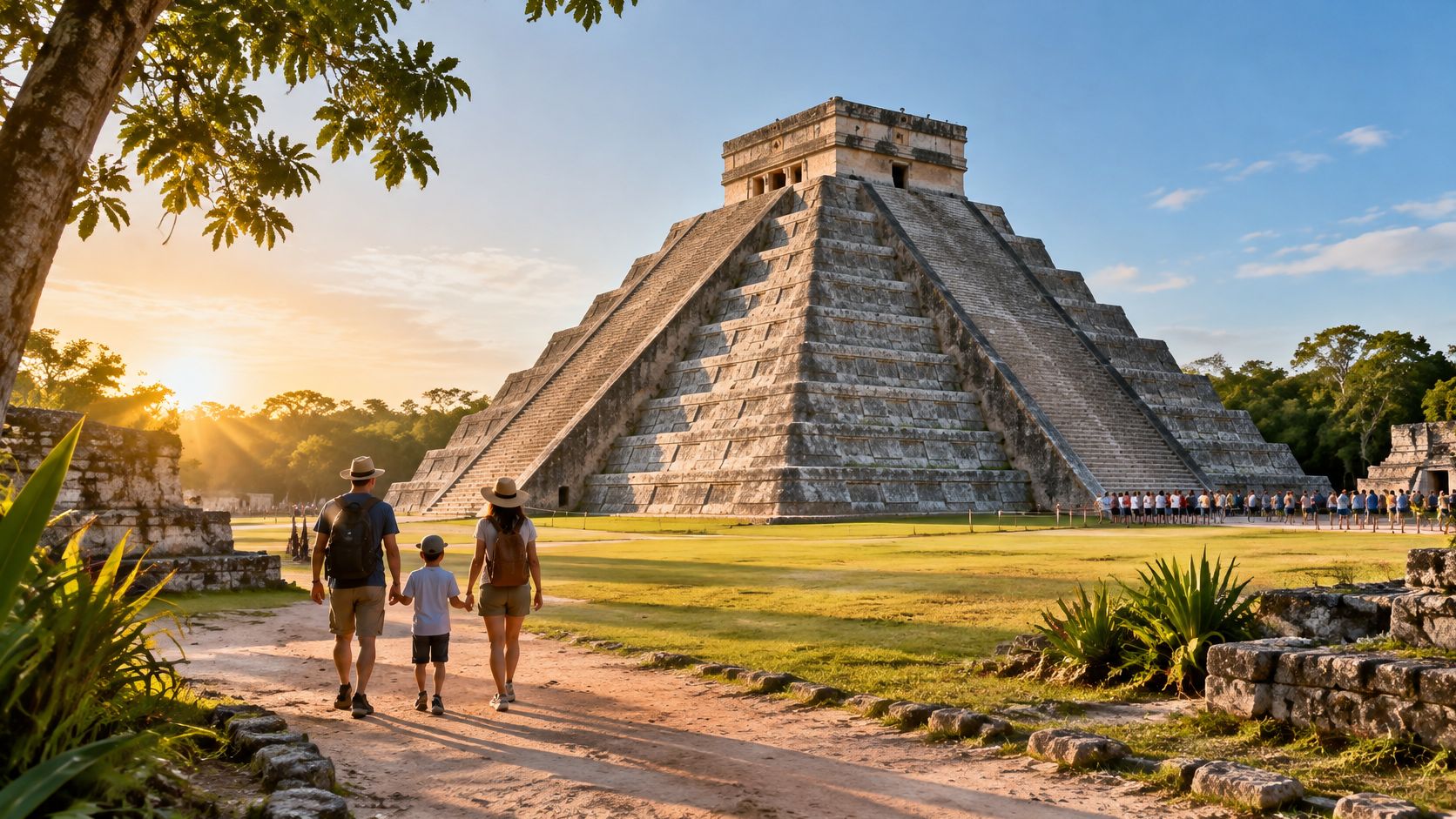
Yes, Chichén Itzá is worth it for history and culture travelers who can give it a full day and reach the gate close to the 8:00 a.m. opening. It is a weaker choice for short-stay visitors who mainly want beaches, and the factor that most changes the answer is whether your ride gets you there before heat and crowds take the day.
Most rankings stop at the pyramid. They never price the day you give up. Is Chichén Itzá worth it when that day could be a beach morning, a swim, or a shorter ruin closer to your hotel? The stone does not answer that. Your arrival window, the heat, and the transfer from Cancún or the Riviera Maya do.
Treat the trip as a time cost, not a badge. A well-timed morning can return one of Mexico's great archaeological cities. A late arrival often returns a hot, crowded, shortened walk after hours on the road.
Table of Contents
- Verdict by Traveler Type at a Glance
- Highlights That Justify the Time on Site
- Crowds, Heat and the Best Arrival Window
- What the Visit Costs in Entry Fees and Time
- How Transport Changes the Value of the Day
- Nearby Alternatives Worth Comparing
- Decide Whether to Go and Plan the Day
Verdict by Traveler Type at a Glance
For most visitors with a full day based in Cancún or the Riviera Maya, the answer is yes. The Yucatán Times reported that Chichén Itzá remained Mexico's most visited archaeological site in 2025, with 2,182,034 visitors, about 5,980 a day. That demand shows cultural weight. It also means the grounds are managed and busy, not a private ruin. If you have only one free day and you came for the beach, this is the weaker use of it.
Five checks decide the trade before you book: interest in Maya history, hours you can spare, heat tolerance, mobility, and budget. Fail one and the same site feels like a poor exchange.
| Traveler type | Verdict | Deciding factor |
|---|---|---|
| History and archaeology enthusiasts | Strongly worth it | Monumental architecture and Maya-Toltec design; allow 3 to 4 hours |
| Families with young children | Worth it with planning | Early start, shade and child seats; keep the visit to 2 to 3 hours |
| Short-stay tourists with one free day | Only with a fully free day | A full day from base; skip it if you only want beaches |
| Luxury and private-tour travelers | Worth it | Private timing avoids fixed group schedules and peak crowds |
| Older travelers or limited mobility | Worth it with caution | Long walks on uneven stone; plan rest stops |
| Repeat Yucatan visitors | Optional | Cenotes, Ek' Balam or Valladolid may suit better |
History readers get the strongest return because the architecture is the reason for the drive. Families can make it work when the walk stays at two to three hours and the vehicle has child seats. A short-stay guest should protect a beach day unless this is the one thing they came to see. Private-tour travelers gain the most from owning the clock. Older guests should plan rests on uneven stone, not a long march. Repeat visitors in Yucatán often get more from a cenote, Ek' Balam, or Valladolid.
Practical rule: Go when you have a full day and an early start. Skip it when you need quiet ruins or a beach day.
Highlights That Justify the Time on Site
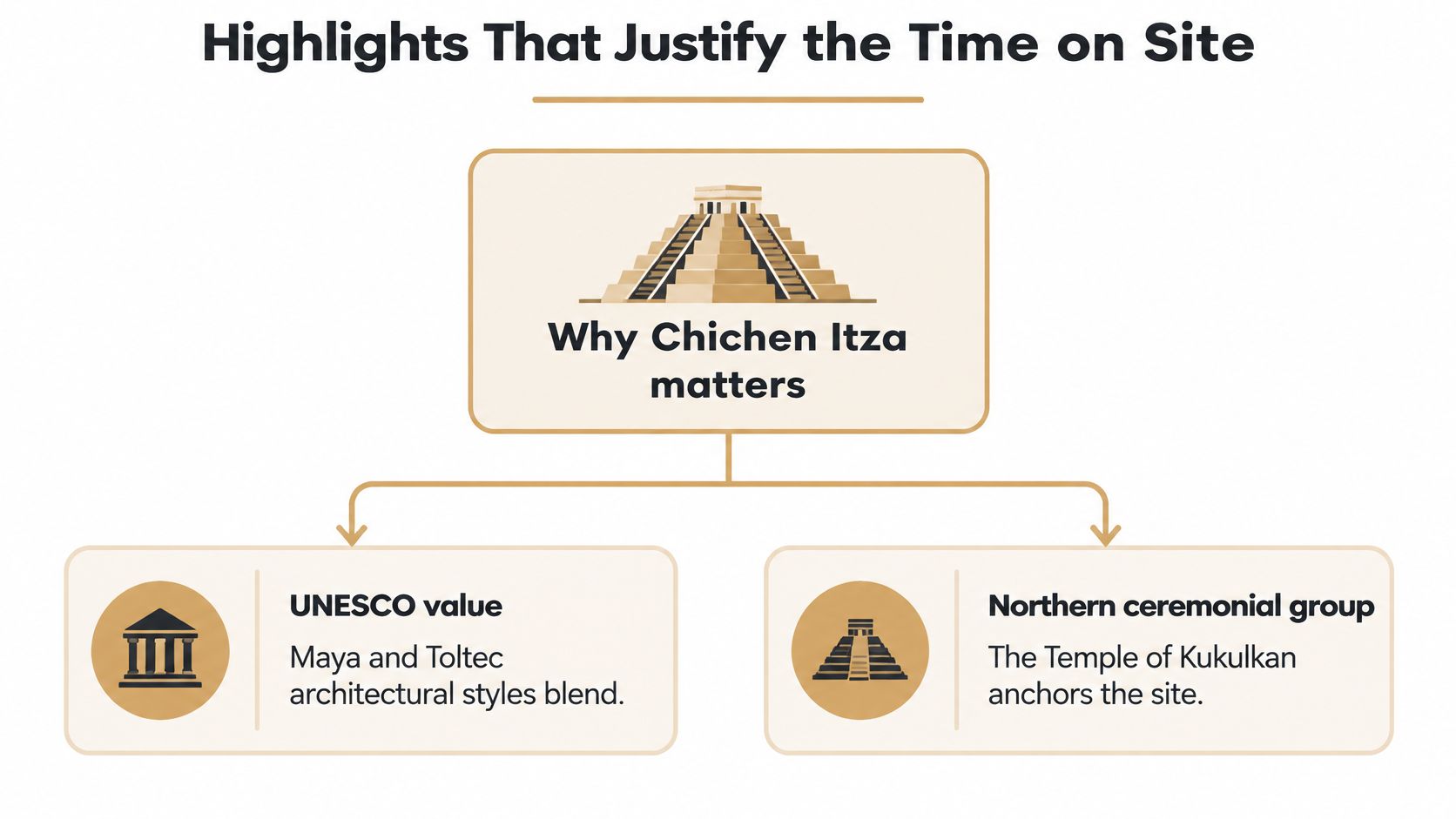
The payoff is a city, not a single photo. UNESCO's advisory evaluation calls Chichén Itzá an outstanding example of Maya–Toltec civilization. Monuments combine Maya construction techniques with artistic and architectural elements from central Mexico. The northern ceremonial group holds the Temple of Kukulkan, the Great Ball Court, and the Temple of the Warriors, which UNESCO places among the masterpieces of Mesoamerican architecture. The same evaluation says the city influenced the wider Yucatán cultural zone from the 10th through the 15th centuries and holds the most important Maya–Toltec remains in Yucatán. It also covers more than 300 hectares, between Cancún and Mérida, so El Castillo is only the front door.
Mexico's National Institute of Anthropology and History adds the longer arc. The city's strongest development ran from about the 10th to the 15th centuries, no major monuments appear to have been built after the 13th century, and the city declined rapidly after about 1440. Excavation did not begin until 1841, more than 400 years later. The site is also a UNESCO World Heritage property. The New7Wonders organizers named it one of the New7Wonders of the World in Lisbon on July 7, 2007, after a campaign of more than 100 million votes. Fame is not the same as a good day on the ground. The hectares are.
A route most visitors can finish
Walk in the order people reach the buildings, and give each stop a clock.
| Area | What it holds | Time to allow |
|---|---|---|
| El Castillo (Temple of Kukulkan) | Stepped pyramid and the site's icon, viewed from the base | 30 to 45 minutes |
| Great Ball Court | Largest ball court in Mesoamerica | 20 to 30 minutes |
| Temple of the Warriors and Group of a Thousand Columns | Maya-Toltec architecture and carved columns | 30 to 45 minutes |
| Sacred Cenote | Limestone sinkhole linked to ritual offerings | 15 to 20 minutes |
| El Caracol | Round observatory with astronomical alignments | 15 to 20 minutes |
Start at El Castillo and stay at the base. Climbing is not part of a normal visit, so the value is the mass of the pyramid and the plaza around it. Move to the Great Ball Court next. History readers should not skip it. The scale of the court is the clearest proof that this was a ceremonial capital, not a lone temple. The Temple of the Warriors and the Group of a Thousand Columns come next, and they are where the Maya–Toltec blend is easiest to see in carved stone. The Sacred Cenote is a short walk off the main group. El Caracol, the round observatory, sits a little apart and rewards anyone who cares about alignments.
Who can cut the route
History readers should keep the ball court and the warriors' temple even if they drop the observatory. Families with small children often get enough from the pyramid, a look at the cenote, and a short stop at El Caracol, then leave before the walk turns into a meltdown. Sun cover, water, and a hat matter across more than 300 hectares of open stone. A private vehicle with a set departure helps here because you can arrive early, skip a fixed coach timetable, and leave when the group is done rather than when a bus is.
If you can see the core groups within three to four hours, the cultural return usually covers the drive.
Crowds, Heat and the Best Arrival Window
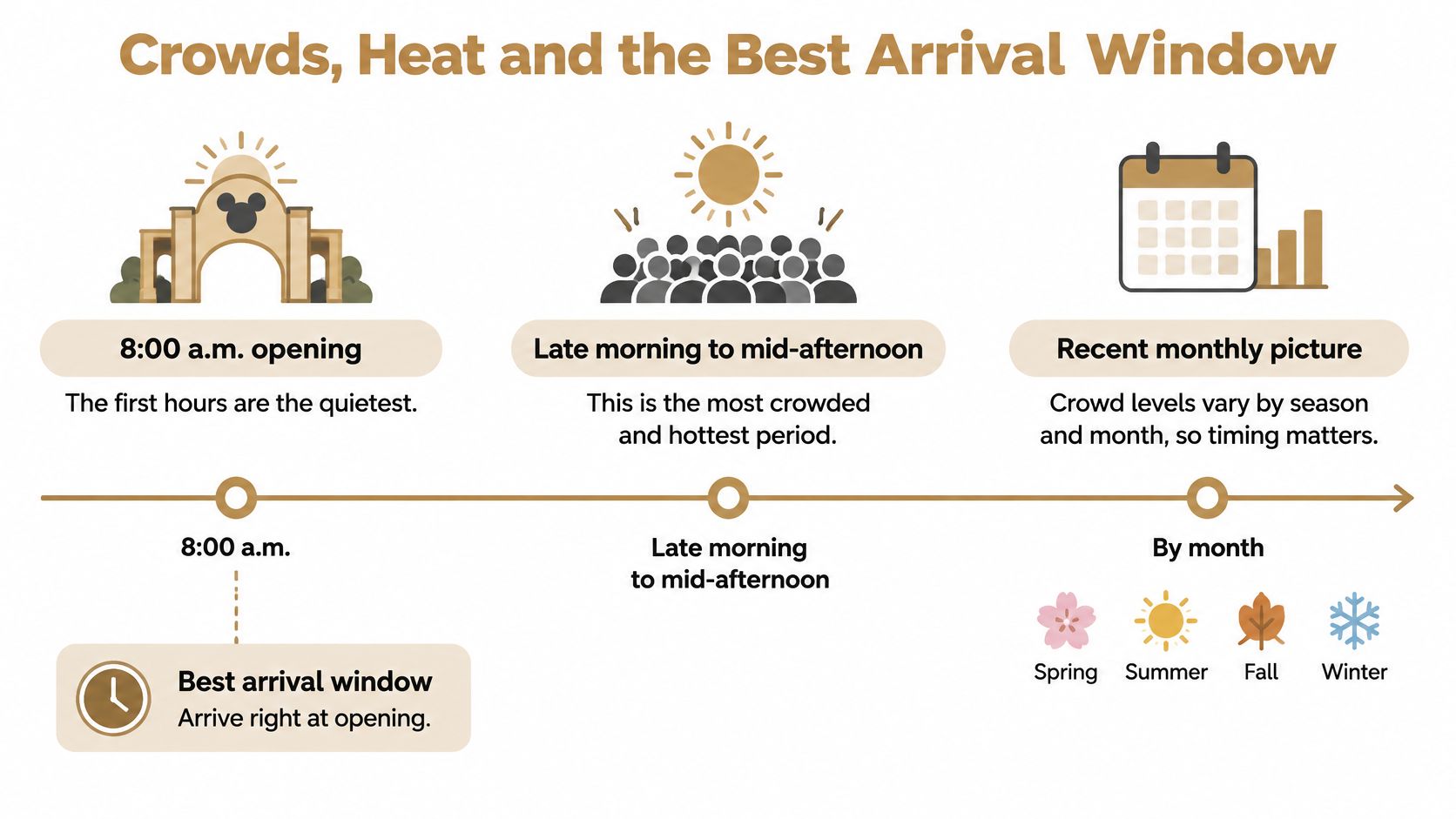
The case for an early gate is measurable. Yucatán Magazine reported 227,434 visitors in January 2026, the strongest month in that reporting, and most of that traffic arrives after mid-morning. The first hours after the 8:00 a.m. opening are the quietest the site gets. Late morning through mid-afternoon combines peak density with peak heat. Hotter months thin the paths and still ruin the day, because the open plazas offer little shade and dehydration risk climbs with every hour you wait.
Four windows on the same day
Before 8:30 a.m. The window that repays the drive. Crowds are lowest, the heat is mildest, and you can stand at the pyramid without a wall of tour groups in the frame.
Late morning. Coaches arrive, shade thins, and the plaza fills. You can still see the main buildings, but you will share every viewpoint and move more slowly between them.
1:00 to 3:00 p.m. The hardest stretch for families. Heat and density peak together, and a child who was fine at the gate is often done by the columns.
Late afternoon. You may still get in, but the visit turns short and rushed. You will see the icon and little else before you need to head back.
What a late start actually costs
From Cancún, an early gate is a logistics exercise. Breakfast before you leave, a restroom stop on the road, water in the car, child seats fitted before anyone is strapped in. Each item is small on its own. Stacked together, they decide whether you reach the gate at opening or at the same hour as the coaches. Add a cenote or Valladolid only once the morning at the ruins is already protected, because layering those stops onto a late departure turns a strong visit into a checklist people endure.
A private transfer with a set departure is what buys that window. The ruins stay the same either way; what the timing protects is the short period when the site still feels like a place rather than a queue. Plan to be through the gate before the crowds build, and treat any later arrival as a shorter visit. Cut the route on purpose instead of racing the heat.
What the Visit Costs in Entry Fees and Time
International admission is two charges rather than one sticker price. Chichén Itzá ticket information lists a federal INAH fee of MX$105 and a Yucatán state fee of MX$592, a combined MX$697 per adult. Paying one booth and assuming you are done is how visitors lose early minutes at the entrance, so budget for both charges before you leave the hotel.
| Item | Amount (MX$) | Notes |
|---|---|---|
| INAH federal fee | 105 | Charged to international visitors |
| Yucatán state fee | 592 | Charged to international visitors |
| Combined international admission | 697 | Total per adult |
| Children aged 3 to 12 | 105 | Listed child rate |
The grounds open daily at 8:00 a.m. and close at 5:00 p.m., with last entry at 4:00 p.m. Mexican citizens and Yucatán residents pay reduced rates with valid identification, and children ages 3 to 12 enter at the listed MX$105. Carry the ID in the car rather than leaving it in a hotel safe.
The ticket is priced by the hour you keep
MX$697 looks modest until you divide it by the time you will spend inside. Three hours among the core groups spreads that cost across a full morning of walking. Ninety minutes after a slow departure buys the same buildings for the same money in a fraction of the time. The ticket does not get cheaper when your visit gets shorter. It gets more expensive per hour, which makes the arrival plan part of the admission price rather than a separate decision.
The last entry is a deadline with a price attached
The 4:00 p.m. cutoff turns the ticket into a shrinking asset. Every delay on the road shortens what the combined fee buys, and the hours are not refunded because transport was already paid. Admission is also only the on-site slice of the day. The ride, lunch, and water sit on top of it, so the honest comparison is the full day's cost against the hours of walking it delivers.
Confirm before you leave the hotel
- Ticket type: International adult, child, or a reduced resident rate.
- Age rule: Children 3 to 12 at the listed MX$105.
- ID: Valid identification for anyone expecting a reduced rate.
- Latest entry: 4:00 p.m., with the grounds closing at 5:00 p.m.
If you are pricing the ride beside the tickets, our luxury transportation rates put the transfer side of the same day in one table, so entry fees and transport sit in a single plan.
How Transport Changes the Value of the Day
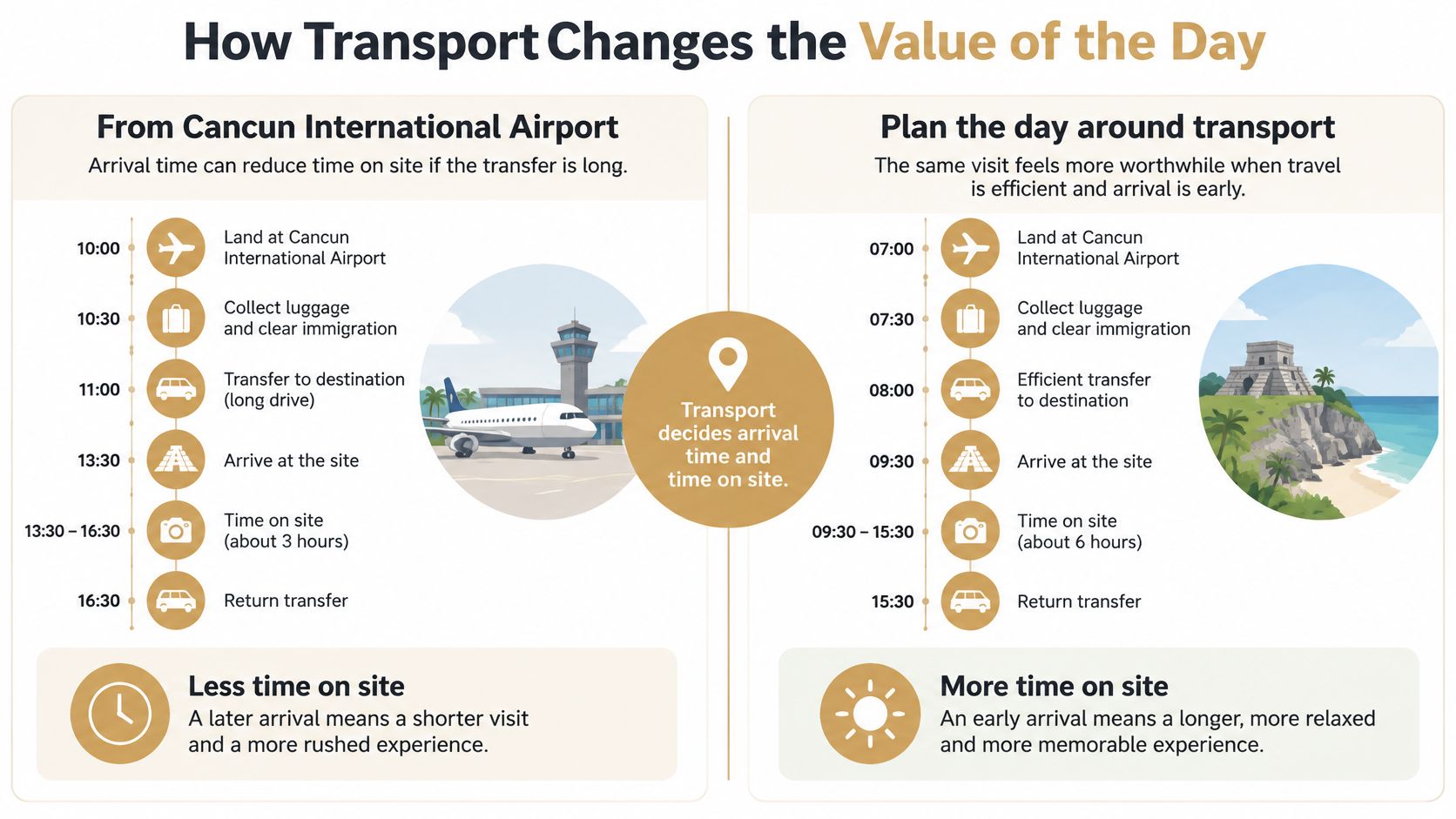
The same ruins are worth it or not depending on how you travel. Transport sets the arrival and the hours you keep on site. Land the same morning and the first constraint is the airport, not the highway.
Cancún Airport's FAQ is clear that ordinary taxis cannot pick up arriving passengers. Pickups are limited to authorized transportation companies. The airport has Terminal 2, Terminal 3, and the Domestic Terminal, linked by a free shuttle. Confirm the terminal in the booking so the driver is at the right door after immigration. Published airport transportation guidance says you should confirm both the fare and a confirmation number before you land. Its fare table lists Cancún Hotel Zone service at about 28 km and 30-plus minutes, and downtown Cancún at about 17 km and 25-plus minutes. The same guidance says online rates can be up to 60% below regular local rates in some cases, which is a reason to lock private transportation Cancun airport travelers need before the flight, not in the arrivals hall.
ADO bus service runs daily and stops at all terminals, with routes to Cancún, Playa del Carmen, Tulum, and Mérida. That is useful scheduled ground transport. It is not a door-to-door ride to the archaeological zone. A bus day adds a terminal change and a second vehicle, and those links eat the quiet morning.
Three ways to spend the road time
| Option | Arrival control | Time on site | Best for |
|---|---|---|---|
| Rental car (self-drive) | Full control of departure | Good if you leave early | Confident drivers and couples |
| Group tour coach | Fixed pickup and shared schedule | Often shortened by group timing | Solo travelers on a budget |
| Private chauffeur | Set departure and flexible stops | Maximum, with an early arrival | Families, groups and luxury travelers |
A rental gives full control if you like driving, and it leaves parking, navigation, and the return drive on you after a hot walk. A coach is cheaper per person and weaker on time, because shared pickups and shared stops shrink the morning. A private chauffeur costs more and returns the most usable time. You set the departure, you can pause for a restroom or a cenote, and you control the ride home.
Cancun airport transportation and a Cancun car service are different jobs from the ruin day, but they fail the same way when the meeting point is vague. Cancun luxury airport transfers should name the terminal, the fare, and a confirmation number. Unique Private Transportation runs private transfers from the airport and out to regional stops. Luxury transportation is offered to Playa del Carmen, Chichén Itzá, and Bahía Petempich. For a wider price check before you choose a shared shuttle over a car, compare airport shuttle costs from Lodging Nearby. If you want the ruin day mapped from the hotel zone, read our notes on exploring the ruins of Chichén Itzá from Cancún.
If the ride brings you through the gate after 9:00 a.m., the visit becomes a rushed stop, whatever the mode.
Nearby Alternatives Worth Comparing
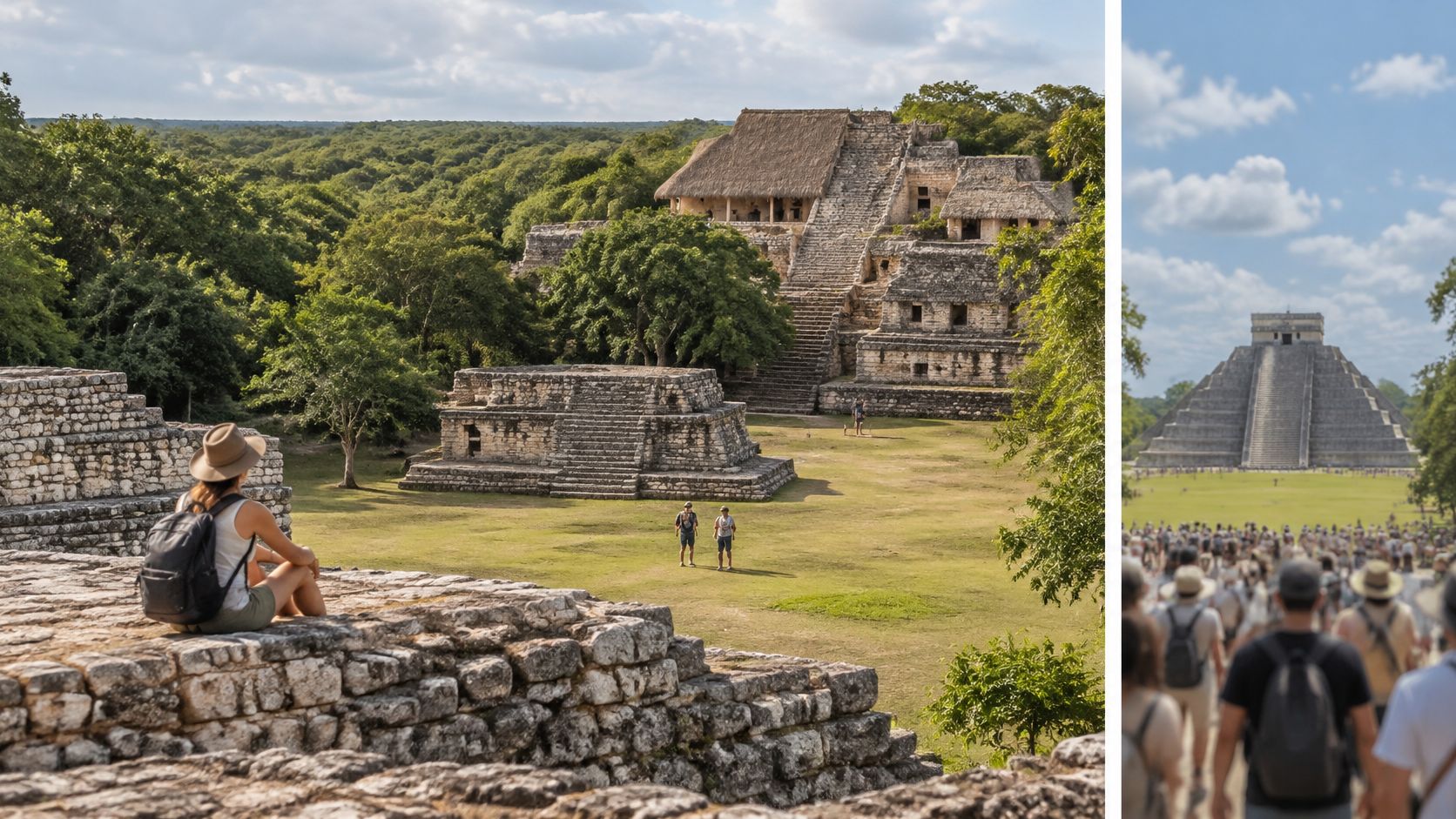
An alternative is a fair test of the verdict. If you want Maya history without the density of a world-famous plaza, another site can return more of the day. Chichén Itzá still holds the largest and most documented ruins in this set. The others trade that scale for space, water, or a shorter clock.
What you gain by not going
Ek' Balam sits about two hours from Cancún. You get stucco-decorated ruins and fewer people on the paths. You give up the ball court, the warriors' colonnade, and the recognition of the main pyramid. Choose it when the crowd is the thing you are trying to avoid.
Tulum is about an hour and a half away and pairs ruins with a coastal setting, so the day is shorter and you still see the sea. You do not get a vast inland ceremonial city. Choose it when the beach is still the point and a cliff-top site is enough history.
Valladolid and the cenotes nearby are about a two-hour drive. Colonial streets, a meal, and time in the water suit people who want heat relief more than plazas. You will not walk a monumental capital. You will get a town you can sit in.
Cenotes nearer Cancún vary by entrance, and they suit families who want a swim inside a short day. A forest pool such as Kantún Chi, a hidden treasure, is a different kind of afternoon from a stone city. You trade archaeology for cool water and a simpler return.
Alternatives buy you lower crowds and a looser clock. Chichén Itzá buys you the architecture nothing else in this list matches.
Pick an alternative when the goal is a beach, a swim, or a quieter visit. Keep Chichén Itzá when monumental architecture is the thing you would regret missing.
Decide Whether to Go and Plan the Day
The decision is binary once you know your day. Either you can protect a full morning on site, or you should spend that day somewhere else.
- Confirm the clock. You need a full day and a start that puts you at the gate before 8:30 a.m. A late breakfast plan is already a no.
- Match your profile. Use the traveler table. History readers go. Beach-first short stays usually should not. Families go only with a short route and seats fitted. Repeat visitors can choose Ek' Balam, Valladolid, or a cenote without missing the only good day of the trip.
- Pick the ride that keeps time on site. Self-drive if you will leave early and handle the return. A coach if budget matters more than the quiet hour. A private chauffeur if the group, the children, or the schedule cannot absorb a shared pickup. If you land the same day, book the airport transfer in advance with a confirmation number, a named terminal, and a confirmed fare. An unconfirmed pickup is how a good plan misses the gate.
- Lock the ticket rules. International adults pay both fees. Check the child age band, carry ID for any reduced rate, and treat 4:00 p.m. as a hard stop for entry.
- Book early, including last-minute trips. For last-minute reservations, pay at booking to guarantee the service. You can reach us by phone at +1 (347) 699 0024, by WhatsApp at +52 (998) 5358669, or by email at reservations@uniquecancun.com.
Each step fails in a specific way. A late start turns a strong visit into a rush. An unconfirmed transfer leaves the morning exposed to a terminal mix-up or a delayed flight with no driver waiting. A missing ID at the booth burns the cool hour in a line. Families comparing a ruin day with a beach holiday can also look at holidays designed around your family from Little Blue Door when the coast, not the plaza, is the trip you booked.
For a full day and an early start, go. For a beach day or a quiet ruin, choose an alternative and do not apologize for it.
Unique Private Transportation runs chauffeured private transfers and custom days from Cancún and the Riviera Maya to Chichén Itzá, with hotel pickup, a set departure, and a controlled return so the morning at the ruins stays intact. If this is the day you want, book the car before you book the rest of the schedule, and start at Unique Private Transportation.