
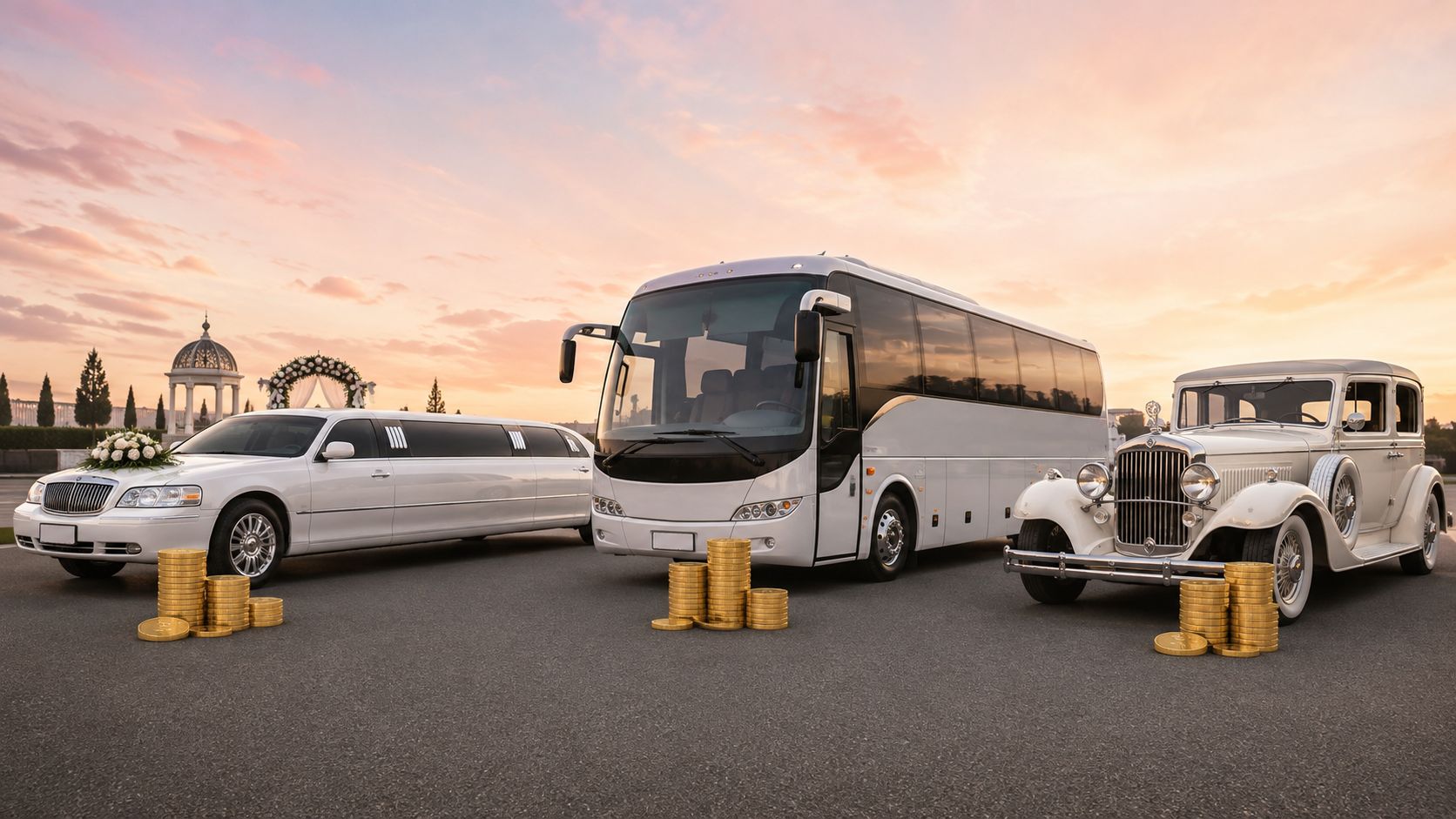
U.S. couples spent an average of $1,075 on wedding transportation in 2024, but a real full-service wedding-day package usually lands in the $1,500 to $4,500 range. That gap is why the first quote you get rarely tells the whole story.
If you're trying to figure out how much does wedding transportation cost, start here instead of chasing a single “average.” The number only makes sense once you know whether you need one getaway car, a bridal party vehicle, guest shuttles, or the whole grid of pickups, loops, and late-night returns.
Table of Contents
- What Wedding Transportation Actually Costs in 2026
- What Actually Drives the Price You Are Quoted
- Matching Your Vehicle Mix to Your Guest Count
- Shuttles Versus Multiple Cars Versus Ride-Hailing Vouchers
- The Hidden 25 to 35 Percent Most Quotes Bury
- How Cancun and Riviera Maya Pricing Really Works
- A Five-Step Checklist for Getting Accurate Quotes
- Putting It All Together Into Your Wedding Transport Budget
What Wedding Transportation Actually Costs in 2026
A couple planning a simple send-off in town and another trying to move guests between a hotel, ceremony site, and reception will not get the same bill. That is why the cleanest benchmark is still $1,075, the average wedding transportation spend in The Knot Real Weddings Study, which surveyed nearly 17,000 people who married in 2024 (The Knot). Useful, yes. A full answer, no.
For a real wedding-day setup, professional operators usually quote a $1,500 to $4,500 package range for multi-vehicle service (Detailed Drivers). That spread is normal because the quote is not just a vehicle. It bundles vehicle class, booked hours, route complexity, and how many separate runs your timeline forces.
Budget by wedding size, not by wishful thinking
Geography still moves the number. The Knot's regional data shows couples averaged $1,500 in the Northeast/New England and $755 in the Southwest, with averages of $1,443 in the Mid-Atlantic, $1,039 in the South/Southeast, $934 in the Midwest, and $932 in the West (The Knot). Before you even choose a vehicle, the market has already pushed your baseline around.
The better budgeting frame is simple. Price against your guest count and route density, not a single internet average. An intimate wedding may only need one car and a short transfer. A larger guest list with hotel shuttles, late-night returns, and multiple photo stops moves you into package pricing fast.
| Wedding Size | 2024 Average Spend | Typical 2026 Package Range |
|---|---|---|
| Intimate wedding | Around the lower end of the market | Often below a full shuttle setup |
| Mid-size wedding | Near the national average | Commonly in the middle package range |
| Large wedding | Above the national average | Usually in the upper package range |
There are three cost layers. First is the base vehicle rate. Then come hourly minimums. Then the add-ons arrive, and they can lift the total by 25% to 35% (Check Limo).
Practical rule: if you build your budget from a single average, you are underpricing the day. Build it from your route plan, and use the luxury transportation rates guide to compare vehicle categories before you start requesting quotes.
What Actually Drives the Price You Are Quoted
A wedding transport quote usually rises or falls on three things, vehicle class, hourly minimums, and routing density. Vendors know which one is padding the bill, and they will build the number around the part that costs you most.
Vehicle class sets the base rate
A classic sedan usually sits around $75 to $125 per hour, a stretch limousine around $125 to $250, a luxury Sprinter around $150 to $300, a minibus around $200 to $400, and a full-size motorcoach around $400 to $800. Bigger vehicles cost more to stage, staff, and reposition, which is why the quote climbs fast once you move beyond a simple bridal car (Detailed Drivers).
Couples get tripped up when they ask for “a limo quote” without naming the job. A bridal car, a wedding party ride, and a guest shuttle are different assignments. They should be priced differently, and if they are not, you are probably paying for capacity you do not need.
Minimum hours and routing matter more than the sticker rate
Wedding transportation is rarely priced like a point-to-point ride. Sedans often carry a 3-hour minimum, while coaches can require 5 to 8 hours on Saturdays. Those minimums are what make a short transfer look expensive on paper.
Route design drives the rest of the bill. If the ceremony, photos, reception, and hotel block are spread out, the vehicle stays on the clock. Deadhead miles, the empty return trip to the garage, can also be billed as time or mileage, and that is where quotes swell.
Peak dates push it higher. May, June, September, and Saturdays often price 15% to 30% higher, and anything running past midnight can trigger an overnight surcharge. Two weddings that seem similar can still land thousands apart once the vendor accounts for vehicle class, timing, and dispatch logistics.
Straight answer: lower the quote by shortening the route, tightening the pickup window, and cutting separate vehicle assignments. Shopping brands first is the wrong move.
| Wedding Transportation Pricing Levers | Hourly Rate | Typical Minimum | Seats |
|---|---|---|---|
| Classic sedan | $75 to $125 | 3 hours | Small party |
| Stretch limousine | $125 to $250 | Varies by operator | Larger bridal party |
| Luxury Sprinter | $150 to $300 | Varies by operator | Mid-size group |
| Minibus | $200 to $400 | Longer minimums common | Guest shuttle |
| Full-size motorcoach | $400 to $800 | 5 to 8 hours | Large guest group |
Matching Your Vehicle Mix to Your Guest Count
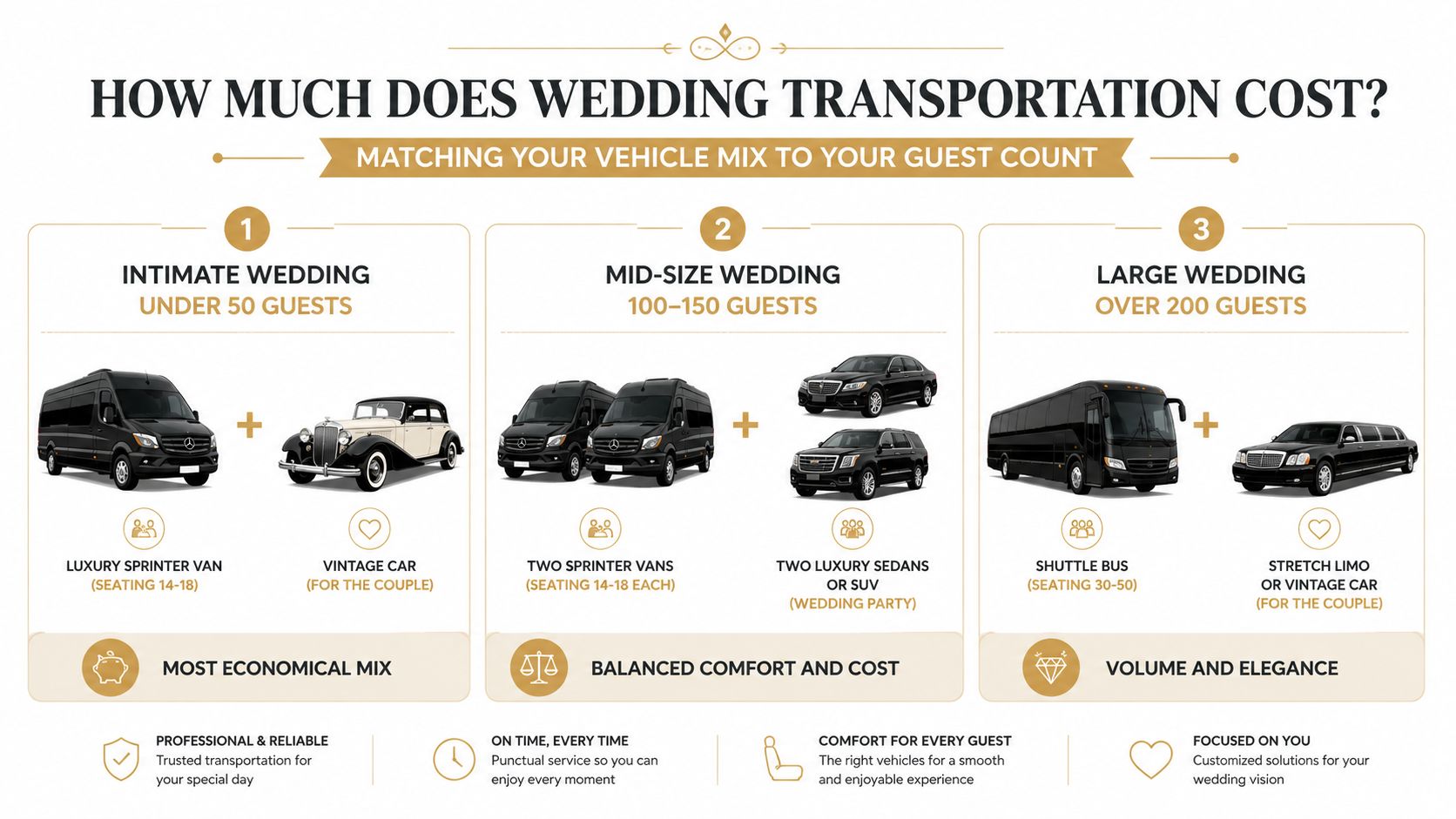
The easiest way to overspend is to buy the wrong vehicle mix for the wrong guest count. Couples often think in terms of “what looks nice,” then end up paying for capacity they never use or underbuying and scrambling on the wedding day.
Small weddings need restraint, not a fleet
For an intimate wedding under 50 guests, the sensible move is a single luxury Sprinter or vintage car plus a bridal car. That setup usually lands around $900 to $1,800 and works cleanly when the hotel block sits within about 10 miles of the venue. If you're paying for more than that, you're probably buying comfort you don't need.
Mid-size weddings need loops, not chaos
For 50 to 100 guests, the common setup is a bridal limousine plus one or two shuttles running loops between the ceremony, reception, and hotel block. That package usually lands between $2,200 and $3,800. The point isn't to impress people with the vehicle list, it's to keep guests moving without forcing everyone to self-coordinate rides.
Large weddings need structure
Once you hit 100 to 200 guests, expect a bridal car, two to three motorcoaches or minibuses for guest loops, and often a late-night return shuttle. That can push the total to $4,000 to $7,500. At that scale, venue layout matters as much as headcount. A rural venue ten miles from hotels is cheaper to serve than an urban venue with traffic, restricted bus access, and slow loading zones.
If you're comparing fleet options by capacity, this charter buses in Austin page is a solid real-world example of how operators organize larger vehicle classes for guest movement.
Matching vehicle size to actual block counts, not the full guest list, is where couples overpay most. You don't need a giant shuttle because you invited a lot of people. You need the right vehicle only for the people who need transport.
Shuttles Versus Multiple Cars Versus Ride-Hailing Vouchers
A 140-guest wedding is where the trade-offs show up fast. The question is not “what looks nicest.” It is “what keeps guests moving without turning arrivals into a headache.”
A 56-passenger motor coach for three round trips typically runs $1,400 to $2,100 all-in. That is the cleanest setup if you want one vehicle handling the hotel loop with little confusion. A coach also gives you tight schedule control, and that matters more than couples usually expect on the wedding day.
Three executive Sprinter vans doing continuous loops often land between $2,100 and $3,000 once deadhead time is included. You get more flexibility than a single coach, but coordination gets harder. One late van can throw off the whole rotation.
Ride-hailing vouchers look tidy until you run the math. At $25 to $45 per ride with 280 legs of travel, couples can end up around $7,000 to $12,600. That is the wrong tool for a controlled guest movement plan.
The trade-offs are operational, not cosmetic
- Guest experience: Coaches feel organized. Smaller vehicles feel scattered. Ride-hailing leaves guests to sort themselves out.
- Schedule control: One coach is easiest to time. Vans work if someone is actively dispatching them. Vouchers depend on app availability and guest follow-through.
- Liability: Once alcohol is involved, guests need a plan that does not depend on them choosing their own ride at midnight.
For couples who want a dedicated driver assigned to a multi-stop wedding day, this dedicated chauffeur resource is worth reviewing before you settle on a vehicle count.
| 140-Guest Wedding Transport | Total Cost Range | Guest Experience | Schedule Control |
|---|---|---|---|
| Motor coach shuttle | $1,400 to $2,100 | Organized and predictable | Strong |
| Multiple Sprinter vans | $2,100 to $3,000 | Flexible, but more moving parts | Moderate |
| Ride-hailing vouchers | $7,000 to $12,600 | Least controlled | Weak |
The Hidden 25 to 35 Percent Most Quotes Bury
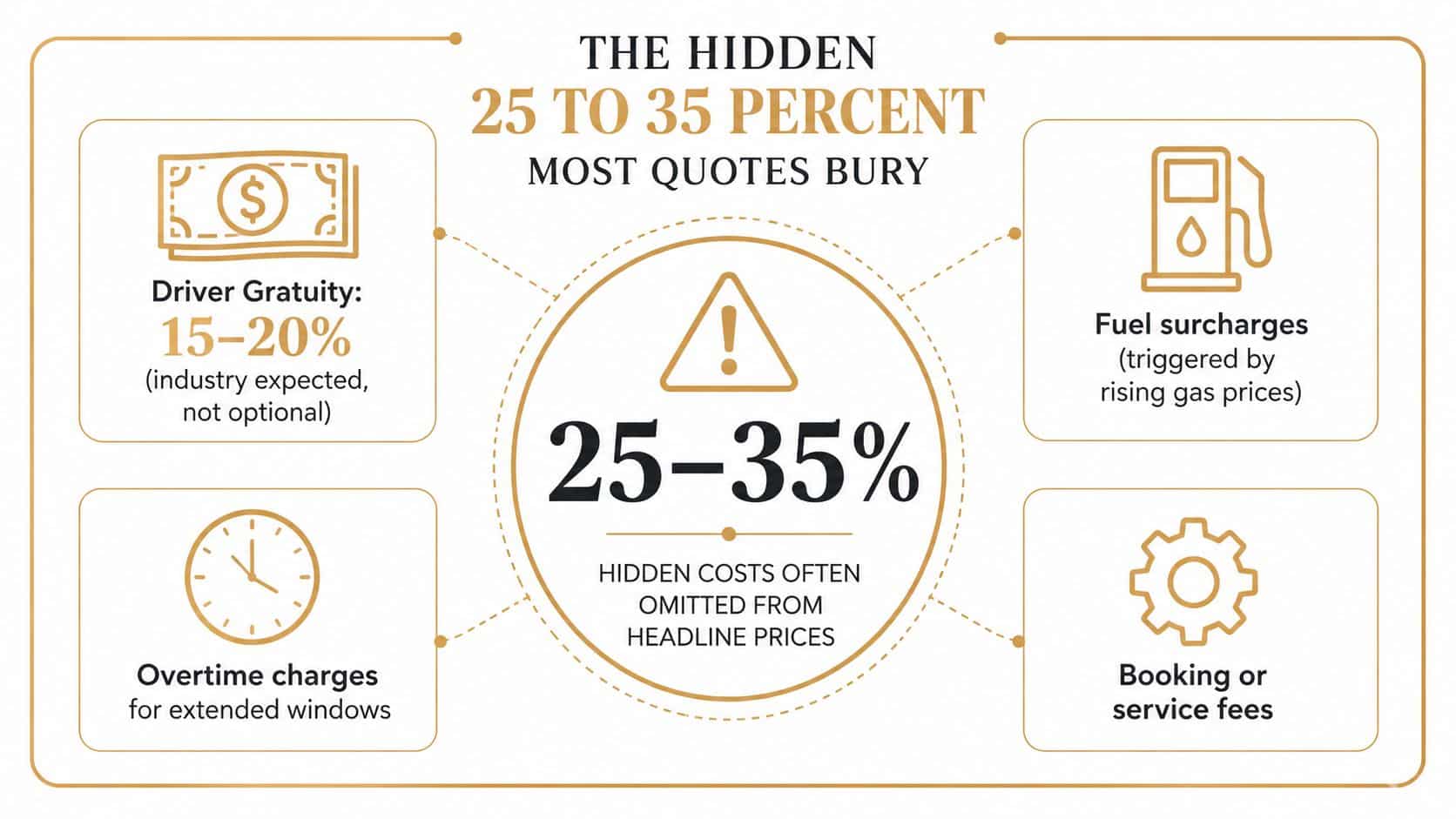
A quote can look tidy and still miss the final bill. Vendors often lead with the base rate, then add fees after the fact. That is how a wedding transport quote that looks manageable can end up 25% to 35% higher than expected.
Where the extra money actually goes
Driver gratuity is usually built in at 15% to 20%, even when the quote makes it look optional. Admin or reservation fees can add $50 to $150. Overtime starts as soon as the booked window runs long, sometimes by just 15 to 30 minutes. Deadhead mileage can also appear when the vehicle returns empty to its base.
Fuel surcharges are another common place where quotes drift upward, especially on longer routes. If your ceremony and reception are far apart, or the vehicle has to reposition between runs, the base number often leaves out part of the trip cost.
A simple worked example
A $2,000 quote can turn into $2,600 to $2,700 once gratuity, admin fees, overtime, and mileage are added. That is not a rare surprise. It is what happens when the operator prices the headline rate tightly and fills in the rest later.
Ask for the invoice to be broken into base fare, gratuity, fuel, mileage, overtime, and admin fee before you sign anything. If they will not itemize it, assume the final number is higher than the quote.
Use the infographic above as your checklist, then send every vendor the same line-item request. If you do not force comparability, you are not comparing quotes, you are comparing sales tactics.
How Cancun and Riviera Maya Pricing Really Works
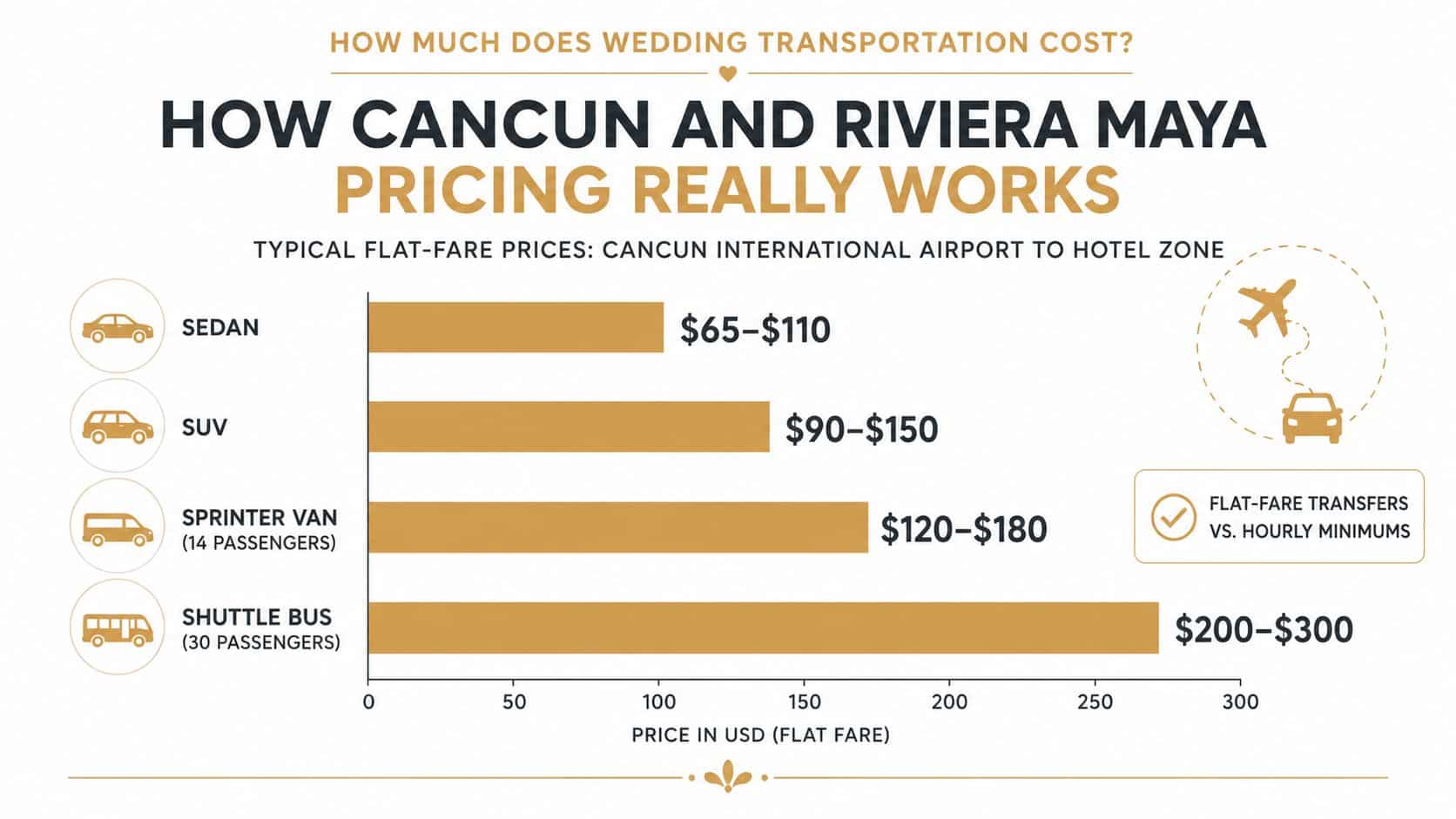
Destination wedding transport in Cancun and the Riviera Maya plays by a different rulebook. You're usually dealing with flat fares and event-window pricing instead of the hourly structures common in U.S. wedding markets.
Airport transfers are fixed, not metered
Cancun Airport pricing is usually shown as destination-based fares. For example, official pricing pages list Cancun Airport to Playa del Carmen at $69.99 USD and Cancun Airport to Tulum at $127 USD (Cancun International Airport transportation). A separate transport price table lists luxury transportation as a higher class, with Cancun Airport to Tulum at $135 USD one way and $270 USD round trip, versus $70 USD one way and $139 USD round trip for standard private transportation (Airport Cancun transportation).
That's the value of private transportation Cancun airport passengers should understand right away. It's not a meter. It's a fixed fare, which makes budgeting cleaner.
Wedding-day routing in Riviera Maya works by vehicle, not by whim
For the wedding day itself, Riviera Maya transport is often quoted per vehicle for the event window. A 20-passenger van can run $550 to $850, while a 40-passenger motor coach can run $1,100 to $1,600. All-inclusive resorts often build transfers into the room block, which is why the quote can look low until you step outside the resort contract and start paying separately for arrival logistics or off-property events.
Unique Private Transportation's Cancun wedding transportation page is one example of a provider that frames these trips as clear, upfront transfers instead of mystery pricing.
Special routes change the bill
If your event includes ferries to Isla Mujeres or Cozumel, expect more moving parts and a much higher bill. Ferry transfers can add $400 to $900 per vessel. That's not a line item couples should discover after the contract is signed.
Cancellation, resort rules, and dock timing all matter here. Cancun and Riviera Maya pricing rewards couples who think in transfers and event windows, not in the same hourly structure they'd use at home.
A Five-Step Checklist for Getting Accurate Quotes
Couples usually ask for quotes before they have a real transport plan. That is backwards. Vendors can only price the job correctly when you give them the same brief and make them answer the same questions.
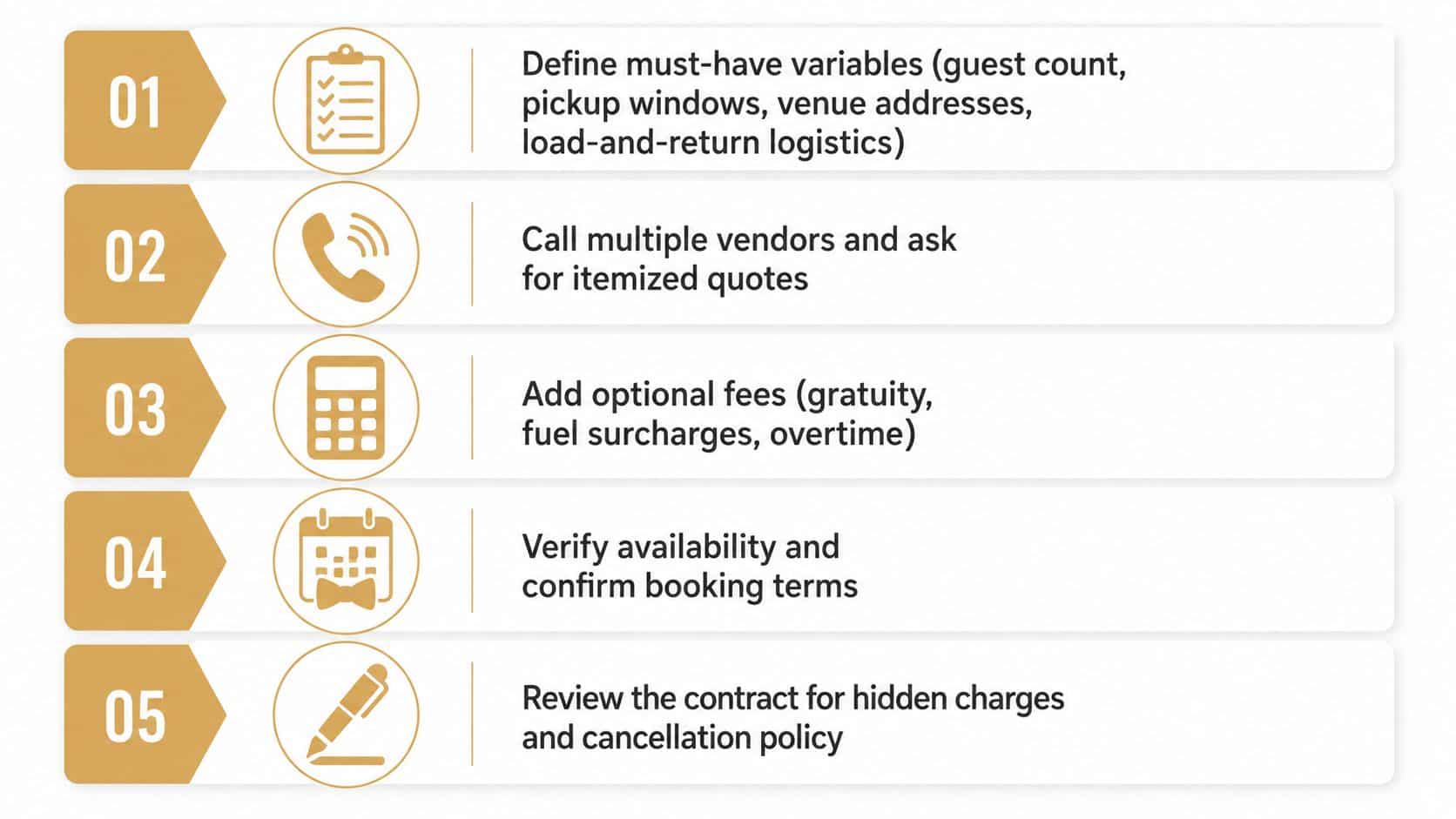
Step 1, define the route before you email anyone
Lock down guest count, pickup windows, venue addresses, hotel block locations, and loading and return timing. If the operator does not know where the vehicle starts, where it waits, and where it parks, the quote is guesswork.
Step 2, send one written brief to at least three vendors
Ask for line-item pricing, not a single total. Require hourly minimums, mileage caps, overtime rates, gratuity expectations, and any package assumptions in writing. If one quote includes extras and another leaves them out, you are not comparing the same service.
Step 3, force hidden fees into the open
Ask directly about deadhead fees, driver meals, overnight surcharges, and fuel escalator clauses. Those are the charges that usually create the 25% to 35% add-on layer that shows up after the first draft of the quote.
Step 4, verify operations, not just price
Get vehicle age, licensing, insurance certificates, and backup-vehicle guarantees in writing. A cheap quote means nothing if the vendor cannot replace a broken shuttle or show up with the promised class of vehicle.
Step 5, compare on a normalized basis
Judge each offer by cost per guest and cost per hour, not by the headline total alone. That is how you catch the quote that looks cheaper because it omits fees you will pay later.
Best practice: request a sample contract clause list before you sign. If the operator dodges that request, treat it as a warning.
The cheapest bid is rarely the best value once you do apples-to-apples math. It is usually the quote that is easiest to read, not the one that costs least after the wedding.
Putting It All Together Into Your Wedding Transport Budget
Start with the route, then build the budget. Transportation should be a real line item, not whatever is left after flowers and music. A practical planning range is 8% to 12% of the total wedding budget, especially when you are moving guests, not just booking a getaway car.
| Wedding Transportation Budget by Guest Count | Typical Vehicle Mix | Base Cost Range | After 25-35% Add-Ons |
|---|---|---|---|
| Around 50 guests | Couple car plus light shuttle need | Near $900 to $1,400 | Higher once fees are added |
| Around 100 guests | Bridal car plus one or two shuttles | Near $2,200 to $3,200 | Noticeably higher after add-ons |
| Around 140 guests | Shuttle setup with coordinated loops | Near $3,500 to $5,000 | Higher again after add-ons |
The average spend of $1,075 still works as a rough reference, but it is not the right target if your wedding has more than one venue or requires guest transport. Smaller weddings usually stay closer to the low end. Once shuttle loops enter the picture, the total climbs fast.
For Cancun and the Riviera Maya, airport transfers deserve their own budget line. Flat fares replace hourly minimums, and that usually makes the math cleaner than a fully staffed hourly booking when arrivals and departures are tightly timed.
Build the budget around guest count and venue geography first. Then cut vehicle class if the number is too high. That approach keeps the focus on what drives cost, route complexity, wait time, and the number of people you have to move. It also keeps you from paying for a prettier quote that still solves the wrong problem.
If you want a quote that fits your actual route, guest count, and timing, Unique Private Transportation handles Cancun airport transfers, wedding-day movement, and private chauffeur service across Cancun and the Riviera Maya. Visit Unique Private Transportation and send your date, venue list, and guest count so you can get a transport plan that fits the day instead of fighting it.