

You've just landed after a long flight into Cancún. Your bags are heavy, your phone is nearly out of charge, and the airport exits are crowded with travelers trying to work out where their ride is allowed to meet them. A taxi counter, a rideshare app, unfamiliar pickup instructions, and a long transfer to your hotel can turn the first hour of a holiday into an avoidable negotiation.
A properly arranged airport car service removes that uncertainty before you leave home. Your flight is attached to the reservation, the chauffeur knows when you land, and the meeting point is confirmed before you reach arrivals. That matters especially in Cancún, where ordinary street taxis can't pick up passengers curbside and travelers are directed toward authorized pickup arrangements outside the terminal (Cancún International Airport pickup guidance).
This guide focuses on the part most booking pages gloss over, the operation behind a reliable pickup. You'll learn what the service should include, how it compares with taxis, shuttles, and rideshares, why live flight monitoring matters, which booking clauses protect you, and how to choose the right arrangement for families, weddings, corporate groups, and luxury travelers.
Table of Contents
- What an Airport Car Service Actually Feels Like
- The Core Components of a Modern Airport Car Service
- Airport Car Service Versus Taxis, Shuttles, and Rideshares
- How Flight Tracking Changes the Pickup Experience
- Booking, Changes, and Cancellation Policies That Protect You
- Choosing the Right Service for Families, Weddings, and Corporate Groups
- What Travelers Expect From Airport Car Service in 2026
- Practical Tips and Final Recommendation for Smooth Pickups
What an Airport Car Service Actually Feels Like
You step into arrivals with the slow concentration that follows a long-haul flight. One hand holds a suitcase, the other checks a phone for messages, while the airport taxi line seems to begin somewhere beyond the crowd. A rideshare app asks you to select a pickup zone, but you're not sure which terminal exit matches the instructions, and it's late enough that walking through an unfamiliar airport lot feels like the wrong start to the trip.
Then you see a chauffeur holding your name on a printed sign.
The vehicle is already assigned, the pickup point has been arranged, and someone is expecting your flight rather than waiting for you to request a car after landing. There's no app rebooking, no surge-price screen, no queue behind other passengers, and no guessing which curb or remote lot you're supposed to reach. The chauffeur confirms your name, takes the luggage, and guides you to the vehicle.
The handoff matters
A good cancun car service makes the handoff feel controlled. Your luggage is placed in the trunk, the cabin is cool, the door is opened, and the first practical question is your destination, not how you'll authorize a payment. If you're traveling with children, the driver should already know about the requested seats. If you have bulky luggage, the vehicle should have been chosen for cargo capacity before you landed.
That experience isn't accidental. It comes from matching a reservation to a flight, a vehicle, a chauffeur, and a specific meeting procedure. The point isn't to ride in a nicer car. It's to remove the airport decisions that exhaust travelers when they're least prepared to make them.

Treat the arrival as an operation
Airport access is a meaningful part of the journey. A National Academies review found that rental cars accounted for typically 9% to 15% of originating and terminating airline passengers' airport access at selected airports, with New York-area airports and Denver International Airport standing outside that usual range (National Academies airport access review). Travelers have always paid attention to the ground connection. The difference now is that they can choose how much uncertainty to accept.
The rest of this guide looks at the components that create that control, the tradeoffs against other options, the mechanics of flight tracking, the policies worth checking, and the practical steps to take before boarding.
The Core Components of a Modern Airport Car Service
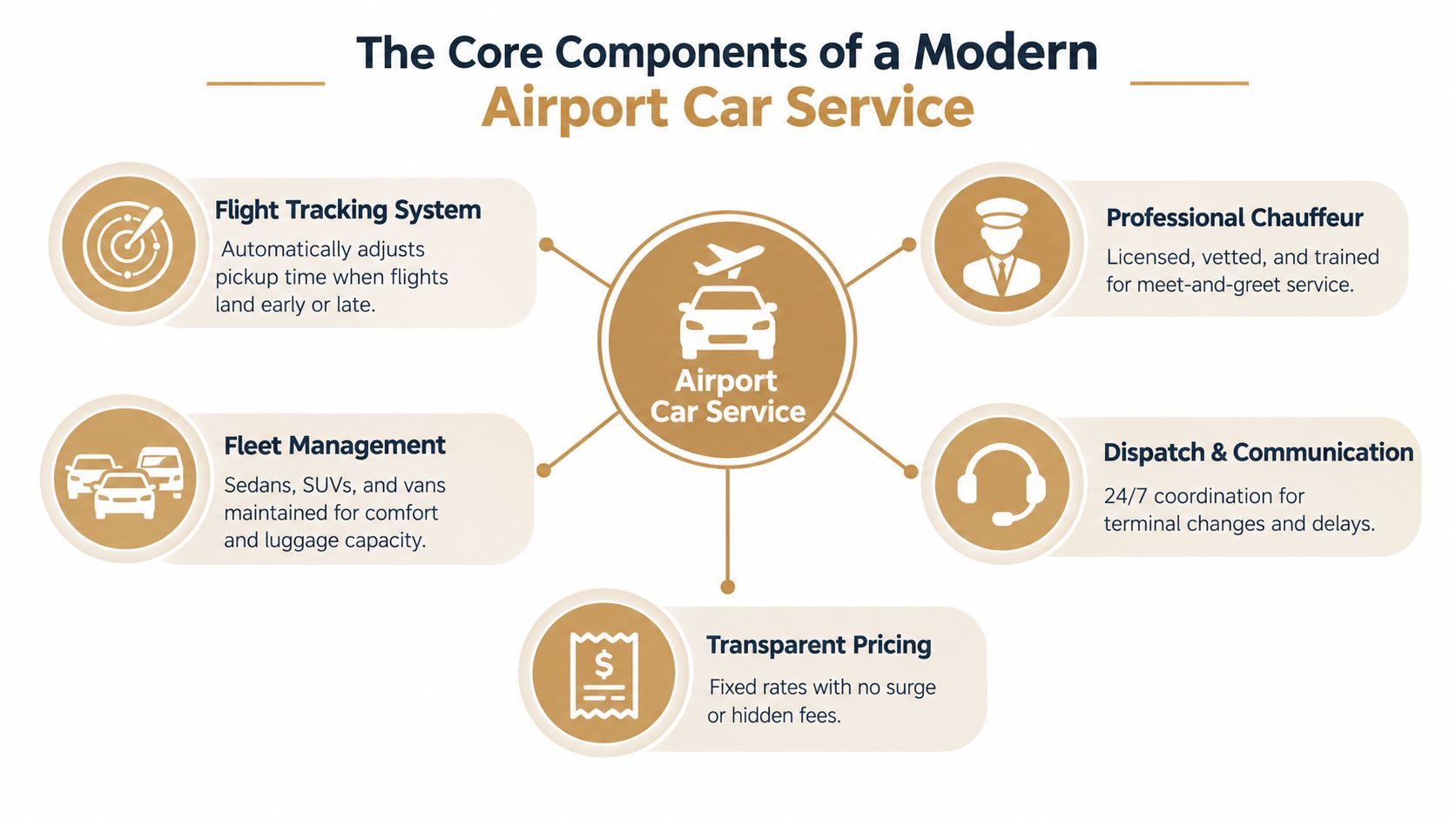
A modern airport transfer is more than a vehicle and a driver. It's a chain of small controls that should continue working when the flight is early, the gate changes, baggage takes longer, or the terminal curb becomes congested.
Flight tracking and dispatch
The reservation should capture your flight number, not only a scheduled arrival time. A flight-linked system can recalculate dispatch and waiting windows when the aircraft is delayed, early, diverted, or cancelled. That prevents two common failures: a driver arriving too soon and becoming idle, or a passenger landing to find nobody ready.
The operator should also explain how the system treats the wait window. In many booking models, the clock is connected to actual landing and baggage-retrieval conditions rather than the original timetable. Ask whether the team monitors the flight directly and whether a dispatcher remains available if the airline changes terminals.
Meet-and-greet procedure
The meeting arrangement should be precise enough that a tired traveler can follow it without improvising. Serious operators provide a terminal, exit, curb or authorized meeting point, chauffeur identification, and a direct contact method such as text or WhatsApp. Some services send a message after landing, while others provide the vehicle details before you leave baggage claim.
A professional chauffeur may meet you at arrivals with a printed sign, help with bags, and guide you through the final steps to the vehicle. That's especially useful for international arrivals, families, older travelers, and anyone unfamiliar with the airport's pickup rules.
Vehicle and passenger care
Vehicle presentation is part of the service standard. Look for an immaculate cabin, working climate control, luggage space that matches your party, and practical amenities such as bottled water or phone charging. Luxury transportation should mean dependable comfort and thoughtful preparation, not just a glossy vehicle photograph.
Chauffeur conduct matters just as much. Discreet attire, clear communication, destination knowledge, and calm handling of changes tell you whether you're dealing with a managed service or a driver who accepted a job.
Practical rule: If the provider can't explain who monitors your flight, where the chauffeur meets you, and what happens when the itinerary changes, the vehicle's leather seats don't solve the operational problem.
A broker may dispatch your trip to whoever accepts it. That isn't automatically unacceptable, but you should ask who controls the vehicle standard, how substitutions are communicated, and whether one support team owns the reservation from booking through arrival.
Airport Car Service Versus Taxis, Shuttles, and Rideshares
The cheapest-looking option isn't always the least expensive arrival. Compare the full journey, including walking, waiting, finding the vehicle, arranging child seats, handling bags, and recovering when the first plan fails.
A private transportation Cancún airport booking usually costs more than joining a shared vehicle or taking the next available taxi. In return, you get a reserved vehicle class, a defined price structure, and one accountable contact. Taxis offer immediate availability and almost no advance planning, but airport fares in Cancún operate through authorized, zone-oriented arrangements rather than a casual meter-based street pickup model (Cancún airport transportation overview).
Rideshares can be convenient in places where airport rules make pickup simple. At airport perimeters, however, the total experience can include a remote meeting location, walking with luggage, waiting for a driver, a cancellation, or a new fare after a delay. Independent coverage of Cancún describes official airport taxi costs of about USD 60 to 80 to the Hotel Zone and USD 150 or more to Tulum, while app-based alternatives can involve 10 to 30 minute waits, long walks outside the terminal, and limited flight-tracking or child-seat support (Cancún airport transfer comparison).
Shared shuttles reduce the price per seat, but they trade away control. You may wait for other passengers, follow a fixed departure schedule, and stop at several hotels before reaching yours. That can work for a flexible solo traveler. It's a poor fit when children are tired, luggage is awkward, or a wedding group needs to arrive together.
| Option | Pricing Model | Average Wait | Reliability | Family Friendly | Payment |
|---|---|---|---|---|---|
| Airport car service | Fixed or quoted private fare | Scheduled and coordinated | High when flight tracking and dispatch are active | Strong, if seats and luggage are reserved | Usually arranged in advance |
| Taxi | Authorized or zone-based fare | Often available at the airport | Depends on queue and vehicle availability | Variable | Counter or driver payment |
| Shared shuttle | Per-seat fare | Subject to departure and other passengers | Moderate, with scheduled stops | Acceptable for flexible families | Usually prepaid or arranged at booking |
| Rideshare | Dynamic app fare | Depends on driver supply and pickup rules | Variable during delays and demand peaks | Uneven, especially with car seats | In-app payment |
For a business traveler, the premium may buy a predictable hotel arrival and fewer interruptions. For a family of five with car seats and large bags, a reserved SUV can be more practical than comparing only the initial fare. For a clear explanation of the wider door-to-door calculation, see this guide to point-to-point transportation.
How Flight Tracking Changes the Pickup Experience
Scheduled arrival times are planning inputs, not reliable pickup triggers. Weather holds, runway congestion, gate changes, aircraft substitutions, and baggage delays can all separate the published schedule from the moment you're ready to leave the terminal.
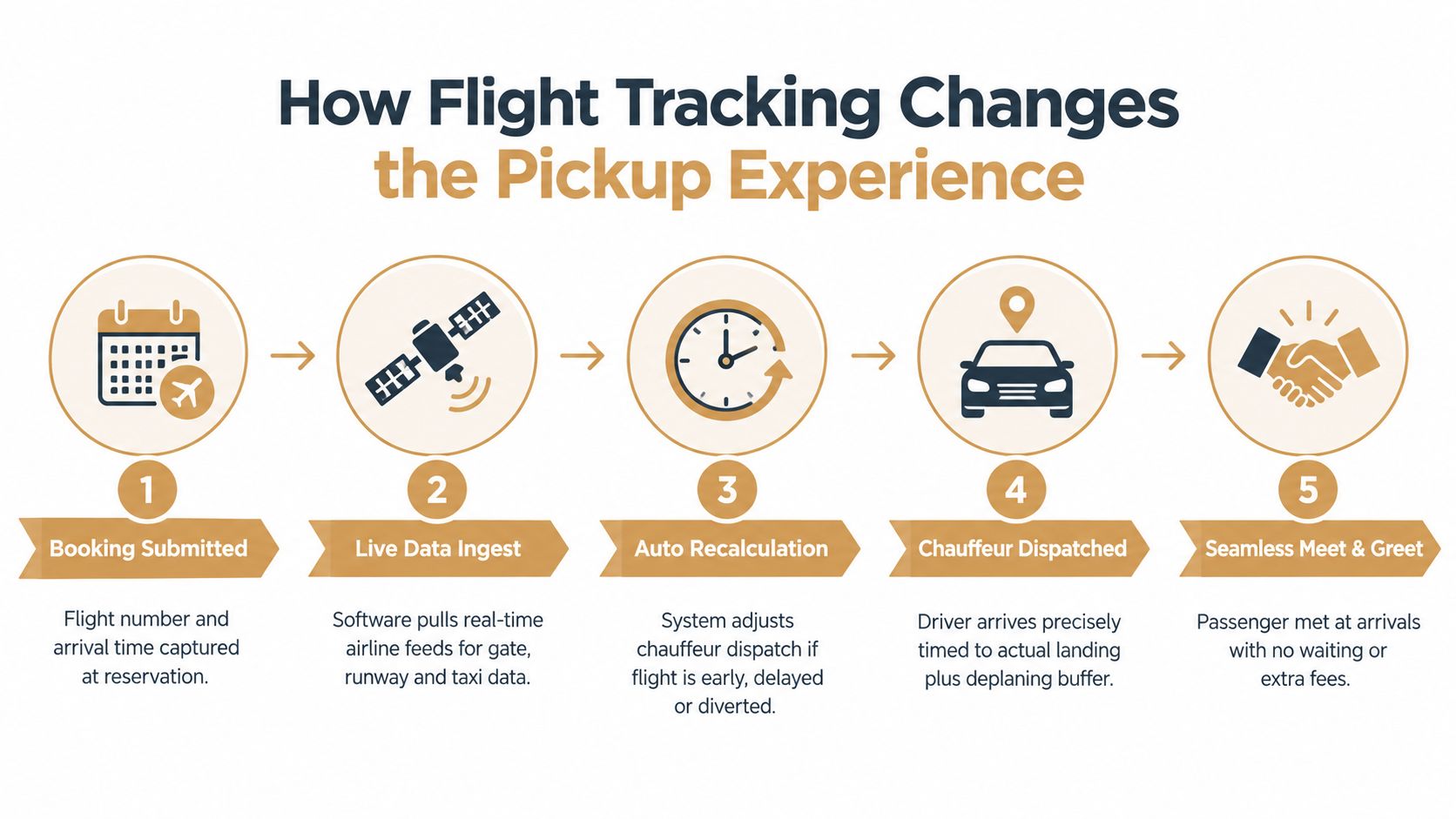
A flight-tracked system receives live airline and airport events, then helps dispatch decide when the chauffeur should leave the garage. The system can adjust when a flight is early, late, diverted, or cancelled. Industry transfer software describes automatic recalculation of dispatch and wait windows using flight-number-linked monitoring, with wait-time calculation tied to the actual landing event (airport transfer flight-monitoring system).
What the dispatcher watches
The practical sequence is straightforward:
- Reservation data is captured. The operator records the airline, flight number, terminal, destination, and passenger details.
- Live movement is monitored. The team checks the aircraft's changing arrival information instead of relying only on the original timetable.
- Dispatch is recalculated. The chauffeur's release time shifts when the flight moves ahead or behind schedule.
- The landing event starts the next stage. The operator accounts for deplaning, baggage, customs, and the agreed meeting process.
- Communication continues. The passenger receives pickup instructions, contact details, or vehicle information when appropriate.
The wait window needs careful wording. Some providers describe a 30 to 60 minute domestic buffer and 60 to 90 minutes for international arrivals, but you should confirm the exact policy because the clock may apply differently to curbside pickup, baggage claim, and garage dispatch.
A useful system can send SMS updates, share a plate number, and allow a dispatcher to reroute another vehicle if the assigned chauffeur encounters a problem. If your bag is delayed, contact the operator rather than leaving the meeting area. If the flight diverts, ask what happens to the reservation and whether the same booking remains active.
The economic reason is clear. A transportation study found that ground activity consumes 22% to 65% of a passenger's total airline trip time, with trip time defined as travel plus waiting (transportation study on airline trip time). Waiting isn't a minor inconvenience when it occupies such a large share of the journey. Flight tracking moves that volatility into the dispatch operation instead of forcing the passenger to absorb it.
Booking, Changes, and Cancellation Policies That Protect You
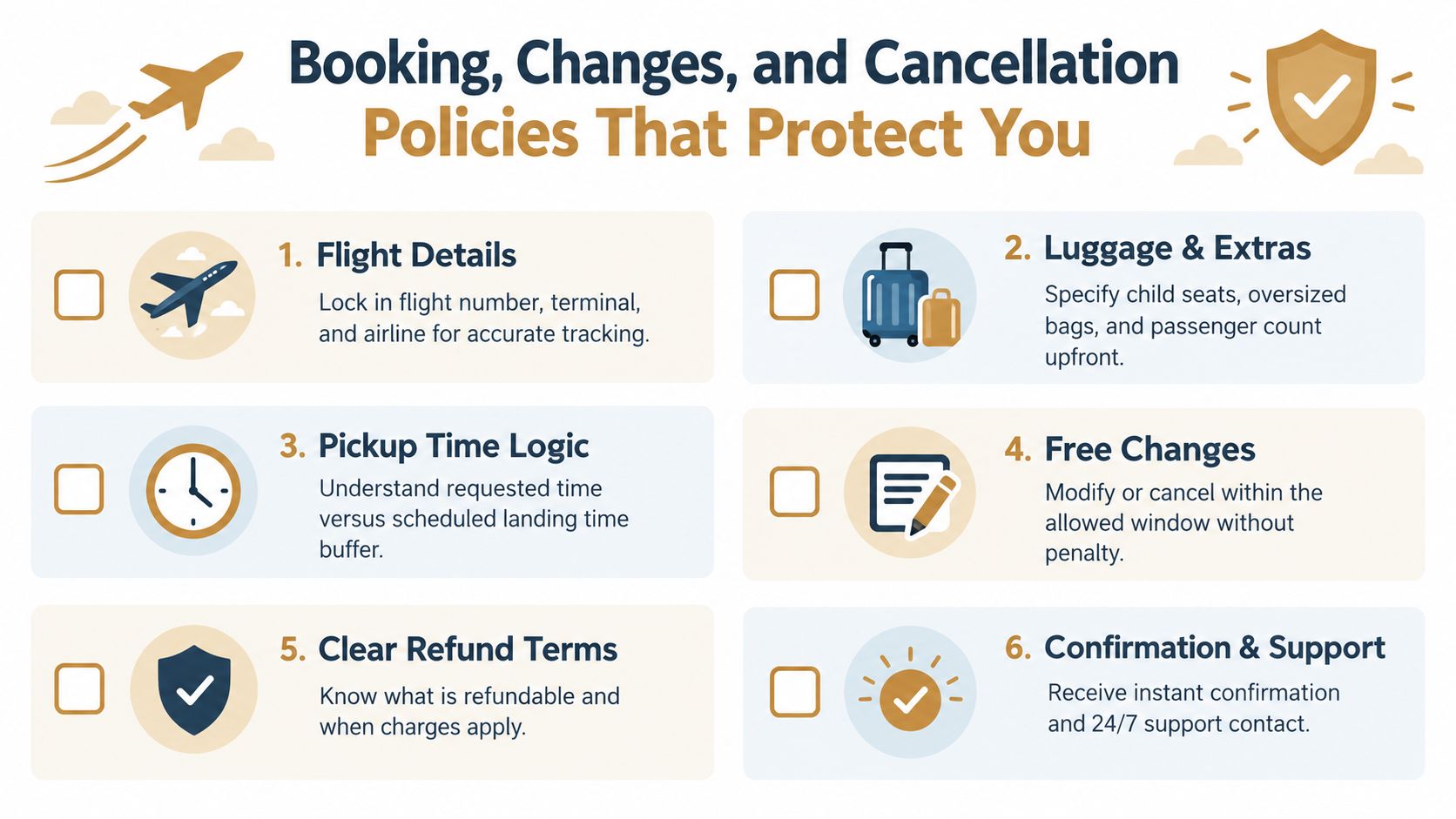
The booking form determines whether the operation can help you later. Enter the flight number, airline, terminal, passenger count, luggage details, destination, child-seat needs, and any oversized items. Don't substitute a requested pickup time for the flight information when the ride is airport-based. The operator needs both if you want a useful plan.
Your confirmation should state the meeting point, chauffeur contact process, vehicle class, passenger and luggage assumptions, total fare, payment status, and support number. If the message only says “reservation confirmed” without explaining where to go, keep asking until the instructions are usable from the arrivals hall.
Read the money terms before paying
A fully prepaid booking and a reservation held against a card don't give you the same advantage if plans change. Check whether cancellation offers a full refund during a stated window, whether a partial refund applies after that window, and whether a same-day charge begins once the driver has been dispatched. No-show language deserves equal attention, especially when baggage or immigration delays are possible.
Question any late-night, early-morning, holiday, toll, parking, or zone-based addition that isn't clearly included. A fixed fare is only useful when you know what “fixed” covers.
Ask for these protections in writing: flight-delay rebooking, the exact meeting point, included tolls and fees, and the procedure for a terminal change.
Save the confirmation email and take screenshots of any delay notices. Store the dispatcher's number before takeoff, when your phone still has reliable service. If you're arranging a trip with a pet, you can also review pet-friendly accommodation websites while confirming the operator's pet policy and vehicle requirements.
For a provider's terms, review the cancellation policy before completing payment. The important point isn't finding the longest policy page. It's knowing exactly what happens when the airline changes your arrival, when your hotel changes the destination, or when you cancel because the trip itself has changed.
Choosing the Right Service for Families, Weddings, and Corporate Groups
A service that works for a solo executive may be completely wrong for a family, bridal party, or corporate delegation. Start with the passenger problem, then choose the vehicle and coordination model.
A family needs more than a clean SUV. Parents should confirm whether child seats are available and installed before arrival, whether the second row accommodates rear-facing carriers, and whether the trunk holds strollers alongside suitcases. Older relatives may need a chauffeur who can assist without rushing them. Ask whether the provider records these requirements on the reservation or merely adds them to a general note.
A wedding party has a timing problem. The operator may need to coordinate airport arrivals, hotels, ceremony venues, receptions, and return trips while protecting formal clothing and maintaining discretion around decorations. Capacity, multi-vehicle timing, red-carpet handling, and the difference between a per-person quote and a flat vehicle fee all matter. For larger itineraries, comparing luxury group travel options can help you think beyond a single airport run.
Corporate groups need accountability and privacy. An account manager, centralized confirmations, monthly invoicing, traveler-data controls, branded arrival signage, and rapid handling of executive flight changes are more valuable than decorative extras. A company should know who receives itinerary updates and who can authorize a last-minute vehicle change.
| Traveler Type | Best Vehicle Class | Must-Have Features | Red Flags |
|---|---|---|---|
| Family with young children | SUV or spacious premium vehicle | Confirmed child seats, cargo room, second-row access, luggage assistance | Seats unavailable, vague luggage policy, no direct support |
| Wedding party | Coordinated SUVs, vans, or group vehicle | Multi-vehicle dispatch, timed movements, attire and decor awareness | One vehicle for every movement, unclear capacity, driver rotation |
| Corporate group | Executive SUV, van, Sprinter, or coach | Account contact, invoicing, privacy, live itinerary control | No named coordinator, cash-only process, weak change policy |
Ask whether the operator assigns a primary chauffeur or rotates drivers, whether the vehicle model is guaranteed or interchangeable, and whether the quote is all-inclusive. A mid-tier sedan can suit a solo traveler with modest luggage. Once the group outgrows that cabin, a Sprinter or coach is the sensible answer. Don't force several small vehicles into a trip that needs one coordinated group movement.
For a destination-specific overview, see this guide to Cancún car service. A provider such as Unique Private Transportation coordinates private airport transfers, point-to-point routes, tours, wedding movements, and corporate transport, with vehicle selection based on the itinerary rather than a single default car.
What Travelers Expect From Airport Car Service in 2026
The word “luxury” no longer excuses weak operations. Travelers increasingly expect fixed pricing, digital payment, live flight tracking, and lower-emission vehicle choices as ordinary features of private airport transportation. Recent industry coverage projects the pre-book airport transfer market at USD 11.67 billion in 2026, with a projection of USD 20.62 billion by 2030, while identifying electric and hybrid fleets, AI booking, and demand-responsive dispatch as developing baseline trends (airport transfer trends and projections).
The 2026 filter
Use these standards when reviewing a provider:
- All-inclusive pricing: The quote should identify what is included and separate genuine optional upgrades from unexpected operating charges.
- Digital payment: Secure online payment, contactless options, and an emailed receipt make the transaction easier to document.
- Live coordination: You should receive useful updates when flight movement changes the pickup plan, not a generic automated confirmation.
- Terminal precision: Meet-and-greet instructions should identify the correct terminal and authorized pickup location.
- Family transparency: Child seats, extra luggage, oversized items, and pets should be handled during booking rather than negotiated at the curb.
- Fleet responsibility: Hybrid and electric vehicles are becoming more visible, but ask what is available for your route and luggage requirements.
The best cancun luxury airport transfers don't rely on a black vehicle and a polished photograph. They make the arrival leg predictable, explain the limits of the service, and communicate before the traveler has to chase an answer.
The next layer will likely include carbon reporting per ride, dispatch coordination across multiple airports, and AI-assisted rebooking during irregular operations. Those features may become useful, but they don't replace the basics. If a provider can't identify your meeting point or explain its flight-delay process, advanced branding won't protect the arrival.
Practical Tips and Final Recommendation for Smooth Pickups
Flight delays, long baggage lines, and terminal changes can disrupt a pickup quickly. Run this checklist the day before departure:
- Confirm the meeting point in writing. Verify the terminal, exit, curb or authorized pickup zone, and whether the chauffeur meets you inside or outside.
- Check the flight number. Confirm that the airline and flight match your itinerary.
- Reconfirm passengers and luggage. List strollers, golf equipment, surfboards, oversized cases, and child seats.
- Save direct support. Store the dispatcher's phone number and messaging channel before boarding.
- Screenshot the confirmation. Keep booking details available offline in case airport connectivity fails after baggage claim.
Turn on phone service before leaving the aircraft if possible. Check the operator's message or app link after landing, but treat it as an update, not the entire meeting plan. You should know where to go if data service fails.
Families should identify bags clearly. Practical adhesive label travel ideas can help distinguish children's items, strollers, and similar suitcases during a crowded baggage claim. Travelers with language concerns should confirm that support is available in a language they can use comfortably.
The common failures are avoidable: the traveler goes to the wrong terminal, follows rideshare signs that do not apply to private vehicles, misses the stated exit, or cannot reach the driver after landing. In Cancún, ordinary street taxis are not a casual curbside hail option. A pre-arranged car with a confirmed meeting point therefore fits the airport's operating rules better than improvising after baggage claim, as noted earlier.
My recommendation: Book a tracked private airport car service when timing, luggage security, family equipment, or predictable pricing matters. Choose a shuttle or rideshare when you accept waiting, pickup friction, and less control in exchange for a lower upfront commitment.
For a resort arrival, wedding movement, or executive transfer, compare the full door-to-door experience before you fly. Confirm the pickup location, delay process, luggage capacity, and cancellation terms. The right choice should still work if your flight arrives early, late, or at a different gate.
Unique Private Transportation provides pre-arranged Cancún airport transfers, live flight monitoring, meet-and-greet coordination, bilingual support, premium vehicles, and point-to-point service across Cancún and the Riviera Maya. Visit Unique Private Transportation to confirm your route, vehicle needs, luggage requirements, and pickup plan before you fly.