
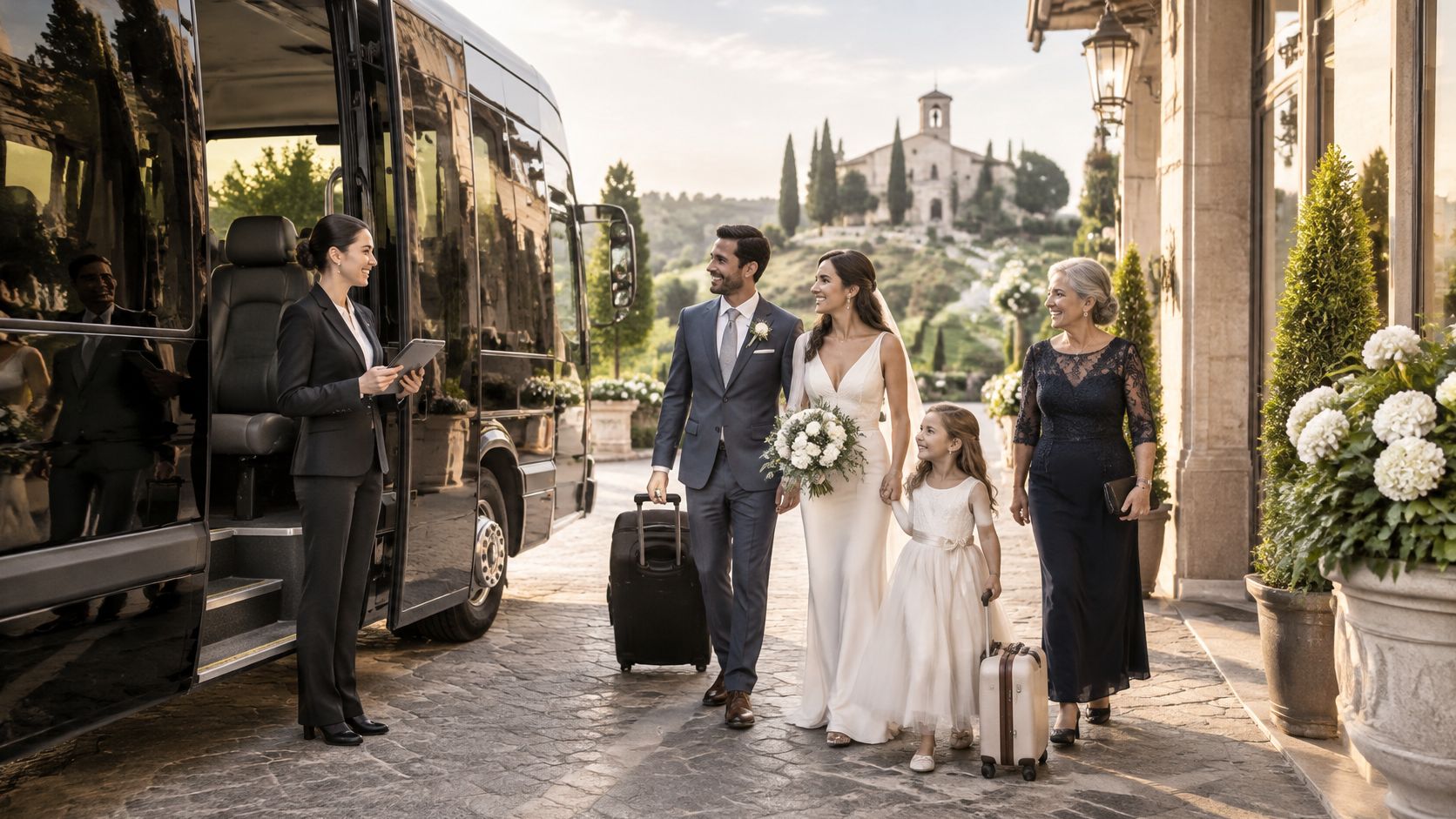
You're three days out, and the group chat just flipped. One cousin's flight into Cancún is two hours late, the grandparents are already in the hotel lobby, and the ceremony and reception sit in two different places. You didn't book one ride. You booked a chain of rides, and that late plane just moved the first link.
That chain is what wedding transportation for guests is. It is airport, hotel, rehearsal, ceremony, reception, and the ride back after midnight. When one flight slips, you check the windows that flight touches. You don't rebuild the whole day.
This is already a normal budget line, not a last-minute extra. The Knot's Real Weddings Study, based on a survey of nearly 12,000 couples, found that 35% booked transportation for their wedding day, with an average transportation expenditure of $980. On a Cancún weekend those dollars usually start at the terminal, not the chapel.
Table of Contents
- How to Split Guests Into Transport Segments
- Choose Vehicles by Guest Group Size
- Plan Rides for Elderly, Young and Mobility-Limited Guests
- Airport Pickups and Meet-and-Greet Logistics
- Booking Timeline and Delay Backup Plans
- Guest Messages, Signs and Final Check
How to Split Guests Into Transport Segments
A destination wedding makes the chain longer. Guests don't share one lobby and one clock. A 2024 wedding-industry data summary found that 84% of destination-wedding participants stayed overnight at the location and 34% had to fly there. Overnight stays plus flights mean airport rides, hotel rides, and returns that don't line up.
Treat every movement as its own transport segment.
- List every event. Write the date, start time, and venue for welcome drinks, the rehearsal dinner, the ceremony, and the reception. A vehicle can't be assigned until you know which door people walk out of.
- Mark the bed and the flight. Note where each guest is staying and whether they're flying in. Two cousins at the same resort can still land six hours apart.
- Group by arrival window, not by family. A family on two flights is two groups. The window is what a driver can meet. The surname isn't.
- Assign one segment per group. Use airport arrival, hotel to venue, rehearsal dinner, ceremony to reception, late-night return, or departure. Mixing a late plane into the ceremony coach is how seated guests end up waiting in a hot lobby.
- Count the busiest moment. Add passengers on each segment and circle the peak. That peak sets the vehicle, not the weekend average.
- Pull off-schedule arrivals out. A red-eye, a missed connection, or anyone landing after the group window gets a separate row. Don't stretch the main coach to cover them.
The usual miss is assuming the hotel loop covers the ride home. Those loops often stop while the reception is still going. Late returns need their own row, with a pickup at the reception exit.
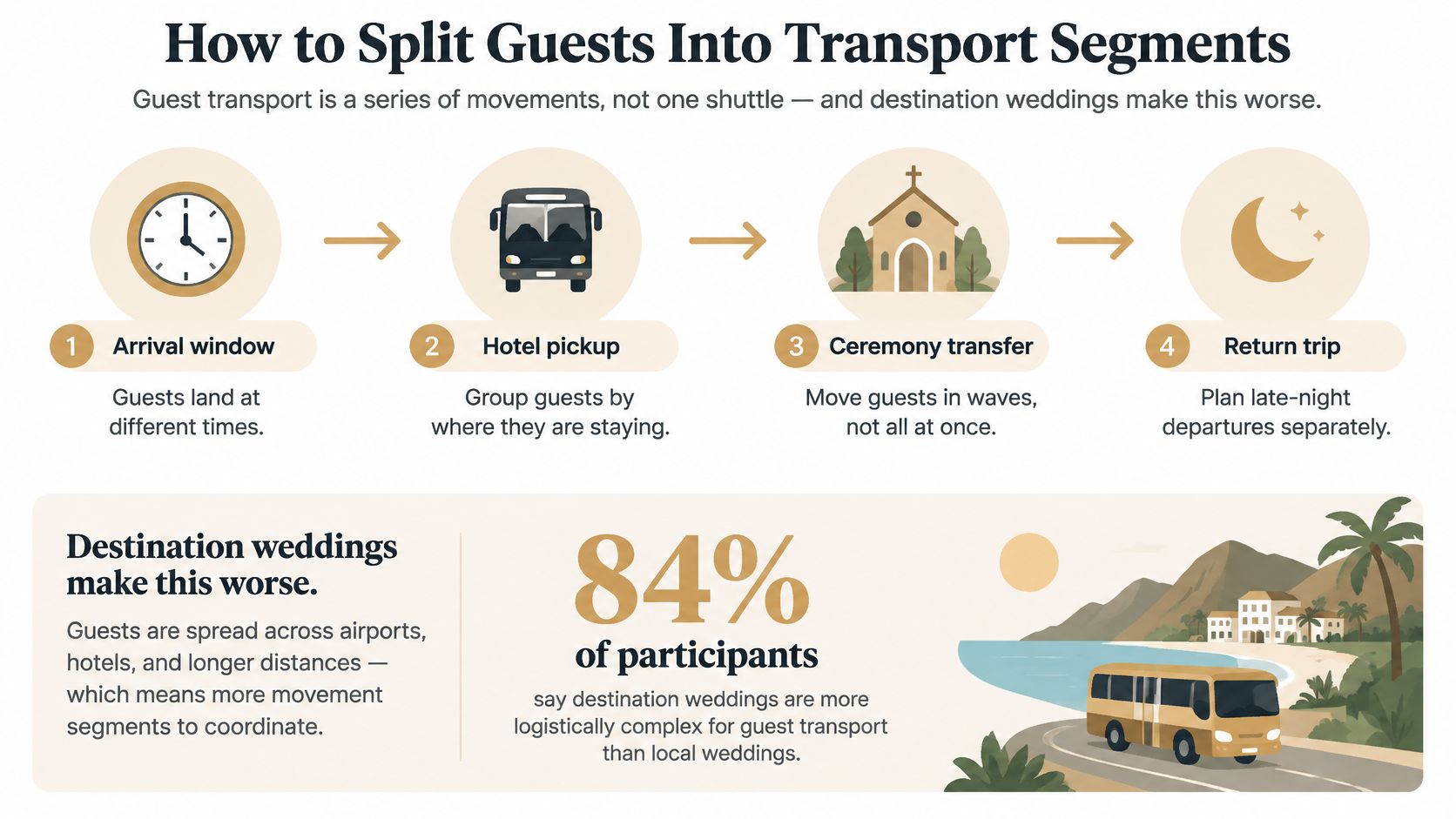
The finished segment sheet
One row per segment, with headcount, time window, and pickup point. A delayed flight rewrites only the rows it touches. A direct hop that isn't on a loop is a point-to-point ride, so one late group doesn't hold everyone else.
| Segment | Pickup point |
|---|---|
| Airport arrival, 14 guests, 11:00 a.m. to 1:30 p.m. | Arrivals hall meeting point after baggage claim |
| Hotel to venue, 40 guests, 2:30 p.m. to 3:10 p.m. | Hotel lobby |
| Rehearsal dinner, 22 guests, Friday 6:00 p.m. | Hotel lobby |
| Ceremony to reception, 40 guests, 5:15 p.m. | Ceremony venue exit |
| Late-night return, 36 guests, 10:30 p.m. and 11:45 p.m. | Reception exit |
| Departure, 14 guests, Sunday 9:00 a.m. | Hotel lobby |
Practical rule: If a row has no pickup point and no clock time, it isn't a segment yet.
Choose Vehicles by Guest Group Size
Match the vehicle to the largest window before you compare quotes. The number on the door is seats. Luggage takes seats. A sedan with one suitcase per guest carries fewer people than the label suggests.
| Vehicle | Typical capacity | Best for | Main limit |
|---|---|---|---|
| Sedan | 3 passengers plus luggage | Couples and small families on one flight | Little room for luggage |
| Full-size SUV | 6-7 passengers | Small family groups and bridal parties | Seats fill quickly with bags on airport runs |
| Passenger van | 12-15 passengers | Hotel-to-venue runs for mid-size groups | Needs room to park and turn at resorts |
| Mini coach | 25-30 passengers | Ceremony and reception runs for a full table of guests | Longer boarding time and higher hourly rate |
| Full coach | 45-55 passengers | Large groups moving together on one route | Runs half empty when guests arrive at different times |
The split-taxi cost trap
Cancún airport taxis are priced by zone and charged per vehicle, not per person. One airport guide reports indicative one-way airport-taxi prices of approximately $65–$120 per car, depending on the zone, with payment at a counter rather than to the driver. A group of eight split across three cars can outspend one van, and you still manage three meeting points.
Size it in one pass. Count guests in that arrival window, add one seat for luggage for every two guests, then round up to the next vehicle. Eight guests need four luggage seats, so you need 12 seats, which is a passenger van, not two SUVs.
A 50-seat coach at half full wastes the booking and makes early arrivals stand around for people who aren't there yet. Right-size the window. Don't upsize the whole day because one flight is full. A short wedding transportation cost breakdown is worth reading before you lock hourly minimums.
Write one line per arrival window: headcount, luggage seats, and the vehicle row that fits the largest window. If that row's limit is parking or boarding time, say so on the line. That's the quote you ask for.
Plan Rides for Elderly, Young and Mobility-Limited Guests
A yes-or-no checkbox is how the wrong vehicle shows up. "Needs assistance" doesn't tell you whether the guest needs step-free boarding, a lift or ramp, space for a folding wheelchair, a companion seat, or extra minutes at the door.
Ask for the journey, not a medical history. A short private note is enough, and guests shouldn't have to share diagnoses to get a safe ride.
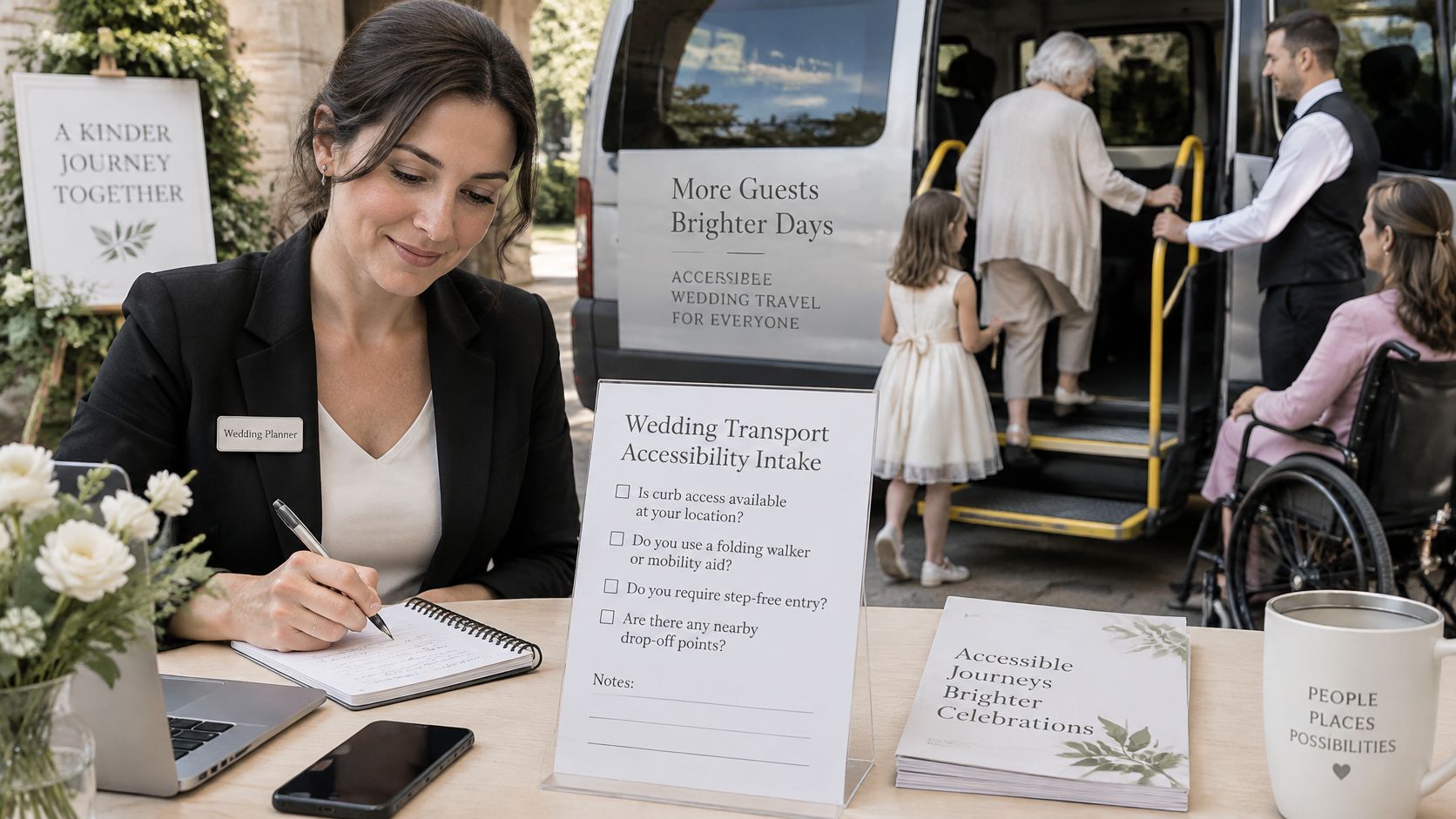
A premium cabin is not an accessible cabin. Confirm the step height, whether a lift or ramp is fitted, and how wide the door is before you promise the seat. Then walk the pickup in your head. Resort paths, gravel, and long walks from a distant porte-cochère undo a good vehicle. Ask the hotel for a lobby-side meeting point or a drop-off that stays on level ground.
Public-transport operators have started publishing step-free passenger journey improvements that judge the whole path, not a single vehicle feature. Use the same test here. Boarding time, the meeting point, and the late ride home all have to work, or the plan fails at the curb.
Who needs a longer door
Older guests do better in a seat near the door, with boarding opened ten minutes early so they aren't rushed behind a full coach line. Families with infants need the seat booked by age and weight, not "a car seat" as a vague note. Ask whether a bulky stroller or travel cot is coming too. Those items take the luggage seat you already counted.
Send one confirmation so the driver and the guest read the same plan. Use this wording and don't paraphrase it later:
Itinerary message: Saturday. Pickup at 3:40 p.m. Meeting point is the hotel lobby by the front desk. Vehicle reference SUV-2. The day-of phone is the number on your confirmation.
Airport Pickups and Meet-and-Greet Logistics
The meeting point is the terminal printed on the ticket, not "Cancún airport." Cancún International Airport runs four passenger terminals, and a complimentary inter-terminal shuttle connects them from 07:00 to 22:00 at intervals of about 20–30 minutes, according to AirportsData.
| Terminal | Main traffic | Gates | Pickup note |
|---|---|---|---|
| Terminal 1 | Charter, private general-aviation and executive flights | No published gate count | Confirm with the operator before arrival |
| Terminal 2 | Domestic and selected international routes | 31 | Check each guest's airline and terminal before pickup |
| Terminal 3 | Mainly scheduled international flights | 22 | Common landing point for scheduled international guests |
| Terminal 4 | International and selected domestic services | 12 | Confirm the terminal on every ticket in the group |
Why curbside hailing fails
Street cabs and off-site vehicles can't pick up passengers curbside without an authorized pre-purchased voucher or an advance reservation. Airport transport guidance for Cancún sends travelers to licensed-transport booths inside arrivals, where fixed-fare tickets are issued. Guests told to "grab a taxi outside" often can't. That's the failure that strands a wedding party with their bags.
Set Cancun airport transportation up before anyone lands.
- Collect the airline and terminal for each guest. The boarding pass beats the group chat.
- Group the same terminal and the same window. Terminal 3 at 11:20 and Terminal 4 at 11:40 are different pickups.
- Put the meeting point inside arrivals, after baggage claim. One spot per group, named in the message.
- Send a name sign, a vehicle reference, and the terminal name. The guest shouldn't have to describe the car.
- Use the inter-terminal shuttle only as a bridge. It helps someone who landed in the wrong building during its running hours. It isn't your pickup plan.
Chauffeurs pick customers up at the airport and take them to their destination, which is the whole job of a meet-and-greet. For a tight connection through New York before the Cancún leg, JFK transfer advice from Passport Premiere is a useful read on how a missed link upstream wrecks a ground pickup.
For a group, compare a Cancun car service or Cancun luxury airport transfers with several fixed-fare taxis. Each taxi is priced per car, so one reserved vehicle is often cheaper than three separate rides, and you keep one meeting point. Private transportation Cancun airport bookings should name the terminal in the same line as the flight number. Our Cancun car service notes walk through how that handoff is written.
Booking Timeline and Delay Backup Plans
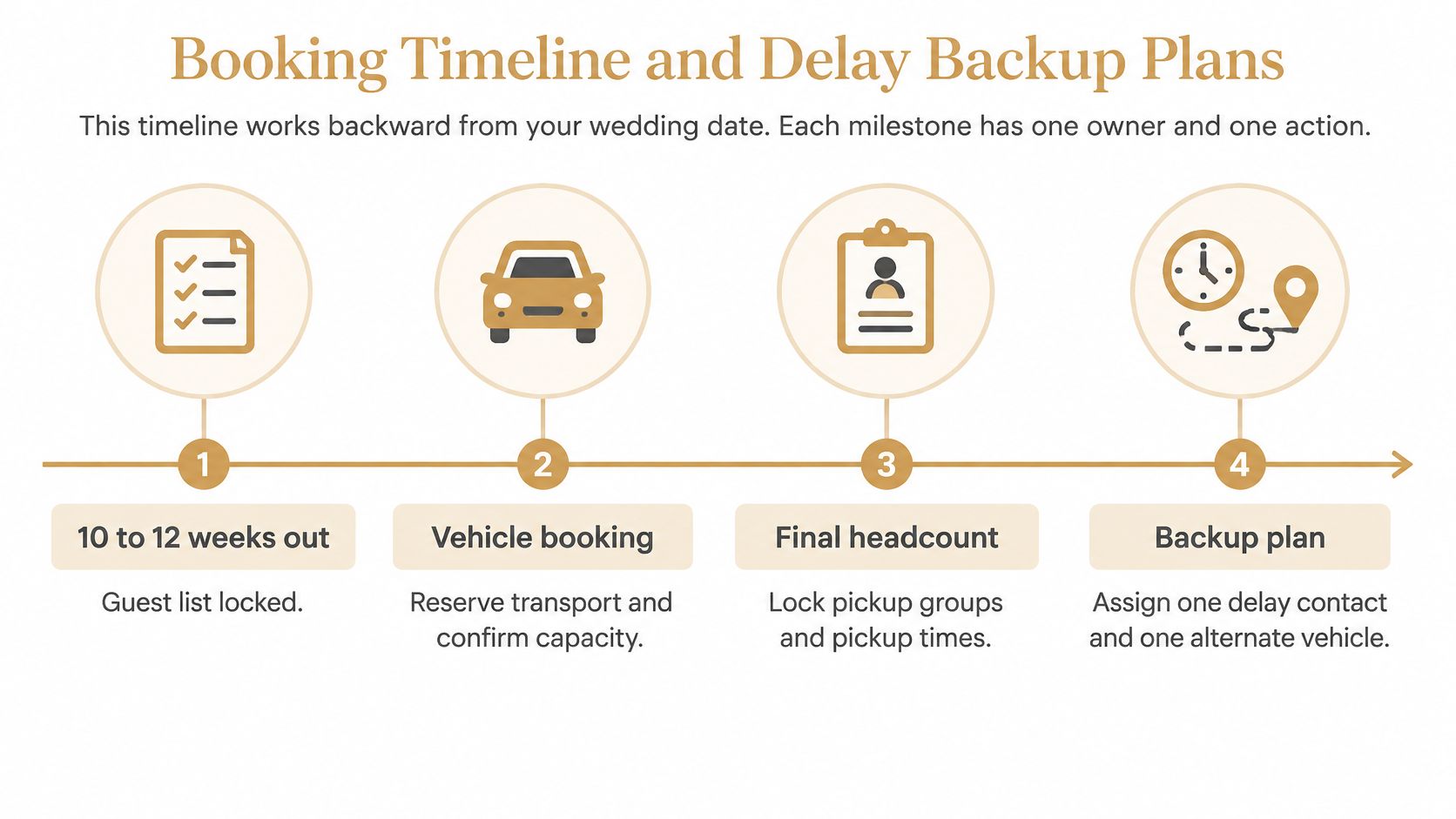
Work backward from the wedding date. Each milestone has one owner and one action. If two people "have it," nobody does.
| Milestone | When | Action |
|---|---|---|
| Guest list locked | 10-12 weeks before | Assign each guest to a transport segment |
| Vehicles reserved | 8-10 weeks before | Book vehicle size per segment and hold dates |
| Flight details gathered | 4 weeks before | Collect airline, flight number and terminal |
| Itinerary sent | 2 weeks before | Share pickup times, meeting points and vehicle references |
| Final confirmation | 72 hours before | Confirm passengers, drivers and any late changes |
| Day-of check | 2 hours before each pickup | Verify flight status and driver location |
What a delay does to the day
A late inbound flight shouldn't send the guest hunting. The driver tracks that flight and waits at the named meeting point. Build at least an hour of buffer into each airport pickup, and mark on the itinerary which later pickups can slide and which can't. The ceremony wave usually can't.
A missed connection moves that guest onto the next scheduled run in the same segment. Don't invent a new route at the curb. A breakdown needs a named backup vehicle, or a second provider, written down before the wedding morning. A ceremony that runs long needs a decision in advance: who may hold the reception transport, and for how many minutes, before the next hotel wave is released.
One delay contact, one alternate vehicle. Everything else is a guess made in a lobby.
Guest Messages, Signs and Final Check
Guests follow the last thing they were sent. One change, one message. A thread of replies leaves half the group on the old time.
Itinerary message: Saturday. Pickup at 3:40 p.m. Meeting point is the hotel lobby by the front desk. Vehicle reference SUV-2. The day-of phone is the number on your confirmation.
Change message: The 3:40 p.m. lobby pickup has moved to 4:10 p.m. Same meeting point, same vehicle reference SUV-2. The 3:40 p.m. pickup does not run.
Delay message: We're watching flight AM 402. Keep the arrivals-hall meeting point after baggage claim. If you land early, wait there. If you land late, the driver stays at that point. Don't leave to find another car.
One current plan, one message per change.
What goes on the sign
Print a single sheet. Skip a collage of names in small type.
- Guest name: Large capitals, one sign per arriving party.
- Terminal name: The terminal on the ticket, not just the airport.
- Vehicle reference: The same code that's in the message, such as SUV-2.
- Group name: Family or bridal party, so a cousin can spot the sign if the lead guest is at baggage service.
If you want something sturdier than paper for the welcome table, affordable wedding décor projects for DIY enthusiasts show simple acrylic options. The transport sign itself should stay plain and readable at ten paces.
Send bilingual messages when guests read Spanish or English first. A bilingual driver covers the ride. The message has to be clear before they land.
Before anything goes out, check the segment sheet, the accessibility list, and the delay backups against each other. Then send that segment sheet and accessibility list to info@uniqueprivatetransportation.com. Unique Private Transportation runs airport transfers and wedding chauffeur service, and can confirm vehicles, meeting points, and timings in one reply. Cancun Airport Transportation also takes private transfers with last-minute bookings when a flight change lands inside the final week.
Unique Private Transportation handles wedding guest rides across Cancún and the Riviera Maya, from airport meet-and-greet through hotel, ceremony, and late returns, with flight tracking so a late arrival doesn't leave someone at the curb. If your segment sheet is ready, or if a delayed flight just broke the first window, visit Unique Private Transportation and send the rows you need covered.