

If your transfer van is hit on the way to your hotel, who pays the hospital bill, you, the driver, or the company that sold you the ride as "insured"? Most travelers can't answer that, because passenger insurance coverage is usually sold as one reassuring phrase. In practice, it's at least two separate products with different triggers, and confusing them is how people end up paying costs they thought were covered.
Table of Contents
- Passenger Insurance Coverage at a Glance
- How Passenger Liability Responds After a Crash
- Where Passenger Cover Ends and Travel Insurance Starts
- Limits and Exclusions With Real Examples
- Mexico Rules for Cancun Airport Transfers
- Confirm Your Passenger Cover Before You Book
Passenger Insurance Coverage at a Glance
Passenger coverage types compared
| Coverage | What It Pays | Usually Responds When | Typical Gap |
|---|---|---|---|
| Passenger bodily-injury liability | Injuries to passengers when the operator or driver is legally responsible | Fault is established against the insured party | Doesn't pay medical bills automatically |
| Medical expenses after a ride injury | Hospital and treatment costs | The named policy covers that injury | Often met by the traveler's health or travel policy |
| Accidental death | Benefit to named beneficiaries | Death results from a covered accident | Payment is capped at the sum stated in the policy |
| Baggage and trip interruption | Lost bags, delays and cancelled trips | The traveler's own travel policy is in force | Not part of transport liability |
Reading the four rows
Bodily-injury liability is the operator's legal safety net. It responds to a claim for harm the operator is responsible for, within set limits. It isn't a promise that a clinic will be paid on the spot.
Medical expenses sit in a different place. Treatment after an injury may run first through your health or travel policy, even if a liability claim continues in the background. That's why two policies can be involved in one injury.
Accidental death cover only exists where the policy names it, and the amount is whatever that policy states. Don't assume a benefit, or a figure, from the words "passengers insured."
Baggage and trip interruption aren't transport liability at all. A lost suitcase or a missed tour belongs to travel insurance, not to the vehicle policy.
"Insured passengers" tells you a policy exists. It doesn't tell you which benefit applies, how much it pays, or who pays first.
Some systems work differently, which adds to the confusion. If you're used to no-fault rules at home, understanding Florida PIP coverage shows how a fault-free medical benefit differs from liability, a useful contrast before you travel.
Before you book any cancun airport transportation, ask three questions. Which benefit applies to a passenger injury? Who pays the hospital bill first? Does the policy name a limit per person? Clear answers matter more than the word "insured."
How Passenger Liability Responds After a Crash
A transfer van is heading toward Playa del Carmen when another vehicle rear-ends it at a junction. You fracture your wrist and need treatment. The crash starts two separate questions: who was legally responsible, and which insurance policy may respond?
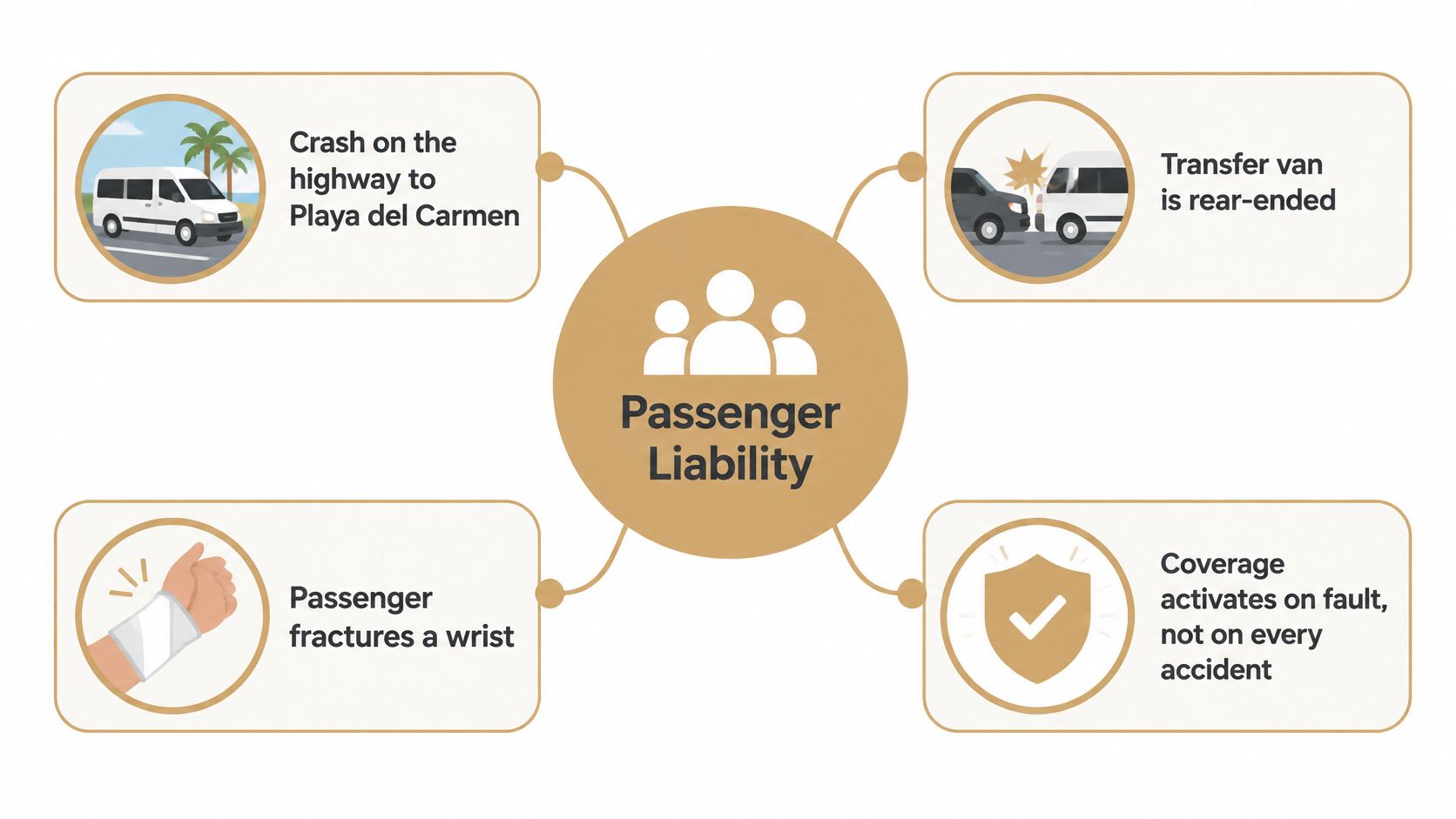
Passenger liability works like a safety net tied to responsibility. An injury alone does not establish that the transport operator is liable. The policy responds when the operator is legally responsible, subject to its terms and limits.
The four steps in that story
- The crash happens and responsibility is assessed. The circumstances and any authorities' findings may help establish who was at fault.
- A claim is made. You or your representative can seek compensation from the party considered legally responsible.
- The relevant liability policy is considered. If the transport operator is responsible, its commercial vehicle policy may respond within the applicable limits.
- Covered losses are assessed. The policy may cover bodily injury and, where its terms allow, property damage. Exclusions and limits still apply.
If the other driver caused the collision, that driver's liability cover may be relevant instead of the operator's. If the driver leaves, record any available vehicle and driver details, then report the hit-and-run to local police right away. The hit-and-run guidance from LA Law Group also discusses what to record and report.
The vehicle's insurance must be appropriate for commercial passenger transport. A policy for private car use may not cover a vehicle carrying paying passengers. In other words, the word “insured” alone does not show that the policy applies to your ride.
Treatment may be needed before responsibility is settled. Your health or travel policy may be involved while a liability claim is assessed, so keep records of medical care and incident details.
Before booking, ask the operator for the per-person limit and whether the vehicle collecting you is covered. For a Cancun airport transfer, clear answers help you understand what the operator's liability cover can address, and what may depend on your own insurance.
Where Passenger Cover Ends and Travel Insurance Starts
Passenger liability and personal travel insurance handle different losses. Liability cover may respond when a carrier is legally responsible for an injury in a covered vehicle incident. Your travel or health policy may cover certain medical or travel costs, depending on its terms.
A driver runs a red light and you are injured. The question is whether the driver or carrier is legally responsible and whether liability cover applies. If you become ill during a tour stop, with no vehicle incident, your own health or travel policy may be relevant instead.
A travel policy may cover sickness or accidents, emergency evacuation, repatriation, cancellations and baggage, and sometimes personal liability, subject to exclusions for matters such as pre-existing conditions, known events and pregnancy, as described in The State's travel insurance guide. These are potential benefits of your own policy, not benefits provided by the vehicle's liability cover.
Four questions travelers ask after an injury
- What happens first? Get medical help. Then document the incident with the operator and, where needed, the authorities.
- Who contacts the insurer? The operator notifies its liability insurer, while you notify your travel or health insurer. You may need to handle your own report.
- Are bills paid directly or reimbursed? Check your policy before traveling. Some travel policies reimburse expenses rather than paying a hospital upfront.
- Does cover continue during stops or vehicle changes? Ask how the policy applies when you leave the vehicle or switch vehicles. Cover linked to a vehicle may not apply to an incident on foot.
On a day with several stops, the distinction matters: a point-to-point transfer describes the transport between destinations, while your policy terms determine what cover applies beyond the ride. Ask how each part of your itinerary is treated before booking.
Check whether your booking confirmation identifies the insurer, scope, claim process, territorial limits and deductibles, and whether cover is primary or secondary.
Keep receipts, medical notes and incident references together, and save the operator's incident contact before you travel. Clear records can help when you need to explain what happened and submit a claim.
Limits and Exclusions With Real Examples
A family lands in Cancun with a six-month-old and walks to their luxury transportation pickup assuming a car seat is fitted and covered. That assumption has three separate parts, and each can fail on its own. The seat might not be supplied, it might be the wrong size, or it might be installed incorrectly.
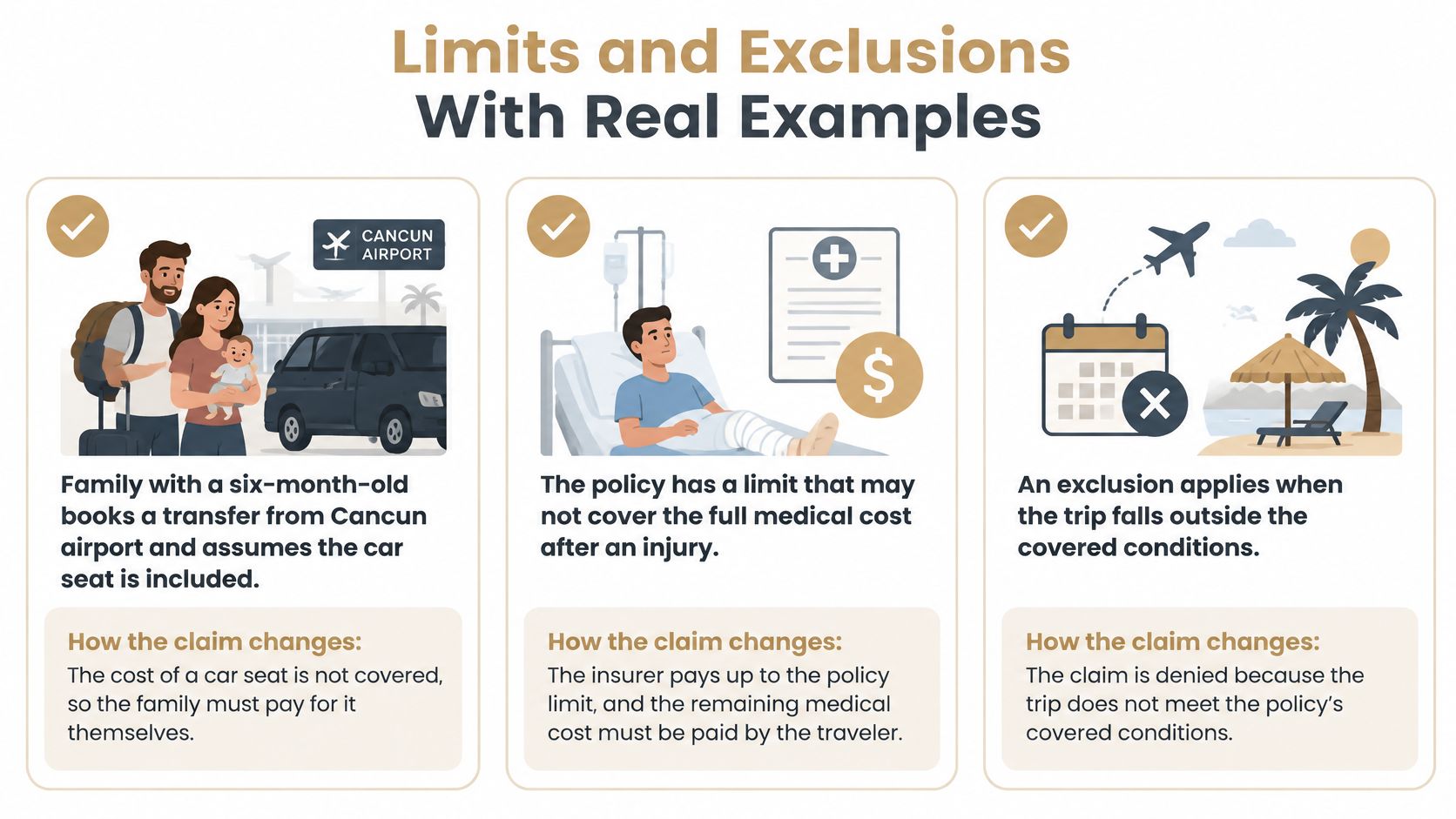
Claim outcomes can depend on vehicle capacity, seat-belt use, properly installed child restraints, passenger behaviour and the exact wording of exclusions, and "car seat available" doesn't prove the correct restraint will be supplied, installed, age and size appropriate, and covered, as Miss Tourist's Cancun driving guide notes while stating that Mexico requires seat belts for passengers where belts are fitted. Confirm child-restraint and rear-seat rules with an authoritative local transport or legal source before you rely on a booking policy, and send the child's age, height and weight when you reserve.
Outside the vehicle
Now say a private tour stops at a cenote and a guest slips and is hurt on the path. No vehicle was moving and the driver did nothing wrong. Vehicle liability may not respond at all, because the injury happened outside the vehicle and outside the driver's control. The relevant question becomes what the traveler's own policy covers, and whether the tour operator carries separate cover for the stop itself.
Split across two vehicles
Finally, a wedding group is divided across two vehicles after a last-minute substitution. One vehicle is involved in a minor crash. Which policy responds depends on which vehicle each passenger was riding in, so a booking that names only "transport for 12 guests" creates avoidable argument. Get every vehicle named on the confirmation, with its passenger list.
Group bookings also expose a limit people miss. A per-accident limit is shared across everyone injured in that accident, so several claims draw on one pool.
Practical booking terms sit alongside insurance limits. If you miss your scheduled flight, we can't guarantee rescheduling your transportation service and no refund is provided. Notify us immediately if you miss it, which increases the chances of rescheduling at no additional cost.
Work through the checklist in the final section before you pay, while these details are still easy to fix.
Mexico Rules for Cancun Airport Transfers
Does the vehicle picking you up at Cancun Airport have the required authorization? Airport pickups are regulated, so how a transfer is arranged affects both whether it can collect you and which operator is responsible if something goes wrong.
Street cabs and off-site vehicles cannot pick up passengers curbside without an authorized pre-purchased voucher or advance reservation. App-based drivers also face restrictions on passenger pickups inside the airport complex, according to Cancun airport transportation guidance. Travelers can use official transportation counters or arrange a transfer before arrival.
Airport transport categories compared
| Category | Authorization | Pricing | Accountability |
|---|---|---|---|
| Scheduled public coach | Public scheduled service | Published fare for the route | The route operator named on your ticket |
| Authorized airport taxi | Official airport taxi company | Fixed fares | The official company named on your voucher |
| Pre-booked private transfer | Booked before arrival with confirmed dispatch | Quoted before booking | Named operator and vehicle |
A published fare gives travelers a clear price before the trip. For example, event travel instructions listed an official airport taxi at about 500 Mexican pesos, or about 50 U.S. dollars, to Cancunmesse and warned participants against unauthorized transport and paying drivers directly, according to the COP16 participant transport instructions.
A named meet-and-greet with confirmed dispatch also makes it clear who is collecting you and which vehicle to expect. That booking information helps identify the operator and vehicle if a claim arises, but it does not by itself establish what the operator's liability policy covers. Learn how a pre-booked Cancun car service works.
U.S. federal minimum insurance rules do not apply in Mexico. Ask the operator to confirm in writing that its passenger liability coverage meets Mexican requirements, and check its certification and policy with the operator and relevant Mexican transport authority.
Confirm Your Passenger Cover Before You Book
What does “passenger insurance” mean for your ride? Unique Private Transportation carries traveler's insurance, and all travelers are insured. That describes cover associated with the transportation service; it does not replace your own travel or health insurance, which may address different costs and situations.
Before booking any airport transfer, check who operates the ride and what the fare includes. Unique Private Transportation's terms and conditions explain that a full refund is available if you cancel at least 24 hours before the scheduled pick-up time.
Your pre-booking checklist
- Ask the operator what its passenger insurance covers. Clarify the policy's scope and how to raise a claim.
- Check that the answer applies to the service you are booking, such as an airport transfer, point-to-point ride, or tour.
- Confirm the vehicle suits your group. Unique Private Transportation offers a Suburban RST for groups of up to seven passengers.
- Ask whether the operator and fleet meet applicable transport standards. Unique Private Transportation's drivers and fleet are certified and subject to SCT and SECTUR quality and safety standards.
- Review the cancellation terms before paying, including whether a full refund applies if you cancel at least 24 hours before pickup.
- Keep your booking confirmation and pickup details accessible on your phone.
Passenger insurance and personal travel insurance serve different purposes. Ask the transport operator about cover for the ride, then check your own policy for travel-related costs it may address. For pickup coordination, share your flight details, group size, and any child-seat needs so the team can confirm the vehicle and pickup timing before you arrive.
For Cancun airport transportation, Unique Private Transportation schedules each service so the driver is present when you arrive. Its rates include private transportation and passenger insurance.