

Buy the cheapest van policy you can find and sort the details later. That popular advice works until a claim handler asks whether the passengers paid, how many seats the van was built with, and where the luggage was sitting. Passenger van insurance isn't priced or judged by the label on the schedule. It's judged by designed seating, paid use, loading practice, and paperwork. Get those four wrong and a valid looking policy can leave you exposed. Get them right and you can defend both your premium and your claim.
Table of Contents
- Why a Passenger Van Needs More Than Family Car Cover
- Minimum Liability Limits by Vehicle Size and Use
- Coverage Parts That Pay When a Trip Goes Wrong
- How to Audit Your Policy Before You Carry Passengers
- Loading and Rollover Risks That Shape Your Premium
- Cancun and Riviera Maya Rules for Van Operators
- Choose Coverage That Matches Your Service Type
Why a Passenger Van Needs More Than Family Car Cover
A family van carries people who chose to be there, usually without payment, a contract, or a hotel waiting for a certificate. A paid transfer van is different. One collision can injure several passengers at once, damage their luggage, hit another vehicle, and trigger claims from the guests, the other driver, and the client who booked the trip.
Say you run a 12 passenger van on Cancun airport transportation work, carrying six guests and a stack of suitcases. Six people on board doesn't make it a six person risk, and a personal policy may exclude hire and reward use entirely. You wouldn't discover that exclusion from the price. You'd discover it after the crash.
The Three Questions That Matter
- How much liability do you legally need? That starts with designed seating, not today's head count.
- Which coverage part pays which loss? Passenger medical bills, luggage, your van, and a substitute vehicle don't all come from the same pot.
- How do loading and territory change the price? Occupancy, seat belts, route, and jurisdiction shape underwriting as much as vehicle age does.
Before you talk to a broker, pull three facts for every vehicle, its manufacturer designed seating including the driver, every service you sell, and every territory you drive in. Operators who can answer those cleanly get clearer quotes for services like a Cancun car service built around private chauffeured trips than operators who just name the van model.
A policy that lists your vehicle isn't proof that your paid trips are insured. The paid use wording is the proof.
Minimum Liability Limits by Vehicle Size and Use
Start with the United States federal floor, because it's the clearest public benchmark for how regulators think about passenger exposure. It doesn't set your Mexican limit, but it shows the logic every serious underwriter follows.
Minimum public liability by operation and seating capacity
| Operation | Designed seating | Minimum public liability | Rule source |
|---|---|---|---|
| Private use, no paid passengers | Any | Not set by the FMCSA for-hire rule | Personal or private policy |
| For-hire, interstate, up to 15 people including driver | 15 or fewer | $1.5 million | FMCSA, 49 CFR Part 387 |
| For-hire, interstate, 16 or more people including driver | 16 or more | $5 million | FMCSA, 49 CFR Part 387 |
| Mixed fleet, interstate for-hire | Highest capacity in the fleet | Largest vehicle's limit applies to all vehicles | FMCSA, 49 CFR Part 387 |
| Cancun airport transfer, Mexico-registered van | Any | Set by Mexican law, airport terms and operator contract, confirm in writing before operating | Mexican law, airport terms and operator contract |
Under the Federal Motor Carrier Safety Administration insurance filing requirements, for-hire passenger carriers in interstate or foreign commerce need at least $1.5 million for a vehicle designed to transport 15 or fewer passengers, including the driver, and $5 million for 16 or more, including the driver. The same rules apply the limit according to the highest seating capacity in the fleet.
How to Read the Table
That federal figure is a financial responsibility floor, not a target and not an adequacy opinion. A serious multi passenger injury claim can test a minimum limit quickly. Hotels, wedding planners, corporate clients, lenders, and airports can also contractually require more, and an umbrella layer may sit above your primary auto limit.
Work the example through. A van designed for 15 people including the driver sits in the $1.5 million tier even if you only carry eight guests that day. Add one vehicle designed for 16 to the same interstate for-hire fleet and the required level for the fleet moves to $5 million. Removing a seat for comfort, blocking a row for luggage, or promising to carry fewer people doesn't rewrite designed capacity on its own. Ask the insurer how it classifies any conversion in writing.
For Cancun work, don't import the U.S. numbers and assume you're compliant. Use them as a risk conversation with a licensed Mexican broker, then match the actual limit to Mexican law, airport terms, and client contracts, including contracts tied to Cancun wedding transportation for multi vehicle guest movements.
Your check is simple. Find the manufacturer designed seating for each vehicle from the build plate, registration, or manufacturer spec, include the driver, and match each vehicle to the correct row before you discuss price.
Coverage Parts That Pay When a Trip Goes Wrong
Treat passenger van insurance as several payers stitched together, not one promise. When something goes wrong, the first argument is usually which part responds, for whom, and up to what sublimit.
What each coverage part pays and the gap if it is missing
| Coverage part | What it pays for | Gap if missing |
|---|---|---|
| Bodily injury liability | Injuries to third parties, including other drivers and pedestrians | Injury claims fall on the operator personally |
| Property damage liability | Damage to other vehicles, fences and hotel property | Operator pays settlements out of pocket |
| Passenger accident or medical | Medical costs for passengers injured in the van | Guests' medical bills fall to the operator or their own insurance |
| Cargo and luggage | Bags and equipment carried for passengers | Lost or damaged luggage claims go unpaid |
| Physical damage | Repair or replacement of the van | Operator pays full repair or replacement cost |
| Hired and non-owned auto | Substitute vans and vehicles a driver supplies | Claims involving substitute vehicles may be uncovered |
| Uninsured and underinsured motorist | Passenger injuries caused by drivers with too little cover | Passengers may be left with injury costs |
| Hire-and-reward endorsement | Confirms paid passenger transport is insured | Paid trips may be excluded from the policy |
Bodily injury and property damage liability protect third parties outside your business relationship with the guest. Passenger accident or medical deals with the people inside your van. Those aren't interchangeable, and a broker should show you both limits separately.
Cargo and luggage deserves a close read because it's often sublimited. A van full of wedding dresses, golf bags, strollers, and camera kit can exceed a token sublimit in one load. Physical damage is about getting your own vehicle repaired or replaced, which matters for cash flow even when nobody's hurt.
Where Gaps Show Up at Renewal
Recent reporting in Carrier Management on the 2025 transportation market notes passenger transport faces heightened underwriting scrutiny, hired and non-owned auto may be unavailable or priced substantially higher, and carriers are increasingly unwilling to provide full uninsured and underinsured motorist limits. It also reports commercial auto claim severity in the latest four quarters reached $27,400, up 62% from $16,900 in the comparison period.
That market pressure shows up in practical places. A substitute van borrowed for a busy Saturday, a driver using his own SUV for an overflow pickup, or a subcontractor covering one leg can sit outside your main policy. A paid use exclusion can stay invisible for years if nobody files a claim.
I would prioritize the hire and reward endorsement first, then passenger medical, then hired and non-owned wording. Price comes after you know those three respond to the work you sell in luxury transportation and group transfers.
How to Audit Your Policy Before You Carry Passengers
Don't audit by reading the premium page. Audit by forcing the policy to describe your real operation, vehicle by vehicle and service by service.
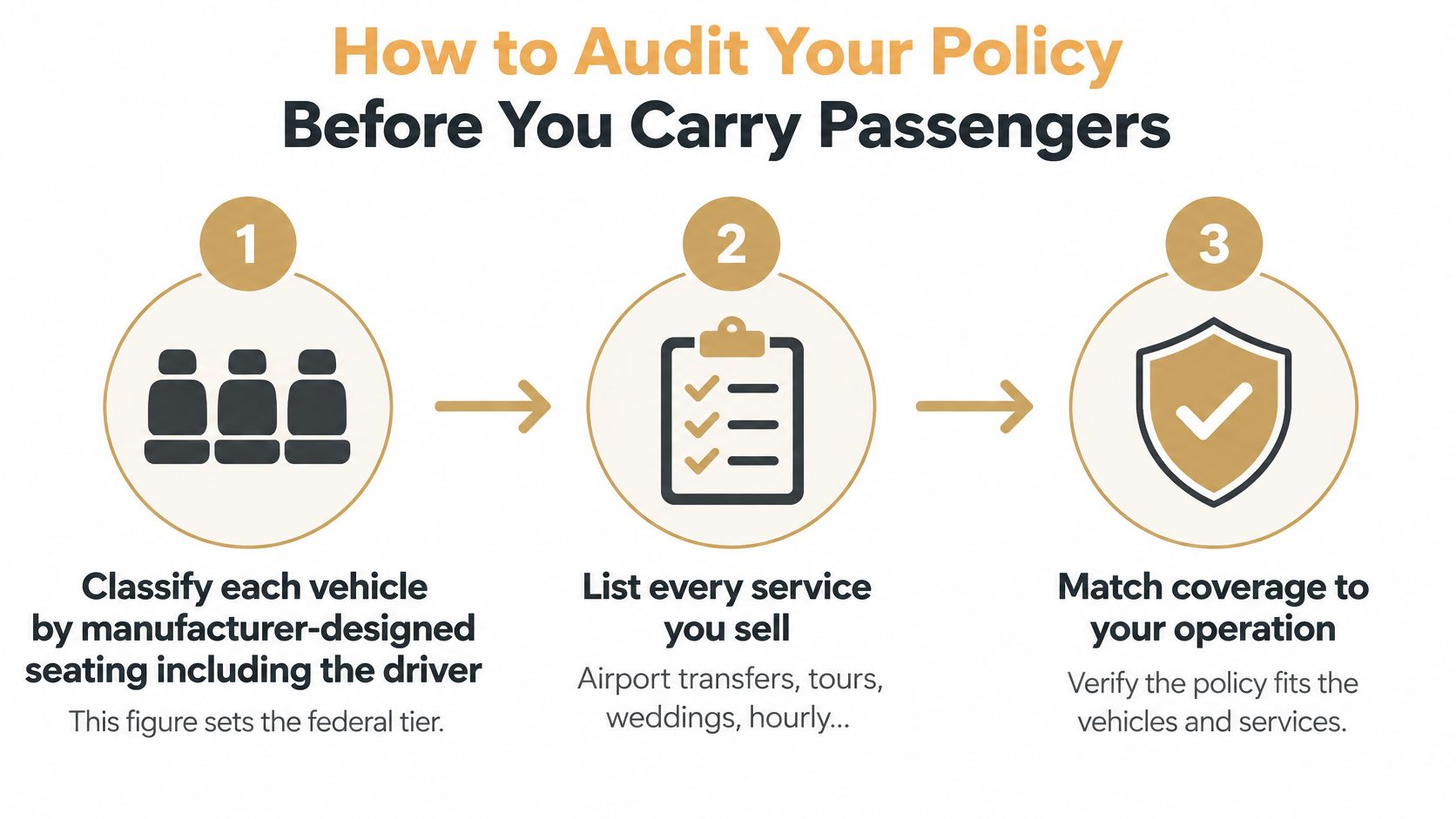
The Seven Step Audit
Classify each vehicle by designed seating. Record manufacturer designed capacity including the driver for every van and SUV. That figure drives tiering, fleet rating, and whether one large vehicle lifts the requirement for the rest.
List every service you sell. Write down airport transfers, tours, weddings, hourly charter, corporate runs, ferry connections, and substitute vehicle work. If a service isn't listed for the broker, don't assume it's covered by goodwill.
Get paid use confirmed in writing. Ask the insurer to confirm that paid passenger transport is covered for each listed service. Some policies tolerate personal or occasional use but exclude regular hire and reward work.
Test the substitute vehicle clauses. Check hired and non-owned auto, rental, borrowed, and driver supplied vehicle wording. Overflow days are exactly when informal arrangements happen and exactly when gaps hurt.
Compare every limit twice. Match each limit against legal minimums and against every client, hotel, venue, lender, or airport contract that names an insurance amount. The higher requirement wins, not the cheaper one.
Confirm every driver is an insured driver. Include employees, subcontracted chauffeurs, and bilingual drivers who only work peak season. Keep licences, driving records, training notes, and authorization to drive on file.
Collect renewal proof early. Request a current certificate of insurance and keep the last three years of loss runs ready. Brokers price uncertainty, and a clean submission reduces the unknowns they have to charge for.
Documents to Keep in One Folder
- Policy and endorsements: The full wording, not just the declarations page.
- Vehicle schedule: Registration, designed seating, and any conversion details for each unit.
- Driver file: Licence copies, records, and training sign offs.
- Trip records: Booking confirmations, passenger counts, and vehicle assignment for each job.
Practical rule: If the written endorsement doesn't describe paid passenger use, treat paid trips as uninsured until the insurer says otherwise in writing.
That single document matters more than a verbal assurance from a sales call. For private transportation Cancun airport work, send the broker your actual service list and sample bookings, including meet and greet, waiting time, grocery stops, and multi stop itineraries. You're asking the insurer to insure the operation you run, not a generic van that happens to move.
If the broker can't explain which clause covers a substitute vehicle at 11 p.m. on a wedding night, you haven't finished the audit. Keep asking until each scenario has a named payer and a limit you can point to.
Loading and Rollover Risks That Shape Your Premium
Underwriters don't only price the badge on the grille. They price how many people you put in the van, where the weight sits, whether belts get used, and whether you can prove any of it later.
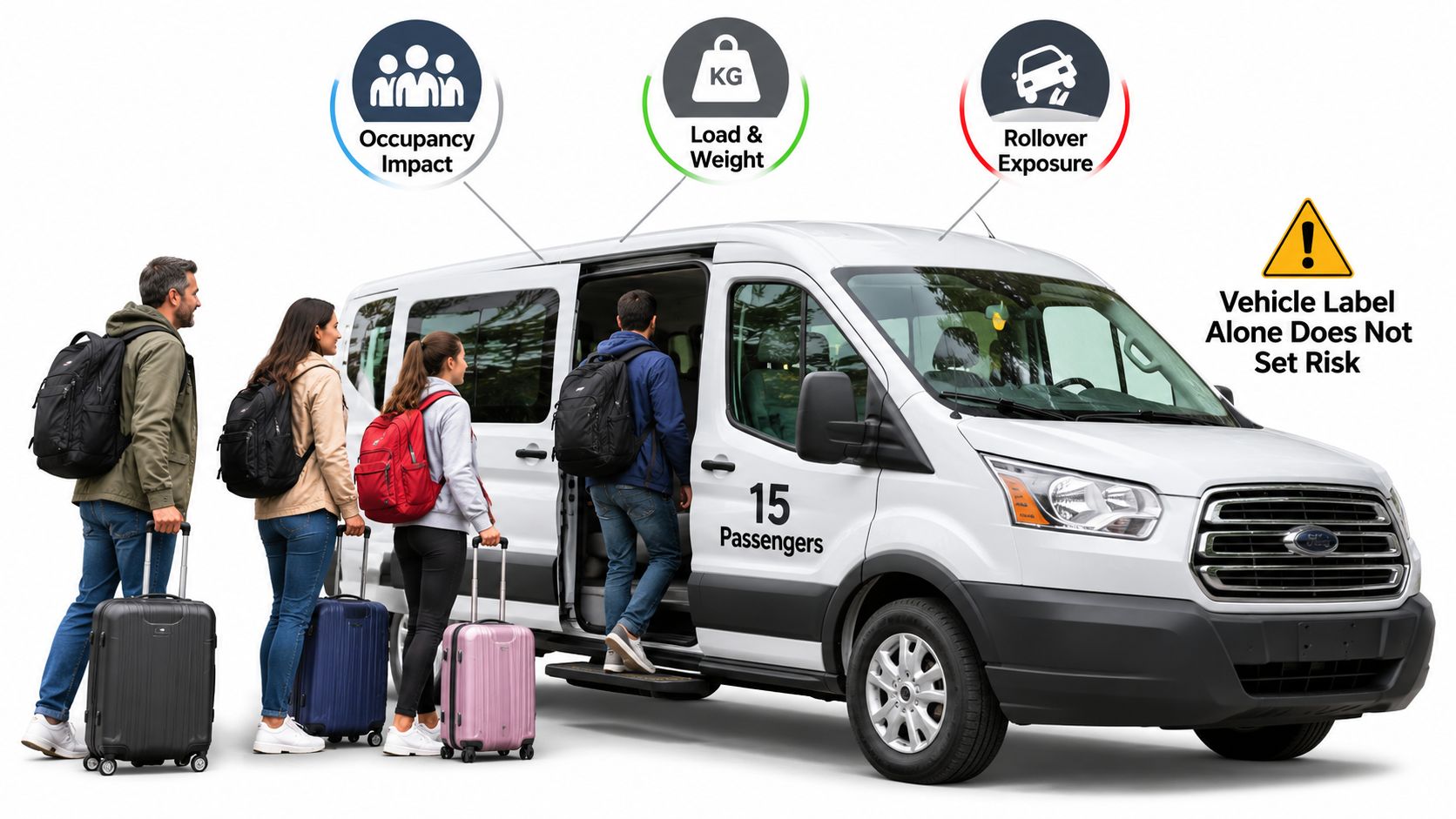
Occupancy and rollover rates in 15-passenger van crashes
| Occupants in van | Rollover rate | Comparison |
|---|---|---|
| Fewer than 5 | 12.3 rollovers per 100 crashes | Baseline group |
| More than 15 | 70.0 rollovers per 100 crashes | About six times the baseline |
| Fewer than 10 | 12.7% of crashes | Baseline for the 10-or-more comparison |
| 10 or more | 35.4% of crashes | Nearly three times the lower group |
The NHTSA analysis of 15-passenger van crashes found vehicles carrying more than 15 occupants had 70.0 rollovers per 100 crashes versus 12.3 for fewer than five occupants in single vehicle crashes. It also found vans carrying 10 or more occupants rolled in 35.4% of crashes versus 12.7% for fewer than 10, and that 57% of the 235 occupants killed in 15-passenger van rollover crashes during 2010 to 2019 were ejected.
Controls an Underwriter Can Verify
- Written maximum passenger count: Set it below rated capacity when luggage is heavy, and don't let dispatch override it for a tip.
- Passenger manifest: Record names or at least head count, child seats used, vehicle, driver, and route for every trip.
- Low and secured luggage: Keep heavy bags low, forward where the layout allows, strapped or contained, and avoid roof loading.
- Enforced seat belts: Brief passengers before departure, check belts visually, and follow written child restraint procedures for infants and small children.
- Pre-trip inspection log: Document tires, brakes, suspension, lights, and stability control warnings before the first pickup of the day.
Documented controls do two jobs. They lower crash probability and severity in real life, and they give you a defensible record at renewal and after a claim. A newer premium van with weak loading discipline isn't automatically lower risk than an older van run tightly. I would rather show an underwriter six months of inspection logs and manifests than a glossy photo of the vehicle.
Cancun and Riviera Maya Rules for Van Operators
A Mexico registered van working in Quintana Roo doesn't become compliant because it would satisfy a U.S. rule. Mexican law, airport access terms, and your client contracts govern Cancun luxury airport transfers on the ground, and those are the requirements a licensed Mexican broker must confirm for your fleet.
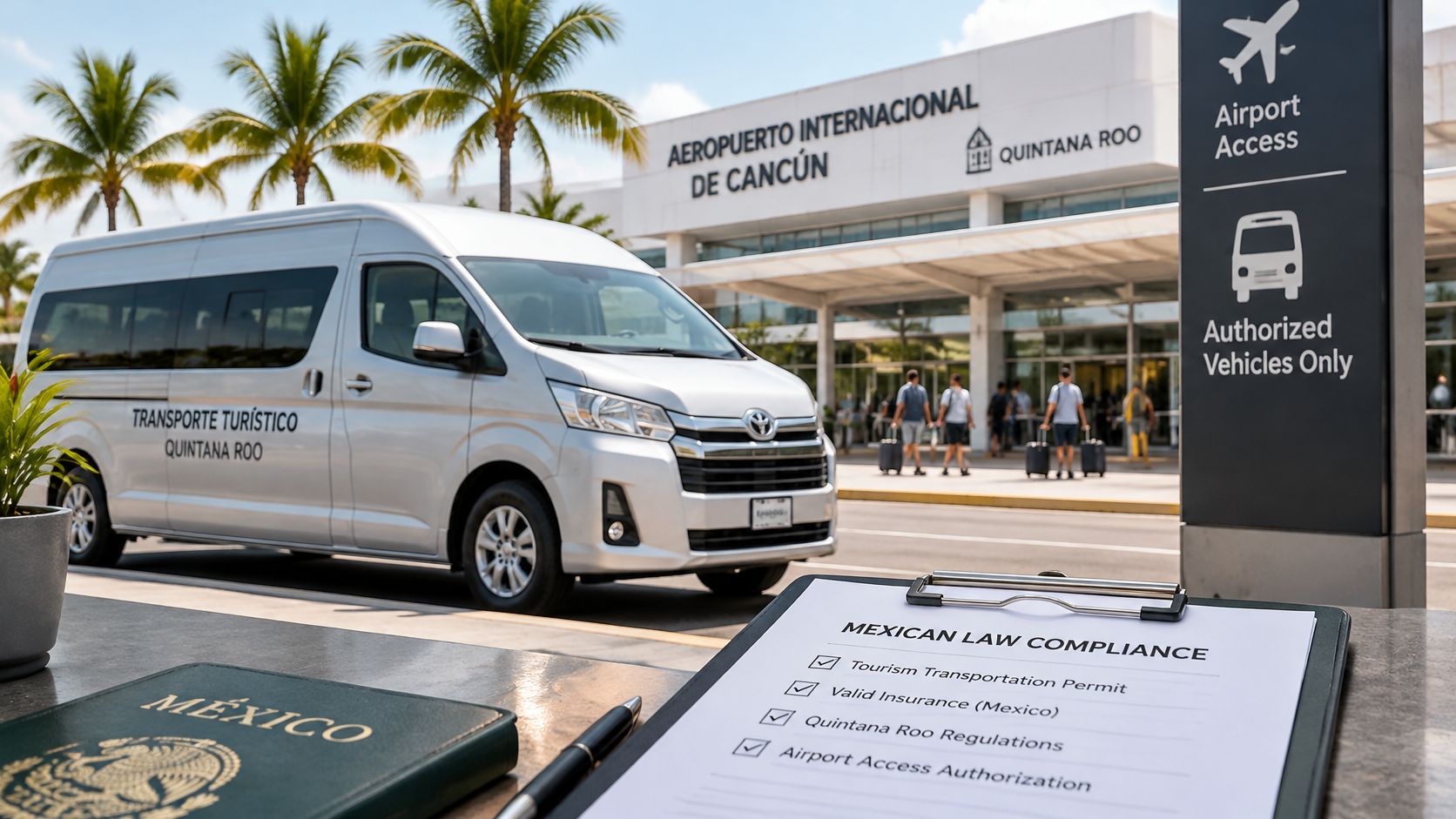
Airport access is the first commercial risk. Cancún International Airport restricts pickups to authorized transportation companies, so authorization and a clear pre-booked channel aren't marketing extras. They're how you legally reach the passenger.
The published Cancun airport taxi guidance says airport taxi service must be pre-arranged, travelers should confirm the fare and a confirmation number, and solicitation of ground transportation at the airport is illegal, with solicitors who may be unlicensed and uninsured. For a traveler, that warning is about safety and recourse. For an operator, it's about reputation, access, and not being confused with the curb offer.
Local Checks Before You Sell the Trip
- Licensing and authorization: Confirm the operator and vehicle are licensed for the pickup and service being sold.
- Territory wording: Confirm the policy covers airport runs, the Hotel Zone, Playa del Carmen, Tulum, and Isla Mujeres ferry connections if you sell them.
- Guests and luggage: Confirm passenger and luggage coverage applies on every leg, including waiting, stops, and return trips.
- Out of territory trips: Ask what happens when a guest extends a trip beyond the stated territory mid booking. Get the answer before dispatch accepts the change.
Work with a licensed Mexican insurance broker to confirm current minimums, required policy language, certificate format, and any airport or federal transport conditions for your permits. Don't let a foreign policy summary substitute for that review, and don't assume a U.S. dollar limit structure maps neatly onto a Mexican policy.
Keep the booking record consistent for every trip, confirmation number, passenger name, flight, terminal, meet and greet point, vehicle registration, driver name, and destination. That record helps the guest find the right car in a busy arrivals area. It also helps you prove who was carried, in which insured vehicle, under which booking, if a claim or complaint arrives weeks later. In unique private transportation operations, that paper trail is part of the product, not back office clutter.
Choose Coverage That Matches Your Service Type
Don't buy one generic profile and stretch it across every job. Match the coverage focus to the service that creates the exposure.
Coverage profile by service type
| Service type | Coverage focus | Limit check |
|---|---|---|
| Airport transfers, one vehicle | Hire-and-reward liability, passenger medical, luggage, Cancun territory | Limit matched to designed seating |
| Wedding or group, several vehicles | Hired and non-owned, substitute-vehicle clauses | Limit matched to largest vehicle in fleet |
| Corporate or tour, regular contract | Contractual-liability review, scheduled certificates | Limits matched to contract terms |
A single vehicle airport operator needs clean territory, passenger medical, and luggage wording that fits real arrival loads. A wedding or group operator needs substitute vehicle protection because backup cars and borrowed capacity are normal on event days. A corporate or tour operator with recurring work, including trips like a Cancun private tour with a dedicated chauffeur, needs contract review and certificates delivered on schedule, not chased the morning of departure.
List each service you sell, assign it to one profile, and send your broker the audit list with vehicle seating, drivers, territories, and sample contracts. If you're booking as a traveler, ask to see the certificate and the written paid use endorsement before you confirm. We carry traveler's insurance and all travelers are insured, and you can reach us at info@uniqueprivatetransportation.com to request the documents for your trip.
Book your next arrival with Unique Private Transportation for insured, pre-arranged private transfers, tours, and chauffeured trips across Cancun and the Riviera Maya. Send us your flight, terminal, passenger count, and luggage needs, and we'll confirm the right vehicle, meet and greet details, and coverage documents before you travel.