
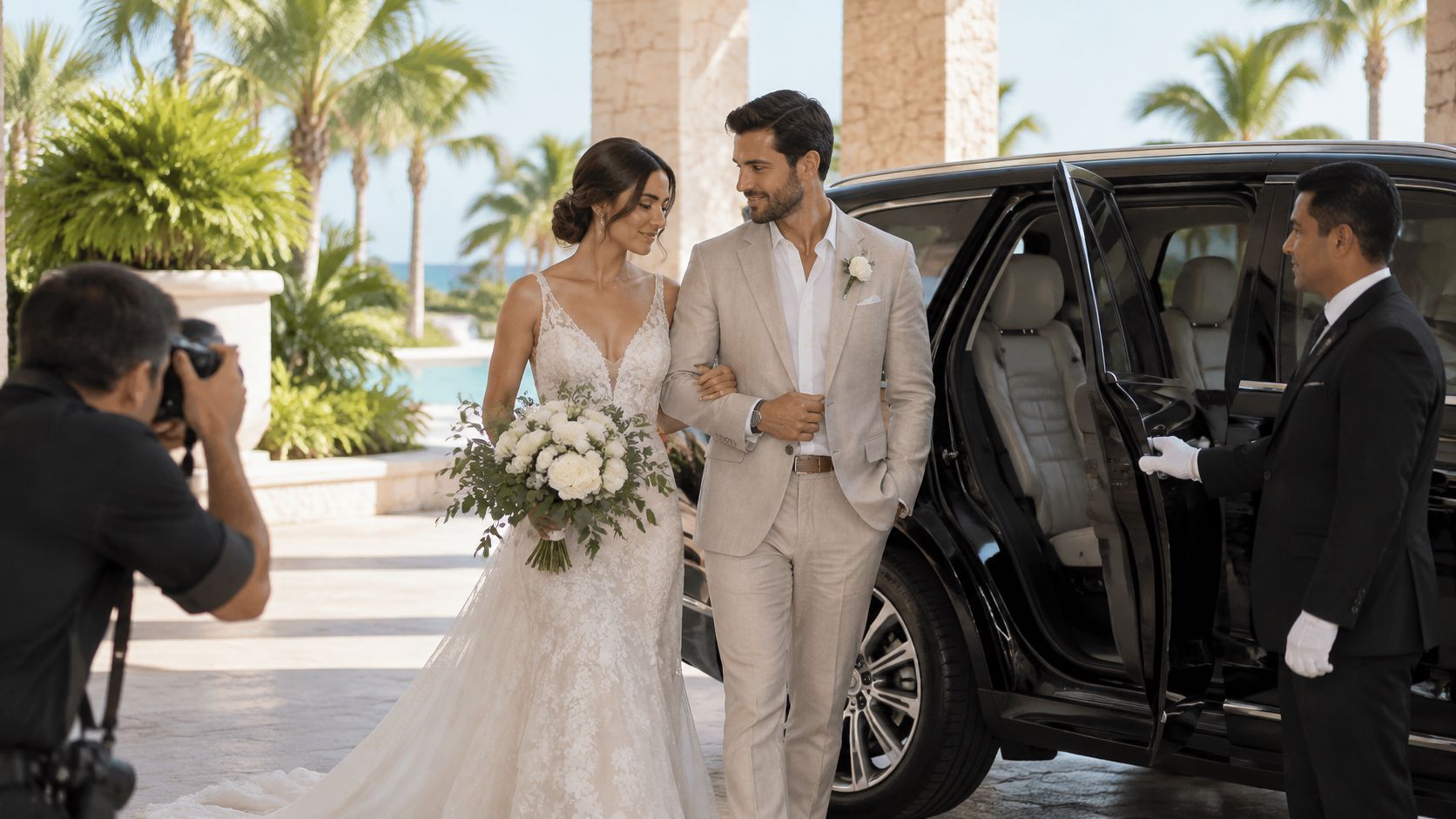
You're in the hotel lobby in a gown or a pressed suit, and the clock is louder than the music. A guest shuttle is sitting in the only pull-through. The couple's car is stuck behind it. Phones are already out. That jam is what happens when wedding transportation for bride and groom gets one generic cushion for the whole day instead of a timed plan with a named owner.
Cancun airport transportation starts the clock long before the ceremony. Private transportation Cancun airport groups use for arrival is a different job from the car that has to hit a first look, a ceremony door, and a photo hold. A Cancun car service that treats those legs as separate dispatches, with slack you can spend, keeps the gown, the photos, and the start time from colliding. I would write the ceremony time first, then subtract each leg, and put one person's name on every row.
Table of Contents
- Ceremony-Day Timing for Every Couple Transfer
- Choosing a Vehicle for the Couple and Party
- Dispatching Guests Without Blocking the Couple
- Privacy, Photos and Staging Stops on the Route
- Dress, Comfort and Access Inside the Vehicle
- Settle Ownership and Send the Plan Before Booking
Ceremony-Day Timing for Every Couple Transfer
At the hotel entrance, the couple is ready, but a guest shuttle is still loading in the only pull-through. The ceremony clock keeps moving while the couple's car waits. Prevent that queue with separate time allowances for each transfer and one named person to make mid-day adjustments.
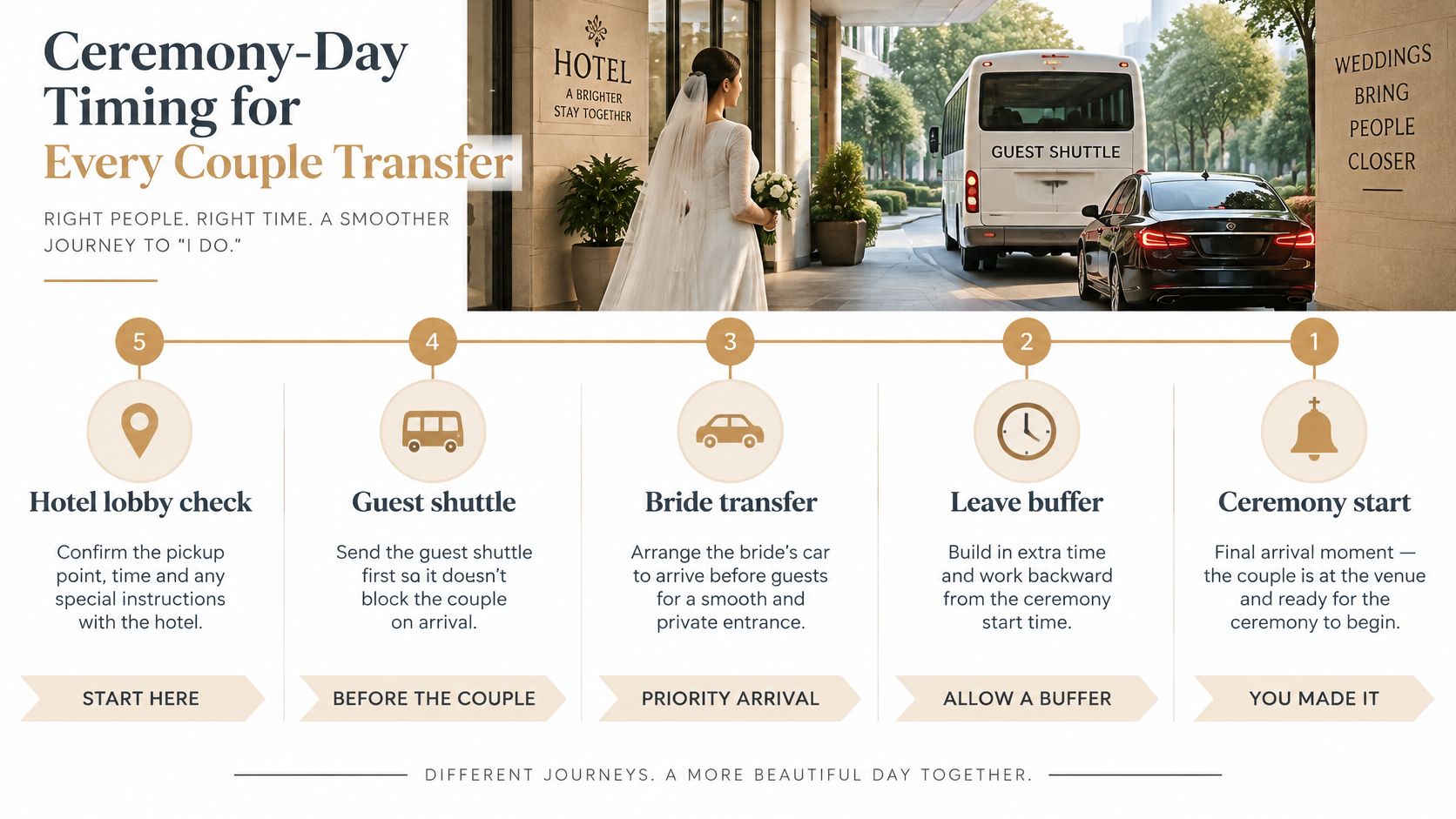
Build the schedule backward from the ceremony start. Set the hotel-to-venue road time from the actual route, confirmed with the driver, then add a separate 15-minute allowance for that drive. Do not use airport-to-hotel estimates to set a ceremony departure time. A short hotel-to-venue trip and a longer regional drive need different departure times; the confirmed route determines the difference.
| Milestone | Plan to leave or arrive | Buffer to add | Confirm with |
|---|---|---|---|
| Couple leaves hotel for first look | Set departure from the confirmed route and first-look time | 20 min for lobby exit | Photographer |
| Hotel to ceremony, Cancun | Set departure from the confirmed route and ceremony start | 15 min after confirmed road time | Driver and planner |
| Hotel to ceremony, Riviera Maya | Set departure from the confirmed route and ceremony start | 15 min after confirmed road time | Driver and venue coordinator |
| Ceremony exit to reception | Leave after the ceremony; confirm arrival timing with the venue | 30 min photo hold at arrival | Planner and photographer |
| Reception departure to hotel | Set release time after the last guest leaves | Allow for the agreed wait | Venue coordinator |
Write the rows, then name the owner
Put the schedule on one page, in this order:
- Write the ceremony start time first. Subtract the confirmed drive and add 15 minutes for that transfer.
- Set the hotel departure for the first look using the confirmed route, with 20 minutes for the lobby exit. Elevators, a dress, or a missing bouquet can use that time quickly.
- Keep the 30-minute photo hold at the arrival point separate from the drive allowance.
- Leave the reception departure flexible until the last guest has left. Confirm the release with the venue coordinator.
- Name one person to decide what changes if a transfer runs late. Put that person beside the relevant row.
A single day-wide cushion hides where time is being lost. Separate allowances for the lobby, road, photos, and return journey show which decision needs attention.
A full-day checklist can help place transport among the other wedding decisions. Use a wedding planning checklist to plan your wedding step by step, then give the driver the timed transfer details. For a direct hotel-to-venue leg without stops, describe the booking as point-to-point transportation.
Choosing a Vehicle for the Couple and Party
Does a bigger car look better in the photos, or does it only cost more and load slower? Choose from the confirmed passenger list, not from the picture you want at the door.
| Vehicle | Passengers | Best for | Trade-off to plan around |
|---|---|---|---|
| Vintage or classic car | 2 plus driver | Couple-only arrival photos | Little room for dress boxes and luggage |
| Luxury sedan | 3 | Couple plus one attendant | Limited trunk space for the dress and bags |
| Premium SUV | 6 | Couple and two or three attendants | Gown can lie flat, but interior décor needs planning |
| Full-size SUV | 7 | Full bridal party with luggage | Less privacy at the curb during photos |
| Executive van | 10 to 14 | Parents and close family | Harder to decorate and slower to load |
| Coach shuttle | 40 | Guest return trips | Not suited to couple privacy; boarding takes about 15 minutes at the curb |
Seat counts assume the dress and the luggage are not sitting in passenger seats. Subtract one seat for each bulky item. A gown box in the back seat turns a "six" into a five before anyone argues about it.
What you gain and what you give up
A vintage car wins the arrival frame and loses the practical load. There is almost no place for a dress box, a steamer, or a second pair of shoes. Use it for the couple only, after the gown is already on, and send bags in another car.
A luxury sedan is quiet and private. The trunk is the limit. A long train plus two attendant bags will not share that space cleanly, so this car fits a couple and one person, not a party.
A premium SUV is the working choice when two or three attendants ride with the couple. Six seats and a flat load floor let the gown lie down. Interior flowers still have to stay off the driver's mirror and out of the passenger's view of the road. Ribbon and florals can sit on door handles or the bonnet if they do not cover glass.
A full-size SUV carries the bridal party and the bags. The curb gets crowded, and the couple is harder to isolate for a clean frame. An executive van is for parents and close family, not for a decorated couple entrance, because it loads slowly and fights décor. A coach belongs on guest returns. It is the wrong cabin for a private arrival.
If you are choosing between a sedan and an SUV, count hanging length and people, then pick the smaller car that still clears the train. Styling never overrides the manifest.
Dispatching Guests Without Blocking the Couple
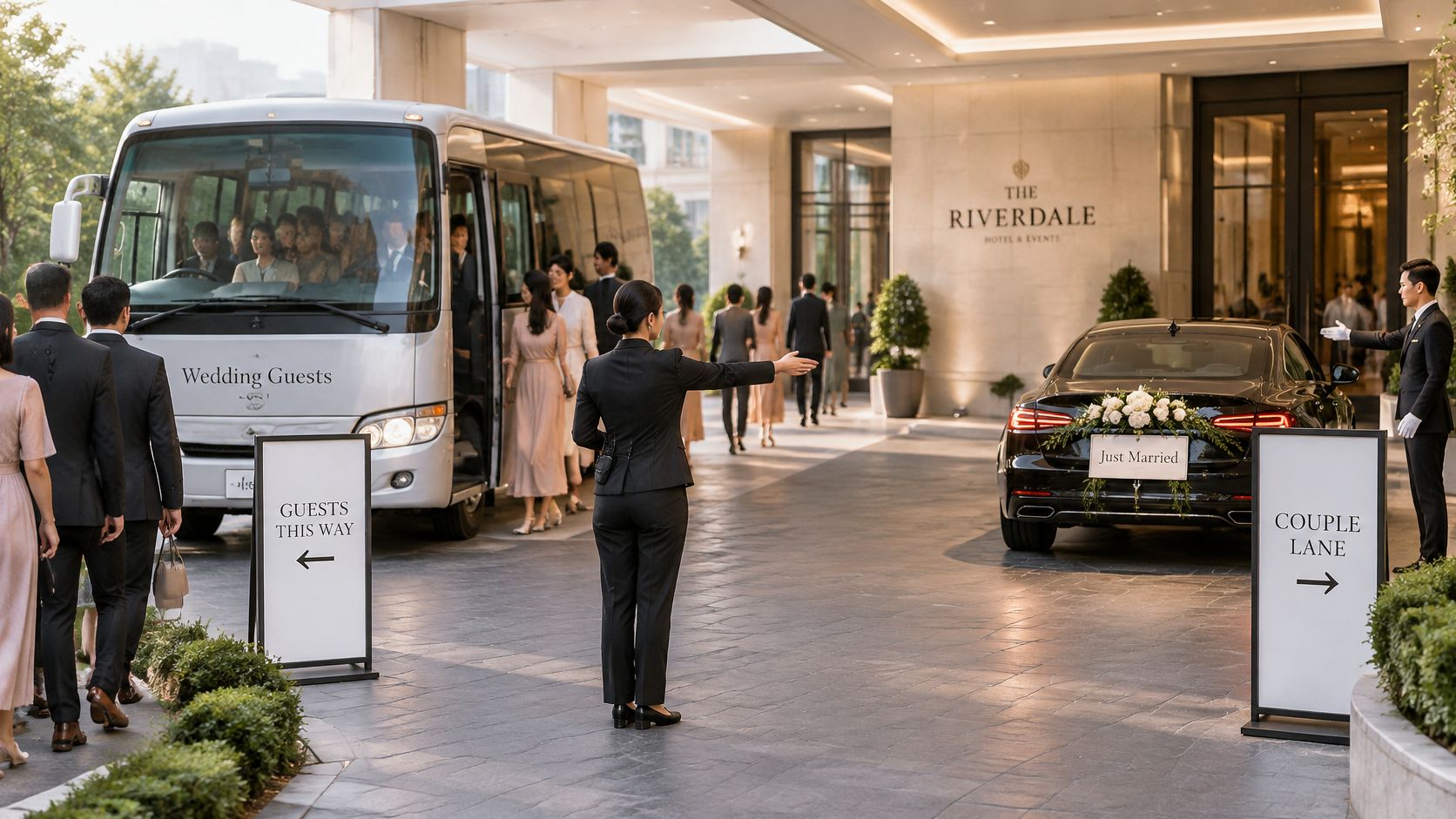
A guest shuttle occupies the only loading zone just as the couple's car arrives. The bride cannot step out, the photographer is behind the bus, and moving the shuttle puts the ceremony start at risk. Prevent that bottleneck by dispatching guest vehicles and the couple's car as separate movements, with one person responsible for mid-day changes.
Sort, count, then sequence
Group the manifest by movement. List the bride and attendants, groom and attendants, immediate family, general guests, and anyone who needs extra time or help boarding. Assign each group a vehicle and pickup point so a late guest does not hold the couple's departure.
Count confirmed passengers and usable seats. Leave room for people and their belongings instead of planning to the vehicle's stated capacity. The actual passenger count, luggage, and boarding needs determine whether a vehicle can load at the curb without delay.
Schedule the couple separately from guest arrivals. Give the couple's car its own departure and arrival time. Stagger guest vehicles so they do not converge on the same curb at once. The ceremony start is fixed; guest arrivals can be managed around it.
Allow a boarding window for each vehicle. Count the passengers who need to board, then set a realistic curb window based on the vehicle and the group. If the hotel only allows a short stop, use smaller, staggered arrivals rather than expecting a full shuttle to load instantly.
Assign a decision owner and confirm the operating details. One named coordinator should handle changes to pickup order, curb access, or a delayed vehicle. Confirm the loading zone, driver contact, vehicle identification, accessibility needs, and hotel or venue parking rules in writing. Track scheduled and actual pickup, departure, and arrival times so recurring delays, such as a long walk from the lot, can be addressed in the plan.
A short drive and a single entrance can make dispatching more difficult, not less. The same curb discipline applies to resort drives in Mexico: keep the couple's arrival separate from guest loading, and give each vehicle a clear release time. For routing between hotels and venues, use a written Cancun wedding transportation plan. Couples who find wedding venues near Taos can apply the same basic principle: assign the loading space and departure order before vehicles arrive.
Privacy, Photos and Staging Stops on the Route
How do you keep the couple off other guests' camera rolls when the car stops? You pick the stop before the day, and you tell the driver where to wait.
Use a quiet pull-off or the hotel's private entrance, not the main drive where shuttles stack. The photographer should be able to reach the car in under a minute from that spot. If the walk is longer, the couple stands in public while you hunt for a frame, and the next leg slips.
Hold the cabin and the gap
Ask the driver to keep a set distance from guest vehicles, both on the road and at the curb. A couple's car tucked behind a coach is not private, even with tinted glass. Wipe the cabin between legs so a water bottle and a garment bag are not in the frame. Do not leave the couple waiting in a public lobby between movements. The private entrance is the holding area.
Plan one car-based photo moment per leg, and write where the car waits during that shoot. A second unplanned stop is how you miss the ceremony door. Say the couple wants a frame on the hotel drive before leaving for the rite. The car pulls to the side entrance, the photographer is already there, and the driver has a written release minute. That is the whole stop.
Name the terminal, then book the arrival
Cancun luxury airport transfers fail in a boring way: the driver and the bridal party wait in different buildings. AirportsData notes that Cancún International Airport uses four passenger terminals, linked by a free shuttle that runs daily from 07:00 to 22:00 at intervals of about 20 to 30 minutes, with wheelchair ramps. The meeting point has to name the terminal and the arrival hall.
Prebook the party's arrival before landing. Airport Cancun guidance puts prebooked private transfers at rates starting at $35 one way for a vehicle carrying up to eight passengers, while airport taxis commonly run about $65 to $120 per car by zone, with payment at an airport counter and a printed ticket before boarding. Luxury transportation arranged in advance is what gets a group with garment bags out of that counter line.
Ask the photographer three questions before the day:
- How long after the car stops can you reach the couple, and where should the car wait during the shoot?
- Which single car-based photo moment do you need on each leg?
- How long will you hold the car for key images before the next leg must move?
Write the answers next to the release time. If the hold is longer than the slack on that leg, cut the photo, not the ceremony.
Dress, Comfort and Access Inside the Vehicle
A fitted dress with a long train can turn a tight sedan into a delay. The train may catch on the door sill, and there may be nowhere to hang the gown. Check the cabin and the boarding point before choosing a vehicle.
For each passenger who needs accessible transport, confirm whether they can remain secured in their mobility device, which seats will be unavailable, and whether the lift can operate on the actual approach surface. Gravel, sand, grass, steep curbs, and uneven resort entrances can affect boarding. A low-step premium SUV is not a substitute for a vehicle designed for wheelchair access. If one vehicle cannot safely carry the party, split the trip.
| Check | What to confirm | Why it matters | Backup if it fails |
|---|---|---|---|
| Dress and train | Hanger or flat box space, door clearance for the train | Prevents a snagged or crushed gown at the curb | Second vehicle with flat storage |
| Step height and door width | Step height at each door and the entrance surface | Reduces the risk of a stumble while boarding | Lower-step SUV or ramp |
| Mobility device securement | Anchor points and seats lost when the device is onboard | Confirms the vehicle can secure the device and carry the group | Separate accessible transfer |
| Lift on the actual surface | Whether the lift can operate on gravel, sand, and steep curbs | A lift may not work at the resort entrance | Drop-off nearer a usable entrance |
| Cabin temperature | When to start cooling the cabin before boarding | Helps keep passengers comfortable in formalwear | Start the cabin early and have water ready |
Walk the checks in order
Dress and veil first. Confirm there is room for a hanger or flat box, then check that the train clears the door. If the opening is tight, arrange a second vehicle with flat storage before the day.
Then check the step. Compare the height at each door with the actual boarding surface. A high sill, sand, or a decorative threshold can make entry difficult. Set up a lower-step vehicle or ramp in advance, rather than relying on a last-minute call.
Count seats after securement. Anchor points alone do not confirm that the vehicle can carry everyone. Count the available passenger seats with the mobility device onboard. If the party does not fit, arrange a separate accessible transfer.
Check the lift where it will be used. Confirm it can deploy on the approach surface. If it cannot, agree on a closer usable entrance with the venue so the guest does not have to board on an unsuitable surface.
Start cooling the cabin before boarding. Give the vehicle time to cool, and have water ready. A hot cabin can make formalwear uncomfortable before the next part of the schedule.
Ask guests privately what access they need, then confirm the vehicle model, lift dimensions, loading surfaces, and boarding time with the transport provider. Coordinate the accessible entrance with the venue and name the backup vehicle in the plan. “Accessible” depends on the vehicle, the route, and the place where passengers board.
Settle Ownership and Send the Plan Before Booking
Controlled slack beats a faster convoy. The best plan is the one with clear authority to change it when photos, weather, traffic, and a reception that will not end all hit the same afternoon.
Polka Dot Wedding flags the collision: photography, weather, traffic, venue delays, and an uncertain reception end. Settle roadworks, public holidays, weather, comfort breaks, and a late-running reception before you book. The command protocol is simple, and skipping a step is how three vendors issue three different leave times.
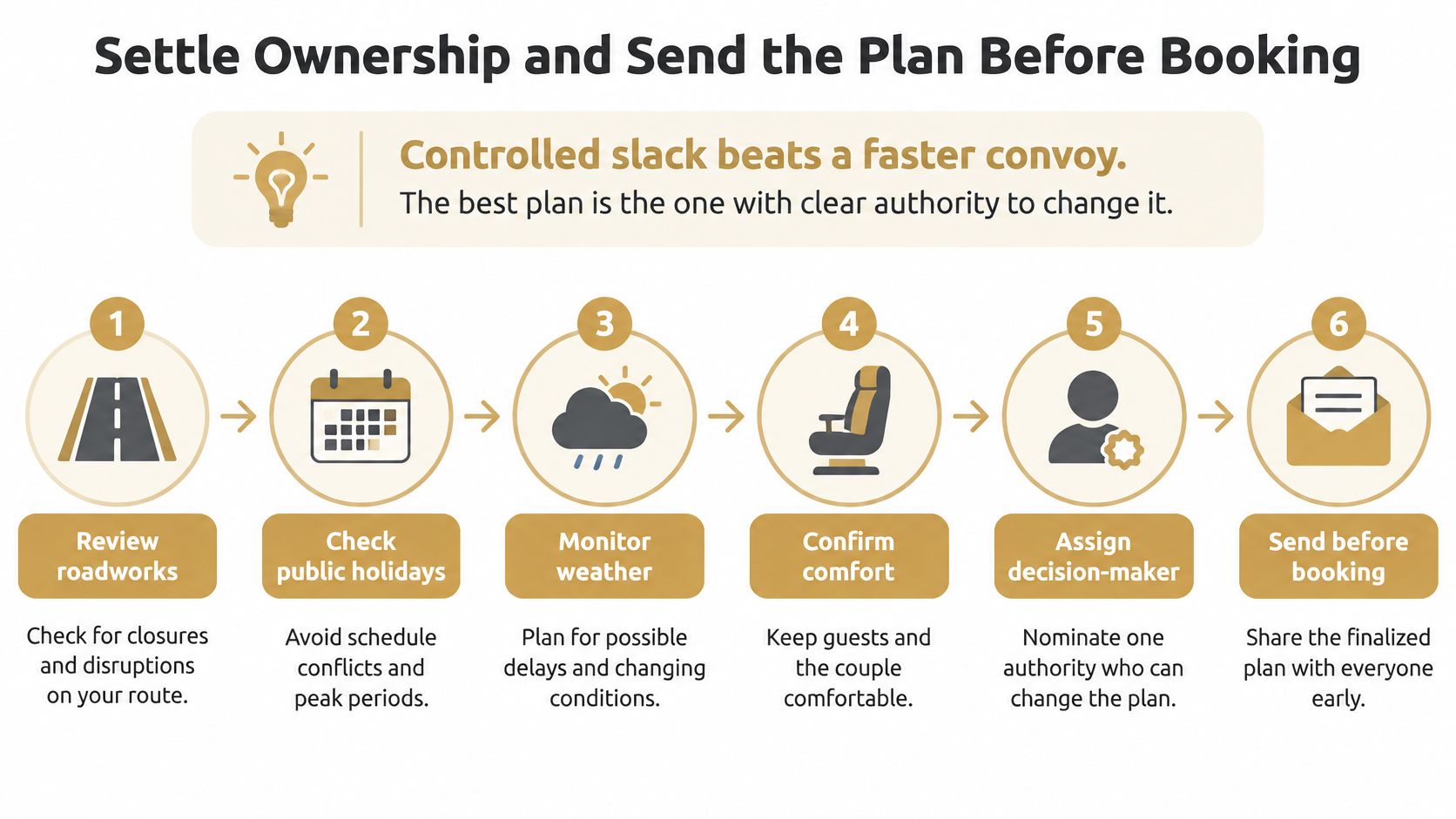
- Name one planner as the single point of contact. Drivers, the photographer, and the venue call that person. Nobody else releases a car.
- Keep one shared itinerary with a version number. If the file is not numbered, someone is still working from yesterday's PDF.
- Set an explicit release time for each leg. "After photos" is not a time. A minute is.
- Decide how long the chauffeur waits for photos. Keep it a short hold for the key images, written next to that leg, not a standing order to wait indefinitely.
- Set a weather trigger that repositions the vehicle: which entrance, who calls it, and how many minutes of notice the driver gets.
- Confirm each guest's hotel on the late-night return before the reception starts. A driver cannot guess a resort entrance at midnight.
Apply separate cushions to the couple's arrival, the photo session, the ceremony exit, and the reception departure. Do not paste one generic 15-minute pad across the day and call it covered. Destination guests often don't know the roads, the language, or which resort gate is theirs, so the written release matters more than a fast convoy.
What you send before anyone is booked
Send three things, and do not book the transfers until they are in the same email:
- Times: Arrival or departure minute for each leg, including the photo hold and the open reception release.
- People: The passenger list, with mobility needs and garment bags marked, so seat counts are already reduced.
- Backup: The named backup vehicle and a working contact, not a company name with no phone.
Unique private transportation through a dedicated chauffeur covers airport transfers, weddings, and special occasions, and round-trip service means the ride back from the reception is already on the booking instead of a scramble at midnight. Send the manifest, the timing table, and the accessibility audit to info@uniqueprivatetransportation.com. Ask for the first written confirmation before you pay: the loading zone and the driver contact. If those two lines are missing, the plan is not booked yet. For how the hours and vehicle count move the invoice, read the notes on wedding transportation cost and match the booking window to the release times, not to a guess.
The person who can change the plan should be the only person the driver answers. Speed without that name is just a convoy that cannot turn around.
Unique Private Transportation runs chauffeured wedding-day cars and private airport transfers across Cancun and the Riviera Maya, with timed pickups for the couple and coordinated returns after the reception. If you want the loading zone, the driver contact, and the backup vehicle in writing before you land, visit Unique Private Transportation and send your ceremony time with the passenger list.