
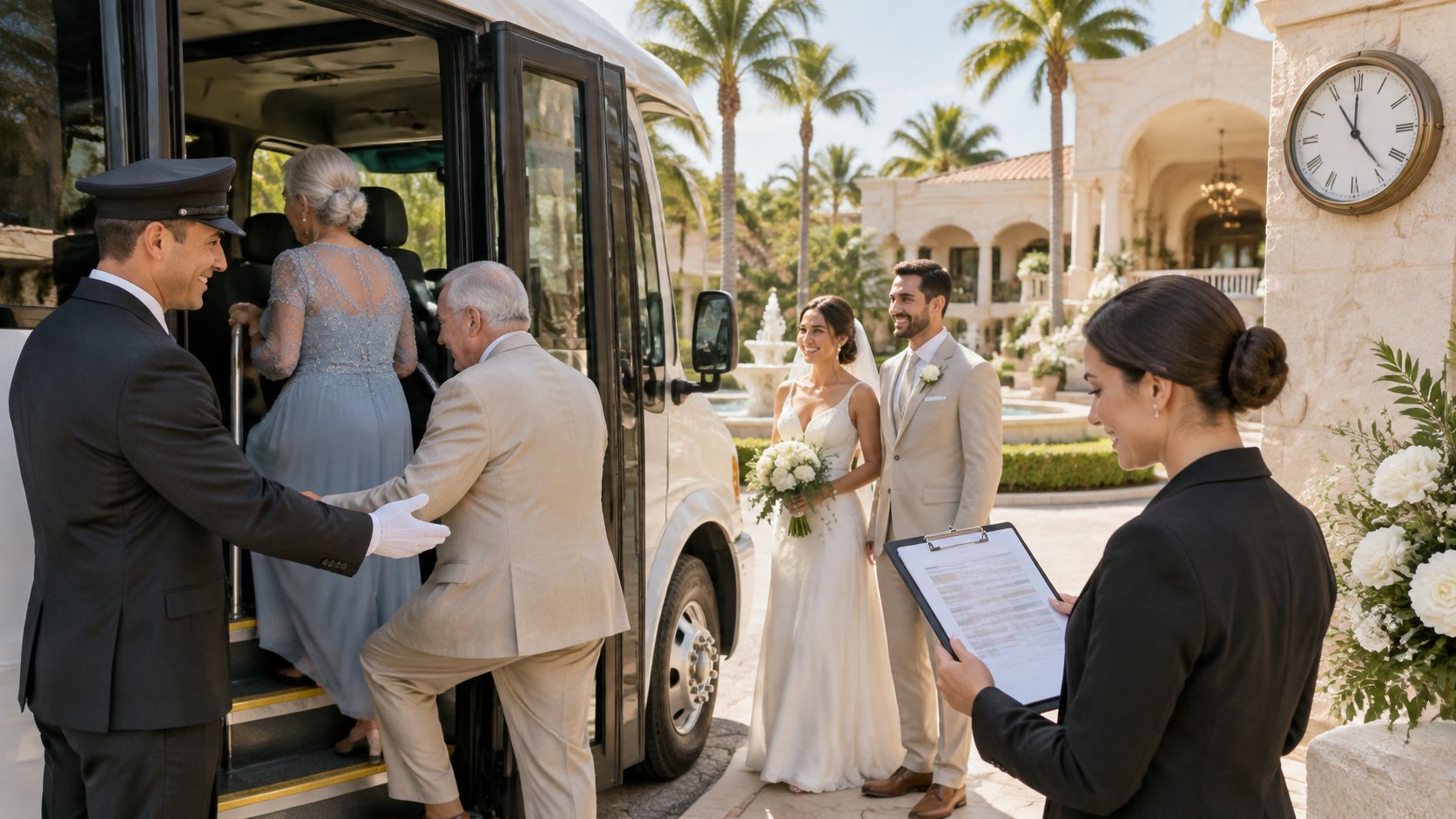
The shuttle is idling outside your Cancun resort, a guest is still in the lobby, and the ceremony starts in 20 minutes. The photographer never received the pickup schedule. You're deciding whether to hold the vehicle, but nobody has agreed who can make that call.
Table of Contents
- Why Guest Transportation Runs on a Timetable
- Timing Benchmarks Every Wedding Transport Plan Starts From
- Who Owns Each Transport Duty and What Each Role Pays
- How to Build a Pickup Schedule Backward from the Ceremony
- Who Pays for Airport and Destination Transfers
- Seating Order and Boarding for Guests Who Need Extra Care
- Handling Delays, Missed Pickups and Late Guests
- Confirm the Transport Plan Before the Wedding Morning
Why Guest Transportation Runs on a Timetable
That's a planning scenario, not a chauffeur problem. The guest thinks the shuttle can wait, the driver has another movement scheduled, and the photographer needs the wedding party somewhere else.
Wedding transportation etiquette is a timetable and a money conversation, not just a decision to provide a nice ride. A wedding shuttle works like a train connection. Hold an earlier departure without checking what follows, and you can delay everyone behind it.
Hosts decide which routes to cover. Guests need understandable instructions, chauffeurs need precise dispatch times, and vendors need the same version of the day's schedule.
Practical rule: Publish a fixed departure time, calculate the whole passenger movement, and settle who pays before invitations go out.

Make the decisions before guests need them
A useful plan identifies the arrival deadline, assigns responsibility, and works backward to boarding. It also tells guests which journeys they're paying for, accommodates passengers who need extra care, and defines what happens when someone misses a pickup.
That applies whether you're arranging a group shuttle or luxury transportation for the couple. A premium vehicle doesn't compensate for an unclear meeting point.
Put the timetable in writing and share it early. The courteous plan isn't the one that promises unlimited flexibility. It's the one guests and vendors can realistically follow.
Timing Benchmarks Every Wedding Transport Plan Starts From
A shuttle booked for a short drive can still need much of an hour before it is ready for another pickup. Start with when guests must be seated, then work backward through boarding, travel, unloading, and the vehicle's return. Treat the figures below as planning assumptions, not industry standards. Confirm them against the route, venue access, and provider's operating plan.
| Planning allowance | Starting assumption | Check before setting the timetable |
|---|---|---|
| Guest arrival before the ceremony or reception | 15 to 20 minutes early | Allow time to unload, walk to the event space, and settle |
| Traffic and passenger-gathering buffer | 10 to 20 minutes | Adjust for pickup locations, traffic, and how guests reach the vehicle |
| Full shuttle cycle for a 15-minute route | 45 to 60 minutes | Ask whether the estimate includes loading, travel, unloading, return, and delays |
| Hosted transport for all guests | Optional host policy, not a distance rule | Weigh guest access, route familiarity, parking, and the budget |
| Pickup instructions | One fixed time and meeting point | Publish clear directions on the invitation or wedding website |
Read the figures as planning allowances
An early arrival means guests are ready to join the event, not just pulling into the driveway. Check where the vehicle can stop, how far guests must walk, and when the venue opens its doors. A short ride can still require more lead time if access is restricted.
The gathering buffer covers the time before the vehicle leaves, too. Guests may need to collect bags, find relatives, or walk from separate buildings. Ask the provider whether its quoted schedule already includes that time, so it is not added twice.
For a 15-minute route, the 45-to-60-minute cycle is an initial allowance for the vehicle's full assignment, not a claim that every trip takes that long. Have the provider map each leg, including the return and any required reset before collecting the next group. A timetable works like a train schedule: one late turnaround can hold up the next departure.
Match the service to the guest journey
A gap between ceremony and reception can make hosted transport useful, but there is no fixed distance at which every host should provide it. Offering rides to everyone is a policy choice. Consider whether guests can manage the route, whether roads and parking are unfamiliar, and whether the cost fits the hosts' budget.
For international arrivals, give guests the exact resort entrance or lobby, rather than only the property name. Leave time for wayfinding and language differences. Confirm a sheltered, comfortable place for early arrivals to wait.
Use the upper end of each relevant allowance for an initial schedule, then have the provider validate the actual route and cycle. Keep arrival time distinct from boarding time, and check that the vehicle can complete every assigned movement before setting departures.
Who Owns Each Transport Duty and What Each Role Pays
Organized transportation isn't an unusual extra. The Knot's wedding transportation guidance cites a Real Weddings Study of nearly 12,000 couples, with 35% booking transportation, and recommends arranging vehicles three to six months before the wedding once locations are established.
The same guidance describes the historical family payment split. Treat that convention as context, not an invoice addressed to a relative who hasn't agreed to pay.
| Role | Owns | Deadline | Money norm |
|---|---|---|---|
| Couple, as hosts | Routes, vehicle count, seating plan, written policy | Book within the lead time above | Pays for promised routes and states exclusions |
| Bride's and groom's families | Traditionally, bride's family covers organized transport and parking; groom's family covers groom and best man | Agree before invitations go out | Modern splits vary; record the chosen arrangement |
| Guests | Attend the printed pickup point, use assigned shared rides, disclose needs privately | Share requirements at RSVP | Pay their own transfers unless hosts promise otherwise |
| Chauffeur | Punctual boarding, agreed waiting, flight tracking where contracted | Operational sign-off before service | Hosts check gratuity terms rather than leaving guests to guess |
| Vendor coordinator | Chauffeur communication, manifest, timeline changes | Final manifest ready for confirmation | Include the role in the couple's contract; don't assign guests a tipping obligation |
Separate the payer from the decision-maker
A parent funding the service doesn't automatically become the dispatch contact. Name the person who can authorize waiting, overtime, or a replacement vehicle, and give that person the relevant contract details.
For budgeting, distinguish vehicle charges from coordination and gratuity using a wedding transportation cost breakdown. Those are different responsibilities even when they appear on the same invoice.
For chauffeurs, Coventry Transportation's etiquette guidance describes 15 to 20 percent as customary tipping in US practice. Check whether gratuity is already included, and don't automatically apply a US convention to a Cancun contract.
The final confirmation should collect each role's sign-off. It shouldn't reopen the question of who was supposed to organize the service.
How to Build a Pickup Schedule Backward from the Ceremony
Start with when guests must be ready at the venue, not the driving estimate on a map. The Knot's questions for wedding transportation companies support backward scheduling, including positioning the vehicle about 15 minutes before departure.
Turn the arrival deadline into dispatch instructions
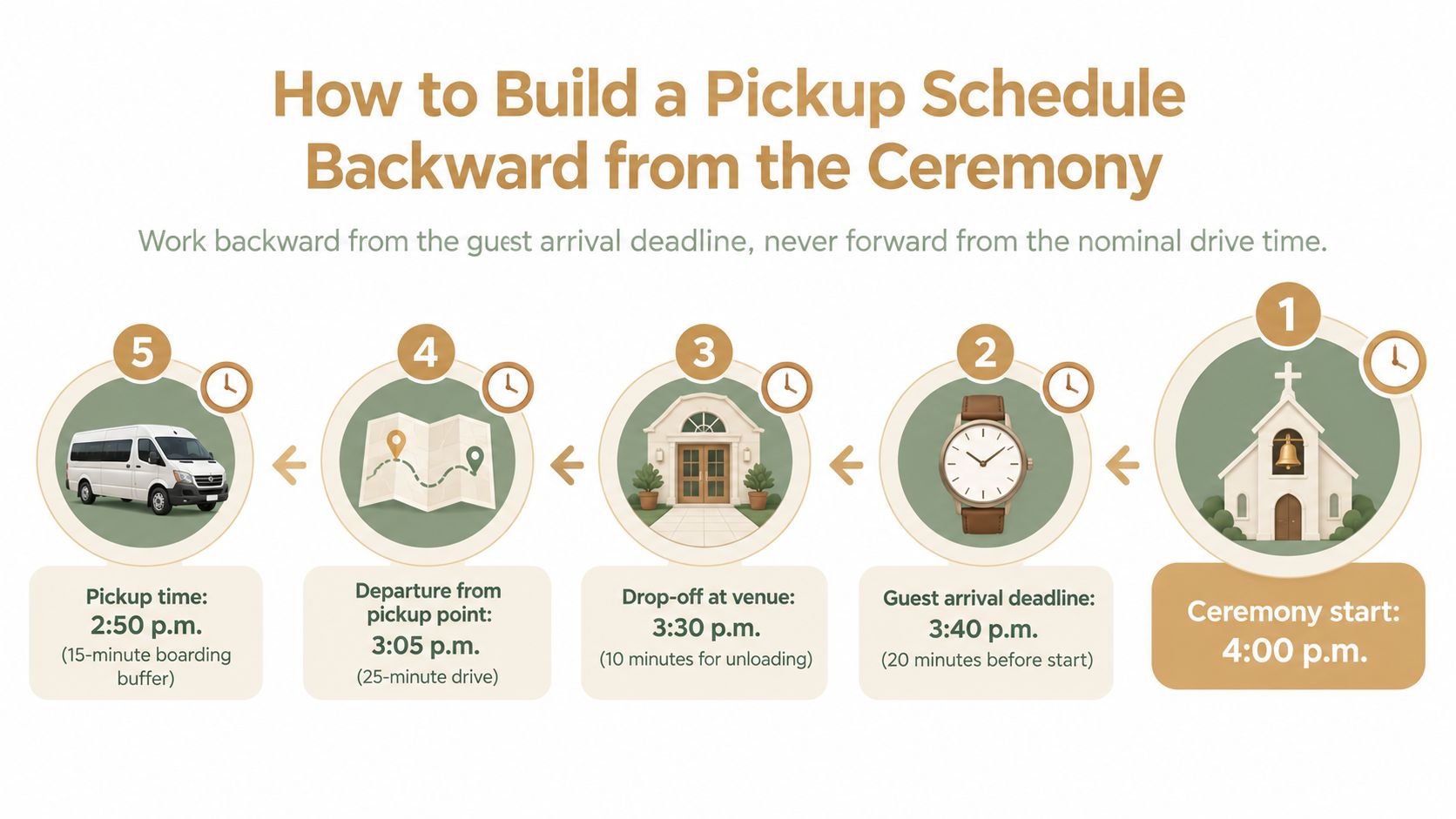
Fix the ceremony start. Use the printed event time, not an informal expectation that proceedings will begin later. For the worked example, the ceremony begins at 4:00 p.m.
Set the guest arrival window at 3:40 to 3:45 p.m., following the earlier arrival benchmark. Define arrival as guests unloaded and able to reach their seats, rather than the chauffeur reaching the gate.
Account for the complete movement. On the example's nominal 15-minute route, reserve time for boarding, variable road conditions, unloading, and venue access. If the vehicle returns for another group, calculate that return separately.
A conservative example starts boarding near 2:50 p.m. for the earlier arrival deadline. That's an illustrative schedule to validate with the provider, not a universal pickup rule; a 3:25 p.m. departure leaves no allowance beyond the nominal drive.
Separate boarding from wheels moving. Label when passengers must assemble and when the chauffeur will depart. Have the vehicle in position for the advance boarding period rather than arriving as guests expect to leave.
Assign a named coordinator to communicate with the chauffeur. Publish what late passengers should do, so the driver isn't negotiating the timetable through an open window.
Allocate passengers before staggering departures. Match each group to actual seat capacity and luggage space. Don't assume everyone can board simultaneously or move between vehicles without affecting assignments.
Apply the same method to airport arrivals, rehearsal dinners, and ferry connections. Include baggage handling, curbside loading, and the walk between the meeting point and vehicle.
The visual below illustrates the backward-planning method. Its road allowance includes contingency rather than assuming the nominal journey will always be achievable.
Read the schedule like a guest
Use your Cancun wedding transportation plan to create a guest-facing timetable and a separate operational call sheet. Guests need their location, boarding instruction, departure deadline, and contact; the coordinator needs every vehicle movement.
Read the guest version aloud. If you have to explain whether “pickup” means assemble, board, or depart, rewrite the label before publishing it.
A timetable should answer questions without requiring the couple to answer their phones.
Who Pays for Airport and Destination Transfers
A guest books a flight after seeing “transportation provided,” then learns the airport ride is not included. Prevent that surprise by stating who pays for each journey before guests book. The etiquette obligation is disclosure, whether the hosts cover the fare or not.
A destination wedding guest-etiquette guide reports that about 15% of couples cover airport-to-hotel transportation. The figure describes how often couples cover that route. It does not tell you what your guests should expect, so publish your own policy plainly.
Divide the policy by journey
| Route | Payment options | What to publish |
|---|---|---|
| Airport-to-hotel transfer | Host-paid, guest-paid, shared, private, or optional | Current estimated prices for any guest-paid ride, before flights are booked |
| Hotel-to-ceremony shuttle | Host-paid, shared, or privately arranged | Departure time and exact meeting point |
| Late-night return | Host-paid, guest-paid, optional, shared, or private | Who pays, cancellation terms, and how late departures are handled |
Payment and vehicle type are separate decisions. A shared ride may be host-paid or guest-paid. A private ride may be covered by the hosts or offered as a paid option.
For Cancun airport transportation, specify whether arrival service, departure service, both, or neither are included. An included ceremony shuttle does not imply that an airport ride is covered.
Make the cost conversation specific
The Wedding Report's 2025 estimate and Peter Norman's US Wedding Cost Report concern US wedding budgets and transportation costs, not Cancun transfer quotes. They do not provide a useful fare for a particular destination wedding. Get current quotes from providers serving the relevant airport and hotels.
Before guests commit to travel, publish:
- Covered journeys. Name each route and event the hosts will pay for.
- Guest-paid journeys. Give current estimates and state whether the charge is per passenger or per vehicle.
- Booking choices. Explain shared and private options, including any price difference, without pressuring guests to use a preferred provider.
- Changes and delays. State the cancellation, reimbursement, missed-flight, and waiting arrangements.
A guest comparing Cancun luxury airport transfers with a shared ride needs to know what each option includes and what it costs. List every airport and hotel transfer as host-paid, guest-paid, or optional with a price, before guests book flights. That gives guests a clear basis for deciding whether to book a ride, share one, or make other arrangements.
Seating Order and Boarding for Guests Who Need Extra Care
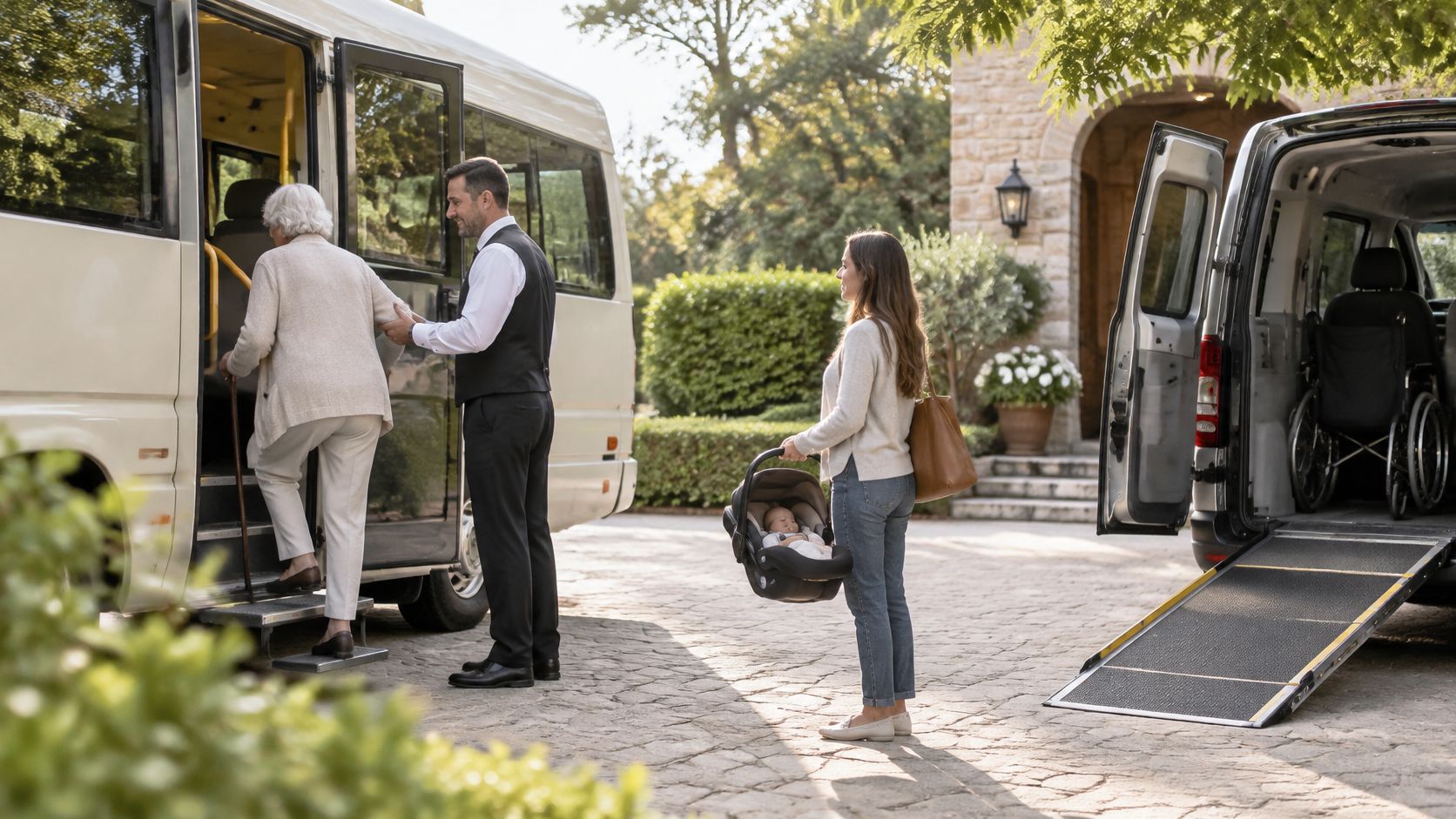
Board guests with mobility needs and older relatives first, then families with infants, followed by the wedding party, immediate family, and remaining passengers. Use that as a practical starting order, not a rigid hierarchy that overrides someone's preferred assistance.
Ask before helping. Have requested child seats fitted and checked before pickup, and allocate baggage space before assigning luggage-heavy passengers to a vehicle.
Share rides without shifting the burden
PCMA's event sustainability reporting identifies audience travel as 39% of total event emissions and recommends consolidating passenger movements and right-sizing vehicles. That's event-industry context, not a measurement of your wedding.
Shared transport is a sensible default for routine group movements. It stops being considerate when a guest must endure an inaccessible vehicle or unsuitable departure just to preserve that default.
- Offer private alternatives. Include wheelchair users, families with infants, guests with medical needs, very late departures, and conflicting schedules.
- Collect requirements privately. Ask about accessibility, child seats, luggage, language, and mobility through RSVP communication, not a public group thread.
- Verify the actual vehicle. Confirm the required boarding method, passenger space, and equipment rather than relying on a broad vehicle category.
- Publish contingencies. Tell guests whom to contact if their assigned ride no longer meets their needs.
Sustainability is a design constraint, not a reason to transfer inconvenience onto vulnerable guests.
Protect dignity over appearances
A smaller, properly matched vehicle can be more courteous than an overloaded shuttle described as green. Likewise, luxury transportation should mean suitable space and assistance, not just a premium badge.
If the couple wants the traditional last arrival at the ceremony, reserve a separate movement only when the timetable supports it. Don't make guests wait without information to preserve an entrance.
Handling Delays, Missed Pickups and Late Guests
A guest's flight lands late, the shuttle is ready, and the ceremony timetable is already moving. Decide in advance who can change dispatch, how long a driver waits, and who tells the guest what happens next. Treat each ride like a train connection: one delay can affect later movements unless someone has authority to adjust the plan.
At Cancún International Airport, ordinary taxis cannot collect arriving passengers directly, and only authorized transportation companies may do so, according to Cancún International Airport's FAQ. Book an authorized provider and confirm the terminal and exact meeting point for each flight. The airport is not one universal pickup location.
| Situation | Likely cause | Response | Who acts |
|---|---|---|---|
| Flight lands late | Airline delay or schedule change | Track the arrival and adjust dispatch under the agreed policy | Chauffeur with coordinator |
| Guest misses the shuttle | Late arrival at the hotel lobby | Hold within the agreed window, then depart and share the next option | Coordinator |
| Ceremony runs late | Earlier timeline has slipped | Confirm revised dispatch; avoid rushing the departure | Coordinator and venue contact |
| Traffic on the route | Congestion or road works | Use the scheduled buffer and reroute where appropriate | Chauffeur |
| Vehicle breakdown or no-show | Equipment or provider failure | Activate the named backup and communicate revised timing | Provider and couple's authorized contact |
| Guest is not on the manifest | Late addition | Add the guest before final confirmation and verify capacity | Coordinator |
Decide who can authorize waiting
Set a short hold window with the provider before the event. For example, five to ten minutes can be a planning choice, if the provider agrees. The coordinator should know when waiting would put another trip at risk and be authorized to dispatch without the missing passenger.
If the ceremony runs late, issue a revised instruction rather than hurrying guests into the next transfer. Confirm the destination is ready, and tell the provider if the delay may affect contracted hours.
Set clear limits for flight tracking
Flight tracking helps the provider adjust dispatch when an arrival changes. It does not automatically include unlimited waiting after landing. Before booking, clarify how the provider handles baggage delays, a guest who cannot be reached, or a terminal change.
When comparing a Cancun car service, ask who contacts a missing guest and who can authorize a replacement ride. Search results alone will not establish those responsibilities.
Put the backup vehicle or provider in writing, including availability, authorization, and activation terms. A backup contact helps only if the coordinator knows exactly when and how to use it.
Confirm the Transport Plan Before the Wedding Morning
Use the booking lead time already established to collect decisions, then make the final checks operational rather than ceremonial. The Knot's earlier guidance recommends reconfirming the day before and again on the wedding morning.
Complete the sign-offs in sequence
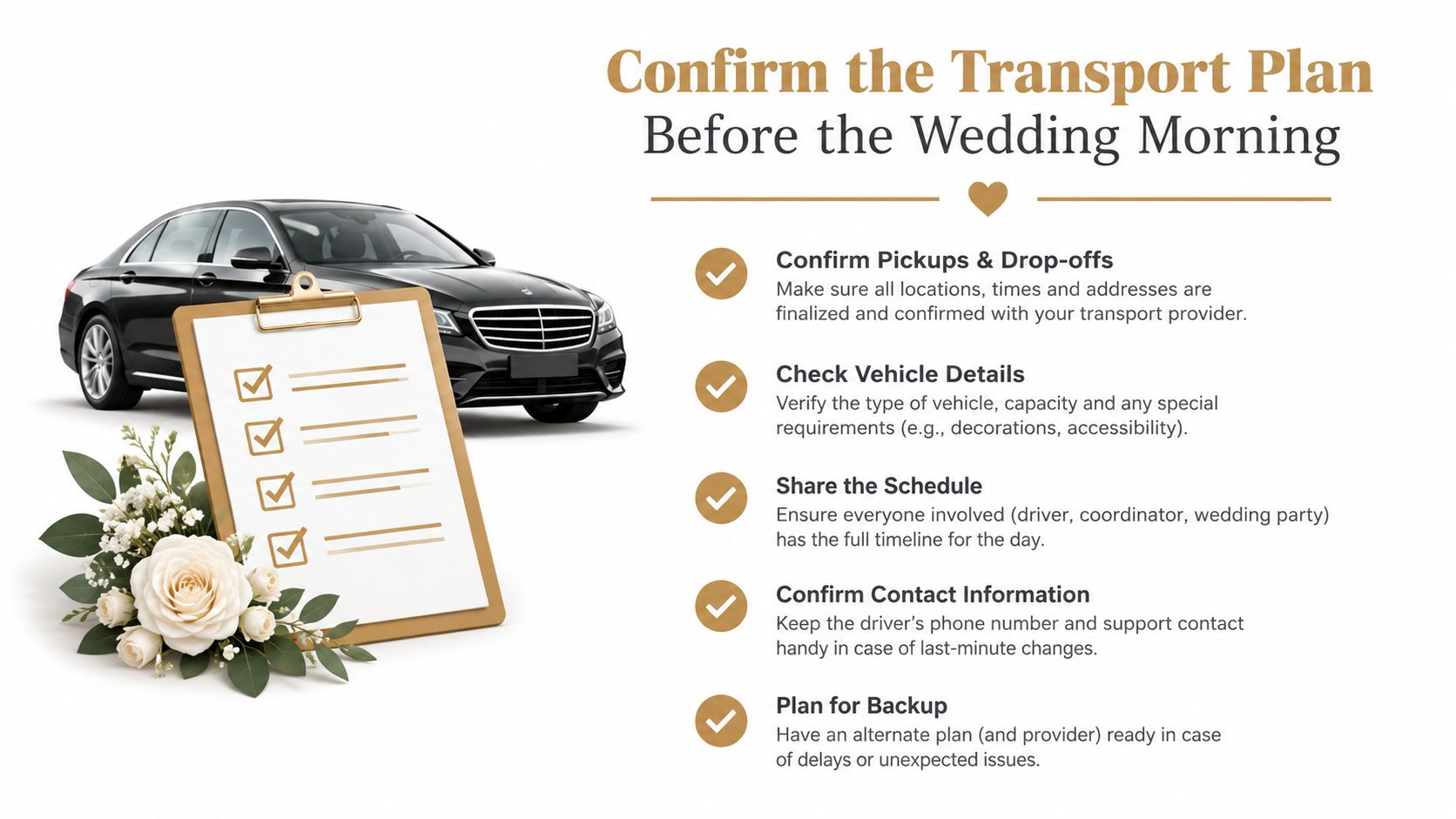
- Publish the timetable. Include meeting points, departure instructions, covered routes, and payment policies.
- Name the coordinator and chauffeur contact in writing, including who authorizes changes.
- Match vehicles to the manifest. Verify passenger capacity, baggage, child seats, and accessibility arrangements.
- Share assignments and pickup instructions after RSVPs close.
- Reconcile late additions. Check every role and passenger assignment before the day-before confirmation.
- On the wedding morning, verify vehicle positions, driver readiness, flight tracking, and backup availability.
- Record the outcome. Afterward, note missed handoffs and successful arrangements for future events.
Choose the provider arrangement deliberately
Using a single provider can simplify communication; splitting airport and event routes may suit different requirements. Either way, request airport pickup authorization, a written manifest, named contacts, flight monitoring, bilingual coordination, appropriate capacity, and a named backup before committing.
Settle the timetable and the money first, then the seats. That's the difference between offering transportation and giving guests a dependable way to attend.
Unique Private Transportation offers Cancun airport transfers, chauffeured point-to-point travel, and wedding transportation coordination across Cancun and the Riviera Maya, with live flight monitoring and bilingual communication. Visit with your ceremony deadline, hotel locations, passenger requirements, and covered routes to discuss a written pickup plan and quote.