
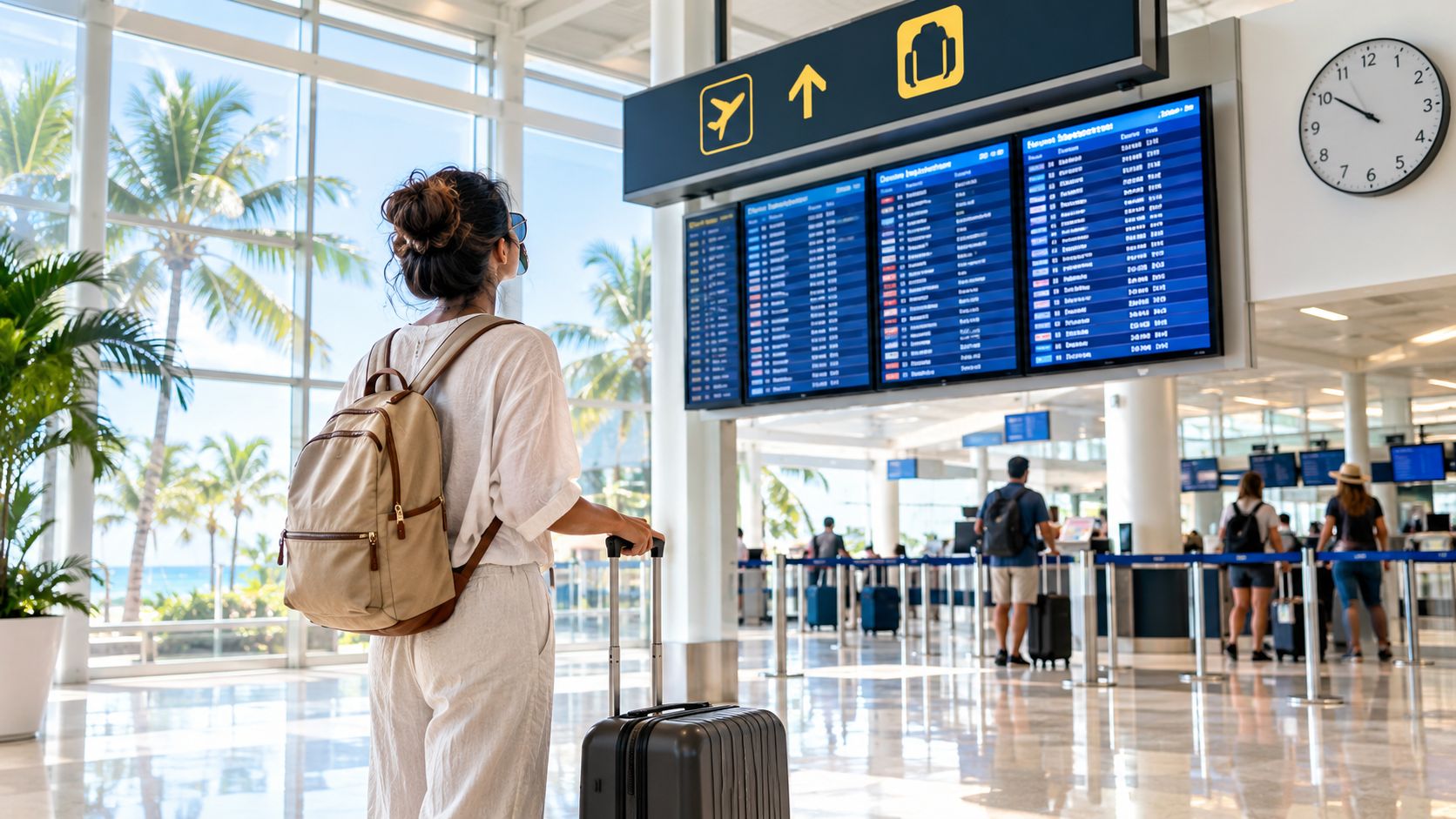
Your flight leaves this afternoon, the suitcases are almost closed, and the hotel asks when you want the car. You know the departure time, but you still don't know when to leave, which terminal to request, or whether the stroller and extra suitcase change the calculation.
For Cancun international departures, the useful question isn't just how early to arrive. It's how to build a hotel-to-gate schedule that accounts for your airline, travel date, luggage and passengers without pretending the driver controls what happens inside the airport.
Table of Contents
- Which Terminal Handles Your International Departure
- Recommended Arrival Times by Traveler Type
- Documents, Bags and Carry-On Rules to Prepare
- How to Move From Curb to Gate, Step by Step
- Cancun Airport Transportation Options for Departures
- Seasonal Congestion and Date-Specific Timing
- Special Needs for Families, Groups and Mobility
- Confirm Your Terminal and Leave on Time
Which Terminal Handles Your International Departure
Your terminal is a constraint to verify, not a default to assume. Start with the type of flight, then confirm the building assigned to your particular departure.
Cancun terminals and their international departure role
The Cancun Airport terminal guide identifies Terminal 2 as domestic and international, Terminals 3 and 4 as primarily international, and Terminal 1 as private and charter aviation; it also describes a free inter-terminal shuttle whose wait can reach approximately 15–20 minutes.
| Terminal | Traffic handled | When it applies | What to check |
|---|---|---|---|
| Terminal 2 | Domestic and international | Scheduled commercial flight that lists Terminal 2 | Confirm on the day; domestic and international share the building |
| Terminal 3 | Primarily international | Scheduled international departure | Confirm the terminal; ask staff about the free shuttle if directed elsewhere |
| Terminal 4 | Primarily international | Scheduled international departure | Confirm before pickup; allow for the published shuttle waiting time |
| Terminal 1 | Private and charter aviation | Private or charter flight | Not the scheduled-commercial departure default; confirm with the operator |
This table tells you which buildings fit each type of operation. It doesn't replace current flight information, and an airline name alone isn't enough to dispatch a vehicle confidently.
Codeshares can add confusion. Use the airline shown as operated by on your reservation, not just the company that sold the ticket.
Verify the flight rather than memorizing an airline list
Use a short, repeatable check before departure:
- Identify the operating airline. Open the actual flight segment in the airline app or reservation.
- Match the flight number and departure date. Make sure you're checking the flight leaving Cancun, not the flight that brought you there.
- Open current airport flight information. Compare its terminal with the airline's same-day information.
- Resolve a mismatch before pickup. Contact the airline or airport rather than asking the driver to choose between conflicting screens.
Say your international flight departs from Terminal 4, but your driver drops you at Terminal 2. You haven't arrived at the correct check-in location, even though you're technically at the airport.
You must retrieve your bags, locate the appropriate transfer and reach the correct building before the airline closes check-in. With children, hand luggage and a folded stroller, that's a much harder correction than changing the destination before leaving the hotel.
Dispatch rule: Put the confirmed terminal in the driver's instructions, not just the words Cancun Airport.
For group travel, the coordinator should keep terminal-specific instructions with the passenger list. Travelers on different flights may need different drop-offs even when they leave the same resort together.
Before pickup is confirmed, send the driver the operating airline, flight number and departure date. Have the terminal verified against those details and included in the written confirmation.
Recommended Arrival Times by Traveler Type
Public CUN departure guidance sets a floor of at least two hours before an international departure. Treat that as a starting point, not a promise that every passenger can finish every airport procedure within that window.
The table below gives operator planning recommendations, not additional airport-published requirements. An airline's check-in or baggage cutoff takes priority whenever it requires an earlier arrival.
Recommended airport arrival time by traveler type
| Traveler type | Time before departure | Why the extra time |
|---|---|---|
| Solo traveler, carry-on only | 2 hours | Published CUN baseline for international passengers |
| Solo traveler or couple with checked bags | 3 hours | Bag drop and check-in queue |
| Family with infants or young children | 3 hours; consider 3.5 with checked bags and substantial handling | Strollers, car seats and a larger passenger count |
| Wedding or corporate group of 8 or more | 3.5 hours | Multi-vehicle drop, bag counts and centralized check-in |
| Traveler with mobility needs | 3 hours, adjusted with the airline's assistance team | Assistance requests and slower curb-to-gate movement |
| Oversized sports or music equipment | 3 hours | Special bag handling at check-in |
These recommendations deliberately give passengers with more handling requirements additional room. Several long-haul flights checking in together can make the published minimum uncomfortable, even when your road transfer runs exactly to plan.
Use the visual as a quick planning prompt, then adjust for the actual passengers and bags.
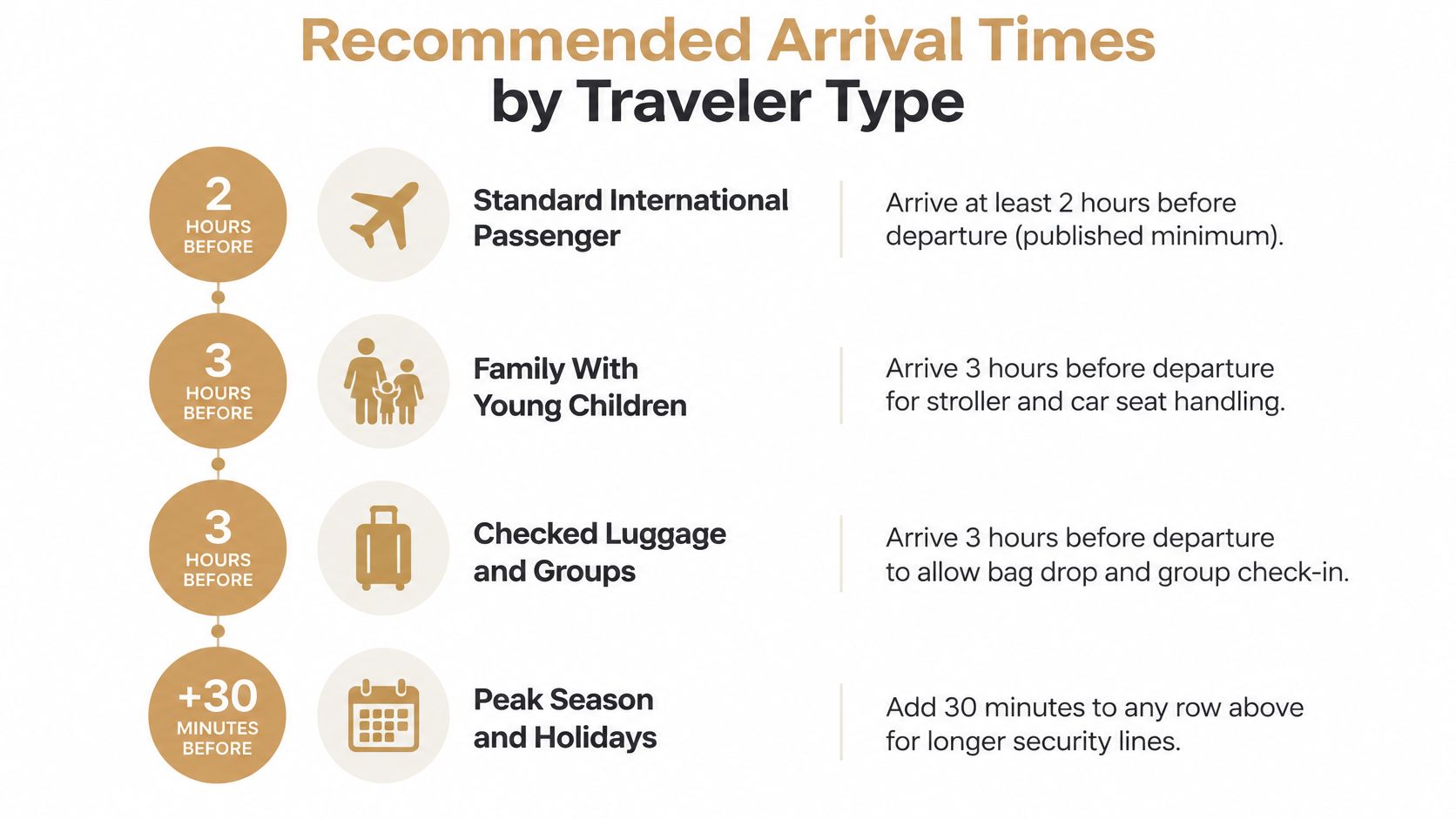
A calendar-based allowance is a precaution, not a forecast of the security queue. Don't add time mechanically without checking whether your airline's counters will be open and what assistance arrangements apply.
Work backward from the terminal curb
Use this calculation:
Hotel departure time = flight time − airport processing allowance − expected drive time − road contingency.
Keep the road contingency separate. Otherwise, a driver may quote an ordinary drive time while you assume it already includes congestion, resort access and terminal approach delays.
For a hypothetical 14:00 flight, suppose a family with an infant and checked bags chooses a 3.5-hour airport allowance. The vehicle should reach the terminal by 10:30.
If the hypothetical drive takes 40 minutes, departure from the hotel is 09:50 before adding road contingency. The driver should confirm the route estimate on the day and move pickup earlier when conditions warrant it.
That calculation is more useful than asking whether a resort is close to the airport. A hotel entrance, luggage collection point and congested access road can all affect when the vehicle really gets moving.
For a prearranged Cancun car service, request both the pickup time and target terminal arrival time in writing. The distinction makes it clear whether the reservation was built around your flight or only around vehicle availability.
The variables that move you toward a more generous allowance are checked bags, passenger count, mobility needs and oversized items. If several apply, choose the more cautious plan rather than averaging them away.
Documents, Bags and Carry-On Rules to Prepare
A missing passport can stop check-in before the airline even weighs a bag. Keep passports and required travel documents with you, never in checked luggage. Mexican departure immigration and statistical-form requirements can depend on nationality, so follow the current instructions from your airline and Cancun Airport for your flight.
Pack for document checks first
Each adult should carry their own passport in an accessible, secure pocket or document pouch. A parent or guardian can manage children's documents, but drivers and group coordinators should not collect everyone's passports.
Keep the operating airline's reservation available offline. If a document check requires a destination address, onward itinerary or other supporting record, you do not want access to depend on hotel Wi-Fi after leaving.
Before closing a suitcase, move these items into cabin baggage:
- Travel documents. Passports, boarding information and required entry or transit documentation.
- Medication. Medicines you need during the journey and any supporting prescription information.
- Electronics. Your phone, chargers and equipment needed in transit.
- Valuables. Jewelry, keys and irreplaceable personal items.
- Arrival essentials. Anything you will need promptly if checked luggage is delayed.
Check the fare, not the suitcase label
Check baggage weight and dimensions against the operating airline, ticket class and route. A case sold as cabin size may exceed your fare's allowance, while paying for a checked bag does not necessarily include sports equipment.
Measure the bag with wheels, handles and bulging outer pockets included. Weigh it after packing the toiletries and souvenirs. That final check catches a problem before it reaches the counter.
Power banks and spare lithium batteries belong in carry-on baggage, not checked bags. Devices with installed batteries can have different conditions, so check the airline's restrictions instead of applying one rule to every electronic item.
Liquids must meet the container and bag limits posted for security. Put the liquids pouch where you can remove it without unpacking the rest of your bag, and keep larger electronics similarly accessible.
If the airline gate-checks your cabin bag, remove documents, medication, valuables, power banks and spare batteries before handing it over. Once the bag goes into the hold, those items are no longer available to you in the cabin.
The night before departure, check three things: documents accessible, carry-on electronics correctly packed, checked-bag weight confirmed. Repacking an overweight case at the hotel is simpler than redistributing belongings at an airline counter.
How to Move From Curb to Gate, Step by Step
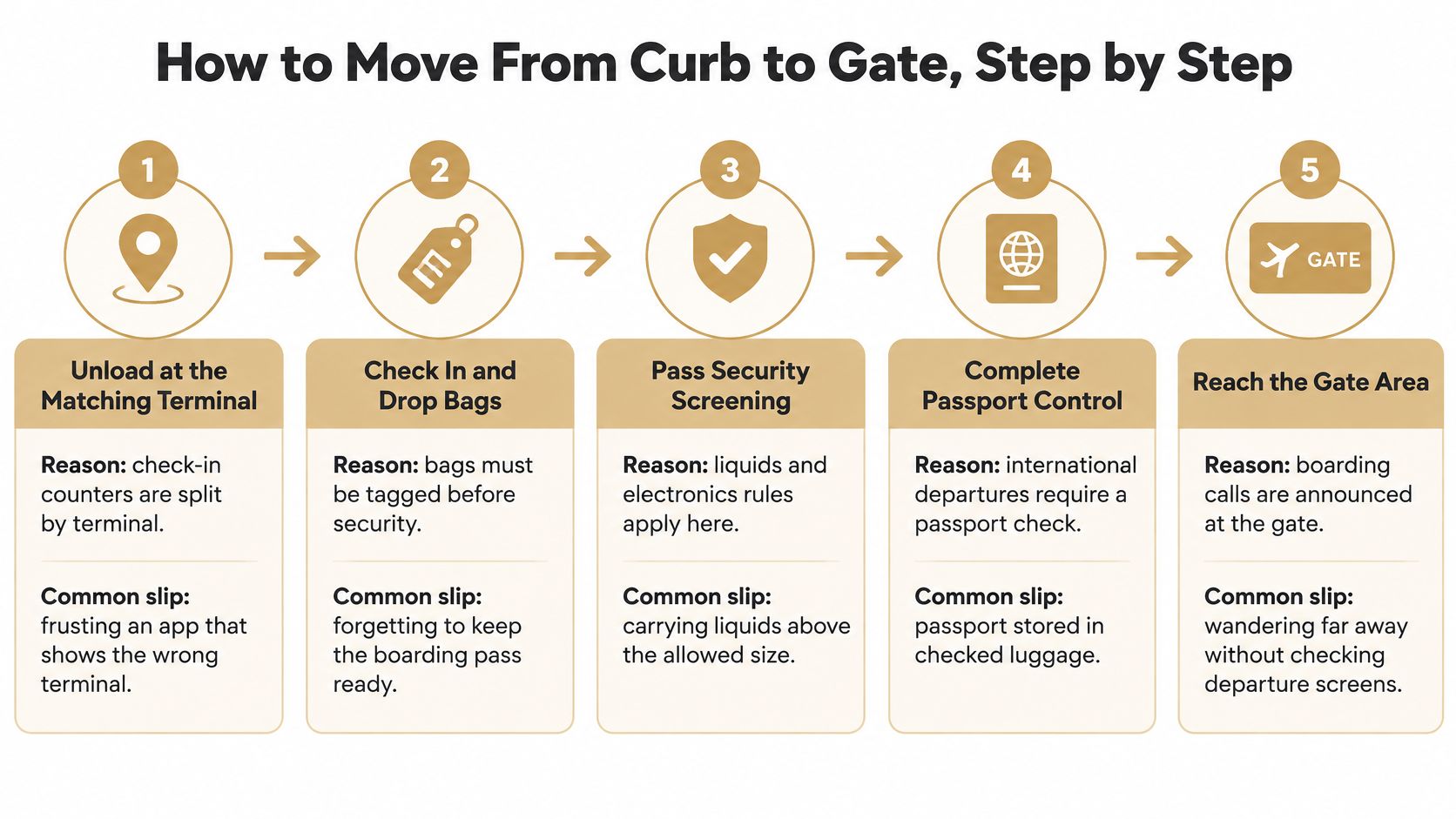
Your airport journey is not finished when the vehicle stops. From the curb, you still need to reach the correct airline area, complete any document checks, check in, clear security and find your gate. Confirm the terminal and entrance with the driver before unloading, then follow airport staff and airline directions inside.
ASUR's June traffic release shows high international passenger volume at Cancun in June 2025, but a monthly total doesn't tell you how long your particular airline's queue will take.
Follow the live instructions inside the terminal
Unload at the matching terminal entrance. Confirm the airline entrance with the driver before the vehicle leaves. Count every suitcase and personal item before moving inside. The first available curb position may not be the right building or entrance.
Check which document or immigration counter applies. Foreign passengers should follow the posted immigration instructions before joining a queue. Mexican passengers should confirm whether a statistical-form process applies. A long line is not proof that it is the right one.
Check in and drop checked bags. Use the airline counter or kiosk as directed, and keep baggage receipts through boarding. Hold onto each tag or receipt yourself, rather than leaving it with paperwork carried by someone else.
Pass security screening. Follow the checkpoint's posted instructions for laptops, liquids and electronics. Keep items that need to come out accessible, so you are not unpacking at the conveyor.
Resolve any terminal mismatch with airport staff. If staff direct you to another building, ask how to reach the free shuttle and allow for its published waiting window. Do not assume terminals connect after security or that the route is walkable.
Reach the gate and check the departure display. Compare the gate screen with your boarding pass and airline app. Gate assignments can change, so verify before settling in.
The diagram shows the main curb-to-gate stages. Document checks can vary in location and sequence, so follow current airport and airline directions.
Know where the driver's responsibility ends
A bilingual driver or coordinator can help confirm the drop-off entrance and communicate a terminal change before unloading. This is useful when a resort booking names the airport but does not specify the terminal.
The driver cannot open an airline counter, shorten security screening or guarantee that an aircraft will wait. A premium vehicle does not include priority airport processing unless that service is separately confirmed.
An earlier vehicle arrival only helps if passengers use the extra time to complete the correct airport procedures.
For groups, agree on a meeting point after security before anyone separates. Keep children with their responsible adult, and make sure travelers receiving mobility assistance know where the rest of the party will wait.
If an airline agent or airport screen sends you to another check-in area, ask staff for the correct route before moving. Leaving security or changing terminals may mean repeating part of the process.
Cancun Airport Transportation Options for Departures
Mexico's tourism activity report.pdf) recorded 7,637,393 foreign passenger arrivals through Cancun during January–October 2025; together with Mexico City, Los Cabos, Puerto Vallarta, Guadalajara, Monterrey, Tulum and Silao, Cancun accounted for 92.0% of Mexico's foreign passenger arrivals by nationality in that period.
Those are arrival statistics, not departure-queue measurements. They establish the scale of the gateway, where coordinated transport is more dependable than assuming a suitable vehicle will be immediately available when you finish checking out.
For Cancun airport transportation, choose around the pickup commitment and passenger requirements, not just the vehicle photograph.

Departure transport options compared
| Option | Pickup timing | Luggage and group fit | Child seats | Best for |
|---|---|---|---|---|
| Shared shuttle | Fixed or multi-stop pickups | Limited bag space; confirm group capacity | Not usually guaranteed; ask in advance | Solo travelers on a budget |
| Standard taxi | On demand; queue risk at busy times | Typical bags; limited suitability for large groups | Not standard; ask in advance | Solo travelers or couples with light luggage |
| Private chauffeur, Unique Private Transportation | Scheduled pickup and airport meet and greet; live flight monitoring supports adjustments | Larger SUVs for bags and groups | Pre-fitted seats on request | Families, groups, wedding and corporate transfers |
| Self-drive rental | Traveler controls departure timing | Selected vehicle capacity, plus return logistics | Traveler supplies or arranges with rental company | Travelers comfortable allowing for return and terminal transfer |
A shared shuttle trades flexibility for cost. Ask whether the quoted pickup includes other hotel stops and whether the airport drop-off serves your terminal directly.
A standard taxi can be sufficient for a solo traveler with light luggage. Arrange availability through the hotel rather than waiting until checkout to discover that the next suitable vehicle is elsewhere.
What a chauffeur arrangement should include
For families, the useful features of luxury transportation are adequate cargo space, confirmed child seats and clear communication. English and Spanish coordination, airport meet and greet and live flight monitoring can also help when plans change.
Distinguish arrival tracking from departure planning. A delayed inbound flight may justify adjusting an arrival pickup automatically, but a delayed departure doesn't necessarily mean the airline extends check-in or bag-drop deadlines.
When comparing offers described as private transportation Cancun Airport services, ask whether the quoted vehicle is exclusive to your party and whether all luggage fits with the child seats installed. A seat count alone isn't a cargo-capacity guarantee.
A direct hotel-to-terminal journey is a point-to-point transfer. Adding shopping, another resort collection or a meal stop changes the itinerary and needs an explicitly revised departure plan.
Reliable messaging matters when the hotel lobby is busy or the pickup entrance changes. If you need mobile data for driver messages and airline updates, compare RedSim data plans for Mexico before travel, while keeping essential confirmations available offline.
For Cancun luxury airport transfers, ask what coordination is included, not whether the ride is described as smooth. No provider controls airline queues or security lines.
Before confirming, ask the provider to repeat the flight number and departure terminal, along with the hotel pickup entrance. An airport pickup terminal belongs to an arrival booking; your departure reservation needs the correct airport drop-off terminal.
Seasonal Congestion and Date-Specific Timing
A quieter month does not guarantee a short queue at your departure time. Airline schedules can concentrate passengers into busy departure periods even when overall monthly traffic is lower.
ASUR's February traffic report reports 1,809,498 international passengers for February, down 11.0% year over year. That was the highest total among the months compared here, but monthly totals cannot predict the queue at a particular airline counter or terminal entrance.
Cancun international passengers by month in 2025
| Month | International passengers | Change year over year | Planning note |
|---|---|---|---|
| February | 1,809,498 | Down 11.0% | Highest volume of these months; allow more time if your flight leaves during a busy departure period |
| June | Not stated | Not stated | Summer travel; account for the time needed to handle family groups and checked luggage |
| October | Not stated | Not stated | A quieter resort does not guarantee short airport queues |
Use the February figure as context for that month, not as a prediction for your flight. June and October can bring different travel patterns, but the available figures here do not establish their passenger totals or year-over-year changes. In every month, your airline's departure schedule and the passengers arriving for it matter more to your queue than a broad monthly comparison.
Turn the month into a planning decision
For a February departure, choose the more generous end of the airport allowance if your airline has a busy departure period. In June, include time for family equipment and checked bags, since loading, unloading and counter handling can affect when your group is ready to leave the hotel.
For October, retain a road contingency even if the resort lobby is quiet. Other passengers may be heading to the same airline departure from different hotels, so a calm pickup area is not a reliable guide to airport processing time.
Set your hotel pickup by checking these details:
- Operating terminal and cutoff. Confirm where your airline accepts passengers and when it stops accepting checked bags.
- Road variability. Ask the driver to assess the route from your hotel entrance, including access to the correct terminal.
- Passenger handling. Allow extra time for families, groups, assistance needs and international connections.
- Live status. Check the flight again before leaving. A delay does not necessarily extend check-in or bag-drop deadlines.
A fixed arrival rule can miss the practical differences between travel dates, departure banks and passenger needs. Use monthly totals as background, then work backward from your flight time and the airline's cutoff to set a realistic hotel departure.
Keep the road contingency even when the month's overall traffic is lower.
Before pickup, have the current flight status, confirmed pickup window, passenger-ready time, luggage count and a fallback contact in one place. That makes it easier to respond to a change without assuming the airport will be quick.
Special Needs for Families, Groups and Mobility
The right vehicle solves only part of a complicated departure. The rest depends on how the passengers, documents and equipment are organized before the driver reaches the hotel.
Use the traveler-type arrival table to choose your airport allowance, then make the practical arrangements that let you use that allowance effectively.
Families and wedding parties
For a hypothetical family of two adults, two children and four bags, plan around an SUV rather than assuming a sedan will work. Confirm the actual cargo space with the child seats installed, especially if a stroller must travel unfolded or equipment can't be stacked.
Car seats must be confirmed before pickup, including the children's ages and the appropriate seat type. Ask who installs them and have everyone ready before the scheduled loading time.
Wedding parties need a guest manifest, not a group chat full of partial flight details. Assign a coordinator who can account for passengers without asking the driver to search the resort.
- Passenger names and flights. Separate travelers by actual departure window and terminal.
- Bag counts. Include garment bags, gifts and equipment, not just suitcases.
- Meeting point. Choose a specific lobby entrance or collection area.
- Vehicle allocation. Avoid holding an entire party because a traveler on a different itinerary isn't ready.
For arrival transfers linked to the same event, split vehicles by flight arrival window so a late flight doesn't hold up a hypothetical party of eight. A dedicated Cancun wedding transportation plan should keep those arrival arrangements distinct from departure pickups.
Corporate travel and assistance needs
Corporate groups should confirm that every traveler has their own passport and correct ticket before leaving. Match vehicle capacity to the combined bag count, particularly when presentation equipment travels with the party.
A traveler needing mobility assistance should request it through the airline in advance and tell the transport provider what help is needed at the vehicle. Be specific about walking distance, steps, wheelchair storage and whether the passenger can transfer into a conventional seat.
Curbside assistance and airline wheelchair assistance aren't automatically the same service. Agree on where responsibility passes from the driver to the airport assistance team.
Oversized equipment needs its own check. Surfboards, golf bags and musical instruments can affect both vehicle choice and airline handling, so confirm the airline's policy and whether a separate acceptance counter applies.
Across all these cases, the coordinator should keep a written list of flights, terminals and bag counts. Add assistance and equipment notes beside the relevant passenger rather than relying on memory.
Confirm Your Terminal and Leave on Time
A useful departure schedule assigns checks to specific days instead of leaving everything for checkout. The following is a recommended preparation routine, not an airport deadline.
Seven days before departure
Confirm the operating airline, flight number and scheduled departure time. Review the ticket's baggage allowance and request any airline assistance that hasn't already been arranged.
Check that your transfer reservation uses the hotel you'll depart from. Travelers who change resorts during their stay sometimes leave the original property on the return booking.
Forty-eight hours before departure
Verify the terminal against current flight information and confirm the pickup window. Ask the transport provider for the target terminal arrival time, not just the time the vehicle will reach the hotel.
Resolve outstanding requirements now, including child seats, oversized luggage and a larger vehicle. A vague note saying family transfer isn't an equipment confirmation.
The day before departure
Check flight status, save the driver or dispatcher's contact and confirm the exact collection entrance. Place the document pouch and carry-on electronics together where they won't be packed into checked luggage.
- Hotel account. Arrange checkout so a billing question doesn't delay loading.
- Luggage. Count every piece and identify anything needing special handling.
- Communication. Save the booking and fallback contact offline.
Morning of departure
Check live flight status again, select the airport allowance that fits your party and subtract the driver-confirmed road time plus contingency. Be ready to load at pickup time rather than starting to collect bags then.
When booking the transfer, provide the airline, flight number, terminal, passenger count, bag count and any child-seat or mobility requirements. A prearranged service can then match vehicle capacity and pickup instructions to the confirmed itinerary.
Today's action is simple: write the flight number and terminal on the booking confirmation, then book the pickup using those details. If the terminal changes later, update the written reservation rather than assuming the driver has received the same notification.
Unique Private Transportation offers scheduled airport transfers with bilingual coordination, live flight monitoring, larger vehicles and child seats on request. Visit Unique Private Transportation with your flight details, hotel, passenger count and luggage requirements to arrange a departure pickup built around your terminal and airport arrival target.