
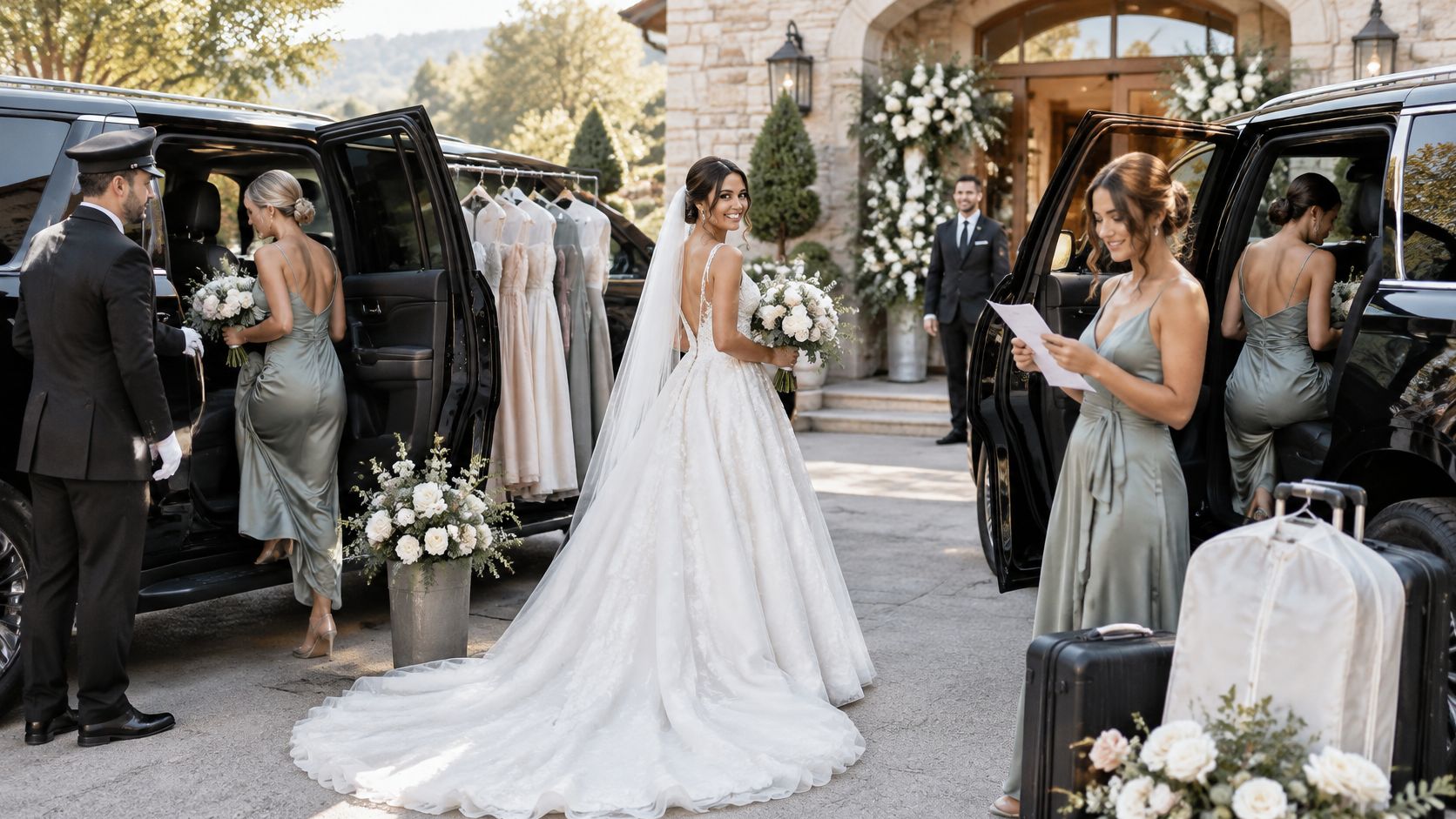
You've got the ceremony time, the getting-ready address, and a group chat full of people asking which car they're taking. Then someone adds a grandparent to the passenger list, the photographer suggests a beach stop, and the vehicle you liked suddenly looks too small.
Wedding transportation for bridal party travel is a timed logistics job, not just a choice of luxury vehicle. One late pickup can delay photos and the ceremony entrance. A vehicle labeled accessible can create the same problem if its ramp can't deploy at the hotel. Start with passengers, routes, and boarding requirements, then choose the cars.
Table of Contents
- Match Vehicles to Your Bridal Party Size
- Check Mobility Access, Child Seats and Gear Space
- Group Attendants and Route Multiple Vehicles
- Sync Pickups With Hair, Makeup and Photo Times
- Plan Airport Arrivals and Early Pickups in Cancun
- Budget Transport and Split the Costs Fairly
- Lock In Your Bridal Party Transport Plan
Match Vehicles to Your Bridal Party Size
Count everyone who'll ride, not just the attendants listed in the ceremony program. Include the bride, flower children, accompanying parents, grandparents joining photos, and anyone traveling with a child seat or mobility device. Put names beside each seat so nobody becomes an unexpected passenger on the day.
For your initial layout, allow a spare seat per car as a space allowance for bags, then verify where those bags can be secured. A spare seat isn't a substitute for proper cargo storage. Keep a rear row clear for the bridal gown in its garment bag where the vehicle configuration permits, without obstructing occupied seats or seat belts.
Use the following as a starting layout, not a capacity guarantee. The exact vehicle's passenger rating, child-seat placement, gown requirements, and luggage load must all fit together.
Vehicle setup by bridal party size
| Party size | Vehicle setup | Why it fits |
|---|---|---|
| 2-4 people | One sedan or SUV | Bride and attendants travel together with room for gowns |
| 5-7 people | One 7-seat SUV or two sedans | Keeps the group together while the gown has a clear row |
| 8-12 people | Two SUVs | Avoids an overloaded car and lets the bride leave separately |
Rated capacity isn't your usable layout
At the upper end of these example groups, the recommended setup may need another vehicle. A full passenger load won't necessarily leave a clear gown row, and folding a seat for luggage removes a passenger position. Don't assume every SUV has the same seating arrangement.
For groups above twelve, compare large SUVs with a passenger van using an actual seating diagram. Two large SUVs work only if their combined usable capacity covers everyone and their equipment. A van can simplify dispatch, but its entrance, aisle, and luggage arrangement may make gown handling harder.
Our guide to why a Suburban SUV is comfortable for travel gives useful context when weighing cabin comfort against group size. For a wedding, also check how passengers reach the rear seats while wearing formalwear.
Sizing rule: If passengers, gowns, and bags don't fit the confirmed layout, add a vehicle. Don't solve a cargo problem by squeezing people into a row.
Before accepting a quote, request the proposed seating arrangement rather than relying on a vehicle-category photograph. A beautiful interior doesn't tell you whether the last attendant can reach their seat without climbing over a gown.
Check Mobility Access, Child Seats and Gear Space
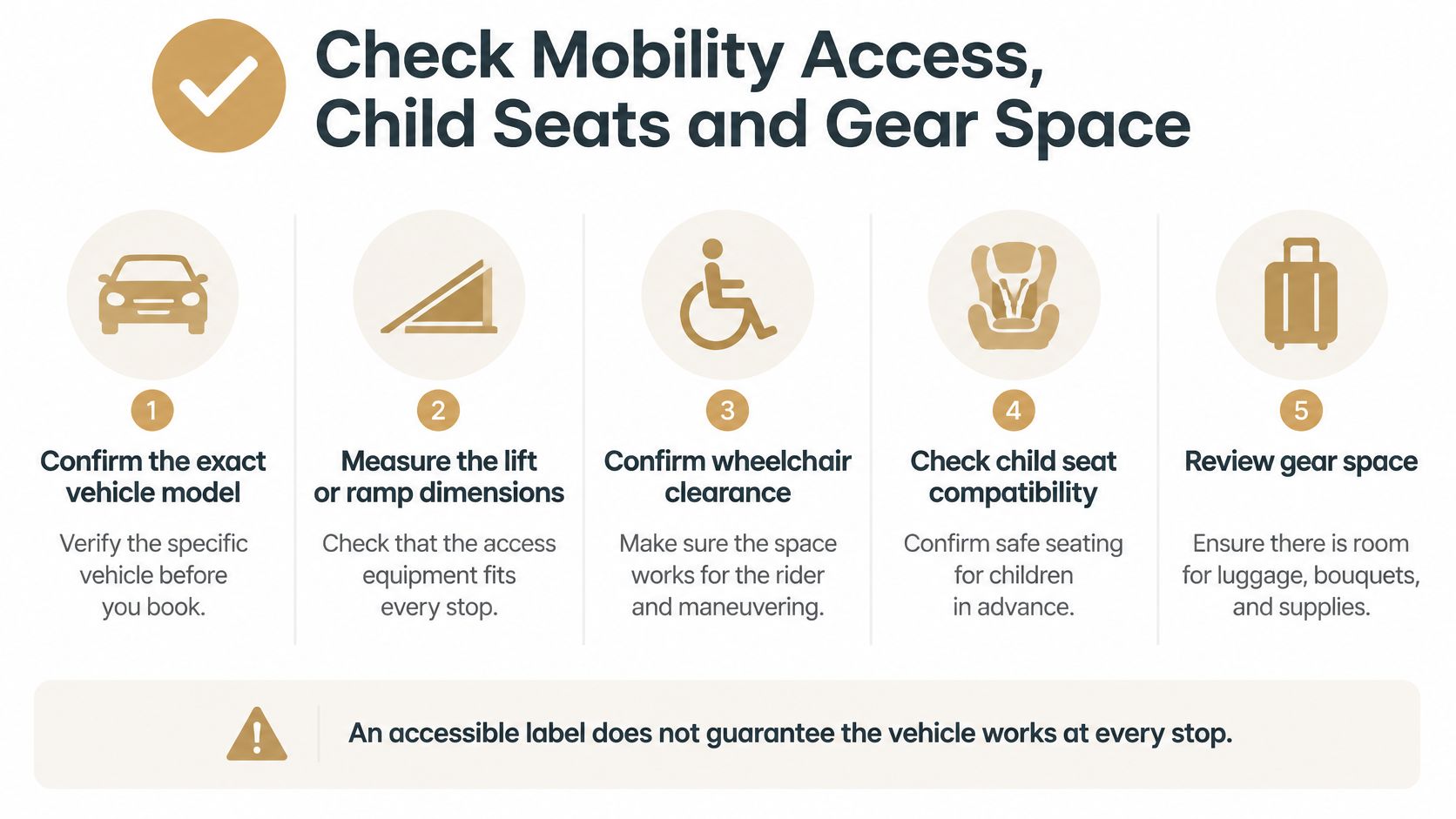
An accessible vehicle doesn't automatically mean an accessible journey. A suitable ramp can still be unusable beside a high curb, and a step-free vehicle won't solve a staircase between the suite and the lobby. The Amelia wedding transportation and accommodation guide identifies vehicle access, mobility equipment, boarding conditions, and private collection of guest requirements as planning considerations.
Collect those requirements privately through the RSVP process or a direct conversation. Ask what assistance the passenger needs, whether they'll transfer to a vehicle seat, and whether a wheelchair or walker needs secure storage. Don't ask someone to explain their mobility needs in the bridal-party group chat.
Verify the whole boarding route
Confirm the exact vehicle model, lift or ramp dimensions, usable wheelchair clearance, and securement arrangement. If the passenger remains in their wheelchair, confirm that the vehicle is designed for that occupied-wheelchair journey. A walker stored in the luggage compartment presents a different requirement.
The planner should check each location, while the transport operator confirms the vehicle details in writing. Venue staff should verify entrances and unloading positions rather than just saying that the property is accessible.
Stop-by-stop accessibility and gear checks
| Stop | What to verify |
|---|---|
| Getting-ready suite | Curb or lobby pickup, step-free route, boarding time |
| Hotel lobby | Lift or ramp dimensions, room for a wheelchair or walker |
| Photo location | Surface type, including gravel, grass, or stairs, and curb height |
| Ceremony venue | Drop-off distance to the entrance, narrow doorways, grass or gravel path |
| Reception | Return pickup time, securing the mobility device |
If the ceremony is on grass, identify a firm unloading surface and a suitable route to the seating area. A curbside drop-off with a short walk works only for someone who can comfortably make that walk. Otherwise, arrange an accessible route all the way to the ceremony.
Request child seats before the wedding and document the child's seating requirements, installation arrangement, and assigned vehicle. Confirm they'll be fitted before pickup, not retrieved while the bridal party waits outside.
Finally, allocate cargo positions for bouquets, hair kits, gown bags, luggage, and mobility equipment. The useful question isn't whether the vehicle has a large trunk. It's whether this passenger list and this equipment list can travel together safely, with access equipment still available when needed.
Group Attendants and Route Multiple Vehicles
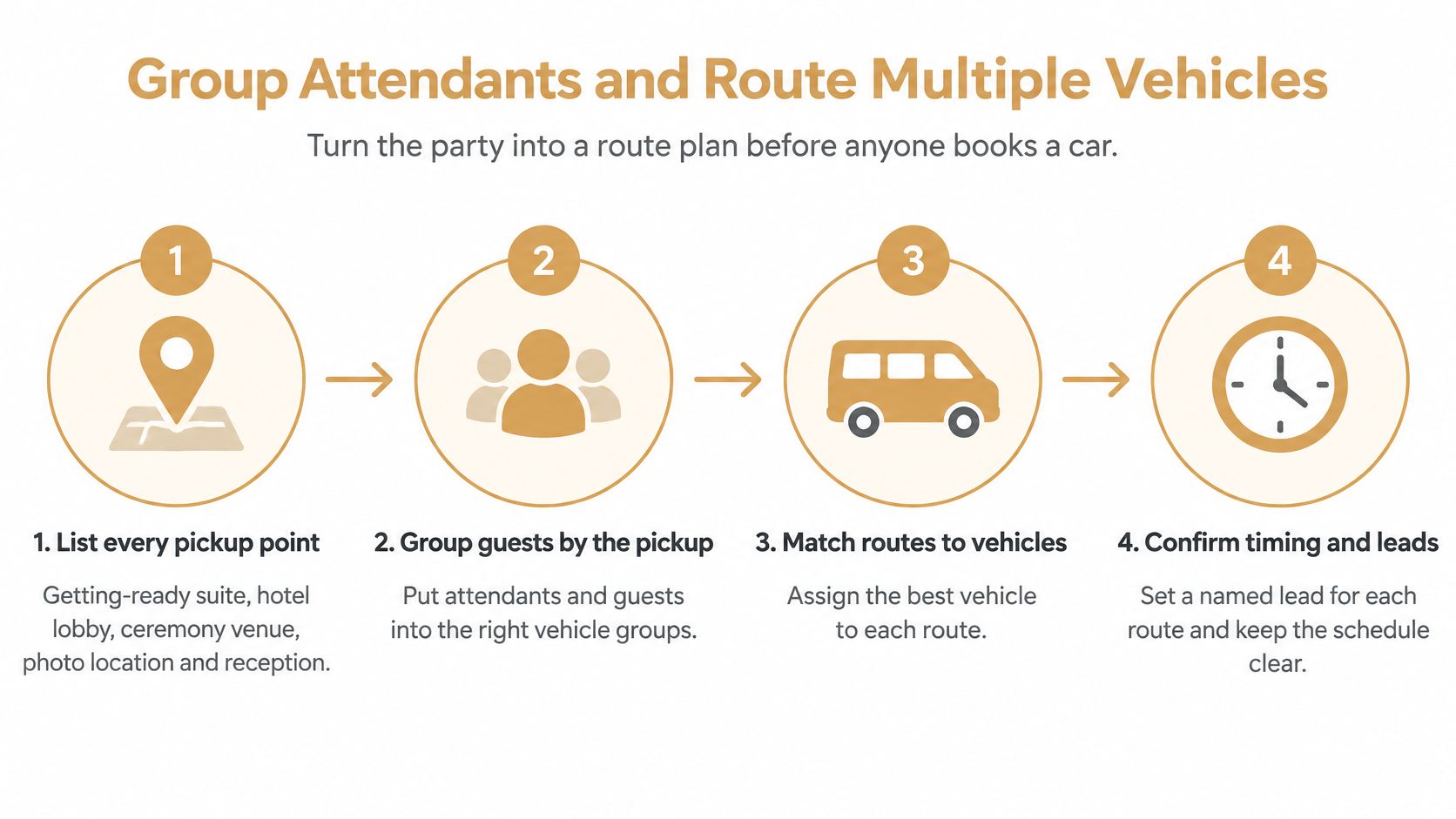
Turn the bridal party into a route plan before anyone books a car. A shared spreadsheet works well: give each vehicle a label, a passenger manifest, a route, and a contact person. Use the same labels in the itinerary and group messages so nobody has to interpret “the other black SUV.”
Build routes around pickup locations
List every pickup point. Record the getting-ready suite, hotel lobby, ceremony venue, photo location, and reception, including the correct vehicle entrance. A map pin at the property's center can send a driver to a service gate instead of the passenger entrance.
Group passengers by their shared pickup. Friends staying at different hotels shouldn't automatically share a car if collecting them creates a detour. Aim for a clear start and destination for each leg, rather than a hotel circuit that makes the final passenger late.
Name a lead and a backup for every car. The lead checks attendance and tells the planner when the group is seated; the backup holds the driver's contact details. Don't make the bride the default contact while she's dressing or taking portraits.
Dispatch the longest route first. Compare complete journeys, including loading and unloading, rather than road distance alone. The common mistake is sending the nearest group first because they're ready, while a distant group still needs collection.
Give every driver the same master itinerary. Include addresses, passenger assignments, pickup instructions, and the person receiving each arrival. Separate message threads become unreliable when a changed photo location reaches one driver but not the others.
Release the bride's car deliberately. Confirm that the earlier group is seated and the receiving coordinator is ready before calling the bride downstairs. Her car leaves the suite last when that matches the ceremony plan, not because the other vehicles happen to be outside.
Put someone at the destination
The easy-to-miss assignment is the person receiving the cars. If every coordinator leaves the hotel with the attendants, nobody may be waiting at the venue to direct unloading, protect a private entrance, or guide relatives to the right room.
A departure isn't complete until someone knows who will receive the passengers.
Give the receiving coordinator the vehicle labels and arrival order, not just a broad arrival window. They should know whether a car needs a discreet bridal entrance or direct access to the photo location.
Test the plan without explaining it aloud: can each car lead name the first stop, final stop, and receiving person? If not, the itinerary still depends on assumptions.
Sync Pickups With Hair, Makeup and Photo Times
Work backward from the ceremony, then fit beauty appointments and photography around the required departures. The hypothetical schedule below assumes a 4:00 PM ceremony, hair and makeup beginning at 10:30 AM, and an off-site photo stop. Its travel times are example planning allowances, not estimates for a particular Cancun route.
Sample bridal party timeline for a 4:00 PM ceremony
| Time | Event | Transport action |
|---|---|---|
| 1:30 PM | Lead car leaves for the photo stop | Pickup from suite for the first group, 20-minute drive |
| 2:15 PM | Second car leaves for remaining attendants | Departs 45 minutes after lead car, leaving buffer |
| 3:00 PM | Bride's car departs the hotel | Arrives 20 minutes before the ceremony |
| 3:45 PM | All attendants seated at the venue | Drivers confirm arrival with the lead |
| 4:00 PM | Ceremony begins | Cars parked and staged for the reception |
The example gives the bride a different journey from the first photo group. Her hotel departure allows for the route and arrival arrangements needed to reach the ceremony at 3:40 PM. Don't copy that departure time unless the actual drive, unloading, and entrance sequence fit it.
Separate ready time from departure time
For this worked example, reserve 20 to 30 minutes before each departure for finishing, gathering belongings, walking downstairs, and boarding. That's a planning allowance, not a promise that every bridal party needs the same interval. Someone being finished with makeup doesn't mean they're dressed, holding their bouquet, and ready to leave.
Stagger departures so the photographer can begin with the first group while the remaining attendants finish. Put the people needed for the opening photo sequence in the lead car. Sending whoever happens to be ready can leave the photographer waiting for the person central to the shot.
Getting-ready clothing also belongs on the preparation checklist. California Cowboy's 2026 bridal robe style tips can help the group choose outfits for those photos, but the planner still needs a firm end to robe pictures and a separate dressing call.
Protect the departure buffers
Check the off-site photo route against the afternoon travel conditions expected for that journey, not a quiet morning map estimate. Include the photographer's equipment loading and the walk from the parking position to the photo spot.
Drivers should confirm arrival at each stop, while the planner controls a single call time for the bride's car. If the route needs more time, move the preparation and departure times earlier. Don't recover a late beauty schedule by deleting the boarding buffer, because the passengers still need that time.
Plan Airport Arrivals and Early Pickups in Cancun
Airport authorization comes before vehicle style. Under the federal airport rules described by AirportsData's Cancun transportation guidance, street cabs and off-site vehicles can't collect passengers curbside without an authorized prepaid voucher or advance reservation; travelers are directed to official arrivals-area transportation booths for fixed-fare tickets and warned against unauthorized solicitors.
For a bridal party, arrange Cancun airport transportation before travel and send documented meeting instructions. Guests need the booking name, the identification procedure, and the contact to use if they can't find their chauffeur. “Find a car outside” isn't an arrival plan.
Group flights without creating a long wait
Collect flight numbers, scheduled arrivals, terminals where available, passenger names, luggage details, and child-seat requirements. Then compare shared transfers with separate cars according to how long the earliest passengers would wait after clearing arrivals.
As a hypothetical grouping exercise, start with flights scheduled within a 60 to 90 minute window. Say attendants arrive at 11:40 AM, 12:15 PM, and 1:05 PM: the first arrivals could share a vehicle, while the last flight gets a separate car. Those times illustrate a dispatch choice, not an airport processing forecast.
A shared vehicle can reduce the number of bookings, but it transfers some inconvenience to the earliest arrivals. Separate cars cost more overall but let each group leave when ready. Don't group an exhausted family with a much later flight just because they're staying at the same resort.
When comparing options advertised as private transportation Cancun airport services, check the meeting arrangement and waiting terms as carefully as the vehicle. Our Cancun car service guide provides context for matching the journey to the right service.
Give dispatch a usable arrival sheet
Send the planner and assigned drivers an arrival sheet containing:
- Passenger group: Names, mobile contacts, and the lead traveler.
- Flight details: Flight number, scheduled arrival, and terminal information.
- Vehicle requirements: Luggage, child seats, and mobility equipment.
- Meeting instructions: Name-sign wording, designated meeting point, and contact procedure.
- Destination: Full hotel name, address, and reservation name where useful.
Live flight monitoring helps dispatch respond to schedule changes, but a landed flight doesn't mean the passengers are ready outside. Keep arrivals-day Cancun luxury airport transfers separate from ceremony-day calls. For an early outbound pickup, record the hotel collection time explicitly so guests don't mistake their flight departure time for their car time.
Budget Transport and Split the Costs Fairly
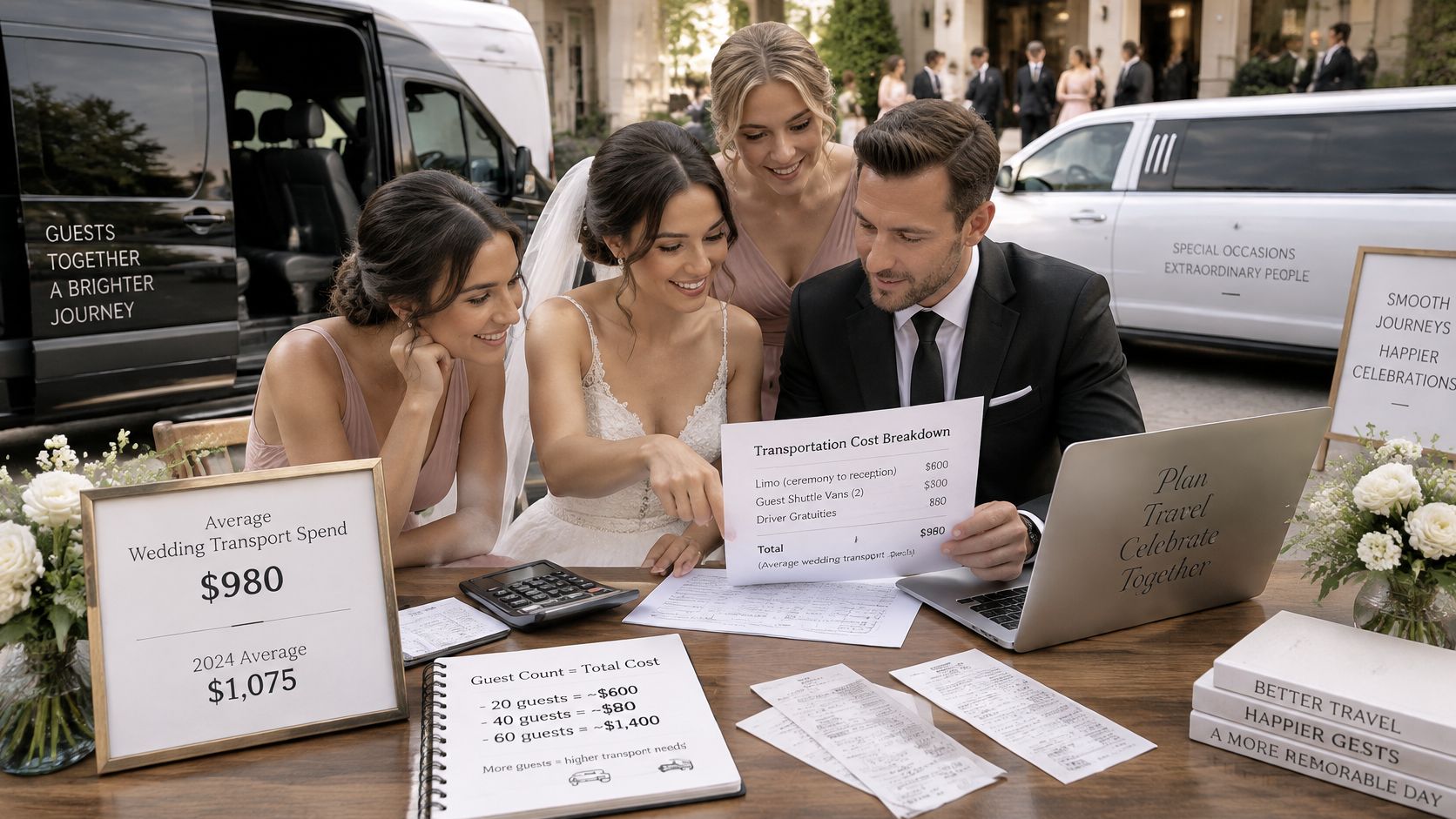
Use a wedding spending benchmark to frame the discussion, not to predict a Cancun quote. The Knot's wedding transportation guide reports approximately $980 in average transportation spending in its earlier Real Weddings Study and $1,075 in its 2024 study of 16,956 U.S. couples; its guest-count figures include $583 for weddings with 50 or fewer guests and nearly $1,200 for weddings with more than 100 guests.
Wedding transportation spending benchmarks
| Study measure | Average transportation spending |
|---|---|
| Earlier Real Weddings Study | Approximately $980 |
| 2024 Real Weddings Study | $1,075 |
| Weddings with 50 or fewer guests | $583 |
| Weddings with more than 100 guests | Nearly $1,200 |
These are wedding transportation averages, not bridal-party vehicle rates or local transfer prices. Your quote needs to reflect the actual routes, reserved time, vehicle configuration, and return requirements.
Assign a payer to each journey
Break the budget into ceremony-day cars, airport transfers, photo-stop runs, and reception returns. Assign each line to the couple, attendants, or family before taking deposits. A total labeled transportation hides the disagreements until someone receives a payment request.
A practical arrangement is for the couple to cover the bridal party's required ceremony-day movements. Attendants may cover their own airport transfers or optional personal stops, provided they know that before booking travel. If the couple requires a particular shared transfer, explain who pays before assigning passengers to it.
For a more detailed quote checklist, use our guide to how much wedding transportation costs. Compare the scope of each quote, not just the headline amount.
Cut unnecessary movements, not essential time
A waiting vehicle costs differently from a simple transfer, but releasing it between stops creates another dispatch dependency. Price both arrangements. Keeping the car nearby may be worthwhile when the photo finish time is uncertain or the next departure is tightly scheduled.
Budget priority: Remove an unnecessary journey before removing the time needed to complete an essential one.
Set boarding etiquette alongside the payment plan. Give parents and grandparents first boarding priority where appropriate, and protect the bride's separate vehicle from becoming overflow transport for guests. A casually added passenger can undo both the seating arrangement and the intended private arrival.
Confirm waiting charges, parking, tolls, additional stops, and gratuity treatment in writing. Decide who handles the driver's tip and whether it's already included, so attendants don't collect money outside the venue. Luxury transportation should have a clear scope, not a series of day-of additions nobody authorized.
Lock In Your Bridal Party Transport Plan
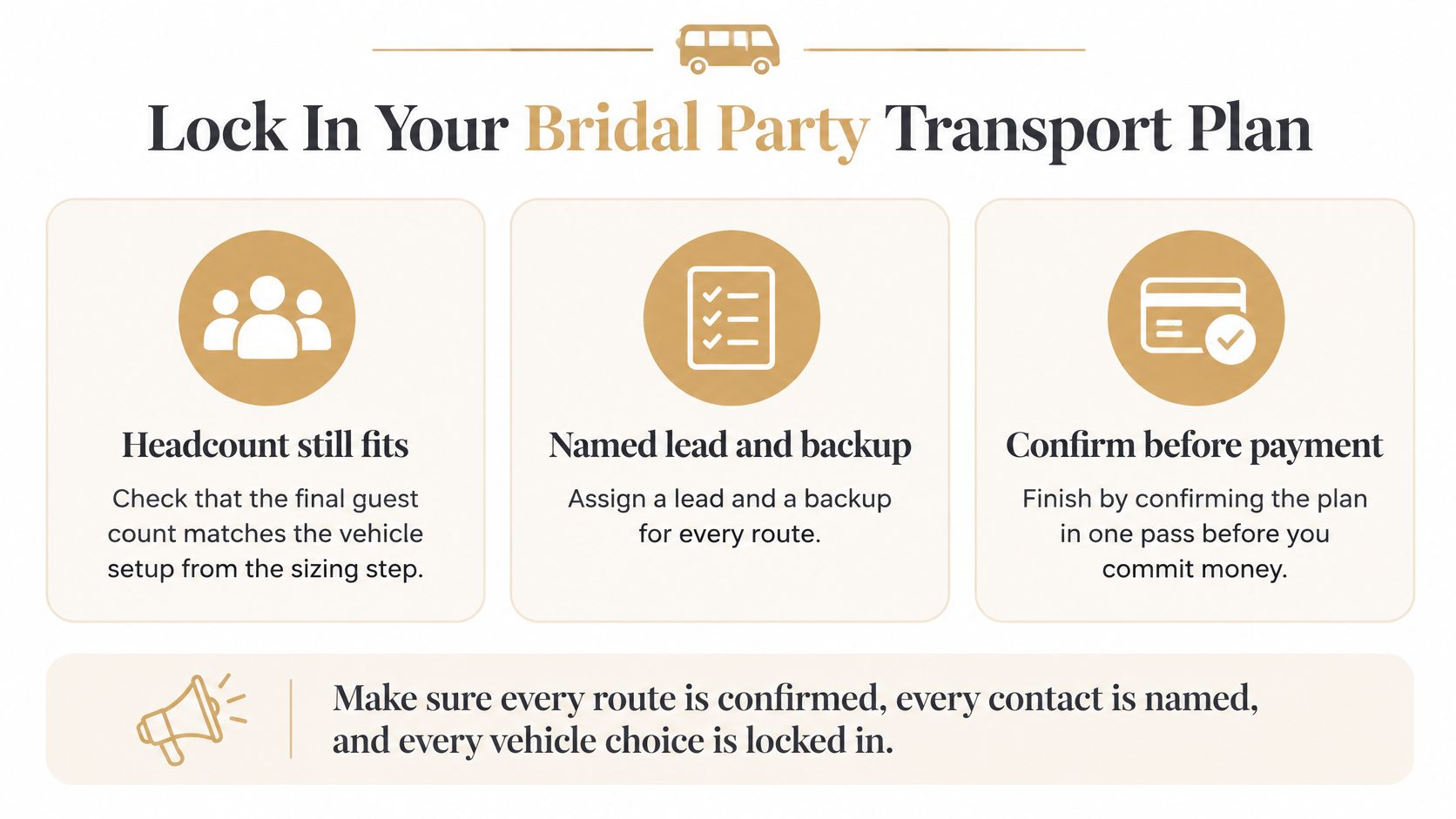
Before payment, reconcile the final headcount, route leads, backups, and departure buffers against the written booking. Compare a full-day chauffeur arrangement with separate transfers on responsibility as well as price: fewer handoffs can simplify coordination, but only if the reserved service covers the complete itinerary.
Resolve the booking questions
- Waiting time: Does the quote cover photo-stop waiting?
- Continuity: Will the same chauffeur stay throughout the reserved period?
- Equipment: How will child seats and mobility devices be accommodated?
- Airport cancellation: What terms apply to canceled transfers?
- Changes: Is the written amendment deadline compatible with the wedding schedule?
Our Dedicated Chauffeur service covers airport transfers, corporate events, weddings, and special occasions; our Suburban RST accommodates up to 7 passengers, subject to the equipment and space your itinerary needs. Scheduling changes or changes to other transportation services must be made before 6:00 PM the day prior to the scheduled pickup.
Book the agreed itinerary, then send the passenger list, arrival sheet, and driver instructions at least a week before the wedding as a planning target. Reconfirm pickups the day before and leave the signed booking with the planner.
Unique Private Transportation offers private airport transfers, luxury transportation, and coordinated wedding travel across Cancun and the Riviera Maya. Visit Unique Private Transportation with your passenger list, flight details, and ceremony itinerary to arrange vehicles and timed pickups around your bridal party's actual needs.