

You've finally stepped off a delayed overnight flight into Cancun International Airport. The air feels warm, your phone is nearly out of battery, and the arrival hall is busy with families, hotel representatives, taxi drivers, and travelers searching for a familiar name. Your planned pickup time has already passed, but your vacation still depends on what happens next.
Delays in flights rarely end when the aircraft reaches the runway. A late arrival can affect immigration, baggage collection, hotel check-in, dinner reservations, excursions, and the driver waiting outside the terminal. The difference between a stressful airport experience and a calm handoff usually comes down to preparation, live flight information, and a transportation provider with a practical plan for changing arrival times.
Table of Contents
- Landing Late and the Waiting Driver
- What Actually Causes Delays in Flights
- How Airports and Regulators Define a Delay
- The Ripple Effect on Travelers and Onward Plans
- How Cancun Airport Transfers Handle Late Arrivals
- Flight Tracking and Flexible Dispatch Explained
- Choosing Private Transportation Over Taxis and Shuttles
- Quick Checklist for Travelers Facing Delays
Landing Late and the Waiting Driver
The doors open at Cancun International Airport's Terminal 3, and passengers from a delayed red-eye out of Chicago move slowly into the arrivals hall. The floor shines under bright lighting, the coffee stand sends out a warm roasted smell, and every traveler seems to be looking for someone.
One passenger checks the phone again. The driver's name should be on the screen, but no new message has arrived. The scheduled pickup time is long gone, and the airport feels unfamiliar after hours in the air. A taxi queue is visible beyond the terminal doors, but the traveler has already paid for a private airport transfer and doesn't know whether to wait or start over.
Then a chauffeur appears near the coffee stand, holding a printed sign with the passenger's name. He offers a quick greeting in Spanish and English, confirms the destination, and takes hold of one suitcase. The traveler's relief is immediate. After a two-hour delay, the vehicle is still ready, with the air conditioning running inside a pre-parked SUV.
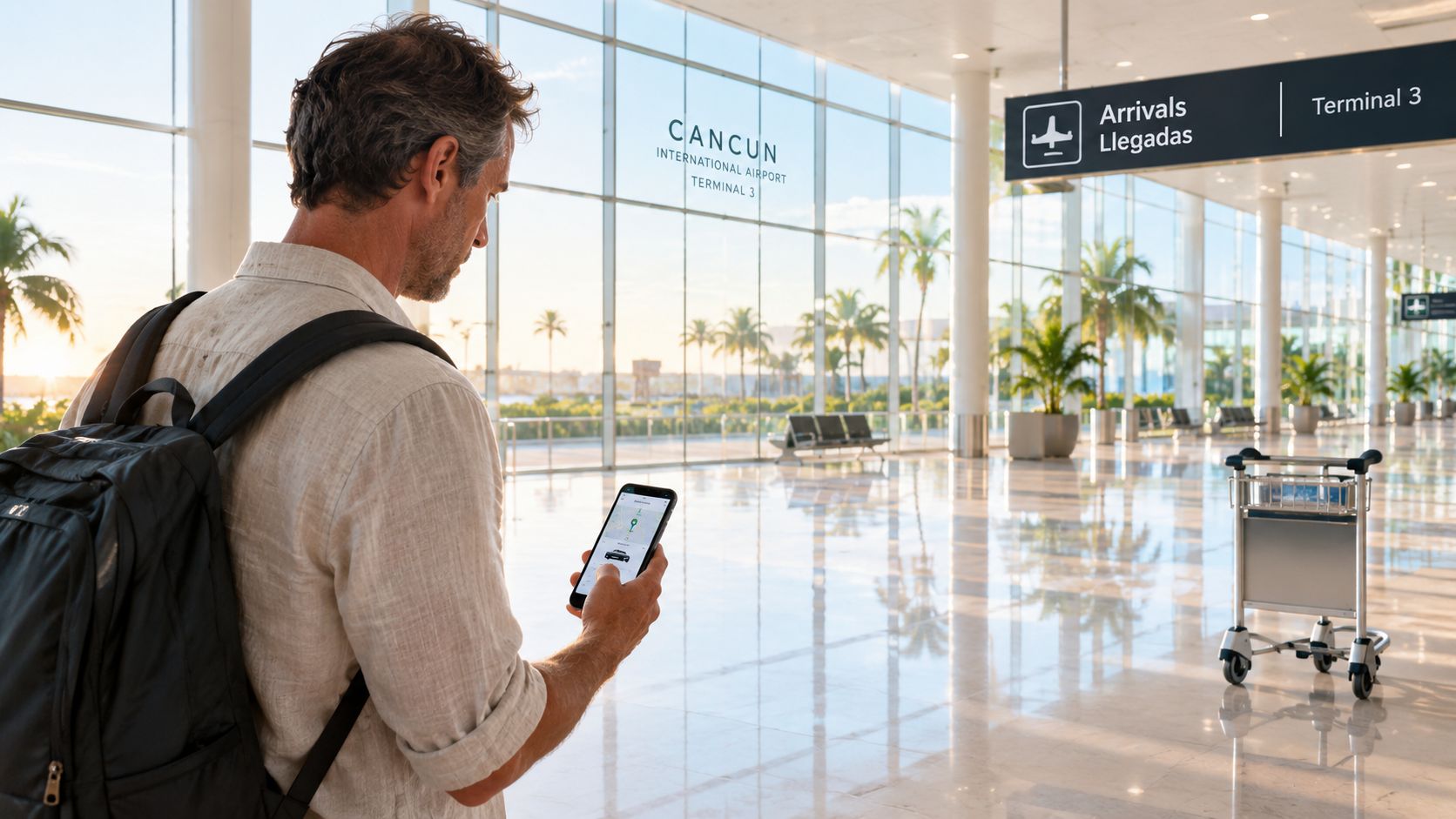
That moment captures the central issue with Cancun airport transportation. The question isn't only why the flight arrived late. It's whether the pickup plan was built around the scheduled landing time or the traveler's actual arrival.
Why the pickup can still work
Airport transportation providers receive flight information, watch for schedule changes, and adjust driver timing when the inbound aircraft moves. Airport guidance for off-airport transportation explains that agencies can monitor flight status, so travelers generally don't need to call about an early or delayed arrival. Travelers should contact the agency if the airline changes the booking to another flight or cancels it. The same guidance warns that transportation without a reservation can involve a 30 to 40 minute wait at the airport, making a confirmed meet-and-greet especially useful after a disruption. (Cancun airport arrival instructions)
A well-organized transfer also depends on clear travel information. Travelers managing executive trips, family itineraries, or several connecting services may benefit from an executive travel itinerary template guide that keeps flight details, hotel information, contact numbers, and ground transportation in one place.
The practical lesson is simple. A scheduled pickup time is only the starting point. Live tracking, a defined waiting policy, bilingual coordination, and a clear meeting point turn a late landing into a manageable arrival.
What Actually Causes Delays in Flights
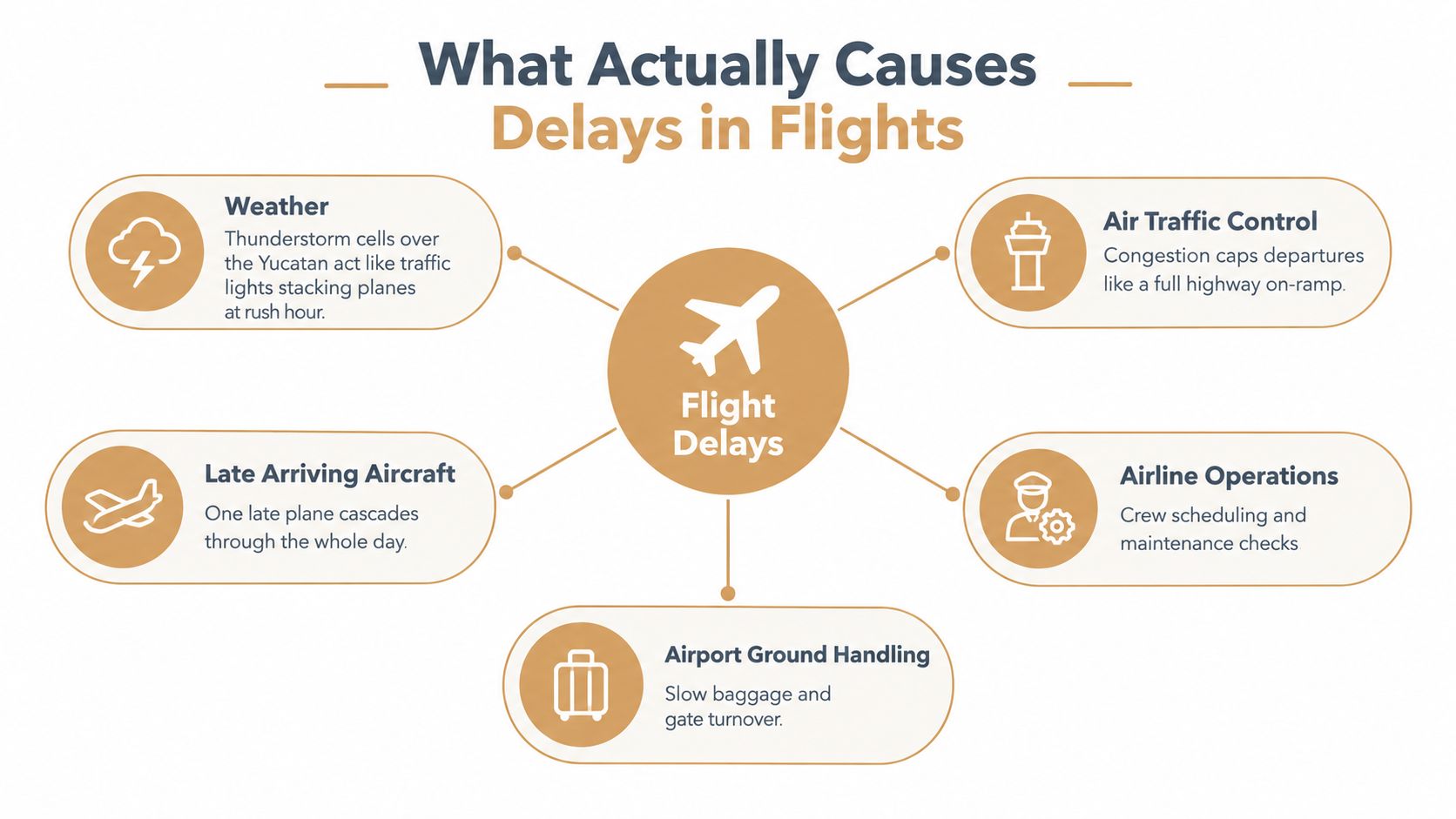
A flight delay usually has more than one moving part. The five categories used in official delay reporting help explain why an aircraft can leave late even when the weather at Cancun looks clear.
Weather changes the flow
Thunderstorm cells over the Yucatán can act like traffic lights stacking cars at rush hour. Controllers may need to route aircraft around unsafe airspace, slow arrivals, or increase spacing between planes. A Caribbean flight approaching Cancun can circle, hold, or follow a longer route even when the terminal itself is operating normally.
Weather also affects flights far from Cancun. A storm over Houston, Miami, or a connecting airport can delay the aircraft before it ever begins the trip south.
Air traffic control manages a crowded system
Air traffic control restrictions work like a full highway on-ramp. The runway may be available, but the system can't release every aircraft at once. Congestion over major hubs such as Houston or Mexico City can create departure queues that reach flights bound for the Caribbean, the United States, or Europe.
EUROCONTROL reported that European arrival punctuality reached 76.1% in 2025, while average European departures left 14.6 minutes late for all causes. The review also estimated 18.4 million minutes of en-route ATFM delay and associated airline costs of about €2.4 billion. (EUROCONTROL delay and disruption data)
A late aircraft carries yesterday's problem into today
The late-arriving aircraft category describes a previous flight using the same aircraft that arrives late and pushes the next departure back. A plane arriving from Miami may need cleaning, refueling, baggage unloading, and boarding before it can continue to Cancun. If that first rotation slips, the next flight inherits the delay.
The U.S. Bureau of Transportation Statistics tracks this category separately from carrier problems, weather, national aviation system delays, and security issues. That separation matters because it identifies schedule contagion rather than a single event. (BTS explanation of airline delay causes)
Airline operations include people and machines
Crew scheduling, required rest, and duty limits can affect a Caribbean or transatlantic route when an earlier sector runs late. A mechanical write-up can also require inspection before departure. Airlines may not have a replacement aircraft, crew, or maintenance team immediately available.
EUROCONTROL's 2023 data attributed an average of 4.5 minutes per flight to airline-side delays, including passenger and baggage handling, cargo processing, and technical issues. Airport restrictions added 1.8 minutes, while en-route ATFM delays added 1.9 minutes. (EUROCONTROL delay category data)
Ground handling creates hidden bottlenecks
A flight can reach the airport but remain on the taxiway because its gate is occupied, baggage teams are busy, or ground equipment isn't ready. At the gate, staff must unload bags, service the cabin, connect equipment, and prepare the aircraft for the next departure. One missing piece can hold the whole turnaround.
For a transfer operator, the operational response is clear. A flight can be “on time” at the gate and still arrive after a previous rotation has disrupted the wider schedule. Dispatchers should pair live tracking with buffer-based decisions, not rely only on the original pickup time.
How Airports and Regulators Define a Delay
Travelers often use “delayed” to mean any disruption that changes their plans. Airlines and regulators use more specific definitions. In the United States, the FAA and BTS use 15 minutes or more as the standard threshold for reporting a flight delay. (FAA and BTS delay threshold summary)
That definition gives airlines, airports, and analysts a consistent way to compare performance. It doesn't mean a shorter delay is harmless. A traveler with a tight connection, a prepaid tour, or a driver waiting at Cancun airport may feel the impact immediately.
The European framework uses its own passenger-rights rules and evaluates the circumstances, route, airline responsibility, and length of the disruption. Rather than treating every delay as identical, travelers need to check the applicable rule for the itinerary and the specific assistance or reimbursement available.
| Criterion | U.S. DOT | EU Regulation 261 |
|---|---|---|
| Basic delay measurement | BTS and FAA reporting generally use 15 minutes or more as the delay threshold. | Passenger-rights assessment depends on the flight, route, circumstances, and length of the delay. |
| Main purpose | Measures airline on-time performance and delay causes. | Establishes passenger protections and possible remedies in qualifying situations. |
| What travelers should check | Arrival or departure status, connection options, baggage information, and airline updates. | Eligibility, airline responsibility, assistance rules, and the final effect on the itinerary. |
| Ground-transport impact | A short official delay can still move a pickup beyond the planned window. | A rights claim and a transportation adjustment are separate practical issues. |
Why the number matters operationally
EUROCONTROL's May 2026 data show average departure delay of 11.8 minutes per flight and average arrival delay of 10.4 minutes, while 11.0% of flights were delayed by more than 30 minutes. (EUROCONTROL May 2026 delay report) Those averages show why travelers shouldn't plan only around the typical flight. A meaningful group of passengers experiences a much longer disruption.
The same principle applies to airport transportation. A standardized threshold supports reliable reporting, but a transfer provider must plan around the actual passenger journey. Immigration, baggage, customs, and the walk to the meeting point all happen after landing. A pickup model that recognizes only the scheduled time can leave a traveler waiting even when the airline's official delay appears modest.
The Ripple Effect on Travelers and Onward Plans
A family flying to Cancun from New York starts with a straightforward plan. Their inbound flight is held on the tarmac, and the delay reaches 90 minutes before the aircraft continues. Nobody has lost a suitcase yet, and the airline hasn't canceled the flight, but the rest of the evening has already begun to move.
The airport pickup now falls into rush hour. The family reaches the hotel after midnight instead of during the planned check-in period. A prepaid tour the next morning loses part of its usable time, and a dinner reservation becomes a no-show. Each change looks small by itself. Together, they turn a late departure into a disrupted holiday.
How the chain develops
The sequence often follows a predictable pattern:
- The flight slips: A gate hold or late aircraft pushes the planned arrival later.
- The connection becomes fragile: A missed onward flight may lead to rebooking and an unexpected overnight stay.
- The pickup window moves: A driver scheduled too early may leave, while an unmonitored reservation creates confusion.
- The hotel plan changes: Late arrival can affect check-in, room access, and the timing of prearranged services.
- The activity loses value: Tours, restaurant reservations, ferry connections, and event schedules may not move with the traveler.
A delay can also become a cancellation or schedule change, and those situations require different action. U.S. Department of Transportation passenger guidance covers delays, diversions, cancellations, baggage, and boarding, and requires airlines to provide a one-page summary of passenger rights. (U.S. DOT Fly Rights passenger guidance)
The transportation provider still has a separate operational responsibility. Airline rights don't automatically rearrange a private vehicle, ferry booking, hotel shuttle, or dinner reservation. Travelers need to notify the right parties when the airline changes the flight itself, while a transfer company with flight monitoring can often react to ordinary timing changes without requiring repeated calls.
Practical rule: Treat the flight number as the moving part of the pickup plan, not the original landing time.
For families, the emotional cost matters as much as the financial cost. Parents are managing tired children, luggage, food, phone batteries, and unfamiliar airport directions. A calm driver and a clear handoff won't erase the delay, but they can prevent one disruption from becoming several more.
How Cancun Airport Transfers Handle Late Arrivals
Cancun airport transportation works best when the provider treats the airport as a process rather than a single curbside meeting point. International passengers must move through immigration, collect bags, pass customs, and reach the agreed meeting area. Domestic passengers may follow a different arrival path, so the pickup instructions need to match the flight.
Published airport transfer policies vary. One Cancun transfer provider states that arrival services can wait for delayed flights for up to 2 hours, and can wait up to 1 hour for lost luggage or immigration problems. (Cancun transfer waiting terms) That kind of policy gives travelers a concrete reference, but every reservation should be checked for its own waiting window and conditions.
What the handoff should look like
A professional meet-and-greet normally follows a straightforward sequence:
- The operator identifies the arrival: Dispatch confirms the flight number, terminal, and updated estimated arrival.
- The coordinator prepares the meeting: A bilingual representative holds a sign and stays in the agreed terminal area.
- The passenger confirms identity: The traveler checks the name, reservation details, and destination before leaving the terminal.
- The coordinator guides the group: The representative leads passengers toward the official parking area and the assigned vehicle.
- The chauffeur checks the ride: The driver confirms luggage, child-seat needs, passenger count, and destination before departure.
At Cancun International Airport, a high-volume gateway, that organization matters. The airport handled 39,908,145 passengers in 2023, compared with 30,342,961 in 2022, a 31.52% increase. (Cancun International Airport passenger statistics) A busy terminal creates more movement, more signs, and more opportunities for an unprepared traveler to miss a pickup.
What to send before departure
Save the provider's local contact number, reservation code, flight number, and terminal information. Share the full itinerary if the booking includes a resort, ferry, wedding venue, or multiple vehicles. If a driver must reroute from a standby area after the inbound flight pushes back, accurate details let dispatch make that change without asking the traveler to repeat the entire booking.
For travelers comparing luxury transportation options, this guide to luxury private transportation in Cancun offers useful context on private vehicle arrangements and airport-to-destination service.
Flight Tracking and Flexible Dispatch Explained
Live flight tracking isn't just a screen showing an aircraft icon. A transportation operator combines airline schedule updates, aviation position feeds, and internal dispatch rules to decide when a driver should wait, reposition, or be reassigned.
Airline systems can send schedule changes such as a new departure time, gate update, or estimated arrival. ADS-B and FAA-related feeds can provide airborne position information for flights operating in or around the United States. An operator dashboard then turns those signals into actions, such as delaying a vehicle's release, sending a message to the passenger, or moving a standby driver closer to the airport.
From signal to driver decision
Consider a Cancun-bound flight whose new estimated arrival becomes 22:40. A dispatcher checks whether the aircraft is airborne, confirms the terminal, compares the revised arrival with the passenger's transfer booking, and keeps the assigned vehicle available. The passenger receives a WhatsApp update with the meeting instructions, while the driver receives the revised operating time.
Flexible dispatch uses buffers rather than assuming every reservation will follow the original schedule. A standby vehicle can remain near the airport instead of returning to a distant depot. If the flight changes again, the operator can adjust the assignment before the passenger reaches the arrivals hall.
| Trigger Signal | Threshold | Driver Adjustment |
|---|---|---|
| Gate departure changes | Confirmed pushback change | Hold the vehicle and update the pickup estimate. |
| Taxi or airport surface delay | Sustained ground delay | Keep the driver in the standby zone and avoid an unnecessary curbside wait. |
| Airborne ETA changes | New estimated arrival | Recalculate the meeting time and send the traveler updated instructions. |
| Diversion or cancellation | Confirmed airline disruption | Pause the pickup and contact the traveler about the new flight or revised service. |
| Passenger delay after landing | Immigration, baggage, or customs issue | Apply the reservation's waiting policy and maintain coordinator contact. |
The thresholds should be operational rules, not promises that every provider uses the same timing. A 20-minute gate push, a 50-minute taxi delay, or a revised ETA can each require a different response depending on the vehicle's location, the terminal, and other active reservations. The goal is to protect the handoff without sending a driver to wait blindly.
Travelers who want a broader explanation of why flight monitoring matters can also review this resource on how to book Hamptons Leisure Limo transfers. The underlying principle applies to Cancun as well. Accurate information is useful only when someone acts on it.
For a practical look at arranging a Cancun car service, travelers should check the provider's vehicle options, contact process, meeting instructions, and policy for flight changes before booking.
Choosing Private Transportation Over Taxis and Shuttles
A late flight changes the value of ground transportation. A taxi line may be manageable after an early arrival, but it can feel very different when a family reaches the terminal late, tired, and carrying beach equipment. Shared shuttles create another constraint because the vehicle may wait for other passengers or make several stops before reaching the first hotel.
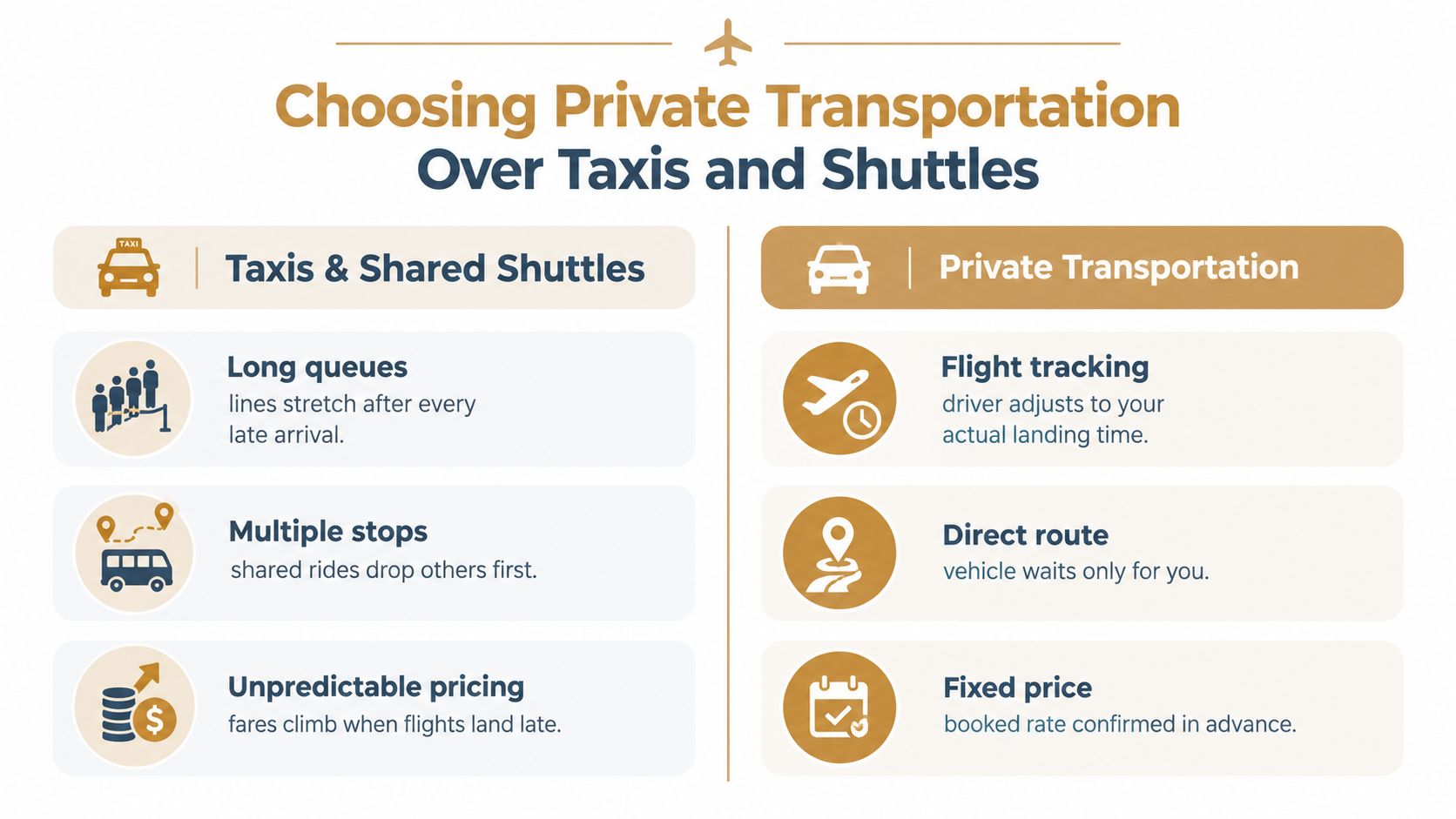
Private transportation treats the changed arrival as part of the booking. The driver can monitor the flight, the operator can preserve the reservation during the published waiting window, and the vehicle can be selected for the actual group size and luggage needs. That matters for families with infants, wedding parties, corporate groups, and leisure travelers who don't want the first part of the vacation to involve negotiating a ride.
The cost of a delay-aware choice
The price of a private transfer isn't the only cost to consider. A traveler should also weigh the time spent in a queue, the risk of multiple hotel stops, the possibility of missing a ferry or dinner booking, and the stress of finding a vehicle after midnight.
A cancun car service or private airport transfer can also provide a direct route to a hotel, villa, ferry terminal, or event venue. With a fixed reservation, the traveler knows who is responsible for the pickup and where the meeting will happen. That clarity is particularly valuable when phone service is unreliable or several arrivals are coming through the terminal at once.
The same planning principle applies in other destinations. Travelers researching how to navigate Barcelona with St Christopher's can see why airport connections, local transport choices, and arrival timing deserve attention before a trip begins. Cancun presents its own conditions, but the decision remains similar: choose transport that matches the way the itinerary can change.
This video offers another visual comparison of private and shared transportation choices.
Travelers planning cancun luxury airport transfers should look for flight monitoring, bilingual support, a named meeting point, transparent vehicle details, and a written waiting policy. Those features don't prevent an airline delay. They reduce the number of new decisions the passenger must make after landing.
For a point-to-point journey rather than an airport pickup, this explanation of point-to-point transportation can help clarify how a direct private ride differs from a shared route.
Quick Checklist for Travelers Facing Delays
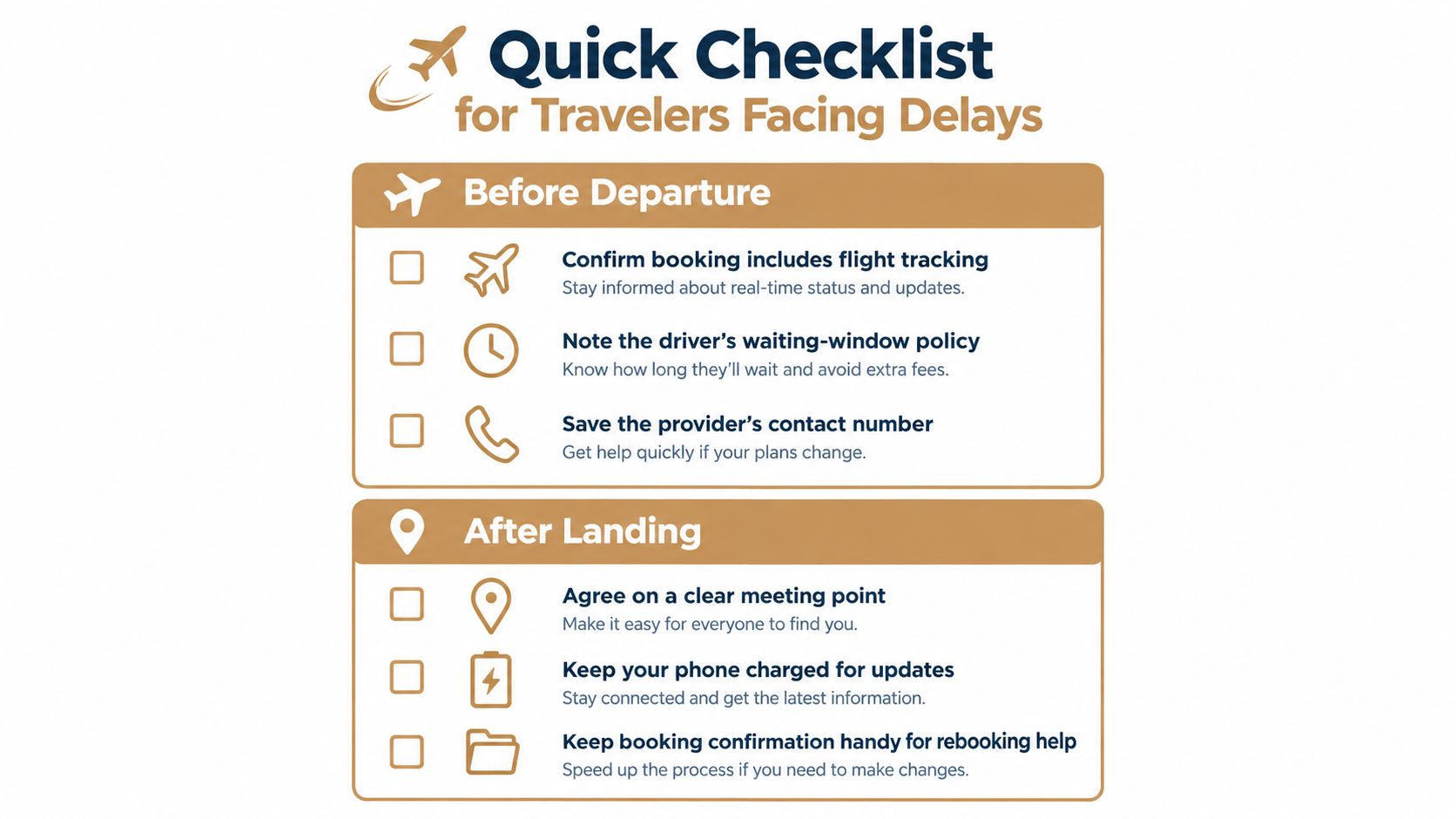
A delay-aware transfer begins before the aircraft leaves. The traveler doesn't need to predict the cause of the disruption, but should make sure the reservation can respond when the arrival changes.
Before departure
- Confirm flight tracking: Ask whether the operator monitors the flight automatically and adjusts the pickup time.
- Read the waiting policy: Check how the company handles delayed flights, early arrivals, lost luggage, immigration, and cancellations.
- Save the contact details: Store the dispatch number, messaging channel, reservation code, and emergency contact in your phone.
- Share the complete itinerary: Include the hotel, resort, ferry, wedding venue, or later stop if the ride involves more than one destination.
- Check vehicle requirements: Request child seats, extra luggage space, pet arrangements, or accessibility support before the journey.
During the delay
- Watch for confirmed changes: Follow airline notifications, but distinguish a tentative estimate from a confirmed rebooking.
- Contact dispatch after a major update: Send the provider the new flight number if the airline changes the booking to another flight.
- Protect the connection: Rebook only when the missed connection is unavoidable and the airline confirms the available option.
- Keep the phone usable: Charge the device when possible and preserve the reservation message for the arrival handoff.
After landing
- Move through the terminal promptly: Complete immigration, baggage collection, and customs without unnecessary detours.
- Use the agreed meeting point: Look for the coordinator, sign, or terminal instruction listed in the reservation.
- Confirm the vehicle and destination: Match the reservation details before loading luggage.
- Report changes before leaving: Tell dispatch about a new hotel, an additional stop, or a changed destination before the vehicle exits the airport area.
The checklist works because it combines traveler preparation with operator flexibility. Flight tracking handles the changing aircraft information, while a buffer-based dispatch plan protects the vehicle assignment. Together, those practices make unique private transportation more dependable during the part of travel that passengers can't control.
Unique Private Transportation provides Cancun airport transfers, point-to-point rides, luxury private tours, and group transportation with live flight monitoring, bilingual coordination, and premium vehicles. If you want your pickup to adapt to a delayed or early arrival, visit Unique Private Transportation and arrange the details before your flight.