
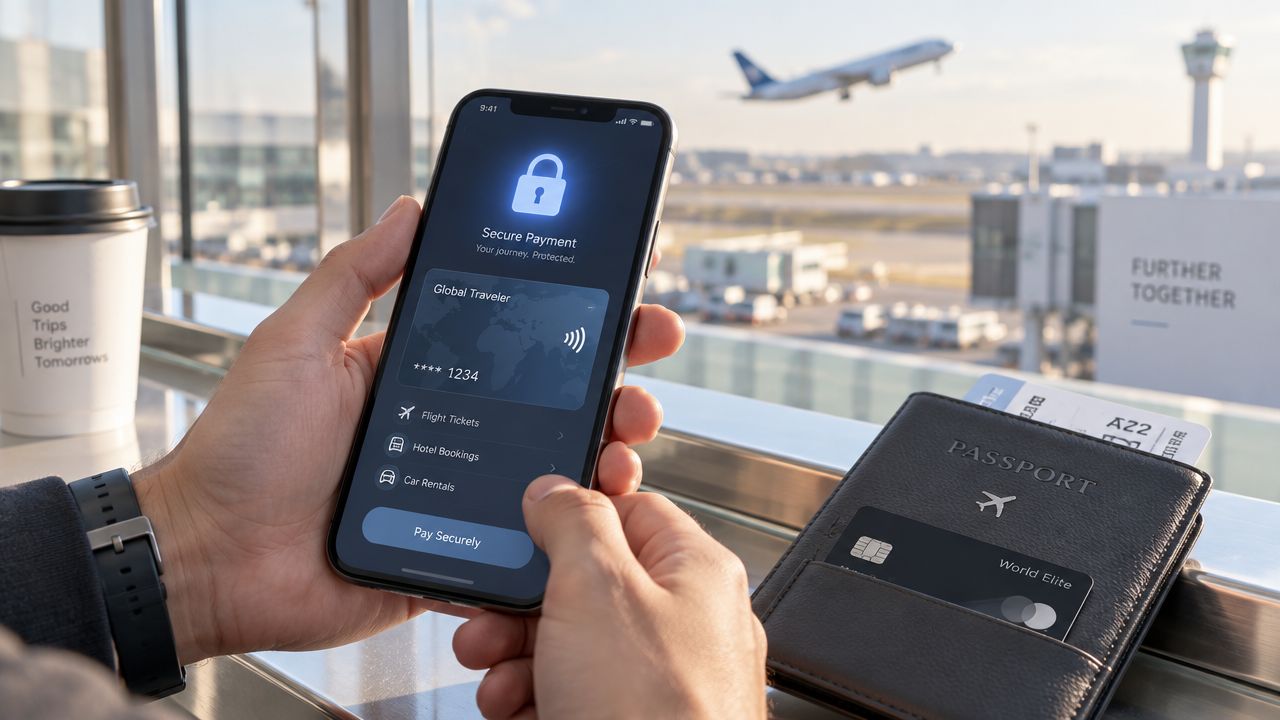
Maria is in Chicago, booking a private ride from Cancún International Airport to her Hotel Zone resort. Her flight is approaching, her phone is in one hand, and the checkout page is loading in the other. Then the questions begin: Will a foreign merchant store her card safely? Is the URL genuine? Should she use a debit card to avoid exposing her credit account, or would that remove useful payment protections?
Those doubts are reasonable. Online payment fraud is a large and growing risk category. Juniper Research forecasts more than $362 billion in cumulative online payments fraud from 2023 to 2028, while industry coverage estimates that merchants could lose $66.5 billion to online payment fraud in 2026 alone and that global retailers lost 3.5% of online revenue to fraud in 2025. A Cancun airport transfer may be a smaller purchase than a hotel or tour package, but it still involves a card-not-present transaction, advance payment, and a service that must be delivered later.
Table of Contents
- Paying for a Cancun Airport Transfer Online Without Second Guess
- What Secure Online Payments Mean
- Comparing Cards, Wallets, Bank Transfers, and BNPL
- Tokenization and 3-D Secure Demystified
- PCI Compliance and What It Signals to Travelers
- Two Travelers Booking the Same Luxury Transfer
- Smart Habits for Paying Online While Traveling
Paying for a Cancun Airport Transfer Online Without Second Guess
Maria isn't only asking whether the checkout button works. She's also asking a more useful question: which payment method protects me, and which signals prove this booking site deserves my trust?
Her hesitation comes from several directions at once. The merchant is in another country, the URL may be unfamiliar, the booking may be last-minute, and the transfer company may request payment before she has met the driver. If she uses a debit card, she may worry about direct access to her bank balance. If she uses a credit card, she may worry that the merchant will retain the full card number.
For a traveler researching cancun airport transportation, those concerns should shape the booking decision. A polished vehicle gallery or a promise of luxury transportation doesn't prove that the payment flow is safe. The useful evidence appears in the checkout process, the payment processor, and the information the operator provides after payment. A clear confirmation, pickup instructions, refund terms, and a way to contact the company matter because payment security protects more than the card. It also helps establish what was purchased and what the operator agreed to deliver.
The three protections behind a safer checkout
Think of secure payment as a three-part arrangement:
- Network protection: Your browser should send information through encrypted HTTPS, so someone intercepting traffic can't read the payment details in transit.
- Merchant compliance: The operator should use a reputable processor and systems designed to limit exposure of card data.
- User habits: You still need to verify the URL, avoid suspicious ads, approve legitimate bank prompts, and keep the confirmation.
The same logic applies whether you're booking a private transportation Cancun airport service, a hotel, or a ferry connection. A traveler can use the Cancun car service booking guide to understand the practical details of arranging a ride, but the payment page still deserves its own inspection.
Practical rule: Don't judge a payment page by appearance alone. Check the address, the processor, the verification step, and the confirmation record before you approve the charge.
Cancún is a high-volume gateway. The airport handled 39,908,145 passengers in 2023, a 31.52% increase over 2022, according to Cancún International Airport statistics. That volume makes advance booking useful, but it also means travelers encounter many operators, ads, and lookalike pages. Secure online payment methods help you separate a convenient booking from an unsafe one.
What Secure Online Payments Mean
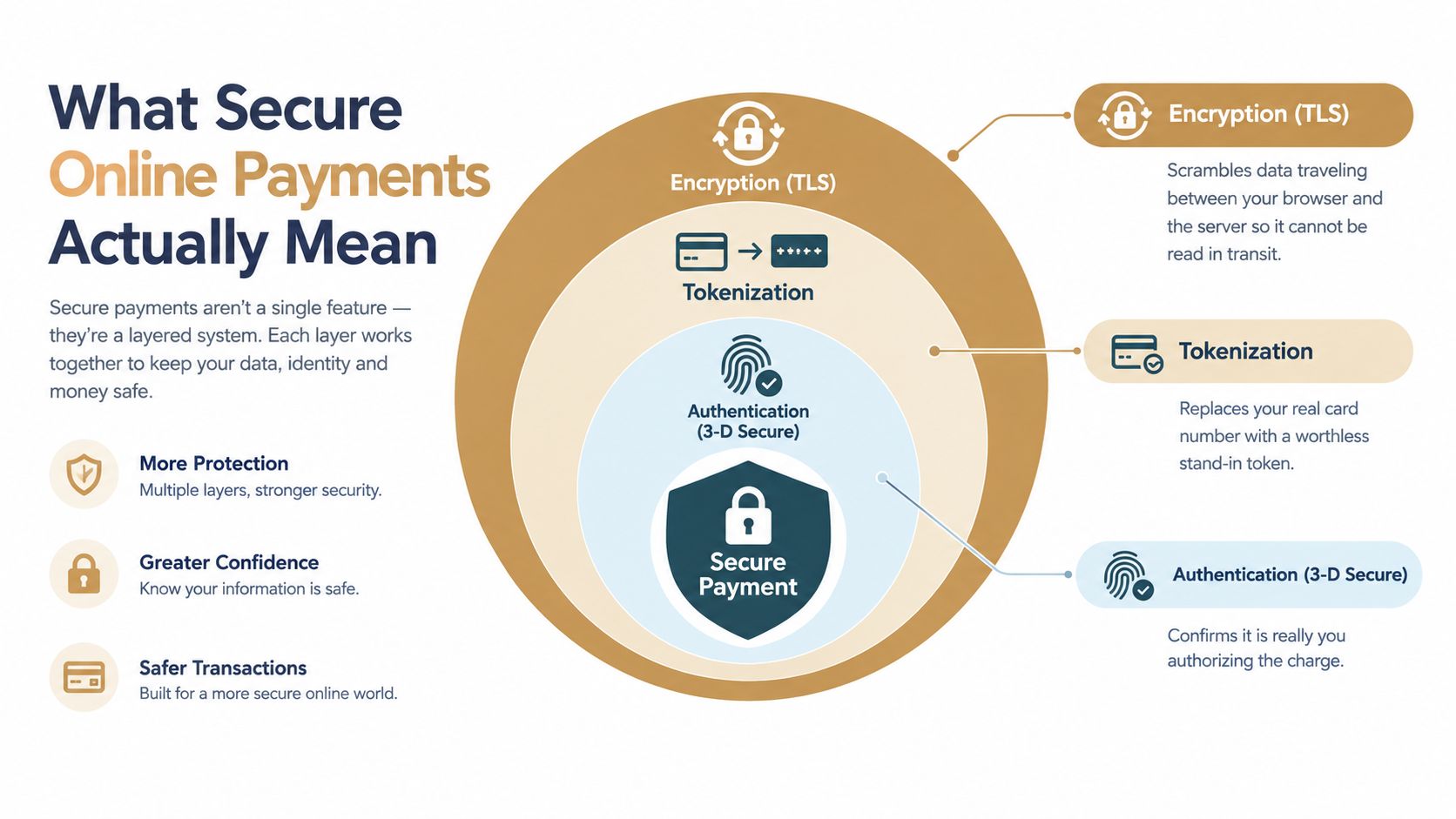
You are booking a Cancun airport transfer from your phone, entering an arrival date, hotel, and card details while watching the clock. A secure payment is not just a green padlock. It is a layered process that protects information in transit, limits the card data a merchant keeps, and verifies that the person approving the charge is the legitimate cardholder.
A sealed envelope provides a useful comparison. Encryption seals and scrambles the message while it travels. Tokenization replaces the original card number with a reference that is far less useful to someone who steals it. Authentication sends the transaction through a checkpoint that confirms you approved the payment.
Layer one, encryption in transit
On a legitimate booking page, TLS encryption scrambles information moving between your browser and the server. An interceptor should not be able to read the card number as it travels.
For a Cancun airport transfer, that protection covers the form containing your arrival date, hotel, phone number, and payment details. Check for HTTPS and inspect the spelling of the domain before entering anything. HTTPS does not establish that a company is honest, but an unsecured payment form is a clear reason to leave.
Layer two, tokenization after submission
Tokenization replaces the primary account number, or PAN, with a surrogate token. The merchant or payment system can refer to that token without retaining the original card number in the same form. PCI guidance describes tokenization as PAN substitution. A token-only environment can also reduce PCI DSS scope because the token has no exploitable value without the controls required to convert it back.
Suppose you return to Cancun and authorize a change to a stored transfer booking. The token can identify the approved payment method without giving the transport operator a reusable card number. It does not stop every fraud attempt, but it lowers the value of a stolen merchant database and limits the damage if card details are exposed.
Layer three, authentication
Authentication checks whether the person authorizing the charge is the legitimate cardholder. EMV 3-D Secure shares more transaction information between the merchant and card issuer. The issuer can approve a low-risk purchase without friction or request an extra step, such as a bank-app approval, code, or biometric prompt. Biometric authentication is projected to grow by 47% over five years, according to CNBC Select's overview of safe payment methods.
A one-time code does not make a fake website legitimate. It confirms the merchant and amount shown in the issuer's prompt, so never approve a request you did not initiate. For a last-minute Cancun transfer or a booking changed from abroad, the safest checkout combines encryption, tokenization, authentication, and your own careful review.
Comparing Cards, Wallets, Bank Transfers, and BNPL
Travelers usually choose among four payment routes for a booking: cards, digital wallets, bank transfers or direct debits, and buy-now-pay-later services. Each can be safe when the merchant, processor, and account controls are sound. The right choice depends on the booking value, how quickly you need confirmation, and what recourse your financial institution provides.
| Method | Key Security Feature | Main Weak Spot | Best Travel Use Case |
|---|---|---|---|
| Credit or debit card | Issuer verification, dispute processes, and possible card benefits | Card details can be exposed on a fake or poorly designed checkout | A solo traveler or family booking who wants a familiar payment route |
| Digital wallet | Tokenized device credentials and biometric or device approval | Phishing, stolen devices, and fake payment prompts can still deceive users | Mobile checkout from a trusted phone, especially for a last-minute ride |
| Bank transfer or direct debit | Payment moves through a bank-controlled account relationship | Recovery can be harder after an authorized scam or wrong recipient | A verified high-value luxury transportation booking with an established operator |
| BNPL | Installment controls and an account-based approval flow | Extra account risk, fees or terms, and a hard credit check may apply | A traveler who needs installments and understands the provider's conditions |
Cards and digital wallets
Credit cards often suit an international booking because the issuer may provide dispute procedures and additional travel-related protections. Debit cards can work, but the money leaves a bank account directly, so transaction alerts and account monitoring deserve extra attention.
Digital wallets such as Apple Pay, Google Pay, and PayPal reduce the need to type the full card number into the merchant page. In the United States, these wallets accounted for about 40% of online spending in 2025, according to CNBC Select. The same source reports that 54% of consumers choose payment methods they trust, while 39% increased their use of bank transfers and 32% used digital wallets more often.
A wallet is especially practical for a solo traveler booking a cancun car service from a phone. It isn't a free pass, though. Confirm the merchant name before approving the wallet prompt, and don't follow a payment request sent through an unexpected message.
Transfers and BNPL
A bank transfer may suit a high-value SUV reservation or a larger group booking, but verify the recipient through an independent channel before sending funds. Direct transfers can be difficult to reverse when a scammer persuades you to authorize the payment yourself.
BNPL may split the fare into installments, but travelers should read the repayment terms and understand whether the provider performs a hard credit check. For a broader look at BNPL integration paths for Portreeve, see this guide to buy-now-pay-later companies. For a solo ride, a card or wallet is usually simpler. Families may prefer a credit card for a clear booking record, while groups arranging unique private transportation should verify the merchant before using a transfer or installment product.
Tokenization and 3-D Secure Demystified
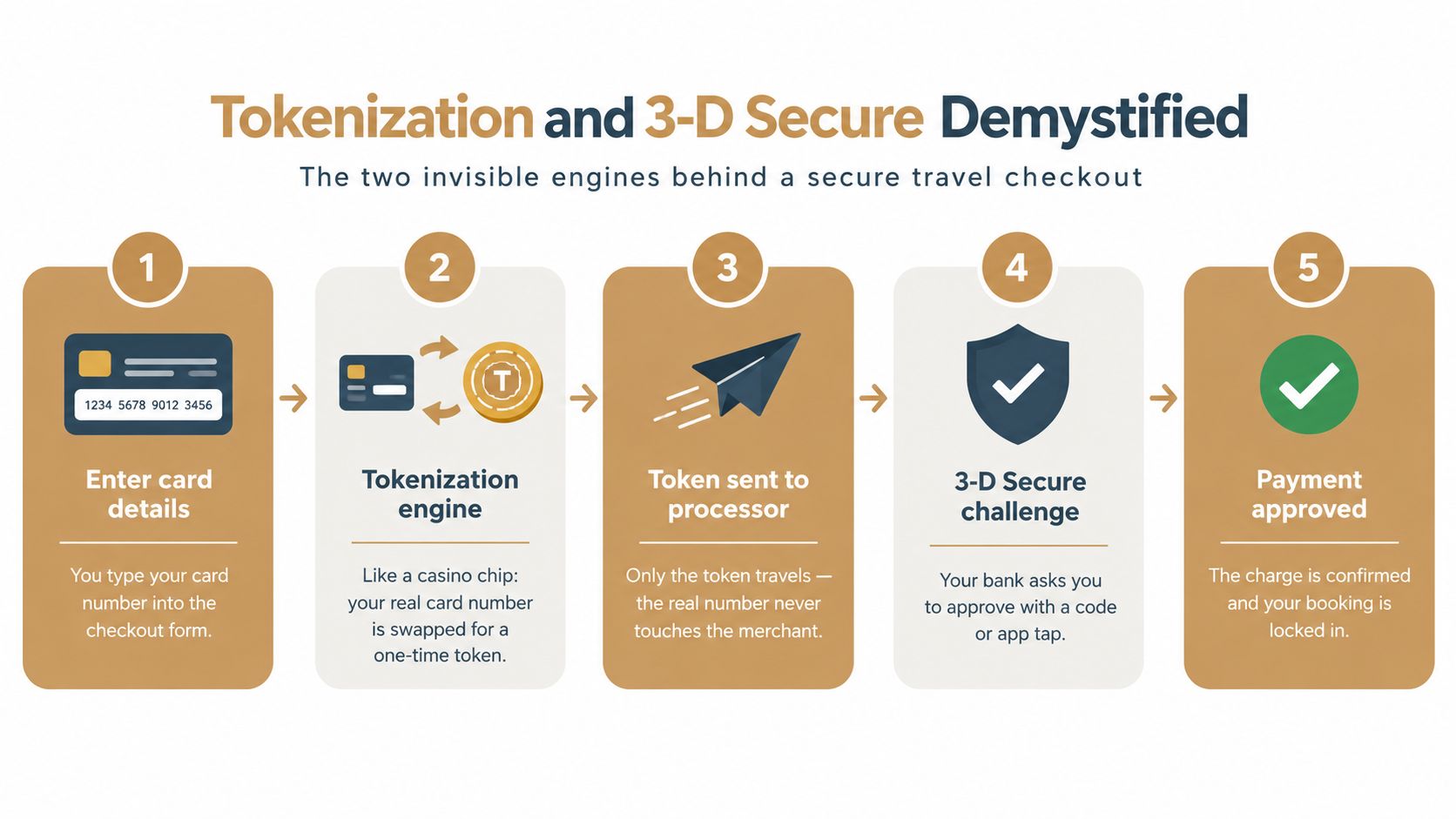
Tokenization and 3-D Secure protect different parts of an online payment. Tokenization protects the payment credential from unnecessary exposure, while 3-D Secure checks whether the person approving the charge is authorized to use it.
You book cancun luxury airport transfers from your phone before an international trip. The checkout may follow this sequence:
- You enter your card number on the payment page.
- The payment gateway sends that number through tokenization.
- The merchant receives or uses a token instead of depending on the original PAN.
- The card issuer evaluates the transaction through 3-D Secure.
- Your bank may request an app tap, biometric approval, or one-time code before authorizing the charge.
Tokenization works like a key-card system in a secure hotel. The card grants access inside that system, while the underlying master key remains protected. A payment token similarly represents an approved credential within the processor's controls. The transfer company can use it to support the transaction without storing the original card number, reducing the places where that number is exposed.
Why the extra approval matters
Visa reports about 11 basis points of fraud for authenticated ecommerce transactions, compared with 20 basis points for non-authenticated ecommerce transactions, a roughly 45% reduction, in its EMV 3-D Secure material. EMVCo explains how 3-D Secure lets issuers and merchants exchange richer transaction data, which supports risk-based authentication.
A low-risk booking may pass without another prompt. A foreign purchase, new device, unusual location, or last-minute change can lead to an extra check. If your bank asks you to approve a Cancun transfer, verify the merchant name and amount before tapping. A fake approval request can still exploit a rushed traveler.
Network tokenization, associated with card networks such as Visa and Mastercard, and PSP tokenization, used by payment service providers such as Stripe or Adyen, operate at different points in the payment chain. Both can reduce the raw card data exposed to the merchant. Neither confirms that the transfer operator is trustworthy, that the route and pickup details are correct, or that the refund process is clear.
PCI Compliance and What It Signals to Travelers
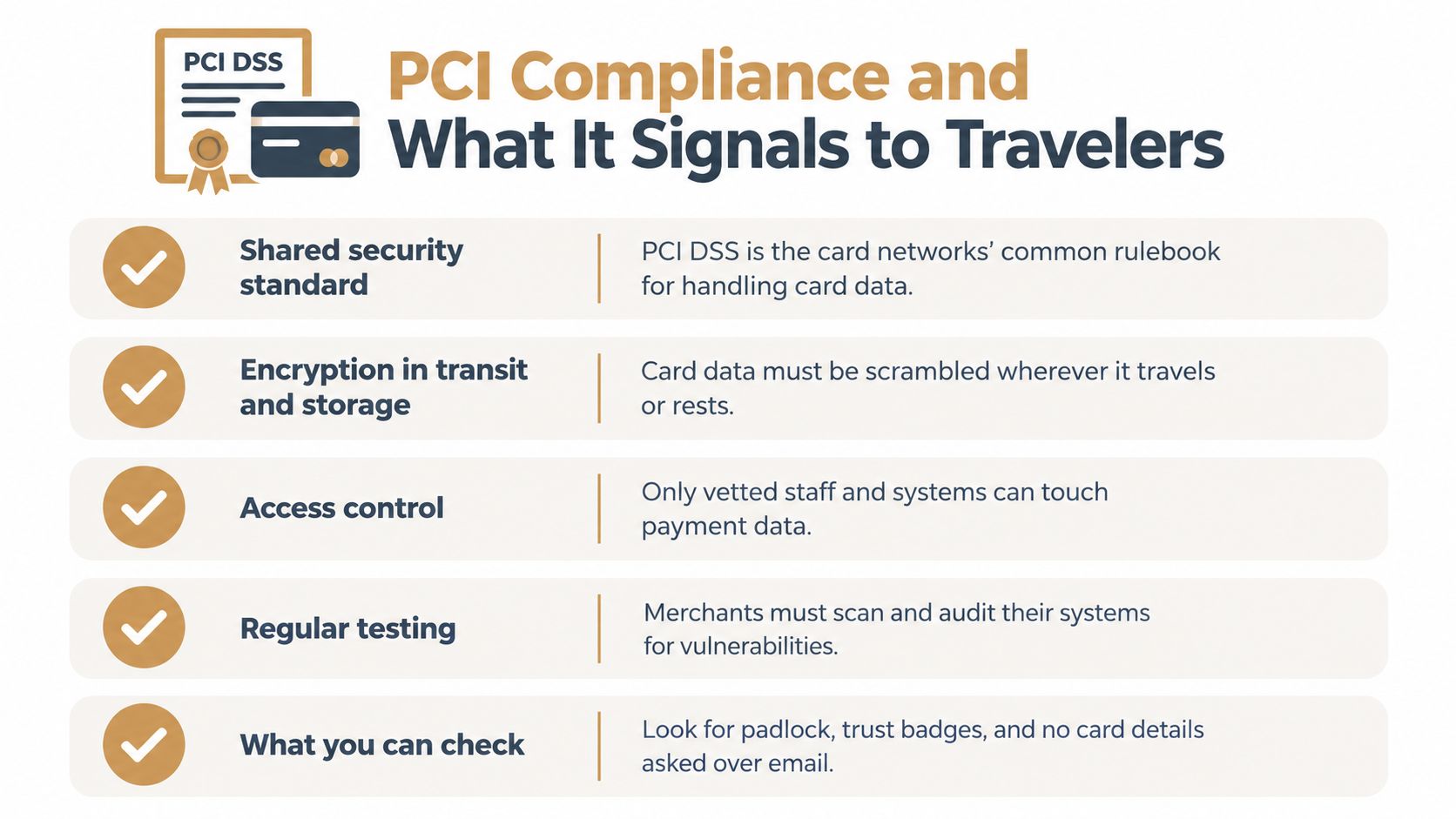
PCI DSS is the shared payment-security rulebook used across the card ecosystem. A processor described as PCI DSS Level 1 aligns with the highest payment-security compliance standard, according to travel merchant-account guidance from Paykings.
Travelers won't usually see the audit paperwork, but they can understand what the label is intended to signal. A serious payment environment should protect cardholder information in transit and at rest, restrict access to authorized personnel and systems, test networks for weaknesses, and maintain documented security procedures. Compliance is a baseline control, not a guarantee that every booking site is honest.
Visible signs behind the invisible controls
A Cancun transfer website should give you practical evidence before requesting payment:
- Correct HTTPS address: The browser should show HTTPS, and the domain should match the operator you intended to visit.
- Recognizable processor: A redirect to PayPal, Stripe, or another known payment page is generally easier to evaluate than a form that asks the operator to handle raw card details directly.
- Clear policies: Review refund, cancellation, privacy, and data-retention terms before paying.
- Traceable confirmation: The receipt should identify the service, date, route, amount, and contact method.
- Independent support: A working phone number or responsive support channel helps you verify suspicious payment instructions.
A trust badge is useful only if it links to a real verification page. A logo pasted into a footer proves little. Travelers can also review an operator's privacy policy to see how it describes information handling and customer requests.
What compliance doesn't tell you
PCI DSS doesn't confirm that a vehicle will arrive, that the pickup time is correct, or that a social-media account belongs to a legitimate operator. It also doesn't stop a traveler from authorizing a scammer's payment after clicking a convincing phishing link.
Businesses that process payments should understand the operational consequences of failing these controls. A plain-language explanation of how merchants can avoid PCI DSS fines with Paylithix can help explain the difference between a formal security program and a decorative badge.
Use PCI language as one trust signal among several. The safest booking decision combines a secure processor, consistent company details, transparent policies, and a confirmation you can verify.
Two Travelers Booking the Same Luxury Transfer
Maya lands in Cancun after a redeye and books a luxury SUV while connected to airport Wi-Fi. She checks the address carefully, confirms HTTPS, and chooses a familiar card-network checkout rather than typing her card into an unfamiliar form. Her bank sends a 3-D Secure approval to its app, and she reviews the merchant name before authorizing it.
The confirmation email includes the route, pickup instructions, driver details, and vehicle information. When her flight changes, she updates the pickup time through the operator's portal. The dispatch record changes without creating a second charge, so Maya has one booking and one payment trail.
A safer booking leaves a paper trail
Maya saves the confirmation as a screenshot and keeps the support number in her phone. She also checks that the receipt identifies the service as a private airport transfer rather than a vague online purchase.
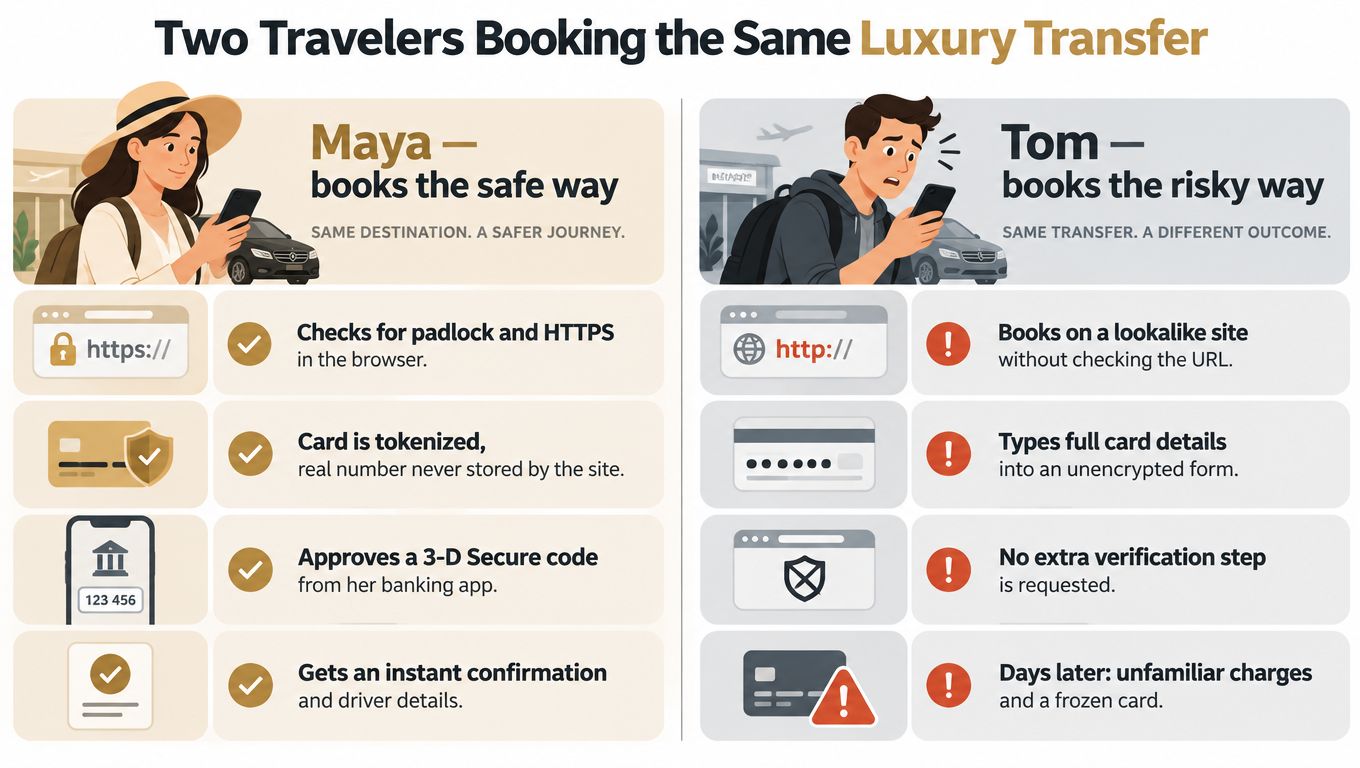
Marco arrives on the same evening and takes a different route. A pop-up ad leads him to a cheaper-looking site with a similar name. He types his card details directly into the operator's form over public Wi-Fi, sees no additional verification step, and receives only a generic PDF voucher. The voucher gives no driver name, plate information, or clear support contact.
Later, Marco notices a duplicate charge. His pickup time isn't honored, and he has difficulty proving exactly what he purchased because the voucher lacks an itemized description. The low price wasn't the only warning sign. The combination of a lookalike URL, direct card entry, public Wi-Fi, no 3-D Secure challenge, and weak confirmation created a fragile booking.
Before you approve: Confirm the domain, use a recognized processor, treat an unexpected 3-D Secure prompt as a warning rather than an inconvenience, and keep the itemized receipt.
A 3-D Secure challenge isn't required in every legitimate transaction, so its absence alone doesn't prove fraud. It does mean you should examine the other signals more carefully, especially when the booking is cross-border or the website appeared through an unsolicited advertisement.
Smart Habits for Paying Online While Traveling
A security-aware concierge would hand you a short checklist before pickup. Use it when booking from Chicago, amending a reservation in a resort lobby, or paying a deposit while standing at the gate.
- Use a card or wallet for unfamiliar international merchants: These options usually give you a clearer transaction record than sending money directly to an account you haven't independently verified.
- Turn on transaction alerts: Your issuing bank can notify you when a charge is attempted, helping you spot duplicate or unexpected activity quickly.
- Avoid public Wi-Fi for checkout: Switch to mobile data or a trusted private network when entering payment details or approving a bank prompt.
- Inspect the payment page: Check HTTPS, the exact domain, the merchant name, and whether the checkout uses a recognizable processor.
- Keep proof of the booking: Screenshot the confirmation, save the receipt, and retain the cancellation terms, route, pickup time, and support number.
- Use a virtual card or wallet token for one-off purchases: A limited or tokenized credential can reduce the usefulness of exposed card data.
- Treat urgent payment messages as suspicious: Call the operator through a verified number before paying a new invoice or changing bank details.
- Match the protection to the trip: A family may value a credit card's dispute process, while a mobile-first solo traveler may prefer a wallet with device authentication.
Consumer expectations support this cautious approach. A 2025 survey found that 71% wanted more security and fraud protection from payment technology, while 64% identified data compromise in a breach as their biggest payment concern, according to NMI's consumer payments survey. Visa research also found that 97% of consumers in its studied markets had taken at least one cautionary step around digital payments, while 86% acknowledged vulnerability to phishing and similar scams. Visa's security and trust research describes mobile payments as both among the safest digital methods and among the easiest to use, but convenience still depends on approving the correct merchant.
Cancun's international traffic makes these habits especially relevant. The airport reported 19,275,570 passengers from January through August 2026, including 12,930,607 international and 6,344,963 domestic passengers, as reported by Travel And Tour World. Flight-aware operators also benefit from monitoring disruptions. Cancún handled 2.11 million passengers in June 2026, down 11.5% year over year, and 14.76 million in the first half of 2026, down 4.7% from the same period in 2025, according to Carib Journal's airport coverage.
For booking questions, pickup changes, and service details, consult the operator's Cancun transportation FAQ. Layered defense is what protects a cross-border payment, not one logo, one wallet, or one authentication screen.
Unique Private Transportation offers secure online booking for private Cancun airport transfers, point-to-point rides, and luxury transportation with flight monitoring, bilingual support, and responsive pickup coordination. Review the payment and service details, then arrange your ride through Unique Private Transportation before your flight.