
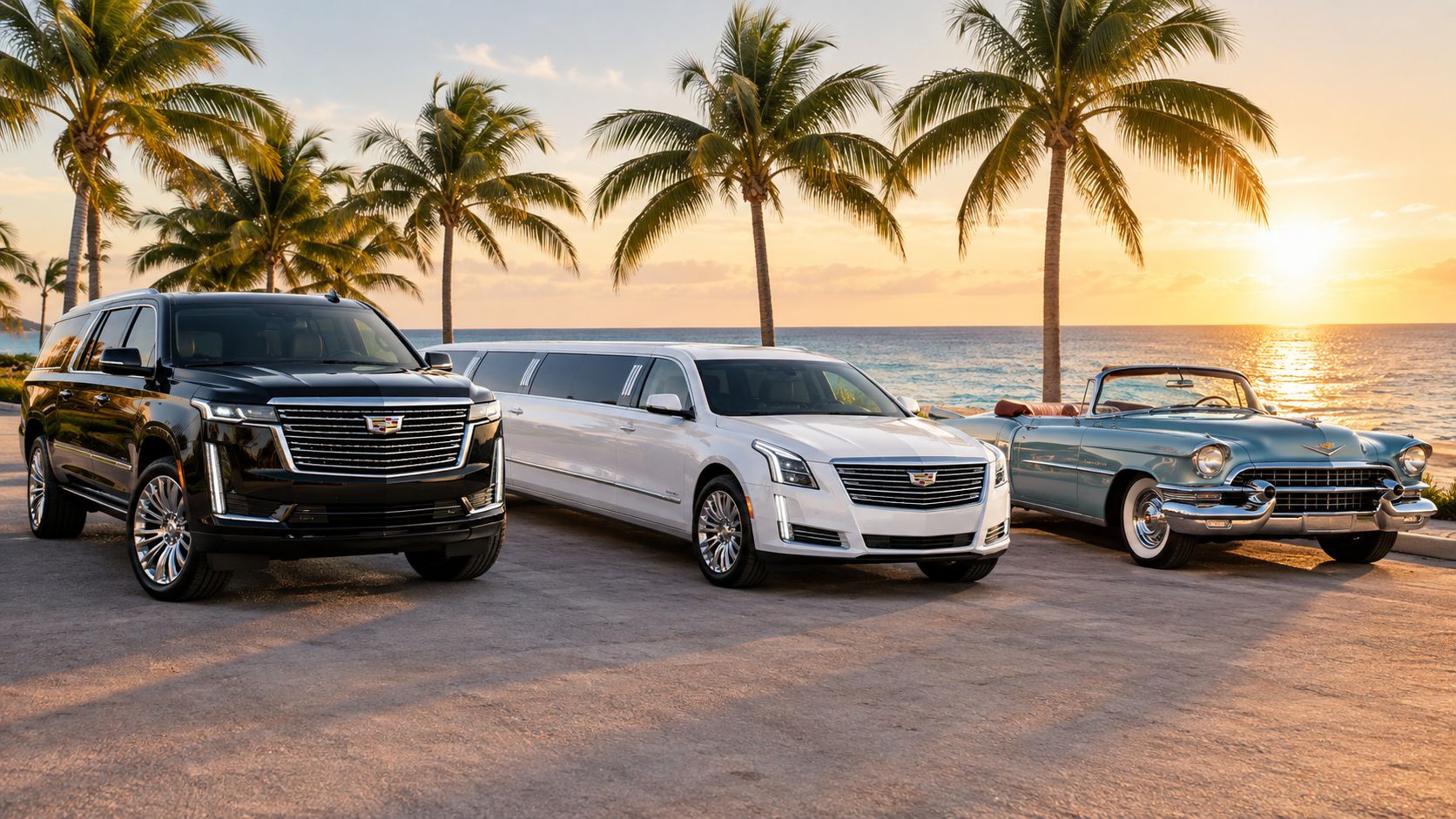
The best wedding car in Cancun is usually a coordinated plan, not one vehicle. In the United States, couples spent an average of $1,075 on wedding transportation, while destination weddings averaged $1,190, so the smartest choice is a late-model luxury SUV for the couple and right-sized vehicles for guests, based on the full itinerary.
You may be choosing between an Escalade, a stretch limousine, a vintage Mercedes, or something more distinctive for your entrance. Before you book, map the entire weekend: Cancun airport transportation, hotel arrivals, rehearsal dinner travel, ceremony transfers, photo stops, reception departures, and late-night returns. A beautiful car that can't handle the route, luggage, formal clothing, or timing isn't the best wedding car. It's an expensive complication.
| Wedding transportation need | Best-fit vehicle | Why it works |
|---|---|---|
| Couple-only arrival and departure | Late-model luxury sedan or SUV | Comfortable, polished, and easy to coordinate |
| Couple with dress, attendants, or luggage | Premium luxury SUV | More room, easier boarding, better cargo capacity |
| Small bridal party | Right-sized premium SUV or van | Keeps the group together without excess capacity |
| Dramatic ceremony entrance | Stretch limousine or classic car | Strong visual impact for a short, planned movement |
| Airport and resort transfers | Private SUV, van, or coordinated fleet | Handles luggage, flight changes, and multiple arrival times |
| Full wedding weekend | Multi-vehicle luxury transportation plan | Matches each vehicle to the movement instead of forcing one car to do everything |
Table of Contents
- Why Your Wedding Car Choice Shapes the Entire Experience
- Luxury SUVs Versus Limousines for Your Wedding Day
- Classic Cars and Alternative Wedding Vehicles
- Coordinating Wedding Guest Transportation in Cancun
- Reliability and Safety Standards for Wedding Transportation
- Building Your Wedding Transportation Plan
- Beyond the Vehicle, What Actually Makes Wedding Transportation Work
Why Your Wedding Car Choice Shapes the Entire Experience
The couple who books one glamorous limousine for every movement often discovers the problem too late. The grandparents need easier boarding, the teenagers want room for bags, and the airport arrivals don't happen at the same time. Suddenly, the limousine is reserved for the wrong movement, guests are waiting at the resort, and someone from the wedding party is trying to coordinate airport pickups from the makeup chair.
A better plan assigns the right vehicle to each moment. The couple may ride in a late-model luxury SUV for the hotel-to-venue transfer, while guests use smaller SUVs or vans for airport arrivals and rehearsal dinner travel. That arrangement feels less cinematic on paper, but it creates a calmer wedding weekend.
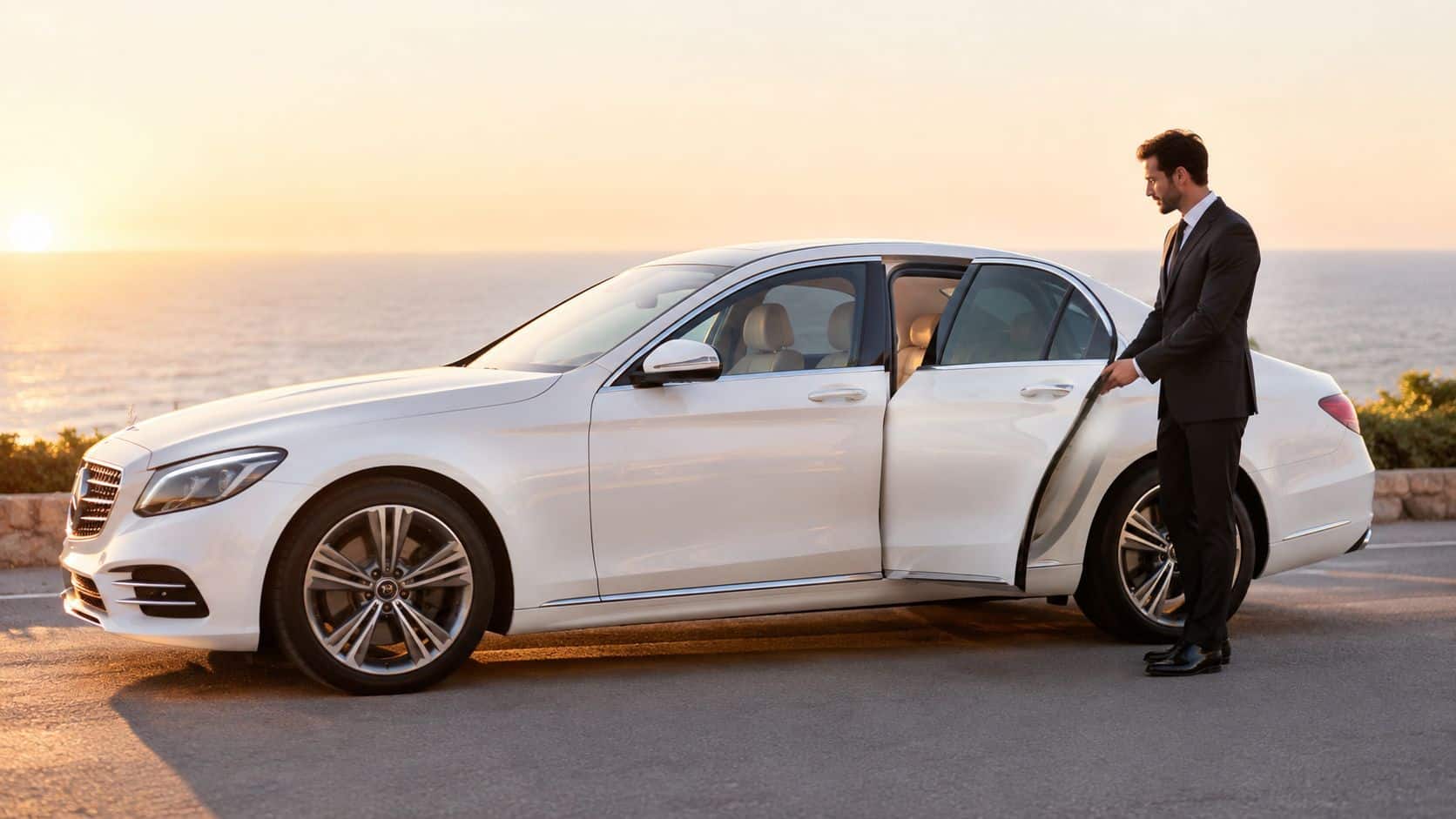
Cancun creates a transportation problem, not just a car decision
Cancun and the Riviera Maya spread wedding events across airports, resorts, restaurants, beaches, villas, and ceremony venues. Guests may arrive through Cancún International Airport, stay in different properties, attend a rehearsal dinner in another area, and leave after a reception that ends well after the original schedule was created.
The transportation plan must account for:
- Boarding comfort: Formal clothing, heels, children, and mobility limitations change which vehicles make sense.
- Luggage volume: Airport transfers require more cargo space than a ceremony entrance.
- Route access: Beachfront resorts and private venues may have specific loading areas or parking restrictions.
- Different schedules: Guests rarely arrive and depart as one group.
- Weather protection: Tropical heat and rain can make a vintage convertible impractical for a long transfer.
Your personal style still matters. If you're wearing a tweed waistcoat or planning a heritage-inspired wedding look, a guide to wedding accessories for tweed can help coordinate the clothing details with the vehicle and photography style. But wardrobe and vehicle should support the schedule, not dictate it.
The broader point is simple. The best wedding car serves the guest experience, not only the couple's entrance. A destination wedding already asks guests to manage flights, hotels, unfamiliar roads, and multiple events. Good transportation removes decisions from their day.
Luxury SUVs Versus Limousines for Your Wedding Day
For most Cancun weddings, I recommend a premium SUV over a traditional stretch limousine for the main transportation block. The SUV is easier to load, more adaptable on resort roads, and more forgiving when the bride has a substantial dress, personal items, gifts, or an attendant riding along.
A stretch limousine still earns its place when the entrance itself is the priority. It offers a classic silhouette, privacy, and a memorable arrival. It just shouldn't automatically become the vehicle for every airport transfer and guest movement.
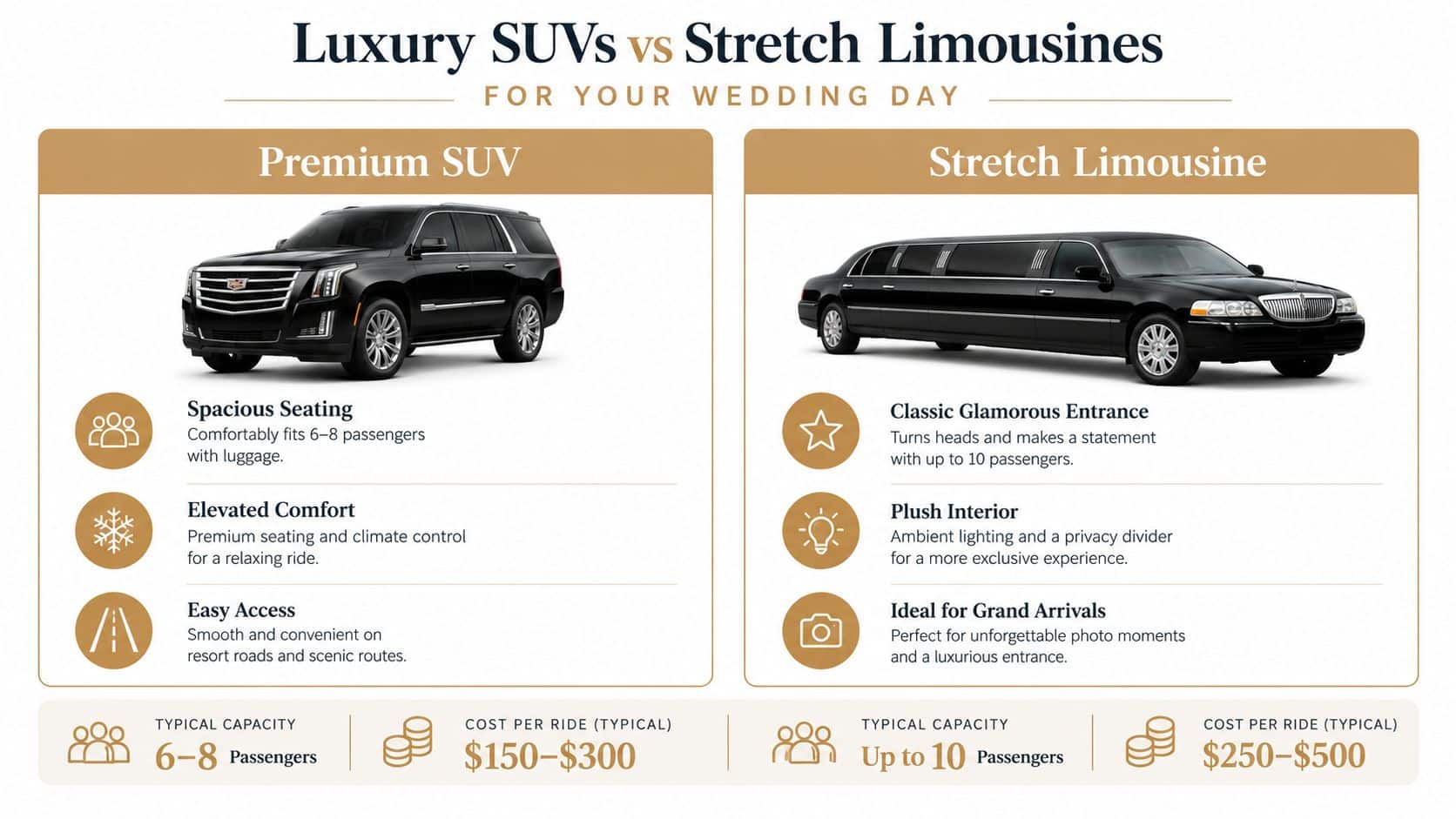
| Criteria | Premium SUV (Escalade) | Stretch Limousine |
|---|---|---|
| Boarding | Higher seating position and wider practical access | Lower, longer entry that may be awkward with a gown |
| Passenger use | Flexible for the couple, attendants, parents, or luggage | Strong for a planned group arrival |
| Luggage | Better suited to bags, gifts, and wedding essentials | Often limited once passenger seating is occupied |
| Child seats | Easier to plan around standard passenger seating | Must be confirmed with the provider and vehicle layout |
| Resort access | More practical for tight approaches and varied roads | May need advance confirmation at beachfront venues |
| Atmosphere | Modern, polished, and versatile | Traditional, glamorous, and theatrical |
| Best use | Full itinerary, airport transfers, and couple comfort | Ceremony entrance, photo moment, or short transfer |
Choose by movement, not by prestige
An Escalade-style SUV works particularly well when the couple needs one vehicle for hotel pickup, ceremony arrival, photography stops, and reception transfer. It gives the chauffeur room to assist with the door and gives passengers enough space to settle without compressing formal clothing.
A limousine works better when its role is clearly defined. Use it for the grand arrival, a short post-ceremony ride, or a photo sequence. Don't place it on a route that requires repeated luggage loading, narrow resort access, or several unscheduled stops.
Luxury transportation can be part of a highly styled celebration, and Creventa's take on lavish weddings offers useful inspiration for couples thinking about how vehicles fit into a larger visual experience. The practical test remains the same: can the vehicle deliver everyone where they need to be, comfortably and on time?
For more detail on why a Suburban-style SUV can work well for travel, see this guide to SUV comfort. The recommendation is not about choosing the largest vehicle. It's about choosing enough space for the actual passengers, luggage, and route.
Classic Cars and Alternative Wedding Vehicles
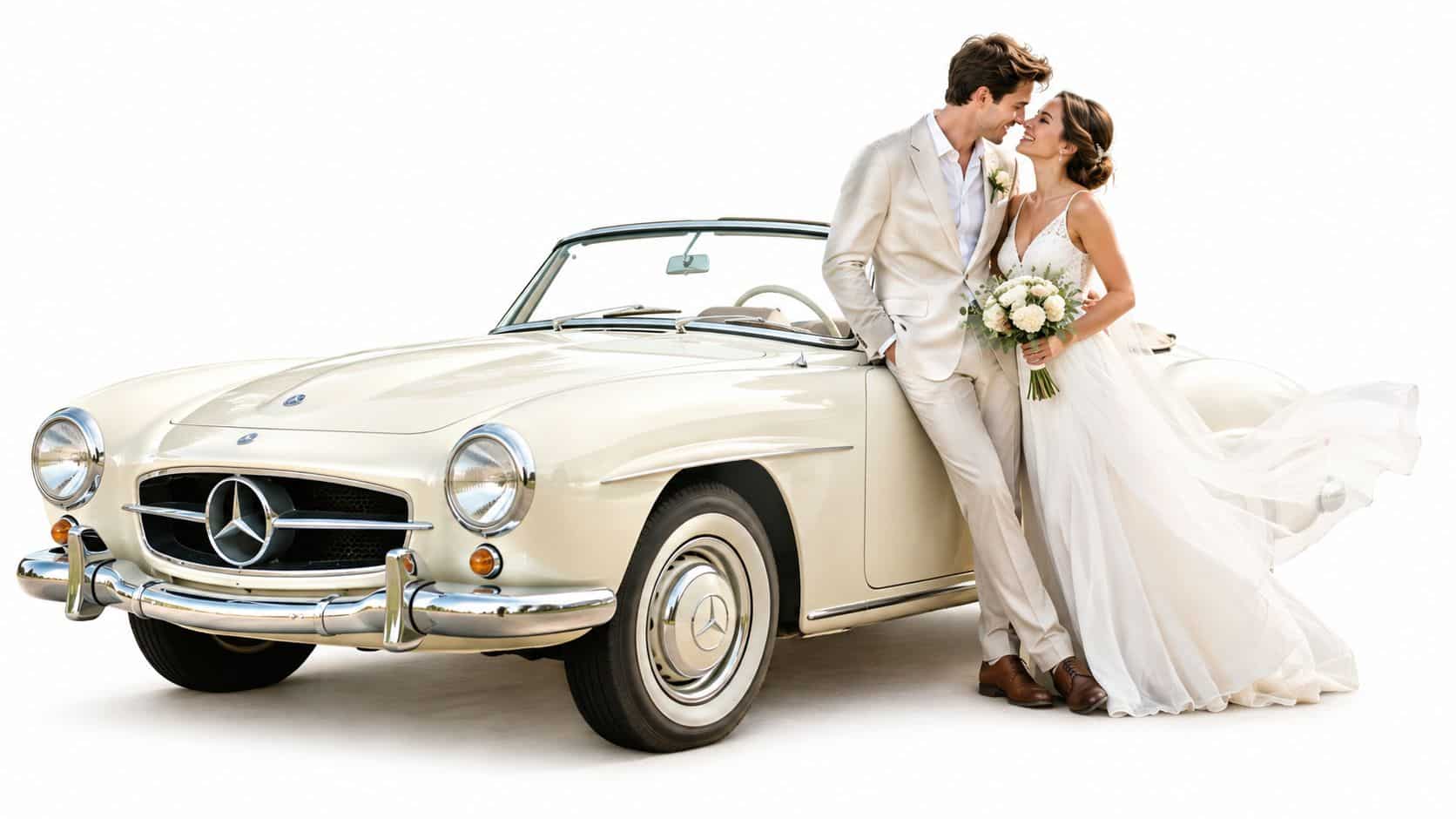
A vintage Mercedes convertible can produce extraordinary photographs. It can also turn a short wedding movement into a memorable visual moment, especially beside a coastal venue or historic property.
That doesn't make it a good all-day vehicle.
Where classic cars work
Use a classic car when the route is short, the weather is favorable, and the vehicle's role is mainly ceremonial or photographic. A restored sedan or convertible can handle a couple's entrance, a portrait session, or a brief transfer between nearby locations.
It should not carry the full operational burden of a destination wedding. Older vehicles may have limited climate control, restricted seating, modest luggage capacity, and more maintenance variables than a recently inspected premium SUV. Formal clothing also changes the boarding equation. A narrow door, low seat, or exposed cabin can make entry difficult for a bride in a full gown or for older guests.
A hybrid plan gives you the appearance without the risk:
- Classic car: Ceremony entrance and photographs.
- Luxury SUV: Couple's longer transfer, luggage, and reception movement.
- Guest vehicles: Airport arrivals, hotel shuttles, and late-night returns.
Budget the entire transportation system
The Knot's 2024 Real Weddings Study found that couples spent an average of $1,075 on wedding transportation in the United States. Destination weddings averaged $1,190, while local hometown weddings averaged $1,044. The same study found that weddings with 50 or fewer guests spent about $583 on average, compared with nearly $1,200 for weddings with more than 100 guests.
Those figures show why vehicle capacity and itinerary complexity matter. Typical town-car and wedding-limo pricing was approximately $75 to $150 per hour, while larger vehicles such as party buses often cost $200 to $300 per hour, according to the same source. Don't compare vehicles only by hourly rate. Compare the number of movements, passenger loads, waiting requirements, and empty return journeys.
For an international destination wedding, the study reported average transportation spending of $839 for international destination weddings and $1,204 for domestic destination weddings. Treat airport transfers, rehearsal-dinner travel, ceremony service, and return transportation as one mobility plan when you build the budget.
Coordinating Wedding Guest Transportation in Cancun
Your guests won't experience the wedding as one ride. They'll experience a chain of pickups, waits, handoffs, and arrivals. That chain deserves as much attention as the couple's ceremony vehicle.
Cancún International Airport handled approximately 29.3 million passengers in 2025, according to ASUR's passenger traffic disclosure. In July 2025, the airport recorded 921,781 passengers, and in March 2025 it recorded 794,115 passengers, bringing the January to March total to 2,319,681, as reported in ASUR's monthly traffic data. That volume makes Cancun airport transportation a coordination task, not a casual taxi decision.
Build the guest plan in four passes
List every movement. Include private transportation Cancun airport to the resort, hotel-to-venue transfers, rehearsal dinner travel, ferry connections, photo locations, and post-reception departures.
Group guests by real need. Keep families with children together when possible. Note mobility requirements, bulky luggage, different hotel locations, and guests who arrive on separate flights.
Right-size each vehicle. A full SUV may suit a family with luggage, while a smaller premium vehicle may be more efficient for a couple-only airport transfer. One oversized vehicle isn't automatically more economical if it creates long waits or unnecessary routing.
Give each passenger clear instructions. Provide the terminal meeting point, chauffeur identification process, hotel name, contact number, and what happens if a flight changes.
A point-to-point booking can be useful when one group needs a direct movement without adding unnecessary stops. Review this explanation of point-to-point transportation when separating guest transfers from the couple's dedicated schedule.
Flight tracking matters because the original landing time may stop being accurate. Mexico's official passenger-rights guidance explains that airlines must communicate delay causes and that assistance changes when delays last longer. For delays exceeding one hour but under four hours, airlines may provide food, beverages, discounts, or other assistance. For delays longer than two but shorter than four hours, the required discount must be at least 7.5% of the ticket price when applicable. If a delay exceeds four hours or a flight is canceled, available remedies can include reimbursement plus compensation of at least 25% of the affected fare, or replacement transportation with meals, lodging, and airport transfers. The Mexican government passenger-rights guide provides the full framework.
Your car service should respond to the changed arrival, not blindly follow the original schedule.
Reliability and Safety Standards for Wedding Transportation
A wedding vehicle must do more than look polished beside the venue. It must complete several time-critical movements without creating uncertainty for the couple, planner, or guests.
J.D. Power's 2025 U.S. Vehicle Dependability Study measures owner-reported problems per 100 vehicles across 184 problem areas after three years of ownership. Lower scores indicate fewer reported problems. Lexus recorded 140 PP100, Cadillac recorded 169 PP100, and Porsche recorded 186 PP100, compared with an overall industry average of 202 PP100, according to J.D. Power's study.
That metric doesn't predict whether a particular wedding vehicle will fail. It also doesn't measure chauffeur quality, cleanliness, dispatch redundancy, or maintenance history. Use it as one procurement signal, then ask stronger operational questions.
Questions to ask the provider
- Maintenance: When was the exact vehicle last inspected, and what preventive maintenance does the fleet follow?
- Backup coverage: What happens if the assigned vehicle develops a problem before pickup?
- Driver preparation: Does the chauffeur know the resort entrances, venue access points, ferry routes, and local roads?
- Passenger protection: Is passenger insurance included, and are seat belts available for everyone?
- Load planning: Can the vehicle carry the people, dress, gifts, child seats, and bags without compromising comfort?
Safety technology adds another useful filter. The IIHS 2025 TOP SAFETY PICK criteria require Good ratings in the updated moderate-overlap front crash test and updated side-impact test, along with Acceptable or Good standard headlights and Acceptable or Good pedestrian front-crash prevention performance.
Verify the exact model year and trim. A test result or award may not apply to every configuration, especially when headlights or driver-assistance features change between standard and optional equipment.
Practical rule: Choose the recently inspected vehicle with a credible backup plan, not merely the most distinctive badge.
For Cancun and Riviera Maya transfers, prioritize outward visibility, stable highway behavior, rear-seat access, properly fitted child restraints, and inspected tires and brakes. A premium sedan may suit a couple-only arrival. A premium SUV is usually more forgiving when formal clothing, assistants, gifts, and luggage enter the plan.
Building Your Wedding Transportation Plan
Stop asking, “What's the best wedding car?” Ask, “What transportation plan makes our wedding weekend easiest for everyone?” That change in wording leads to better decisions because it forces you to plan movements rather than shop for a single photograph.
Start with a route map. Write down each origin, destination, passenger group, luggage requirement, and approximate movement window. Include airport arrivals, resort check-in, rehearsal dinner, ceremony, photography, reception, after-party, and departure transfers.
Match vehicles to the schedule
Use a late-model luxury SUV for the couple when the day includes multiple stops, a large gown, attendants, or personal items. Use smaller premium SUVs or vans for guest groups that need practical luggage space. Reserve a limousine or classic vehicle for a defined entrance or photo moment rather than assigning it to every movement.
Build buffer time between locations. The exact amount depends on the route, venue access, traffic, weather, and passenger count, so don't accept a generic schedule copied from another wedding. Ask the provider to confirm where vehicles can load and unload, whether they can wait, and whether the venue permits the selected vehicle near the entrance.
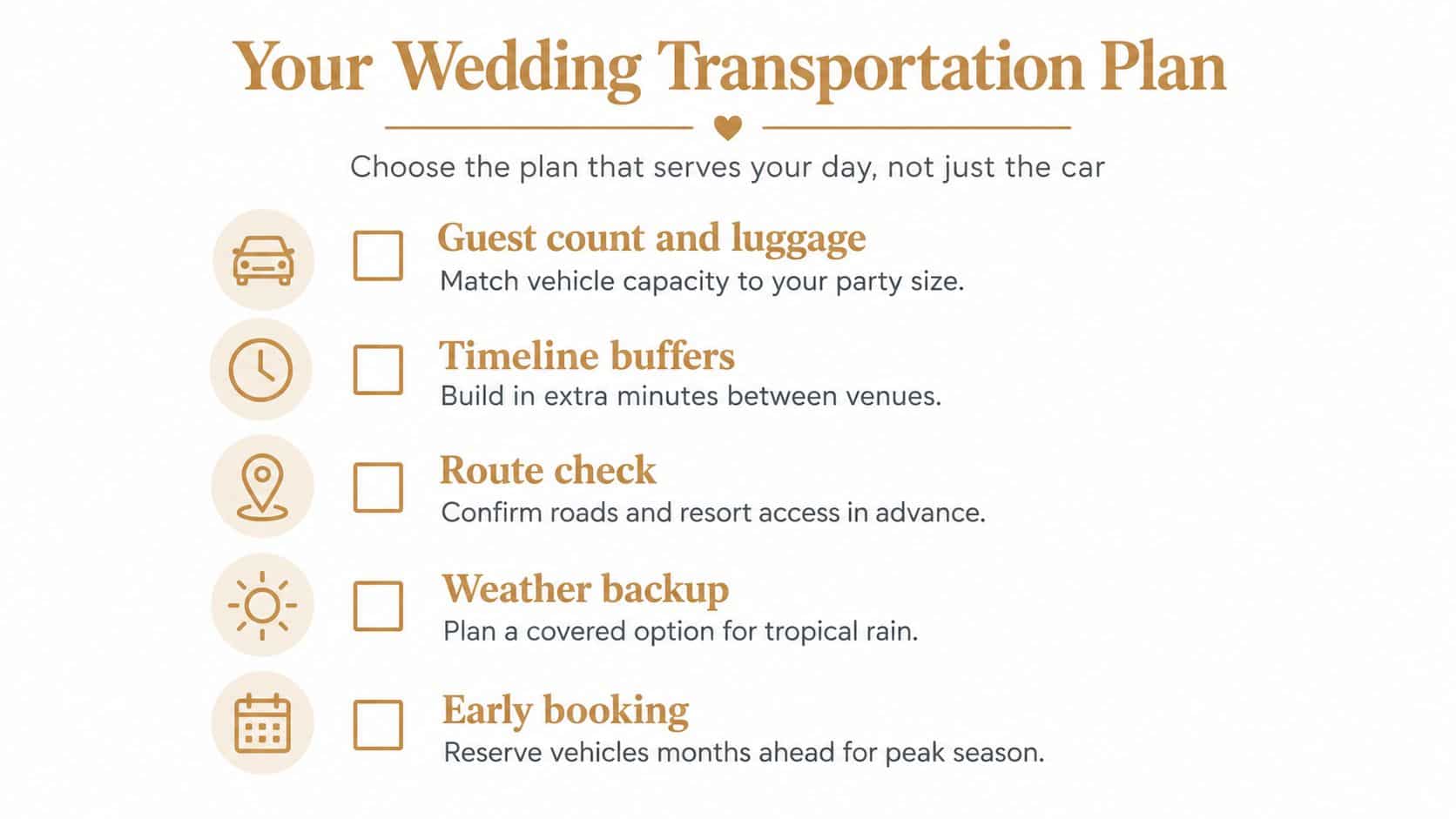
Use this booking checklist
- Guest count and luggage: Match capacity to the actual party, not the maximum theoretical seating.
- Timeline buffers: Leave room for loading, photography, venue access, and changed plans.
- Route check: Confirm resort entrances, ferry connections, road conditions, and parking restrictions.
- Weather backup: Identify a covered loading area and a vehicle plan for tropical rain.
- Early booking: Secure the needed vehicle categories before peak demand limits your choices.
Ask for a written quote that separates vehicle time, waiting time, additional stops, airport service, and cancellation terms. This wedding transportation cost guide can help you organize those questions before comparing providers.
A reliable plan should also include bilingual support, live flight tracking for international arrivals, centralized confirmations, and a contact person who can make dispatch changes. If the provider can't explain what happens when a flight is late or a venue changes its loading instructions, the plan isn't ready.
Beyond the Vehicle, What Actually Makes Wedding Transportation Work
The most prestigious car can still deliver a poor wedding experience if nobody monitors the flight, confirms the terminal meeting point, or answers the phone when the schedule changes.
A well-maintained Escalade with a professional chauffeur, active flight monitoring, and clear resort coordination will usually serve a destination wedding better than a vintage limousine with uncertain communication. The difference isn't visible in a showroom photograph. Guests notice it when the vehicle arrives, the doors open, the bags fit, and nobody has to search for the driver.
Operational details carry the day
Look for a provider that can coordinate several vehicles through one dispatch plan. Bilingual English and Spanish communication helps international guests understand pickup instructions. Meet-and-greet service reduces confusion after a long flight. Baby seats, refreshments, cold towels, Wi-Fi, pet-friendly arrangements, and celebratory beverages can be useful when they match the group's needs.
Sustainability also deserves a practical conversation. A 2025 study of 300 respondents on sustainable destination weddings identified high costs and travel logistics as major challenges. Carbon-neutral transportation ranked lowest among the listed priorities at 11.67%, according to the study on sustainable destination weddings. That doesn't make sustainability irrelevant. It means planners should balance it with access, convenience, safety, and reliability.
Consolidate routes, avoid empty return journeys, and fill vehicles appropriately. A larger vehicle carrying a full group may be more efficient than several underfilled cars, while a smaller car makes more sense for a couple-only transfer. Publish the assumptions behind any emissions estimate instead of making vague environmental promises.
The best wedding car often disappears into the background. Your guests remember the ceremony, the dinner, and the celebration. They shouldn't remember missed pickups, confusing airport instructions, or a vehicle that couldn't reach the venue.
Unique Private Transportation coordinates Cancun airport transportation, Riviera Maya wedding transfers, rehearsal dinners, ceremony schedules, and multi-vehicle guest movements with late-model premium vehicles, bilingual chauffeurs, live flight monitoring, and meet-and-greet support. Visit Unique Private Transportation to plan a wedding transportation system that keeps the couple and guests moving comfortably from arrival through the final departure.