
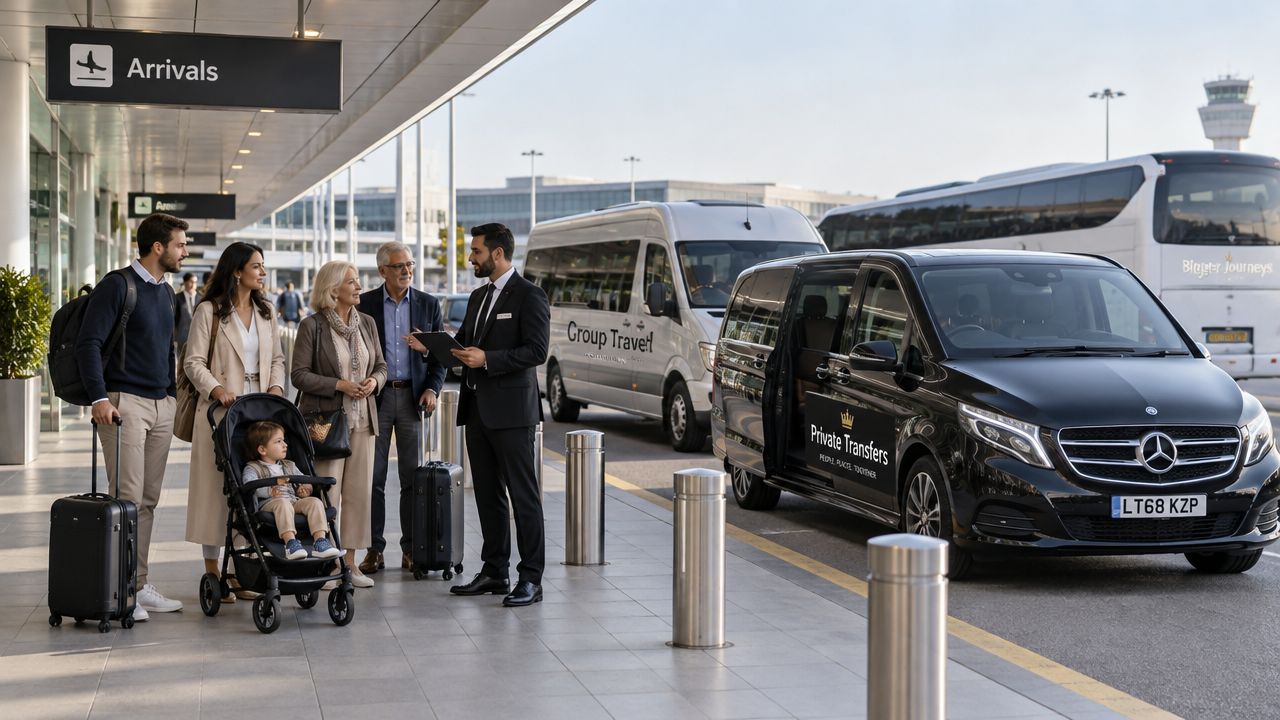
You've got people landing on two flights, one family has a stroller nobody mentioned, and the wedding planner is still asking whether everyone should wait for the last suitcase. That's not a vehicle problem. It's a coordination problem, and if you treat it like a simple taxi booking, you'll pay for it in delays, split parties, and missed connections.
The right group airport transfer starts with one decision, whether you size one vehicle for the larger wave and make everybody wait, or split into two vans and run them in parallel. Everything else, timing, baggage handling, central contact, fallback plans when a flight slips, sits underneath that call. If you get the coordination model right, cancun airport transportation, luxury transportation, and private transportation cancun airport all stop being vague marketing terms and become a workable plan for families, weddings, and corporate groups.
If you want a useful external benchmark before you book, the Melbourne group transfer guide is a solid example of how serious operators think about group movement as a logistics job, not just a ride.
Table of Contents
- Why Group Airport Transfers Need a Plan Before You Book
- What a Group Airport Transfer Actually Is
- Matching the Right Vehicle to Your Group Size
- How Group Transfer Pricing Is Built
- Coordinating Pickups and Drop-offs for Larger Parties
- Handling Delays, Baggage Problems, and Family Logistics
- Booking Checklist for a Smooth Group Transfer
Why Group Airport Transfers Need a Plan Before You Book
A Cancun arrival with 14 wedding guests on two flights within 90 minutes sounds simple until you look at the ground reality. One flight lands early, the other drags, one cousin has checked bags, another forgot to say the child seat was needed, and the sponsor wants everyone in the same car because it sounds neat on paper. That's exactly where bad planning starts costing money and time.
The real decision is coordination, not vehicle shape
The better question is whether the group should move as one unit or in two waves. If you have a central organizer, a flight list, and a clear cutoff for waiting, one larger vehicle can work. If arrivals are split, baggage is heavy, or children are involved, two coordinated vehicles usually beat one overloaded plan.
Practical rule: if the group's arrivals are not tightly aligned, don't force a single pickup to behave like a perfect schedule. It won't.
The broader market backs up that this is a real transport category, not a niche favor. One industry estimate places the global airport shuttle service market at USD 1.67 billion in 2026, rising to USD 1.84 billion in 2027 and reaching USD 3.96 billion by 2035, with a 10.3% CAGR over the forecast period, while shared shuttle services make up 56% of total rides versus 44% for private transfers. A separate estimate values the broader airport transfer service market at USD 26.8 billion in 2025, with shared transfers at 28.2% and shuttle services at 15.8%. Those figures show why pooled airport mobility keeps winning on volume and why logistics matters more than the badge on the side of the vehicle. See the market snapshot in the airport shuttle service market report.
What gets missed when people book like it's a cab
Taxi logic fails the moment a group shows up with more than a few bags or one delayed flight. Conference sponsors, wedding guests, and family groups don't move cleanly through a curbside scramble. The hidden risks are obvious to anyone who coordinates arrivals every week, oversold minibuses, missing child seats, and people who still haven't seen their luggage by the next morning.
A more useful model is the airport-side one. Airport mobility bookings can rival on-airport car-rental bookings in volume, and airport access often happens through shared, multi-passenger runs. One U.S. airport access report found 1.29 vehicle trips per air-traveler trip, while another found 31% of air travelers used someone dropping them off and 16% used ride-hailing. That pattern explains why coordinated airport access keeps winning for leisure, corporate, and event groups. The background on that behavior is laid out in The Airport Mobility Opportunity.
What a Group Airport Transfer Actually Is
A real group airport transfer is a pre-booked, private movement for one party. That can be a single van, a minibus, or a coordinated set of vehicles, but the operating idea stays the same. One dispatcher handles the job, one flight plan drives the pickup, and one point of contact answers for the whole party.
Private, shared, taxi, and ride-hail are not the same thing
A shared shuttle mixes unrelated parties and usually runs on fixed departure windows. That works if you care more about price than control, but it's a bad fit for weddings, children, or corporate arrivals that need everyone together. Taxi service is even less predictable for groups, because vehicle class is opportunistic and large parties can get turned away or split up. Ride-hail adds surge pricing and doesn't guarantee the right class when you need it.
A proper transfer includes flight monitoring, a meet-and-greet with a sign, staged pickup, and one invoice that can cover parking, tolls, and gratuity if the operator bundles those items. That's what you should be buying when the arrival matters. If you want a clean point-to-point model, the internal primer on point-to-point service fits this logic well.
Why the service feels different on the ground
At Cancun International Airport, the difference shows up fast. Authorized private transportation is certified and approved by Mexico's Ministry of Communications and Transportation to operate at the airport, which separates scheduled service from random curbside guessing. That matters when you need the driver waiting inside, the name sign ready, and the route already set to the hotel zone or the villa district.
The operational standard is simple. The organizer gives the flight details, the vehicle is assigned to the party size, and the chauffeur handles the arrival sequence. That is the whole point of unique private transportation, not a branded slogan, but a way to remove uncertainty from the first mile after landing.
Matching the Right Vehicle to Your Group Size
Vehicle choice matters, but not in the lazy way Seat count is only the first filter. Luggage volume, child seats, strollers, and bag shape decide whether the trip feels smooth or cramped.
Four common Cancun booking choices
A 6-passenger private van works for compact adult groups with light luggage. A 10-passenger minibus makes more sense when the party has mixed baggage or a couple of children. A 20-passenger minicoach fits larger wedding or corporate movements, and a multi-vehicle fleet becomes the cleanest answer once the group pushes past 30 or has staggered arrivals.
The trap is booking by headcount only. A family of four with beach gear, two car seats, and hard-shell luggage can fill a vehicle faster than a casual count suggests. If the total checked bags match or exceed the passenger count, step up a vehicle class. Don't squeeze the booking just to save a few dollars and then spend the ride apologizing.
| Vehicle Options for Cancun Group Transfers | Vehicle Type | Passenger Capacity | Checked Bags | Best For |
|---|---|---|---|---|
| Vehicle Options for Cancun Group Transfers | Private van | 6 passengers | Light to moderate | Small families, couples with bags, tight arrival windows |
| Vehicle Options for Cancun Group Transfers | Private minibus | 10 passengers | Moderate | Families with children, wedding guests, mixed luggage |
| Vehicle Options for Cancun Group Transfers | Minicoach | 20 passengers | Moderate to heavy | Wedding groups, corporate teams, event shuttles |
| Vehicle Options for Cancun Group Transfers | Multi-vehicle fleet | 30+ passengers | Depends on mix | Large weddings, conferences, split arrivals |
The practical comparison in London airport transfer minibus is worth reading because it mirrors the same reality, the right bus is the one that fits people and bags without turning the pickup into a puzzle.
Right-sizing beats chasing the cheapest seat count
A lot of planners overvalue the lowest legal seat count. That's sloppy. If a vehicle is full of passengers and the cargo area is already compromised by child seats or oversized bags, nobody will enjoy the transfer, and the driver ends up doing damage control instead of transport.
Bottom line: choose for the party, not the spreadsheet.
If you're comparing broader service options in Cancun, the internal overview on cancun car service helps frame the difference between a clean private transfer and a generic curbside pickup.
How Group Transfer Pricing Is Built
You can't compare quotes unless you understand how they're assembled. A per-vehicle rate and a per-person rate are not the same product, and the cheaper headline number is often the worse deal once the extras show up.
Per-vehicle usually wins for groups
For parties of five or more, per-vehicle pricing usually makes more sense because the cost is spread across everyone in the car. That's especially true when the group wants one pickup, one drop-off, and no split arrivals. Per-person pricing can work for loose leisure groups, but it usually loses once the organizer starts adding on luggage, seat requests, and timing control.
In Cancun, a private van for up to 10 passengers to the Hotel Zone typically runs from USD 70 to USD 120 one-way, while a minibus for 14 to 18 passengers runs USD 120 to USD 180. Those are useful anchor points when a quote feels too high or suspiciously low. They're not the whole bill, just the base most operators build from.
| Group Transfer Price Components in Cancun | Line Item | Per-Vehicle | Per-Person | Typical Range (USD) |
|---|---|---|---|---|
| Group Transfer Price Components in Cancun | Base transfer | Usually flat | Sometimes charged per rider | Depends on vehicle and route |
| Group Transfer Price Components in Cancun | Meet-and-greet | Often included or added | Sometimes embedded | Varies by operator |
| Group Transfer Price Components in Cancun | Late-night or after-hours service | Added to the vehicle | Sometimes added per person | Varies by schedule |
| Group Transfer Price Components in Cancun | Extra luggage or oversized items | May raise vehicle class | Usually not a clean fit | Varies by load |
| Group Transfer Price Components in Cancun | Child seats | May be included on request | Rarely cleanly priced | Varies by supply |
| Group Transfer Price Components in Cancun | Tolls and gratuities | May be included, optional, or extra | Often left to the rider | Varies by policy |
Watch the quiet add-ons
The quote that looks clean on a website often changes once the organizer asks real questions. Airport meet-and-greet fees, late-night surcharges, extra luggage, child seats, and tolls all push the total upward. Gratuity is another fault line, because some operators include it, some make it optional, and some leave it to the passenger.
If you're planning wedding transport, compare against the internal guide on wedding transportation cost. The same rule applies here, ask for the full number, then divide the vehicle total by headcount and add a 15 to 20% buffer for fees and tips before comparing it to a per-person shuttle. If the quote can't survive that math, it's not a real comparison.
Coordinating Pickups and Drop-offs for Larger Parties
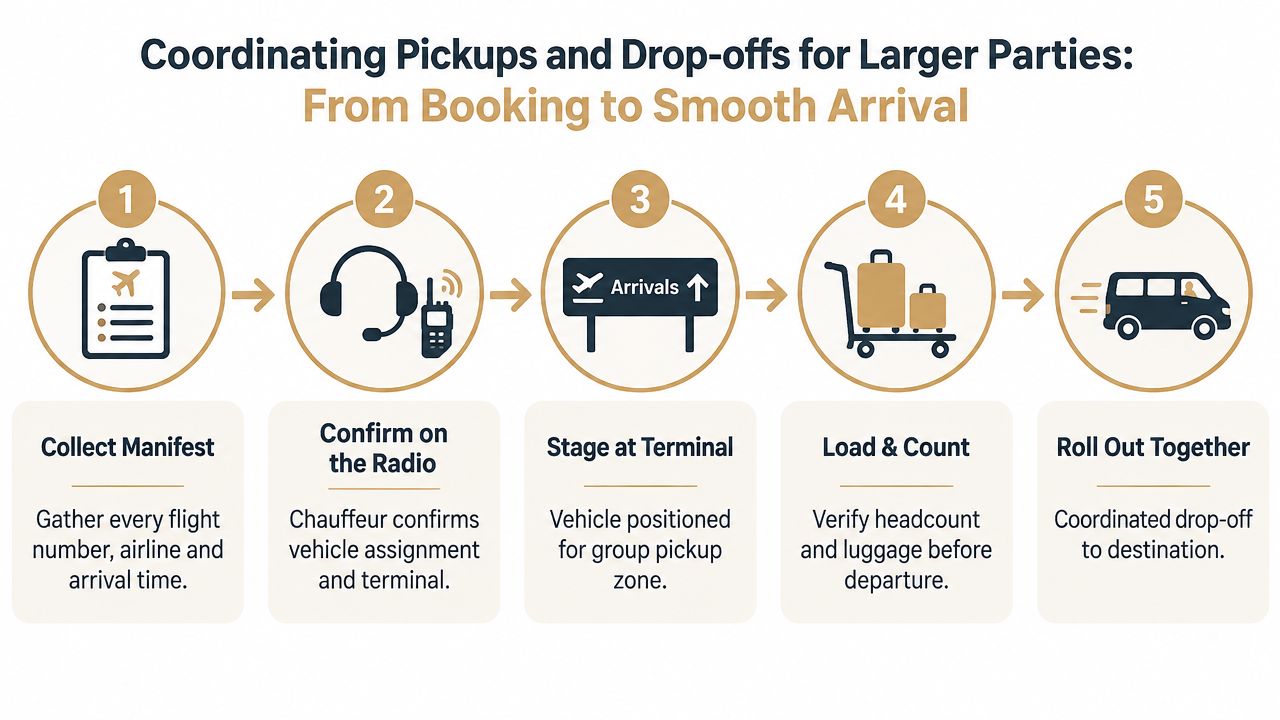
The chauffeur side of this job starts before anyone lands. I want the manifest first, not the excuses later. Every flight number, airline, arrival time, and final destination needs to be in one place before the first plane touches down.
The pickup works only if one person owns the communication
A group should have one central contact phone, not five different people texting the driver. Flight monitoring works when dispatch can move pickup times as delays stack up, but that only helps if one person answers fast and makes the call on behalf of the party. If everyone starts improvising, the job turns messy.
The physical flow inside CUN should be boring in the best way. The driver holds the sign, meets the group at the indoor point, escorts everyone to the parking area, and handles the luggage load. That process is much easier when the organizer has already given the correct terminal and the final destination is clear, whether that's the hotel zone, a villa in Playa Mujeres, or a resort run toward Tulum.
For airport layout clarity, the airport navigation guide is useful because it reminds planners that finding the right pickup point is part of the trip, not an afterthought.
Split arrivals need a decision, not a hope
If two flights are close together, one vehicle can work. If the gap starts stretching, send two vehicles and keep everybody moving. Waiting sounds cheaper until the delay grows into a wasted hour and the whole party is standing around with bags and children.
Rule of thumb: once the gap passes a sensible waiting window, a second vehicle is usually the cleaner move.
That same logic applies at drop-off. Hotel zone stops are straightforward, but villa rentals and multi-stop routes take more time and can change the price. If one party wants to detour to a grocery store, another to a ceremony venue, and a third to a resort check-in, that's no longer a simple airport ride. It's a routed job, and it should be priced like one.
Handling Delays, Baggage Problems, and Family Logistics
Generic guides fall apart. A delayed suitcase can stall a whole van, and family groups create their own math problem the moment a stroller, a booster seat, and a second bag stack onto the booking.
Baggage delays need a cutoff
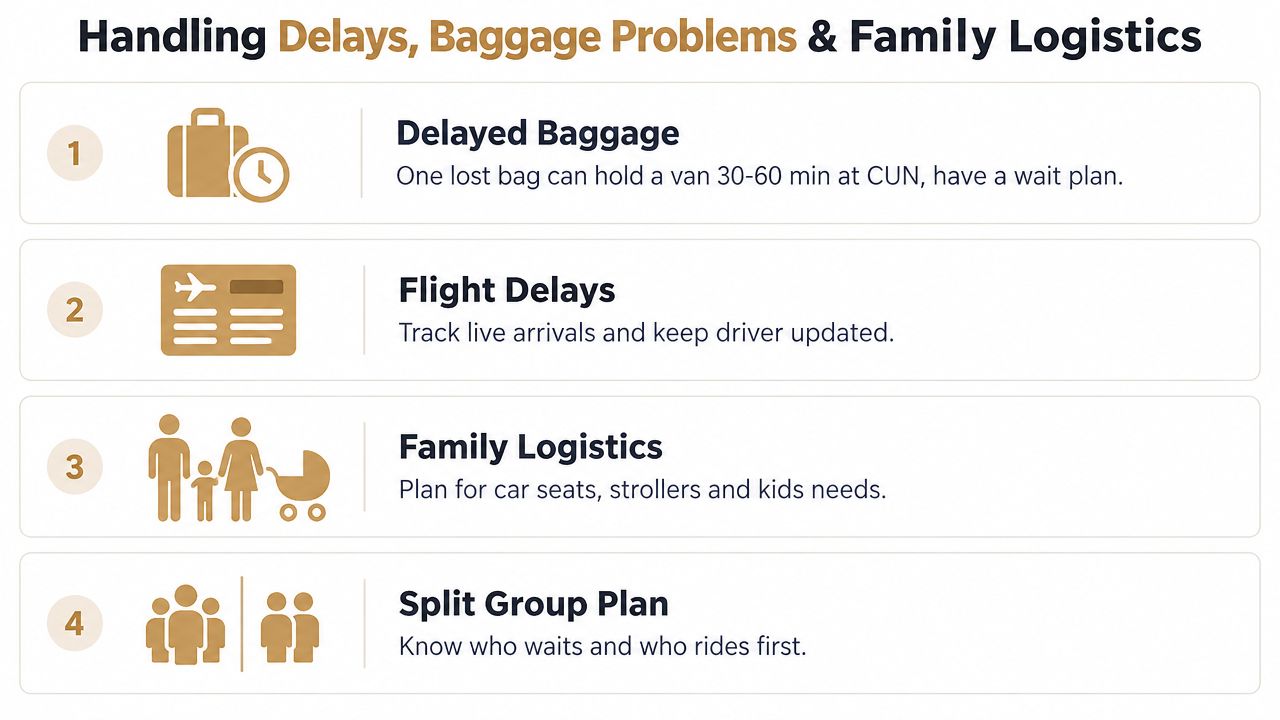
If the missing bag belongs to a child or contains medication, wait. If it doesn't, leave a tag with the driver and move the group forward. Independent transfer guidance says passengers should notify the driver as soon as luggage trouble is confirmed, because the airline or handling company owns the baggage issue, not the transfer provider. Waiting policies vary, but a hard cutoff around 45 minutes after the first bag lands is a sane operating line for a group.
That advice is especially important at Cancun, where a delay can spread across the whole van. One person waiting on a belt shouldn't hold eleven other travelers hostage if the bag can be delivered later. Set the meeting point in advance, set the cutoff in advance, and don't improvise while everybody is tired.
Family loads are bigger than people count
A couple with three kids, two car seats, a stroller, and ten checked bags does not belong in a standard SUV. Seat count is only part of the answer. You have to count luggage volume, then add the child-seat requirement as a separate constraint. If any of those three pieces is tight, the vehicle is too small.
The family-transfer side of the market has gotten better at advertising complimentary car seats or booster seats on request, but that doesn't solve the full puzzle. The vehicle still has to fit the adults, the children, and the gear without turning the ride into a squeeze. The practical fix is simple. When in doubt, book two smaller vans instead of one cramped minibus. Comfort and on-time arrivals beat the tiny savings every time.
Booking Checklist for a Smooth Group Transfer
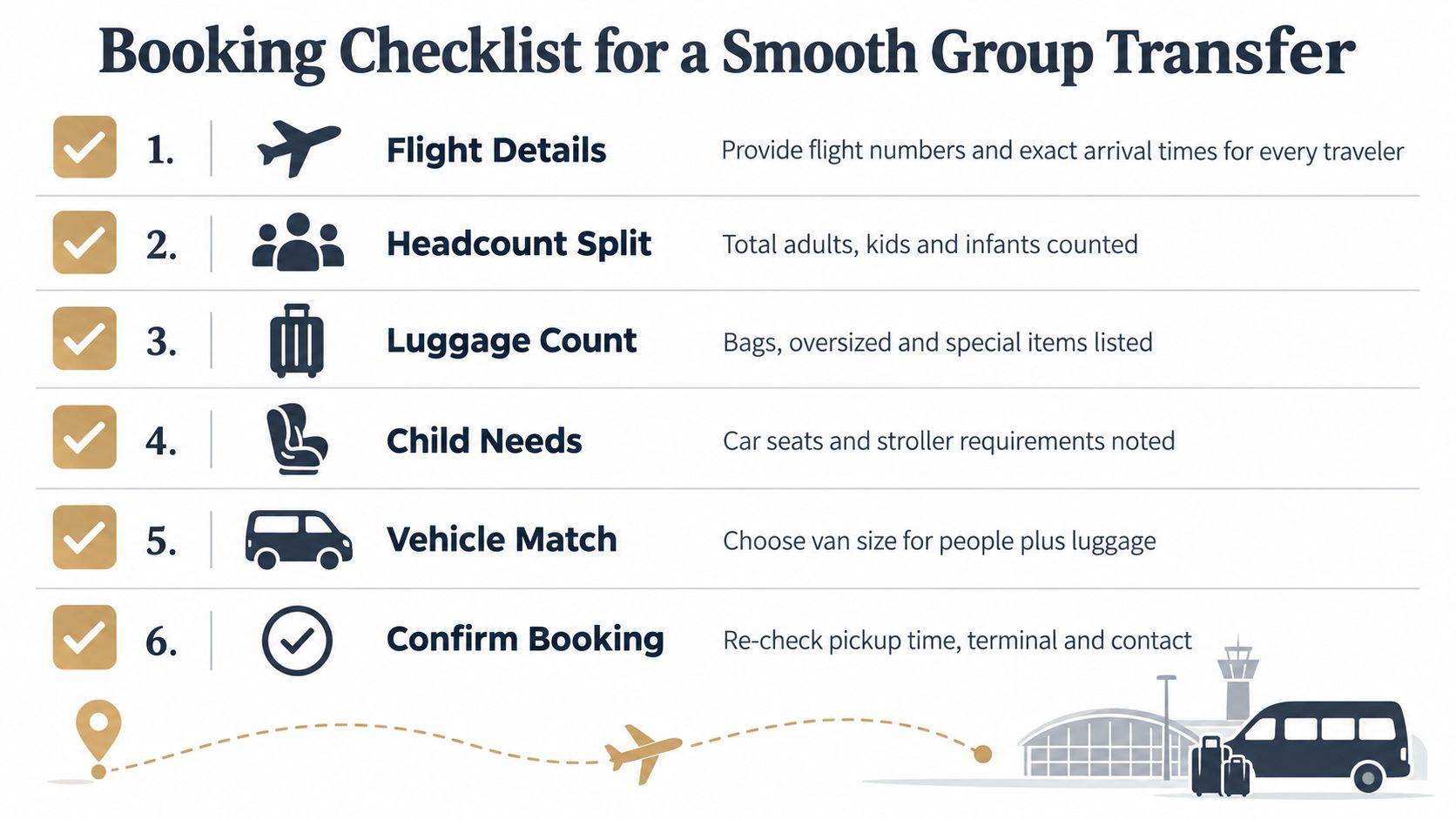
Start with the raw facts, not the price. Get every flight number, exact arrival time, total headcount split by adults, kids, and infants, luggage count including strollers or golf bags, destination address, and the exact child or booster seat needs. If any of that is vague, the booking is already shaky.
Ask for the full operating plan in writing
Confirm the vehicle type matches both seats and bags, not just the passenger count. Verify whether the quoted price includes meet-and-greet, parking, tolls, and gratuities, because those line items decide whether the quote is honest. For multiple flights, ask for one central coordinator contact and a written pickup plan for each window.
A good operator doesn't dodge those questions. The answer should be quick, specific, and written down. If the provider hesitates, that tells you enough.
Use the same standard for weddings, families, and corporate groups
Wedding organizers need timing discipline. Families need child-seat and luggage clarity. Corporate groups need one contact, one plan, and no surprises. The same transfer company can handle all three, but only if it treats the job as coordinated logistics instead of a loose ride request.
The Cancun operators that do this well build the day around live flight monitoring, terminal awareness, and vehicle right-sizing. That is the standard to demand.
If you need a Cancun team that handles private airport pickups, group routing, and vehicle coordination with live flight monitoring, Unique Private Transportation is set up for that kind of work. Use them when you want a clean group airport transfer plan for families, weddings, or corporate arrivals, and when you'd rather book the logistics once than fix them at the curb.