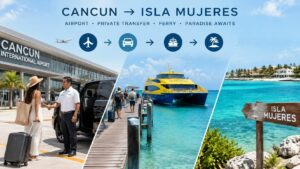
A sales director lands in Cancún at 7:40 a.m. for a 9:00 product briefing. The room is booked, the slides are loaded, and a team of account managers is expected by nine. One delayed airport pickup can undo all of it.
The label covers planned business gatherings built around an objective: knowledge exchange, networking, sales development, employee alignment, or product promotion. The purpose sets the guest list, the agenda, and the budget, not the catering.
A corporate event works like an operating system for logistics. The same framework can run a twelve-person leadership retreat or a thousand-person convention. Transport is the layer that connects every arrival to the first session, and a late car makes a perfect agenda miss its own start. Cancun airport transportation is often the first test of whether that system holds.
Table of Contents
- What Counts as a Corporate Event
- Types of Corporate Events Compared
- Group Size and Vehicle Choice
- Arrival Logistics for Corporate Events in Cancún
- Why Reliable Chauffeured Transport Protects the Event
- Booking Checklist
What Counts as a Corporate Event
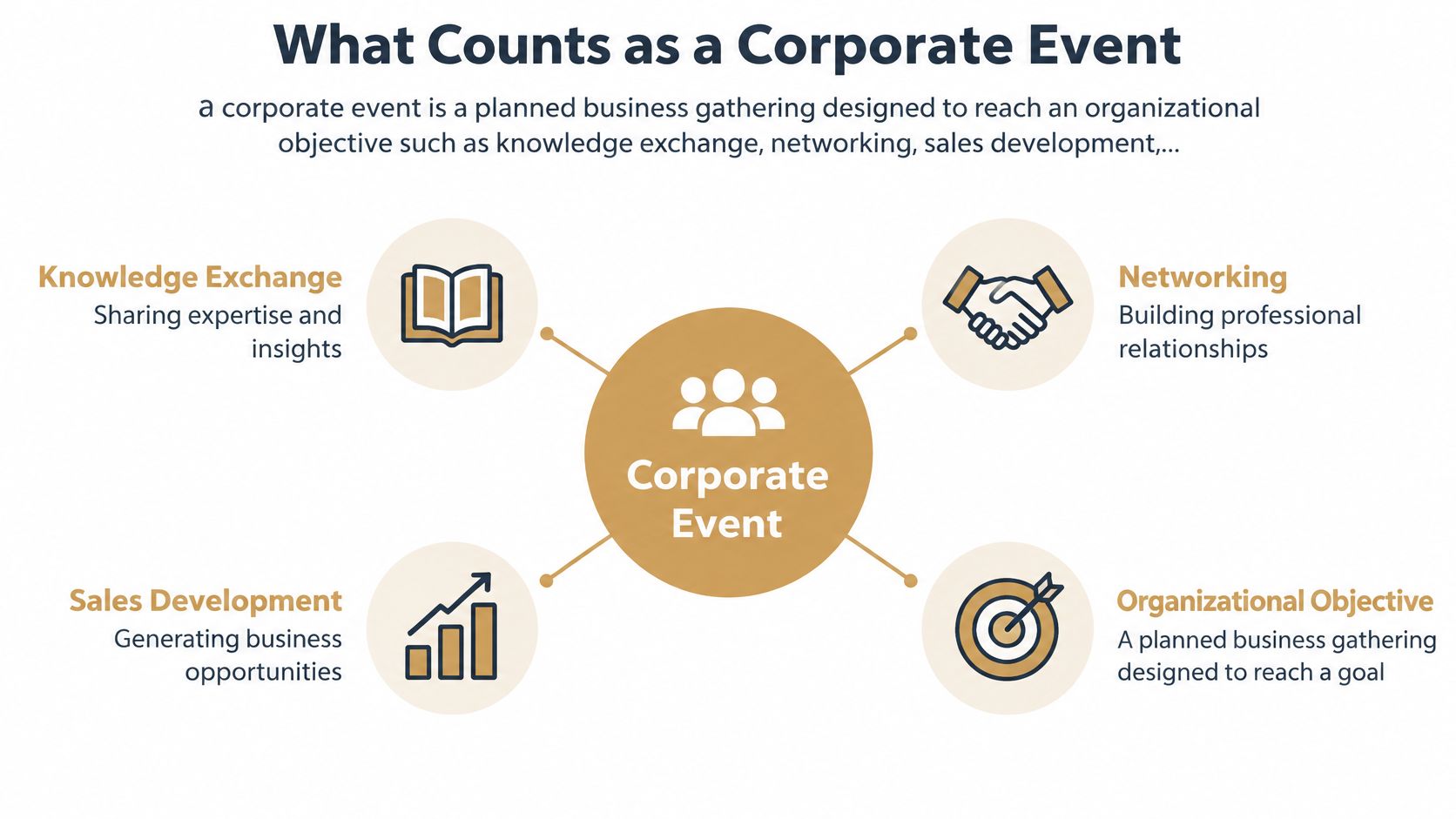
Start with the result the gathering is supposed to produce. A corporate event is a planned business gathering built around an organizational objective: knowledge exchange, networking, sales development, employee alignment, product promotion, or relationship building. Planning runs backward from that destination. The venue, the menu, and even the vehicle list follow the purpose.
An office holiday party and a client product launch can both have food and music. Only the launch gets scored against orders, leads, or partner commitments. A purely social gathering can be lovely and still not be a corporate event.
A corporate event is defined by its purpose, not its headcount, so a twelve-person leadership retreat counts as much as a thousand-person convention.
Business events form a large, measurable slice of global commerce, tracked in its own right rather than folded into tourism totals. That size matters because it turns the gathering into a business instrument, not hospitality with a name badge.
The working benchmark
The Events Industry Council and Oxford Economics framework generally counts a business event as at least 10 participants for a minimum of four hours in a contracted venue, and places corporate events as the largest business-event category by direct spending. Put the purpose test on top of that benchmark. The benchmark is a floor, not a guest-list rule. If you want a fuller walk-through of naming the objective before you book anything, define your event's purpose with EventUploader.
Run four questions on any gathering:
- What is the business objective? Name the result you can check afterward, such as leads, alignment, or a decision.
- Who attends? Employees, clients, partners, or investors change the tone and the pickup plan.
- How long does the program run? A four-hour minimum is the usual event threshold. Shorter working time is usually a meeting.
- Where is it held? A contracted venue gives you a fixed drop-off, a room, and a clock.
| Criterion | Benchmark | Effect on transport planning |
|---|---|---|
| Participants | At least 10 people | Vehicles are right-sized by group size |
| Duration | At least four hours | Pickup windows must fit the agenda, not only flights |
| Venue | A contracted venue | Fixed drop-off points and staffed arrival times |
| Purpose | A business objective, not social entertainment | Schedules are built around sessions and commitments |
A six-person working session is usually a meeting, not an event. A small client dinner with a commercial purpose still qualifies, because the objective is the relationship or the next order. Headcount alone is a weak test now. Booking.com's 2025 trend coverage cited Eventbrite research that 63% of organizers expected demand for micro-events to rise, while Cvent data showed 58% of planners expected to cap guest lists at 100.
Types of Corporate Events Compared
ConventionSouth's 2025 industry survey found conferences were the most common event type, reported by 49.6% of respondents, followed by networking events at 44.4%. Most planners meet a conference first. The table below is the quick reference for the formats that follow.
| Event type | Main objective | Typical attendees | Transport need |
|---|---|---|---|
| Meetings | Internal alignment and decisions | Team or department staff | Short local transfers, often shared vehicles |
| Conferences | Knowledge exchange and networking | Staff, clients and partners | Group transfers timed to session starts |
| Trade shows and exhibitions | Product visibility and lead generation | Exhibitors and visitors | Scheduled shuttles between hotel and venue |
| Product launches | Market awareness and press coverage | Press, clients and partners | Chauffeured VIP arrivals and departures |
| Sales meetings | Sales enablement and targets | Sales teams, often travelling in | Team airport transfers and hourly service |
| Incentive programs | Motivating and rewarding top performers | Top performers and their guests | Multi-day itineraries, airport transfers and tours |
| Corporate dinners | Client relationships | Executives and clients | Door-to-door sedan or SUV service |
| Leadership retreats | Strategy and team alignment | Executive team | Full-day transport with remote venue routing |
| Training sessions | Skills and knowledge transfer | Staff cohorts and new hires | Shared group transfers at fixed start times |
| Shareholder meetings | Governance and reporting | Shareholders, board and executives | Executive sedans and chauffeured arrivals |
Meetings keep a team or department in one conversation, so a shared local vehicle is enough. Conferences mix staff, clients, and partners, and the cars have to hit session starts, not a loose hotel window. Trade shows and exhibitions need scheduled shuttles between hotel and hall so exhibitors aren't stuck in a taxi line while the floor opens.
A product launch is different again. Press and clients expect chauffeured arrivals that look intentional. A sales meeting often brings a whole team in from out of town on one day, so airport transfers and hourly service matter more than a scenic route. Incentive programs reward top performers and their guests across several days and destinations, which means airport transfers plus tours, not a single drop-off.
Corporate dinners are door-to-door sedan or SUV work for executives and clients. Leadership retreats send a small executive team to a remote venue for a full day, so routing is the job. Training sessions move staff cohorts at fixed start times in shared vehicles. Shareholder meetings call for executive sedans and chauffeured arrivals for the board and shareholders.
Name the objective first, then the audience, then the transport need. The objective usually predicts the other two.
Group Size and Vehicle Choice
Group size is the first input in a corporate event's transport operating system. It configures the fleet, the pickup windows and the driver assignments. A sedan suits one or two guests with luggage. An SUV such as the Cadillac Escalade suits a small executive party or a group traveling together. A larger party needs several vehicles moving as one unit, with one chauffeur responsible for each car.
That distinction separates a corporate event from an ordinary meeting. A twelve-person meeting in one office can share a single vehicle. A twelve-person event arriving in three waves cannot. Say a client and a senior colleague land together. They travel best in a sedan or SUV with one named driver who already has the terminal and hotel details. A sales team of eight with roller bags will not fit that car. Split them into two vehicles, or the second wave waits on the curb while the first car leaves.
Matching sequence
- Count confirmed travelers in each arrival window. Don't average the day. A morning wave and an evening wave are two separate jobs.
- Split them into vehicles by seats and luggage. Seats alone mislead when everyone has a full suitcase.
- Assign one chauffeur to each vehicle group. One driver who owns that list beats a pool of cars with no names.
- Set each pickup window back from the agenda start, not from landing time alone. The first session is the deadline.
Travelers landing at different terminals need separate vehicle sets. One terminal's group cannot wait on another's flight without missing the room. Headcount also changes staffing on the ground, the same scaling problem covered in scaling corporate event security in Melbourne. Confirm headcount twice: when invitations go out and again a week before the event. A change of two or three people can move the plan from one SUV to two vehicles, and that change has to happen before drivers are briefed.
Arrival Logistics for Corporate Events in Cancún
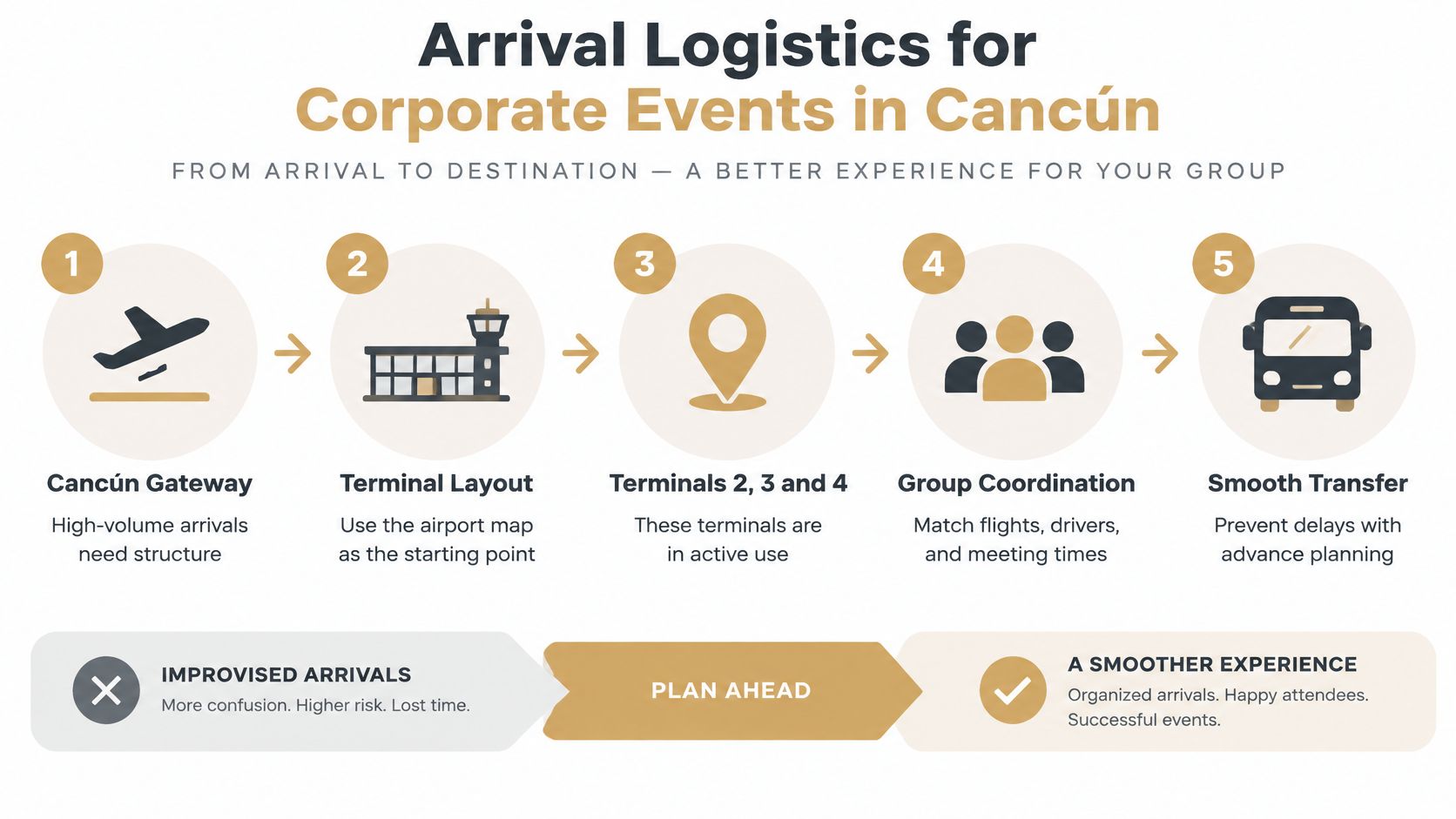
Cancún is a high-volume gateway, so group arrivals need a plan rather than improvisation. ASUR reported 7,457,990 passengers at Cancún Airport from January through September 2025. That volume is why private transportation Cancun airport teams treat the terminal map as the starting point, not a detail to sort out after landing.
Terminals and the shuttle that doesn't reach the hotel
Cancun Airport's FAQ notes that Terminals 2, 3, and 4 are in active use, and a complimentary shuttle connects them about every 10–15 minutes from stops outside each terminal. That shuttle runs between terminal buildings. It doesn't go to hotels, resorts, or venues. Guests who land in different terminals still need a pre-arranged pickup if they're going to the same briefing.
The airport transportation advisory warns that unauthorized providers may be unable to collect passengers and may charge more than official rates, with a risk of lost payment. For an international group, that isn't a minor inconvenience. It's a missed session. Cancun luxury airport transfers work when the meeting point, the driver, and the vehicle are confirmed before anyone clears customs. A practical Cancun car service guide for that handoff sits in our Cancun car service notes.
Six steps before wheels move
- Collect every flight number and arrival terminal. A name without a terminal is a guess.
- Group arrivals by terminal and by time. Don't merge Terminal 2 and Terminal 4 into one curb call.
- Confirm one meeting point for each terminal group. Write it the way a tired traveler can follow it.
- Send drivers and attendees written pickup instructions before landing. Both sides should hold the same note.
- Track flights so vehicles adjust to delays. A driver who only has the scheduled time will be early or gone.
- Set the pickup so guests reach the venue with a buffer before the agenda starts. The buffer belongs to the first session, not to the airline.
The common slip is planning pickups from flight times alone. Landing time isn't session time. Customs, bags, and the ride still sit between the jet bridge and the chair.
Why Reliable Chauffeured Transport Protects the Event
Corporate events create value through direct, indirect, and induced effects, so transport sits in the value chain rather than beside it. The Events Industry Council and Oxford Economics study reported about $1.3 trillion in direct global spending in 2025. Direct, indirect, and induced activity supported $3.1 trillion in total business sales, $1.8 trillion in global GDP, and 24.2 million jobs. Direct spend covers venue, production, hospitality, transport, and suppliers. Indirect spend is what those suppliers buy. Induced spend is household spending by the people paid along that chain.
Late arrivals cut session participation, throw speaker schedules off, raise venue labor costs, and shrink the networking time you paid to create.
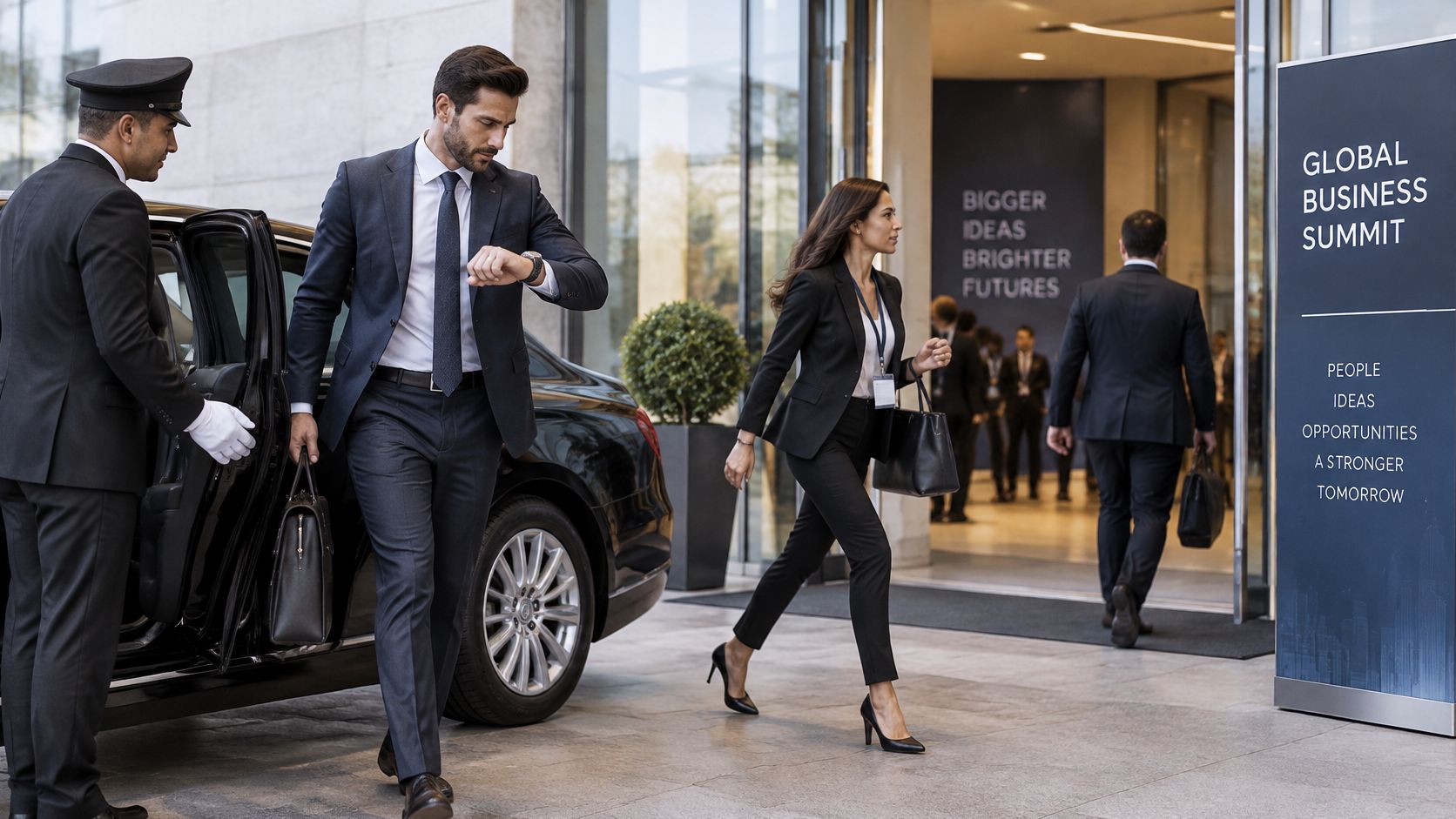
Say a 60-person incentive group lands in two waves. This example is illustrative. Without a shared schedule, half of them miss the opening keynote because the second wave waits on a random desk. With timed pickups and a dedicated chauffeur for each wave, everyone is in the room before the agenda starts. The keynote runs once. You don't get it back.
A scorecard you can actually track
Tie the cars to outcomes, not to a headcount photo:
- On-time arrival rate: Share of guests in the room before the session starts.
- Missed-session rate: People who paid to attend and still missed the room.
- Vehicle utilization: Seats filled versus cars dispatched.
- Passenger wait time: Minutes from meet point to departure.
- Transport cost per attendee: Total ground cost divided by confirmed guests.
- Schedule variance: Gap between planned pickup and actual wheels-up from the curb.
- Post-event results: Qualified leads, meetings completed, or engagement you can name.
Chauffeured service suits executives and clients because a named driver, live flight tracking, bilingual communication, and a right-sized vehicle cut the variance those metrics record. For Cancún and Riviera Maya programs, centralized dispatch and multi-vehicle routing are the controls. Our dedicated chauffeur service is built for that kind of timed movement.
Punctual arrival protects the return on the event.
Booking Checklist
Hand the travel desk a plan the same day, not a pile of flight screenshots.
- Confirm the event type and objective against the purpose test. If it fails that test, you're booking a party, not an event move.
- Collect each arrival flight and terminal, then set pickups from the agenda, the way the Cancún steps require.
- Size vehicles and assign one chauffeur per group. The Cadillac Escalade is what we offer when the party and the luggage need a group vehicle.
- Agree on confirmation and contact before event week, including written pickup instructions and flight tracking. Our Dedicated Chauffeur service covers airport transfers, corporate events, weddings, and special occasions, with premium vehicles coordinated through concierge support, so one driver owns each pickup.
Marketing teams that want the wider planning list can use event planning guidance for marketing teams alongside this transport sequence. When you're ready to price the fleet, review our luxury transportation rates and send the event type plus the arrival list.
Unique Private Transportation provides private airport transfers, point-to-point travel, and chauffeured ground transport for corporate groups across Cancún and the Riviera Maya, with live flight monitoring and meet-and-greet at the terminal. If your event's objective depends on people arriving before the first session, that is the job luxury transportation and a named driver are meant to do. Share your dates and guest movements with Unique Private Transportation and we'll build the pickup plan around the agenda.