

A corporate group is separate companies under one controlling owner, not a single company or the colleagues sharing a van. You're looking at an offsite agenda with one familiar logo at the top, a flight landing in Cancun this afternoon, and a transfer form asking who should be invoiced. The logo doesn't answer that. The exact company does, and getting it right changes who signs, who pays, and who answers if a pickup goes wrong.
Table of Contents
- What a Corporate Group Means
- Which Company Signs, Pays, and Answers for the Transfer
- How Corporate Groups Change a Cancun Airport Pickup
- Right-Size the Vehicle for Each Corporate Party
- How to Coordinate Pickups for a Multi-Stop Group
- Send the Manifest and Book a Cancun Chauffeur Service
What a Corporate Group Means
Eight colleagues walk into Cancun International Airport under one brand for a leadership offsite. Behind that brand, three legal companies may be involved, one employing the travelers, one paying for the trip, and one holding the hotel contract. That's the situation what is a corporate group helps you sort out before you book a car.
A corporate group is a collection of legally separate enterprises linked by ownership or control and directed by the same owner or parent company. The OECD benchmark definition of foreign direct investment defines an enterprise group as all enterprises under the control of the same owner or group of owners and recognizes both direct and indirect control. Control means the ability to determine an entity's strategic financial and operating policies, not just shared branding or friendly cooperation.
A Family of Houses, Not One Big House
Think of a family of houses on one street. The household decides the holiday together, but each house still has its own deed, bills, and front door. A corporate group works the same way. The parent coordinates strategy, money, and branding, while each company keeps its own contracts, accounts, employees, and regulatory obligations.
Control is commonly shown by holding more than 50% of voting power. It can also pass indirectly through a chain of subsidiaries, or come from board appointment rights, shareholder agreements, or other contracts. In a transportation business, for example, separate subsidiaries could own vehicles, employ chauffeurs, operate tours, or run the booking technology. They're a group because one owner controls them, not because each one sells directly to you.
That last point separates three ideas readers often blur. A single corporation is one legal person. A corporate group is several legal persons under one controller. A traveling party isn't a legal structure at all, it's just the people on the transfer.
| Arrangement | Legal identity | Who controls decisions | Name on the transfer booking |
|---|---|---|---|
| Single company | One legal entity | That company's own directors | The company name on the invoice |
| Corporate group | Separate companies under one owner | Parent, often via more than 50% voting power or equivalent control | The exact subsidiary that will pay |
| Traveling party | Not a legal structure | Trip organizer or travel manager | Passenger count, flight, hotel, and payer |
| Shared brand only | A trading name, not proof of control | May differ from the contracting company | Legal entity, not the logo |
Read the table by the last column. For a single company, the invoice name and the decision maker match. For a group, they often don't, so you need the subsidiary that will pay. A shared brand proves nothing about control, which means the logo on the agenda can't stand in for a legal name.
Before you pick a vehicle: Write down two names, the trading name your colleagues recognize and the legal payer accounts will recognize. If you only have the first one, you don't have a booking yet.
Which Company Signs, Pays, and Answers for the Transfer
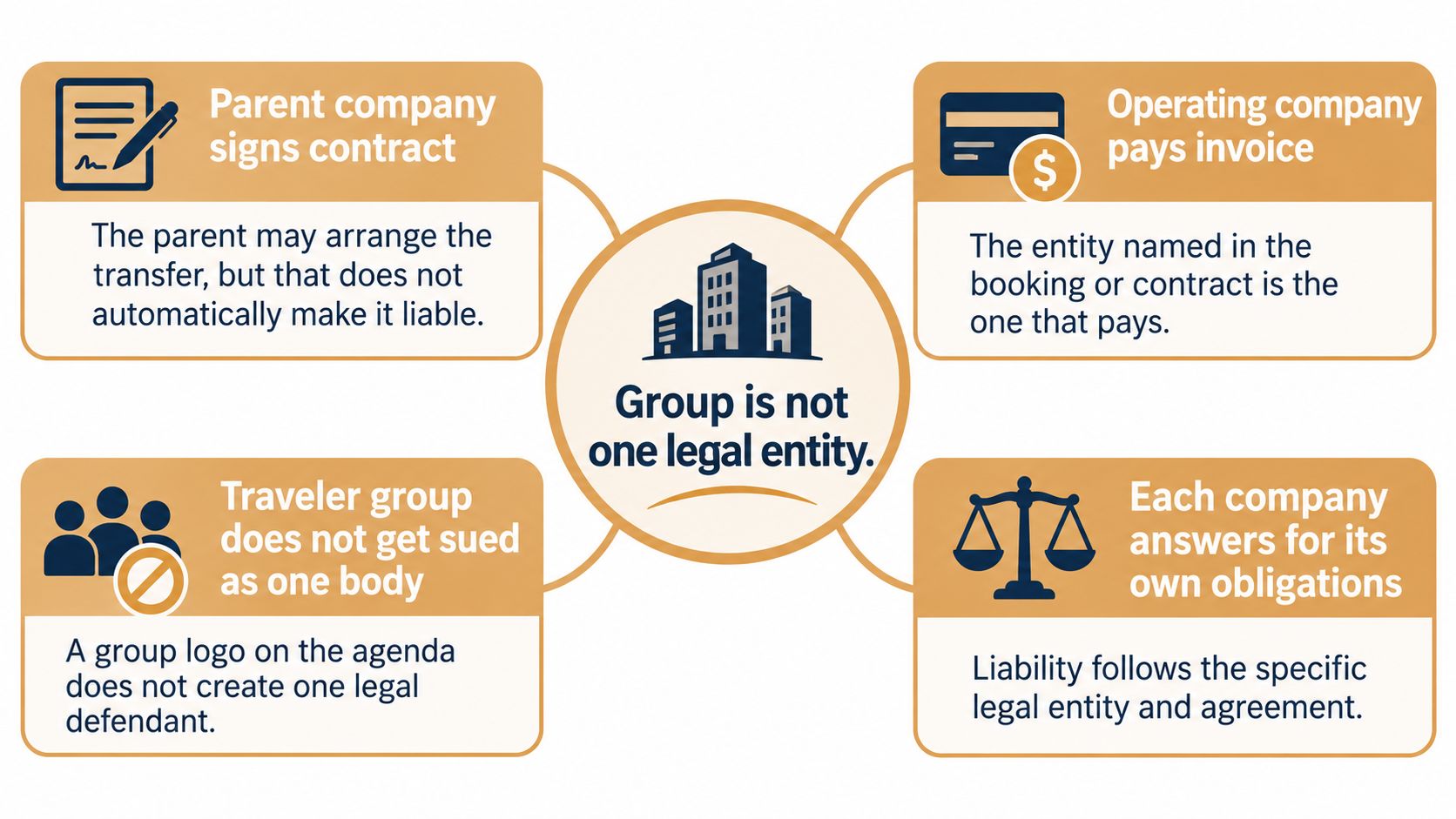
Here's the mistake that causes most trouble. A reader sees a group logo on the offsite agenda and assumes the parent company, or the group as a whole, can be sued or will automatically pay. Neither follows. A corporate group is not automatically one legal entity, and the parent isn't automatically liable for every subsidiary obligation.
Each subsidiary is typically an independent legal entity with its own rights, duties, contracts, and insurance, governed by its own applicable law. The OECD report on duties and responsibilities of boards in company groups explains that limited liability rules generally protect the parent from direct creditor claims, while jurisdictions vary substantially in how they recognize group influence and parent responsibility. Exceptions can arise through fraud, abusive control, environmental rules, guarantees, insolvency doctrines, or shadow director theories, and they differ by country.
Why Head Office Size Doesn't Identify Your Client
Consolidated accounts combine the whole group into one set of figures. That can make the group look far larger than any single subsidiary you're dealing with. Group revenue tells you the parent is substantial. It doesn't tell you which company requested your cancun airport transportation, holds traveler insurance, or will approve the invoice.
We carry traveler's insurance for our passengers, but it applies only to the ride we operate. It does not replace the insurance your own company needs for its travelers. Both sides of the booking have a named entity, and both should be documented.
Four Checks Before You Book
Run these before you confirm any transfer:
- Confirm the exact legal entity name on the purchase order, spelled as it appears in registration, not as it appears on the website.
- Note the registration jurisdiction if the buyer or vendor shows it, because that law shapes liability.
- Ask whether a parent guarantee exists for this transfer specifically, not for the group generally.
- Confirm which company receives the invoice and holds the traveler insurance, then check the luxury transportation rates against that payer's approval limits.
Which exact company is signing, paying, insured, and responsible if a pickup fails?
Send your travel desk that one question. If they can answer it in one sentence, you're ready to book. If they answer with a brand name, you're not.
How Corporate Groups Change a Cancun Airport Pickup
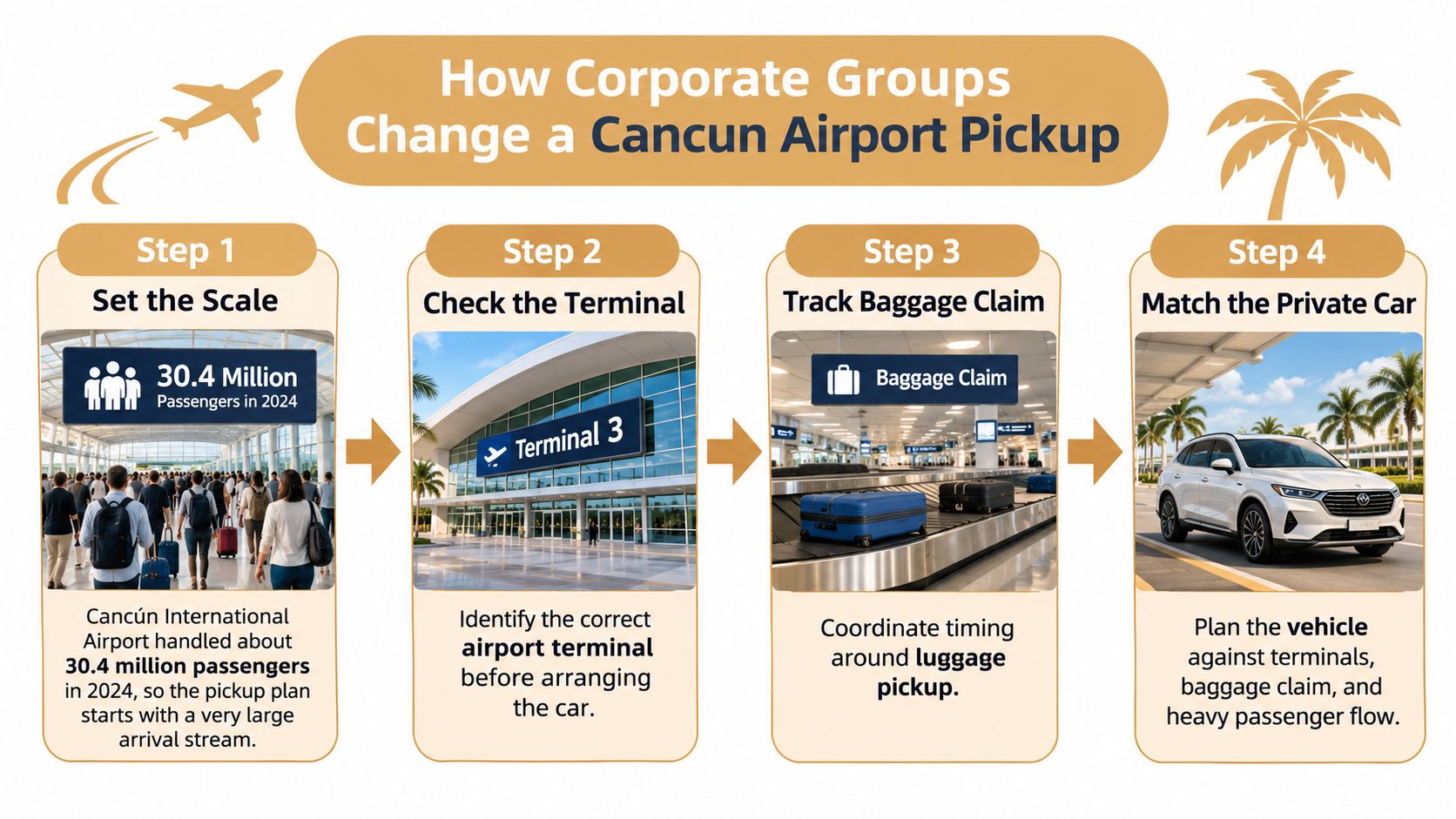
Three flights can bring one corporate group into Cancun across a single afternoon. Four colleagues arrive at midday, three land an hour later, and a delayed connection brings the finance lead in later still. Some are going to a Cancun hotel, others to Playa del Carmen, and two need to continue toward Isla Mujeres the next morning.
The itinerary carries one company brand, but the ground plan needs to account for each arrival and destination. Airport pickups work like a relay: each vehicle takes responsibility for its passengers when they are ready, rather than holding everyone for the last flight.
One Record, Separate Cars
A booking can keep the group's arrangements together while assigning separate vehicles to different flights. For each arrival, share the flight details, passenger count, and destination. That gives the ground coordinator a clear plan for who is meeting each party and where they are going.
A delayed flight then affects its own pickup, rather than holding the colleagues who have already arrived. For broader context on flight planning for busy professionals, consider how the air schedule fits with your Cancun car service arrangements.
Where the Time Actually Comes Back
Good coordination reduces uncertainty between landing and reaching the destination:
- A clear meeting point: Tell each traveler where to look for their pickup after arrival.
- The exact destination: Confirm the hotel or meeting point, especially when the group is split between Cancun and Playa del Carmen.
- Materials kept with their owners: Assign presentation cases and laptops to the travelers carrying them.
- Separate departure times: Let each party leave when its passengers are ready instead of making earlier arrivals wait for a delayed flight.
- Special requests noted in advance: Share requests such as child seats before travel so they can be included in the pickup plan.
Send the flight number, terminal if known, passenger count, and first destination for each arriving party. Those details give the coordinator a practical starting point for organizing the pickups.
Right-Size the Vehicle for Each Corporate Party
Count people and full-size checked bags separately. A week at a Riviera Maya resort fills a trunk faster than an overnight city meeting, and a vehicle that seats six comfortably may not carry six people's luggage for seven days. Start with the table, then adjust for the edge cases below.
| Party size | Vehicle type | Luggage fit | Best use |
|---|---|---|---|
| 1-3 passengers | Executive sedan | About 2 large bags | Solo executive or a small pair |
| 4-6 passengers | Premium SUV | About 4 large bags | Leadership team to one resort |
| Up to 7 passengers | Full-size SUV | A week of checked bags | Offsite team in one vehicle |
| 8-14 passengers | Two SUVs as a convoy | Checked bags split across both vehicles | One flight, one hotel, larger team |
| 15 or more passengers | Staggered multi-vehicle dispatch | Bags assigned per vehicle on the manifest | Conference arrivals across several flights |
Reading the Rows
One to three passengers ride in an executive sedan, which suits a solo executive or a pair traveling light. Four to six take a premium SUV, the right shape for a leadership team heading to one resort. Up to seven fit a full-size SUV, which keeps an offsite team in one vehicle with a week of checked bags behind them.
Past seven, don't squeeze. Eight to fourteen travel as two SUVs running as a convoy, so both cars arrive together and nobody's luggage ends up in a third vehicle nobody planned. Fifteen or more need a staggered multi-vehicle dispatch, with cars released as flights land rather than all at once.
A word on what these terms mean here. Luxury transportation means a late-model private vehicle with a professional chauffeur, not a stretched party bus with a light show. Unique private transportation keeps your group off shared routes, so the car goes to your hotel and nowhere else first.
Edge Cases That Move You Down a Row
- Child seat fitted: A child seat takes one adult seat, so a party of six with a toddler becomes a full-size SUV booking.
- Golf clubs or exhibit cases: Bulky equipment can push three people out of a sedan and into an SUV even though the headcount looks small.
- Two hotels on one arrival: Separate cars beat one car doing both drops when the second stop adds a long detour before a timed meeting.
- Split flights: Assign vehicles by arrival time rather than job title, so each car leaves when its passengers are at the curb and seniority doesn't hold up dispatch.
Sizing rule: If bags, equipment, or a child seat claim a seat, count that seat as occupied. Headcount alone undersizes more corporate transfers than any other mistake.
Finish by marking each row of your guest list as sedan, SUV, or convoy before you request quotes. That one pass through the list gives every provider the same numbers to price against, and it stops the quote comparison from turning into guesswork about what you asked for.
How to Coordinate Pickups for a Multi-Stop Group
One procedure, written so a travel manager can hand it straight to an assistant. Follow it in order and the booking builds itself.
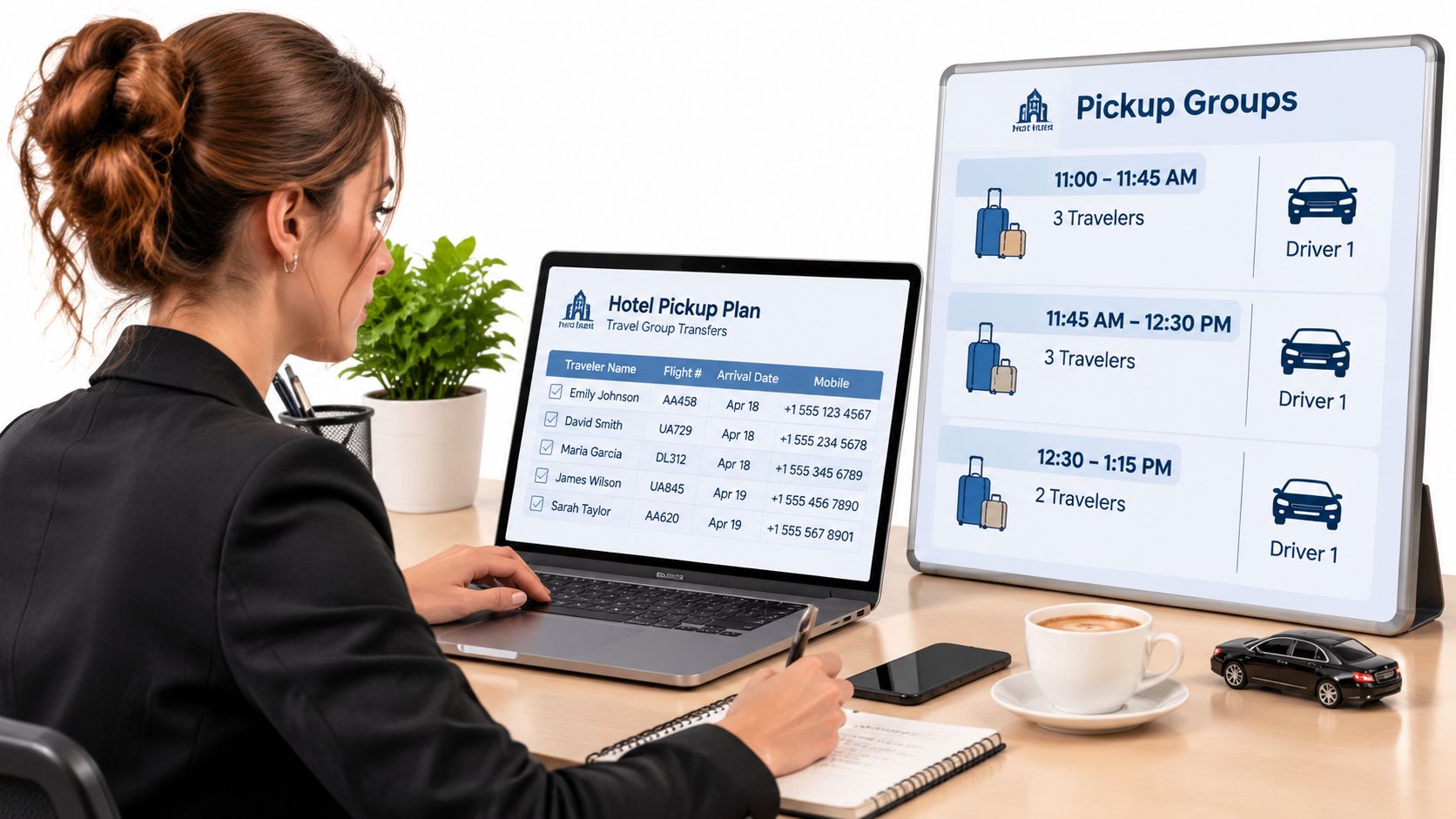
- List every traveler with flight number, arrival date, and mobile number.
- Group them by landing window of about 45 minutes, not by department.
- Match each cluster to a vehicle using the size you've already chosen for that headcount and luggage.
- Name the paying legal entity and the on-site host who'll be reachable on the day.
- Add hotel or meeting stops in order, including a ferry connection or Chichen Itza only if that day is part of the same booking.
- Request child seats, extra luggage notes, and bilingual greet signs now, not from the curb.
- Share a single confirmation thread so dispatch, not each passenger, absorbs delay changes.
- Reconfirm the night before with final passenger counts per vehicle.
Why the 45-Minute Window Works
The clustering step deserves its reasoning. Tighter groups leave people standing at baggage claim while a car waits with nobody in it. Looser groups idle at the curb with passengers watching the clock. About 45 minutes splits the difference, close enough that one car serves the cluster, wide enough that a slow bag doesn't strand anyone.
If you're comparing approaches before you commit, the group travel guidance from Hamptons Leisure Limo walks through large party airport logistics from another operator's angle. The details differ by city. The manifest discipline doesn't.
Two Situations Readers Ask About
Last-minute bookings still need the same eight fields. You just send them by phone or message instead of a spreadsheet, and dispatch works from what you have. Don't skip the payer name or the mobile numbers because you're in a hurry. Those two fields prevent most day-of confusion.
A dedicated chauffeur by the hour suits a meeting day with several Cancun stops, where the car waits between appointments. Our dedicated chauffeur option works that way, while an airport transfer is point to point and ends at drop-off. Pick based on whether the car needs to stay with you.
You're done when you can forward one manifest and one payer name to anyone who asks. If it takes two documents and a phone call to explain the plan, simplify it before travel day.
Send the Manifest and Book a Cancun Chauffeur Service
A clear manifest turns a corporate group's legal arrangements into practical booking details. Set out the paying company's legal name, passenger count for each vehicle, and each car's first stop after Cancun Airport. With those details, the provider can plan the booking with fewer follow-up questions.
Match the service to the itinerary. Unique Private Transportation provides private airport transfers and point-to-point travel across Cancun and the Riviera Maya, with concierge coordination for group trips. For an offsite free day, you can reserve attractions for large groups through My Global Trips while arranging ground transport separately.
Vehicles and Coverage That Match the Plan
The Cadillac Escalade is offered for group travel, and the Suburban RST is offered for groups of up to 7 passengers. Dedicated Chauffeur is a chauffeur service for airport transfers, corporate events, weddings and special occasions, including travel between event stops.
For airport arrivals, the company offers meet and greet and flight monitoring, with 24/7 support and concierge coordination from the first landing through the final drop-off. Share each flight and hotel stop in the manifest so the team can coordinate the pickup plan.
For groups larger than seven, request vehicles sized to the passenger clusters rather than assuming one car will fit everyone. Note luggage needs for each party, too. That helps match the vehicle plan to the people and bags traveling together.
Send the manifest, the payer's legal name, and each flight's first hotel stop before the group boards. The booking can then reflect who is responsible for payment and where each party is going. If you're arranging attractions as well, reserve attractions for large groups through My Global Trips.
Send your manifest, the legal name of the company paying, and each flight's first hotel stop to Unique Private Transportation to arrange a coordinated Cancun airport transfer.