
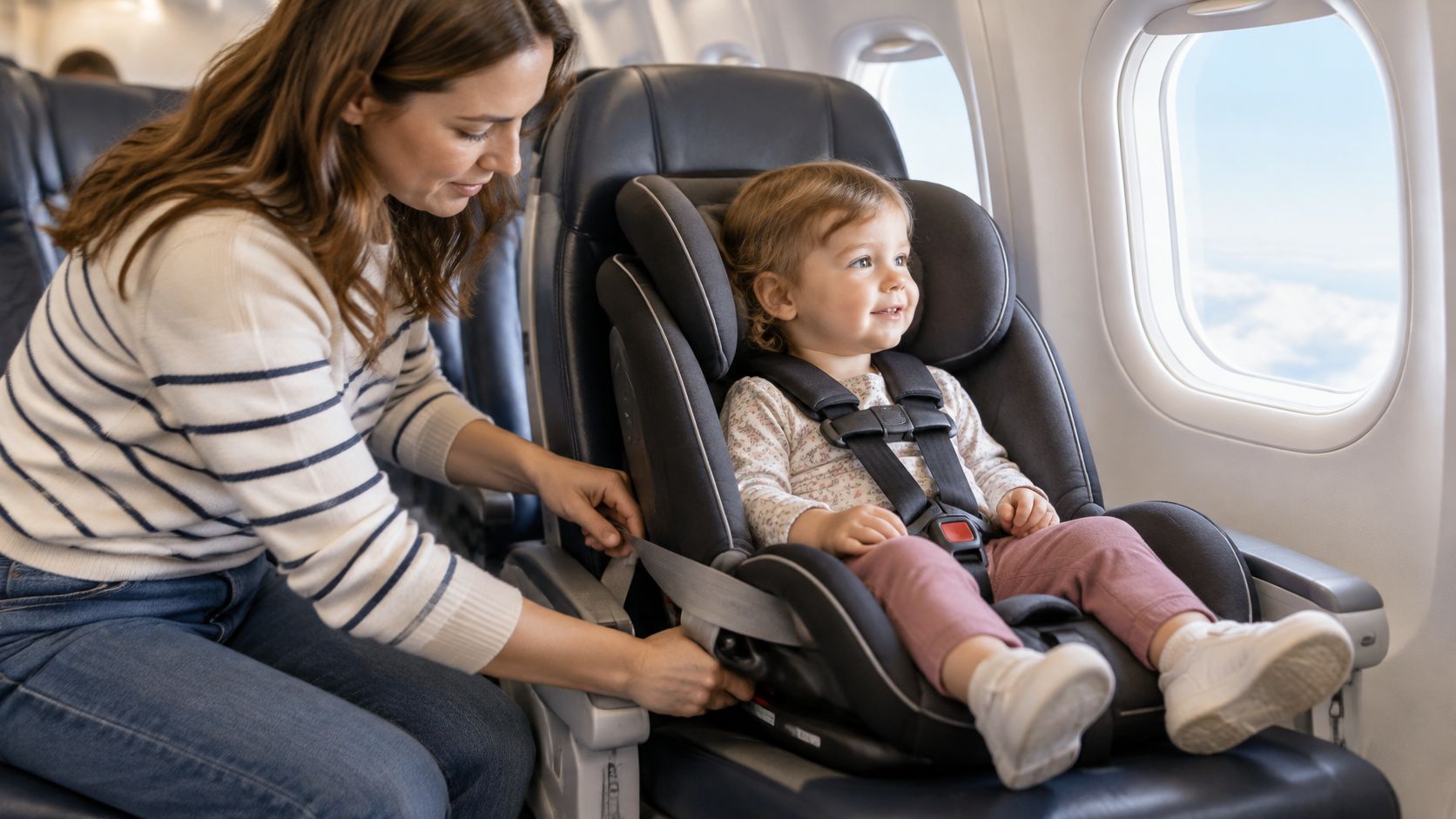
You're standing in your hallway with a car seat on one hip, a diaper bag slipping off your shoulder, and a boarding pass that still lists your child as an infant in lap. The seat fit in the car this morning. Now you're wondering whether it will fit between the airplane armrests, with passengers waiting behind you.
The tricky part starts before you reach the cabin. Decide whether the seat is allowed, whether your child has a purchased seat, and what you'll do if the car seat won't fit. Include the journey after landing in your plan: if you're continuing from Cancun Airport, arrange authorized ground transport that can accommodate the same child and car seat.
Do the checks in order. Confirm the label and your child's limits first, buy the child's seat second, and install third. If the seat cannot be used on board, know your alternative before you leave home. That way, you can board with a clear plan instead of trying to solve the fit problem in the aisle.
Table of Contents
- Which Car Seats Fly and When a Seat Is Needed
- Book the Right Seat and Confirm Before You Fly
- How to Install the Car Seat with the Lap Belt
- When the Car Seat Will Not Fit
- Leave Cancun Airport with the Car Seat
Which Car Seats Fly and When a Seat Is Needed
Start with the split that decides everything else. In the United States, federal aviation rules require passengers to occupy an approved seat and use the installed safety belt during taxi, takeoff, and landing, but children younger than 2 have historically been exempt from occupying their own seat, according to a U.S. Department of Transportation review of child restraints. That same review identified three infant fatalities over 32 years from fiscal year 1980 through August 2011 that investigators concluded could have been prevented by a child restraint system, in Denver in 1987, Sioux City in 1989, and Charlotte in 1994, with no similarly preventable infant fatalities after Charlotte for more than 17 years.
Those numbers explain the policy gap. A lap infant is legal. A lap infant isn't restrained like everyone else during sudden deceleration or turbulence. If you want your child in a car seat for taxi, takeoff, and landing, you need a separately purchased passenger seat for that child, even if they're under 2. No purchased seat means no guaranteed place to install anything.
Check the Label Before You Check Anything Else
Accept only a restraint labeled as certified for use in motor vehicles and aircraft, or carrying an equivalent approval from the relevant national authority. Find that wording on the shell itself, not on the box or a product listing. Photograph it with your phone. Crew members ask to see it, and hunting for small print under a seat in a dark cabin wastes the goodwill you need.
Then weigh your child today and compare that weight, plus their height, against the limits printed in the manual. A seat your toddler outgrew last month doesn't become legal because it's the lightest one you own. If they're over the limit for the mode you plan to use, that seat stays home.
International approval adds one more wrinkle. The International Civil Aviation Organization published its Manual on the Approval and Use of Child Restraint Systems in 2015 after discussions following its 38th Assembly session in 2013, as described in ICAO guidance on traveling with infants and children, but that work didn't create one global approval label. A U.S. label can still be questioned on a foreign segment. That's not a reason to skip the seat. It's a reason to carry the label photo and the manual.
Which child restraints belong on the aircraft seat
| Device | Use for taxi, takeoff, and landing | Own passenger seat | Install note |
|---|---|---|---|
| Rear-facing infant seat with aircraft label | Yes, if within limits and the airline accepts it | Required | Lap belt only, through the labeled path |
| Forward-facing convertible with aircraft label | Yes, if within limits | Required | Do not attach a vehicle top tether |
| Combination seat with aircraft label, harness mode | Yes, while the internal harness is in use | Required | Follow the belt path printed on the shell |
| Airline-authorized aviation harness such as CARES | Only when that carrier authorizes it | Required | Not a substitute for an unlabeled vest |
| Booster or backless seat | No | Not used as a restraint | Gate-check it |
| Infant carrier, wrap, or stroller seat | No | Lap travel only if the child is under 2 | Not a child restraint system |
| Car seat with no aircraft approval on the label | No | Do not install it | Leave it at home or check it |
Read that table as a yes or no gate, not as suggestions. A booster seat needs a lap and shoulder belt to position a child, and an aircraft seat gives you only a lap belt. A wrap or soft carrier holds your baby against you, but it isn't a restraint system and crew won't count it as one for takeoff. A combination seat works only while you're using its internal harness, not once you've removed the harness to use it as a booster.
Practical rule: If you can't point to the aircraft approval wording on the shell in your kitchen, you won't find it fast enough in row 18.
Buy the extra ticket only after the label and limits check out. That order matters. A ticket for a child whose seat can't fly leaves you paying for space you can't use the way you planned, and arguing at the gate rarely changes the label.
Book the Right Seat and Confirm Before You Fly
You'll win or lose this install at booking, not at the gate. Buy a ticket for every child who'll use a restraint, including an infant under 2. Then call or message the airline and have a note added to the reservation that an aircraft-approved car seat is coming. Ask for that confirmation in writing and save the email where you can pull it up offline.
Ask three specific questions on that call. Which aircraft type operates your route, and do the armrests lift in economy? Is the lap belt long enough for a child restraint on that seat? Where will the airline place a car seat on that aircraft? Vague answers like "car seats are welcome" don't tell you if your shell fits between fixed armrests in a premium cabin.
Pick Placement That Crew Will Accept
Request a window seat in a non-exit row, with a parent in the seat beside the child. A window placement keeps the shell out of the escape path for other passengers. An aisle placement traps the people inside you. Crew will move an aisle install, and they're right to do it.
Skip exit rows entirely. Skip a bulkhead if your rear-facing shell is deep and the airline can't confirm the space in front of it. On international connections, check again with each operating carrier. A seat cleared by your first airline can be refused by the next one, because device acceptance and seat location rules sit with each carrier.
Canadian guidance makes the orientation rule plain. The restraint goes in a forward-facing aircraft seat, and Canadian government guidance on air travel with children specifically excludes side-facing, rear-facing, and oblique-facing passenger seats unless special authority applies. That guidance also sets the mechanical limit for the whole trip. The car seat is secured solely with the passenger seat lap belt, the belt must not pass across or contact the child's body, and you don't use a vehicle top tether on board.
That tether point catches experienced parents off guard. In your car, the tether is mandatory for many forward-facing installs. On a plane, there's no anchor for it. Stow it tight against the shell so it can't catch on seat hardware or block anyone's exit. Don't clip it to a seat frame, a tray latch, or anything that looks sturdy. It wasn't tested that way.
Run the Go or No-Go Gate at Home
Two days before departure, lay out four items and check them off in order.
- Label approved: The shell states it's certified for aircraft use, and you have a clear phone photo.
- Child within limits: Today's height and weight fit the mode you'll use, rear-facing or forward-facing.
- Seat purchased: The child has their own ticketed passenger seat on every segment.
- Placement confirmed: You hold a non-exit assignment, ideally a window, with a parent beside the child.
If any item is missing, change the plan now. Gate-check the seat and travel with the child on your lap only if they're under 2 and the airline allows it, or rebook so the pieces line up. Don't invent a tether anchor, don't plan to hold the shell steady by hand, and don't assume an empty seat will appear beside you on a full flight.
Board early when the airline offers family pre-boarding. You need an empty aisle more than you need overhead bin space. Carrying a wide shell sideways past seated passengers is how belt paths get rushed and buckles get twisted. Two quiet minutes at an empty row are worth more than ten minutes of apologizing.
Think Past the Gate If Cancun Is Your Destination
If your ticket ends in Cancun, decide the ground ride while you're still confirming flights. Families reading up on a Cancun car service before departure can tell the provider the children's ages in advance, so the right seats are already in the vehicle. We provide free infant gear on board, and as one parent, Precious, put it, "they went above and beyond by providing baby car seats for us."
A confirmed car seat on the plane and a confirmed car seat in the arrival vehicle are the same decision. Make both before you leave home.
That planning also protects you when flights move. On the day of service, we monitor your flight, and pickup stays on time whether the flight is delayed or not. You shouldn't have to renegotiate a child's ride from the baggage claim while holding that child.
Keep the approval label photo, the airline's acceptance email, and the manual in your carry-on, not in checked luggage. If a crew member questions the seat, you answer with documents, not memory. Calm paperwork ends most cabin disputes in under a minute.
How to Install the Car Seat with the Lap Belt
The cabin install has one job. The aircraft lap belt holds the shell. The car seat harness holds your child. Those two systems never swap roles. The FAA guidance for flying with children requires a restraint explicitly approved for aircraft use, installed with the lap belt through the designated path, with slack removed by pressing the restraint firmly into the seat while tightening, and it states that a separate purchased seat is the only way to guarantee restraint use for a child under two. It also excludes booster seats, backless restraints, and baby carriers during taxi, takeoff, and landing.
Work through the sequence in order. Each step prevents a specific failure that crew see every week.
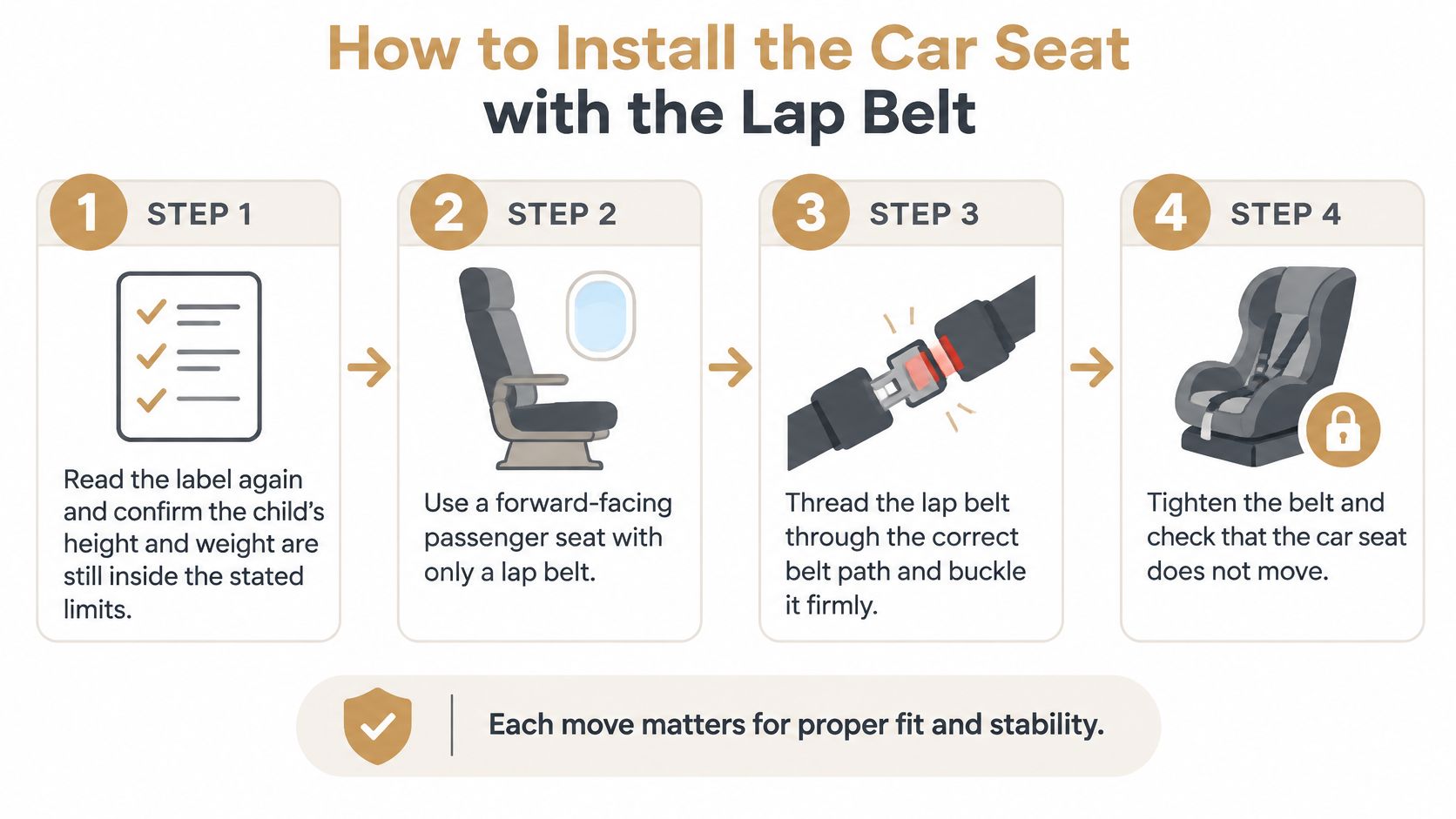
The Eight-Step Cabin Sequence
Read the label again at the seat. Confirm your child's height and weight are still inside the stated limits for the direction you're about to install. This catches the seat you grabbed from the garage instead of the approved travel seat.
Set the shell in a forward-facing passenger seat. Use the window when you can get it. Never use an exit row, and never place the shell where it blocks another passenger's path to the aisle. If your assigned seat violates that, ask crew to move you before you start threading anything.
Place the shell in the direction the label allows. Rear-facing only works when both the manufacturer instructions and the airline permit that orientation for your child's size. Forward-facing on the aircraft seat doesn't automatically mean forward-facing for the child restraint. Follow the shell, not habit from your car.
Route only the aircraft lap belt through the marked belt path. Open the lock-off or belt guide exactly as the manual directs for aircraft installation, which sometimes differs from the vehicle instructions. The webbing must lie flat, without twists, and it must never cross your child's body. If you can't see the path clearly, lift the shell and find the labels printed on the side. Don't guess based on where the belt goes in your SUV.
Buckle the belt, then press down hard. Put your knee or your full weight into the shell, compressing it into the aircraft cushion while you pull the belt tail to remove slack. Aircraft cushions are soft. A belt that feels tight on an uncompressed cushion loosens the moment your child's weight settles in.
Check movement at the belt path. Grip the shell right where the belt passes through it and try to shift it side to side and front to back. If it shifts excessively, unbuckle and repeat step five with more compression. Checking at the top of the shell tells you nothing. Every tall seat wiggles at the top.
Seat your child and close the internal harness. Set the straps at the correct slots for the direction you've installed, buckle the chest clip and crotch buckle, and tighten until you can't pinch a fold of webbing at the shoulder. Bulky coats come off before this step. A harness tightened over a puffy jacket is loose where it counts.
Stow the vehicle top tether. Coil it or clip it to its storage point on the shell so it can't swing into the aisle, catch the seat in front, or interfere with evacuation. Aircraft seats have no tether anchor. Leaving the strap loose creates a snag hazard crew will ask you to fix.
Recheck After Your Child Is Seated
Your child's weight compresses the cushion further. That can introduce slack you didn't feel during step six. Reach down, confirm the lap belt is still snug across the belt path, and pull the tail again if needed. Do the same check if you loosen the harness during cruise for a diaper change or a walk to the lavatory.
Do not improvise around a short belt or a badly placed buckle. Stop, keep your child out of the shell, and call the crew.
That stop rule matters more than speed. If the belt is too short to buckle through the path, or the buckle lands right against the shell where it could press open or dig into your child's back through the padding, the install isn't finished. It's failed. Crew can reseat you, and a different row sometimes solves the geometry completely because belt lengths aren't identical across a cabin.
One more habit helps on longer flights. Keep your child harnessed whenever they're in the seat, not only when the seatbelt sign is on. Clear air turbulence doesn't announce itself. A child already buckled during cruise is protected in the seconds before you could react, and you won't be wrestling straps while drinks slide off tray tables.
When you land, unbuckle the aircraft belt first and lift the shell straight out. Don't drag it across the armrests, which can crack belt guides. Carry it off the same way you carried it on, high and slow, and let the aisle clear rather than forcing the shell past standing passengers.
When the Car Seat Will Not Fit
Most failed installs look correct for the first thirty seconds. Then the base won't sit flat, the belt runs out of length, or crew tells you the placement itself isn't allowed. FAA child safety seat tips state that car seats generally belong in a window seat, cannot be placed in an exit row, and must not block an escape path, and the FAA strongly recommends an approved restraint based on the child's weight while not mandating one on commercial flights. That combination means a backup plan isn't pessimism. It's part of the install.
Treat each failure below as a decision point with one safe action. Forcing the shell is never that action.
The Failures You'll Actually Meet
A wide base between fixed armrests is the most common problem. The shell perches at an angle instead of sitting flat on the cushion, so the belt tightens around a tilted seat. Raise the armrests if they lift. If they don't, ask crew for another non-exit seat. If none exists, gate-check the seat.
A deep rear-facing shell hitting the seat ahead comes next. The shell intrudes into the space and recline of the passenger in front. If your child meets the manufacturer's limits for a forward-facing mode and the airline permits it, reinstall in that direction. If they don't meet those limits, you don't have a legal install in that row. Gate-check rather than wedging the shell upright at an angle the manual never allowed.
A lap belt that's too short tempts parents into bad ideas. Don't tie the belt, knot it, or route it under the shell to gain length. Stop and ask crew for help or a different seat. If length is a recurring concern for your family, reading up on how to request an airplane extender before you travel gives you the vocabulary to ask crew the right question at the seat, though an extender is the airline's equipment to provide or refuse, never something to pack and attach yourself.
A buckle landing on the belt path can keep the latch from holding the shell securely and can press into the seat structure. Reroute only if your label shows another approved path. Otherwise change seats. Twisting the buckle stalk to move it out of the way isn't in your manual, so don't invent it in the cabin.
Fit problems and the safe response
| Problem | Why it fails | What to do |
|---|---|---|
| Shell wider than the armrests | The base cannot sit flat on the cushion | Ask for another non-exit seat or gate-check |
| Rear-facing shell hits the seat ahead | It intrudes on the passenger in front and the escape space | Use a permitted forward-facing mode or gate-check |
| Lap belt too short to remove slack | The shell is not secured for takeoff | Stop and ask the crew; do not tie or knot the belt |
| Buckle lands on the belt path | The latch may not hold the shell | Reroute if the label allows, otherwise change seats |
| Exit row or a blocked aisle | The restraint interferes with evacuation | Move to a window seat that is not an exit |
| Center seat separates the child from a parent | There is no acceptable adjacent place | Ask to be reseated or rebook a window pair |
When Crew Says Move, Move
If a crew member relocates you, comply first and ask questions at the new seat. They own evacuation compliance for that cabin. Arguing from a blocked aisle while passengers stack up behind you won't produce a better row, and it burns the boarding time you need for a careful reinstall.
Carry the printed manual pages for aircraft installation and your label photo for exactly this moment. A calm parent who can show the approved belt path gets reseated faster than a parent insisting the seat worked on another airline last year.
Never solve a fit problem by clipping on a top tether, treating a booster as a harnessed seat, or holding the shell steady with your hands during takeoff. Your grip isn't a restraint system. If the shell can't be held within the movement limit your manual prints, gate-check it and accept lap travel only for a child under 2, knowing that's a lower level of protection.
This is also where vehicle choice on the ground starts to matter for Cancun arrivals. A wide shell that barely fit the aircraft seat still has to fit your arrival vehicle with luggage, which is why many families read about why an SUV Suburban is very comfortable to travel when they're deciding how much cabin and cargo space to book. Space you reserve in advance is space you don't negotiate at the curb.
Leave Cancun Airport with the Car Seat
Landing doesn't finish the restraint plan. Your child still needs a safe ride on the road, and Cancun International Airport doesn't work like an airport where you hail a random car at the curb. Transportation is arranged through an authorized provider or an official airport counter, and Cancun Airport taxi guidance warns passengers to ignore solicitors outside arrival terminals because unauthorized solicitation is illegal and unlicensed operators may be uninsured. Official airport taxi drivers are required to display an airport identification badge and wear a uniform.
Walk past anyone offering you a ride inside or just outside the terminal who isn't your confirmed driver. Overcharging is the smallest risk. No insurance protection after a crash is one, and that's the wrong gamble with a baby in your arms.
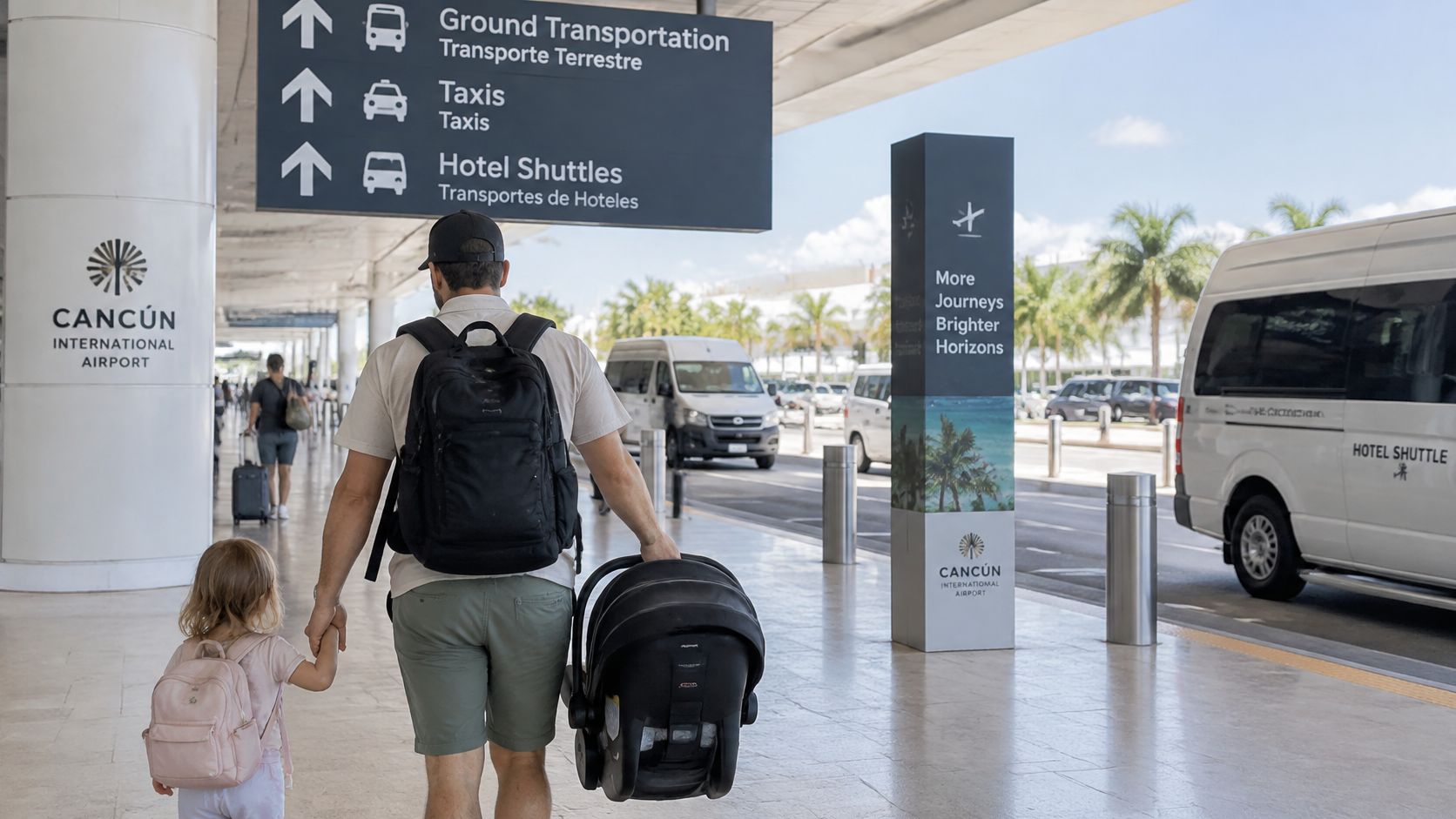
Choose the Ride Before You Land
Airport information lists shared hotel shuttles operating from 7:00 a.m. to 7:00 p.m., semi-private hotel service operating 24 hours, a private taxi service for hotels, resorts, and vacation homes carrying up to six passengers, and ADO bus service to Cancun, Playa del Carmen, Tulum, and Merida stopping at all airport terminals daily, according to Cancun Airport transportation information. Those hours and stop patterns matter when you're traveling with an infant seat, a stroller, and resort bags after a long flight.
Cancun airport ride options
| Option | Operating hours | Stops | Capacity |
|---|---|---|---|
| Shared hotel shuttle | 7:00 a.m. to 7:00 p.m. | Multiple stops | Shared vehicle with other parties |
| Semi-private hotel service | 24 hours | Limited hotel stops | Small shared group |
| Private taxi for hotels, resorts and vacation homes | By advance booking | Direct ride | Up to six passengers |
| ADO bus to Cancun, Playa del Carmen, Tulum and Merida | Daily | All airport terminals | Public bus seating |
For Cancun airport transportation, the useful difference isn't the vehicle badge. It's whether the ride is direct or shared, and whether a child seat is confirmed before you land. Families booking luxury transportation or private transportation Cancun airport service should state each child's age and weight at reservation, the same numbers you checked against your aircraft label. That lets the provider place the right seat in the vehicle instead of improvising at pickup.
A Cancun car service built around a direct ride also skips the shared shuttle pattern of set hours and extra hotel stops. If you're comparing Cancun luxury airport transfers, ask one question first. Will the child seat be installed and waiting when the driver meets you? Everything else, cold towels and music included, is secondary. Understanding what point-to-point service means helps here, because a direct terminal to hotel ride is exactly what a tired child needs.
The road portion of your trip carries more risk than the flight did. Don't protect your child at 35,000 feet and then hold them loose in a stranger's car.
Confirm three things before departure day. Confirm the fare in writing. Confirm the exact pickup point and how you'll identify your driver. Confirm the provider's authorization to operate at the airport. Then keep your child in an approved seat on the road, harnessed the same way you did in the cabin, with bulky coats off and straps snug at the shoulder. If you gate-checked your own seat because it wouldn't fit the aircraft, a pre-booked provider seat covers the gap you discovered in the air. That backup is the whole point of planning the curb before you board.
Book your arrival ride the same day you confirm your child's aircraft seat, and tell us each child's age so the correct car seats are installed and waiting when you land in Cancun. We monitor your flight on the day of service, meet you as scheduled whether you arrive early or delayed, and drive you directly to your hotel with free infant gear already on board. Reserve your private transfer today with Unique Private Transportation and finish the journey with your child restrained on the road, not just in the air.