
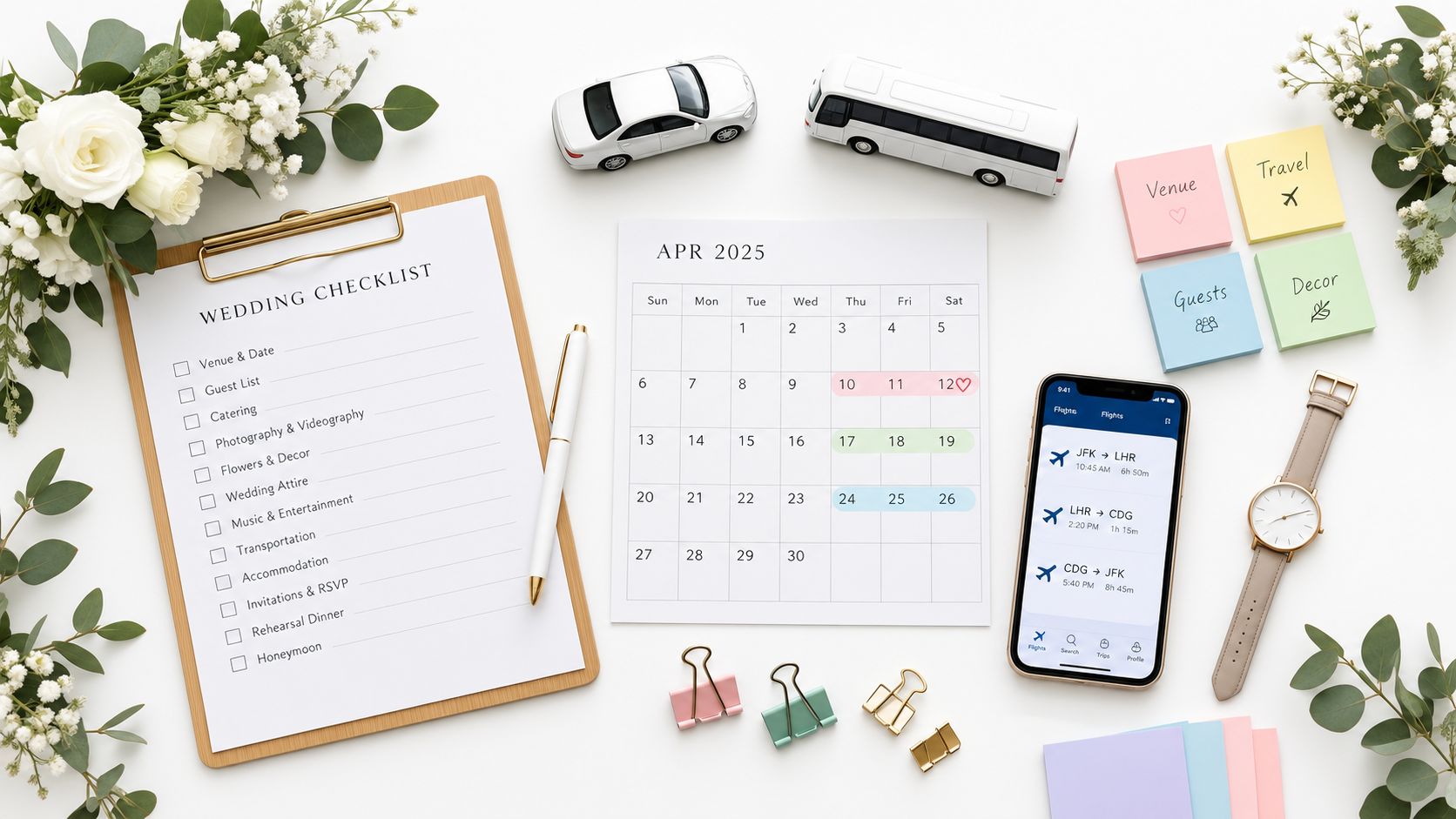
Guests are landing at different terminals. Some are heading to a Cancun resort, others to Playa del Carmen or Tulum. The rehearsal dinner starts on time whether a red-eye arrives smoothly or not, and the ceremony timeline won't wait for a missing shuttle, a confused cousin, or a driver who never got the updated hotel pickup point.
That's where a solid wedding coordination checklist earns its keep. For destination weddings in Cancun and the Riviera Maya, transportation isn't a side task. It's the operating backbone that connects flights, hotels, venues, vendors, rehearsal events, guest communication, and final airport departures. Once the wedding date is set, the whole event runs on staged milestones. That's how established planning timelines work as well, with venue and vendor decisions made months ahead and later tasks flowing from that date-based sequence, as outlined in Emily Post style wedding planning timelines summarized here.
A modern checklist also has to account for scale. Planning references describe an average U.S. wedding guest count of 117 in 2025, along with average U.S. wedding costs around $35,000 in 2025 and a projected $36,500 for 2026, which helps explain why logistics documents now function as budget and coordination controls, not just to-do lists, according to this 12-month wedding planning reference.
If you're organizing a wedding weekend in this region, start with ten checkpoints. Move in order from rehearsal preparation to departure day. Every checkpoint should end with three things: one owner, one confirmed time window, and one backup plan. A coordinated Cancun car service, luxury transportation, and live flight monitoring won't fix every problem, but they do remove a lot of avoidable confusion before it reaches your guests.
Table of Contents
- 1. Cancun Airport Transportation Coordination for Wedding Guest Arrivals
- 2. Luxury Transportation for Wedding Day Timeline Management
- 3. Private Transportation Cancún Airport to Multiple Destination Venues
- 4. VIP and Family Guest Luxury Airport Transfer Sequencing
- 5. Rehearsal Dinner and Pre-Wedding Event Transportation Logistics
- 6. Accessible Transportation Solutions for Elderly and Mobility-Challenged Guests
- 7. Post-Reception Late-Night Guest Return Transportation Coordination
- 8. Wedding Day Tour and Attraction Transportation for Guest Activities
- 9. Multi-Day Wedding Weekend Transportation Passes and Hourly Chauffeur Services
- 10. Post-Wedding Guest Departure Coordination and Airport Return Transportation
- 10-Point Wedding Transportation Coordination Comparison
- Turn Every Transfer Into a Confirmed Handoff
1. Cancun Airport Transportation Coordination for Wedding Guest Arrivals
A guest lands in Cancun after a delayed flight, clears baggage, and opens three different family group chats looking for pickup details. That kind of confusion starts long before the ceremony, and it is usually preventable.
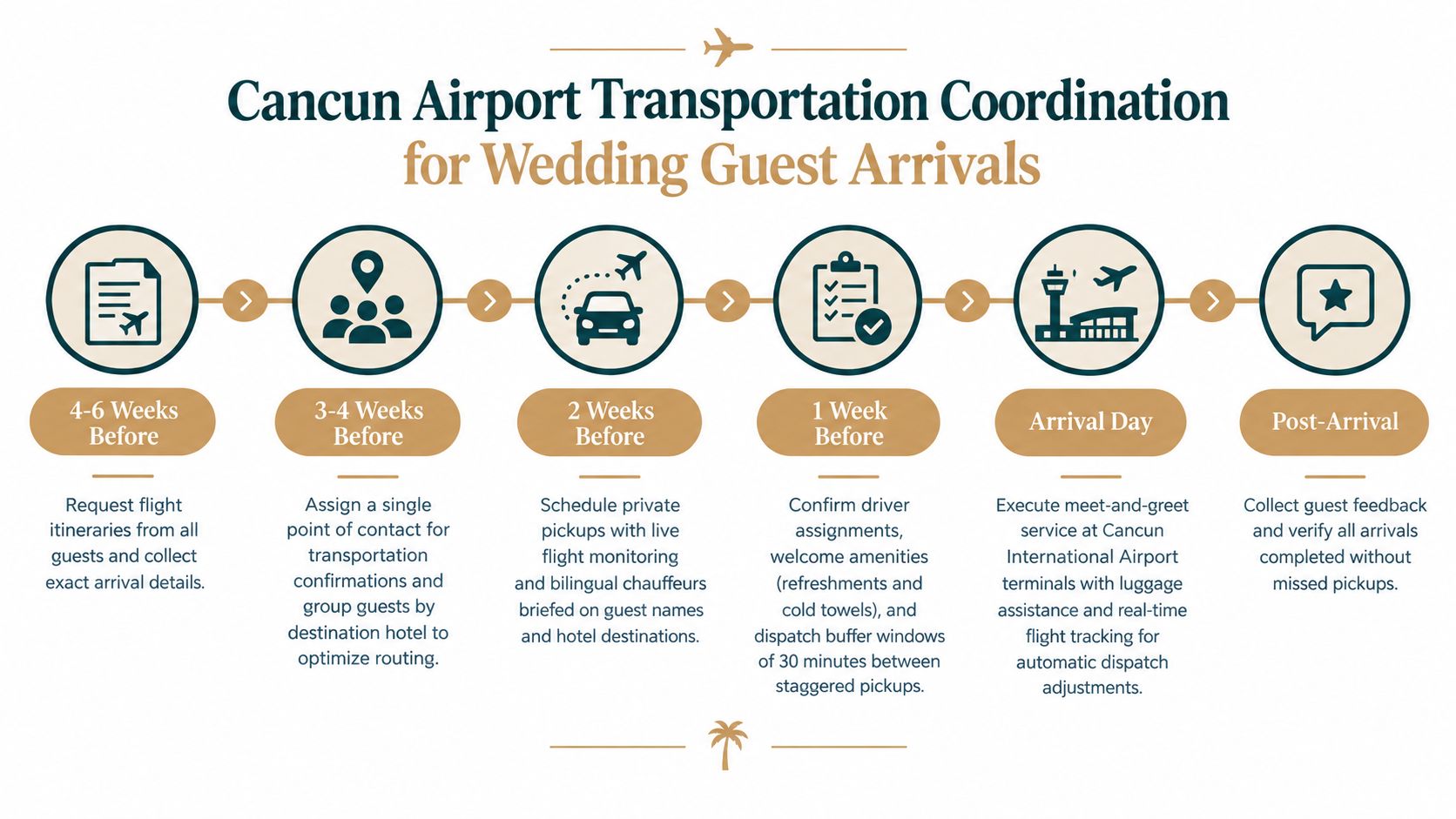
Airport coordination works best when arrivals are treated as the first operational handoff of the wedding weekend. The job is not just to book vehicles. The job is to match each flight to the right hotel, confirm who owns the handoff, stage vehicles by time window, and give guests one clear set of instructions before they land. Public options like ADO buses are available through Cancun Airport ground transportation options, but wedding groups usually need private routing because guests are splitting across resorts, carrying formalwear, and arriving on different schedules.
Start with one arrival sheet that your planner, transportation provider, and lead family contact all use.
Include:
- flight number and airline
- scheduled arrival time
- guest names
- hotel or villa destination
- passenger count
- luggage notes, especially garment bags or oversized items
- WhatsApp number
- assigned vehicle
- pickup window
- on-site contact if the guest misses the driver
Group guests by destination first. Then sort by arrival window. That order matters in Cancun because one clean resort drop is usually faster and easier on guests than trying to combine people from different hotels who happened to book similar flights.
Build in timing cushions. Flights slip. Immigration lines vary. Bags can take longer than expected. A practical plan gives each cluster an arrival window, not a single pickup minute, and keeps one dispatcher or transport lead responsible for changes. I have seen well-meaning relatives create more delay by sending conflicting updates to drivers. One decision-maker is the safer setup.
Driver instructions should go out early and in plain language. Send the pickup terminal details, meeting point, vehicle type, driver name if available, and the number guests should message if they cannot find the car. For a broader Cancun wedding transportation coordination plan, keep airport arrivals in the same master workflow as welcome parties, rehearsal events, and departure transfers so the whole weekend runs from one operating document.
Some groups need a separate sequence. Elderly relatives may need a shorter walk and faster loading. Guests arriving with children may need car seats confirmed in advance. Travelers using wedding jet charter services should be handled on their own line of the sheet, with separate contacts and timing, because private aviation arrivals often follow a different ground access process than commercial terminals.
A good checkpoint for this section is simple: every arriving guest should have one confirmed vehicle assignment, one contact number, and one backup instruction if the first handoff fails. That is how airport transportation supports the rest of the wedding weekend instead of creating work for it.
2. Luxury Transportation for Wedding Day Timeline Management
At 3:40 p.m., hair and makeup is still finishing, the photographer wants ten more minutes, grandparents are ready early, and the ceremony starts at 5:00. That is the point where transportation stops being a background service and starts acting like operations control for the day.
Vehicle timing should be built around actual handoffs, not broad calendar blocks. The useful sequence is usually rehearsal-confirmed pickup points, final vendor check-in, vehicle staging, guest loading, ceremony arrival, post-ceremony repositioning, and departure coverage after the reception. Each leg needs one owner, one time window, and one fallback if the first plan slips.
Start with the timing anchors that cannot move. Ceremony start. Venue access rules. Photographer call time. Catering load-in restrictions. Music cue for processional. Once those are fixed, build transportation backward and forward from them.
A practical wedding-day transport plan usually covers four separate flows:
- getting-ready movements for the couple and wedding party
- early arrivals for parents, grandparents, and anyone needing extra boarding time
- main guest transfers to the ceremony or reception
- reserve capacity for schedule drift, forgotten items, or a vendor who needs a fast reposition
The trade-off is simple. Tight schedules look efficient on paper, but they fail quickly when photos run long or loading takes longer than expected. Wider windows protect the experience, but too much cushion can leave guests waiting in the heat, hotel lobby, or venue drive. The better approach is controlled slack. Keep vehicles staged early, but set guest-facing pickup times close enough to feel organized.
I recommend confirming three things the day before, then checking them again on the wedding morning: who releases each vehicle, where each vehicle can wait, and what event triggers departure. A driver should not have to guess whether “we are almost ready” means two minutes or twenty.
For example, a resort wedding with an off-site ceremony may run best with a sedan held for the couple, a van for immediate family, and a shuttle loop for guests. The sedan departs on a photographer-approved trigger. The family van loads fifteen minutes earlier to avoid rushed boarding. Guest shuttles leave in two waves so late elevator traffic at the hotel does not hold everyone back at once.
Luxury service matters here because calm boarding is part of timeline management. Clean vehicles, experienced chauffeurs, and clearly marked loading points reduce confusion and keep guests from asking vendors where to stand or when to leave. If the same transportation team is covering the wedding weekend, keep service notes consistent so the dispatcher already knows who needs extra assistance, who must arrive early, and which contacts can approve last-minute changes.
A strong checkpoint for this part of the checklist is practical: every wedding-day movement should show the vehicle assignment, staging location, release trigger, target arrival window, and backup option. If those five details are missing, the timeline is still relying on hope.
3. Private Transportation Cancún Airport to Multiple Destination Venues
A common Cancún wedding scenario looks orderly on paper and messy in practice. Guests land within a few hours of each other, but they are heading to different resorts, private villas, or ferry connections. If transportation is treated as one shared airport pickup, the first delay usually starts at baggage claim and keeps growing at every stop after that.
The cleaner approach is to build this part of the checklist like an operations board. Start with destination clusters, then add arrival windows, then assign the right transfer type to each cluster. Guests staying in Playa del Carmen should not sit through a Tulum drop-off first just because they share a surname with someone in that vehicle.
Use hotel confirmations to lock the exact delivery points early. Resort names alone are not enough. Some properties have multiple entrances, separate villa gates, or security procedures that slow unloading if the driver has only a brand name and no rooming contact. This is also where point-to-point transportation planning helps, because each movement needs its own pickup point, route, unloading point, and receiving contact.
I usually sort multi-venue airport transfers into a working grid instead of a guest list:
- Same destination, similar landing times. Use direct shared runs.
- Same destination, staggered arrivals. Use private or semi-private departures on a timing window.
- Different destination, same family group. Split the family if the route saves meaningful time and confusion.
- Road transfer plus ferry or secondary handoff. Add a buffer and confirm the second operator before the flight lands.
That last category causes the most trouble.
For Isla Mujeres, guests may need airport pickup, ferry timing, port-side coordination, and island-side transport. For Tulum weddings, the issue is often spread. A guest group may be divided across several boutique hotels, each with a different check-in process and a narrower access road than a full-size coach can handle. In both cases, the transportation plan has to account for the handoff, not just the drive.
A useful checkpoint is simple. Every guest arrival cluster should show five items in one place: flight range, destination, assigned vehicle type, holding rule for delays, and the contact who confirms the handoff is complete. If one of those items is missing, the route is still too loose to trust on a wedding weekend.
4. VIP and Family Guest Luxury Airport Transfer Sequencing
A wedding weekend gets shaky fast if the couple's parents are still waiting curbside, a grandparent is loaded into the wrong vehicle, or the officiant lands with no direct contact. VIP airport transfers need their own run sheet, separate from the general guest arrival plan.
Start by ranking people by operational impact, not by title alone. Parents, grandparents, elderly relatives, the officiant, and anyone involved in rehearsal timing or wedding-day decisions usually belong in this group. A sibling flying in for the rehearsal dinner may need higher priority than a larger family cluster arriving later, because one delay affects vendors, photos, and event timing across the weekend.
I usually build these transfers in sequence:
- First arrivals who affect the schedule: Parents, officiant, key wedding party members
- Guests who need extra assistance: Elderly relatives, guests using walkers or wheelchairs, anyone who needs a slower boarding pace
- High-comfort private transfers: Families arriving after overnight flights, guests with children, or anyone checking into a resort with a complicated arrival process
- Everyone else in the family tier: Relatives who can travel comfortably on a timed shared plan
That order helps with vehicle staging. The first vehicles should be dispatched with the clearest instructions, the most experienced drivers, and the least chance of waiting in a crowded pickup zone.
Details matter here because small misses create stress later. The driver should have the guest name, relationship to the couple, destination, baggage estimate, and any assistance notes before the flight lands. If the family is using Unique Private Transportation, the useful question is simple: who confirms the handoff is complete? Without that named person, relatives often end up texting the couple instead of the transport lead.
A short VIP transfer brief usually covers:
- Meet-and-greet name: The person the guest should look for
- Direct contact number: One working phone or WhatsApp contact
- Boarding notes: Mobility support, child seat, extra luggage, language preference
- Drop-off instructions: Exact hotel entrance, villa gate, or private residence access point
- Arrival confirmation: Who gets the “guest delivered” message
Shared transport can still work for some family groups, but only if the trade-off is acceptable. If the vehicle saves cost yet adds a long hold, multiple hotel stops, or a confusing loading area, it is often the wrong choice for parents or elderly relatives. A direct private transfer usually reduces calls, standing time, and arrival confusion.
One more point matters. Airport pickup is only the first handoff. For VIPs and close family, the plan should also show who helps them at check-in, who has their rooming details, and who notices quickly if they have not arrived. That is how transportation supports the full wedding coordination checklist, from first landing to first event.
5. Rehearsal Dinner and Pre-Wedding Event Transportation Logistics
At 6:10 p.m., the rehearsal dinner may be scheduled for 6:30, but transportation usually decides whether guests walk in relaxed or already behind. This part of the wedding coordination checklist works best as an operations test, not just a courtesy shuttle.
The rehearsal-to-departure workflow starts before anyone boards. Confirm the guest count against actual rooming, then match that count to vehicle capacity, pickup order, and the venue's loading rules. A dinner for 35 guests at an off-site restaurant needs a different plan than a welcome party where people drift in from multiple hotels and villas.
Build the transport plan around handoffs
Three handoffs matter here: hotel pickup, venue arrival, and return release. If any one of them is vague, the couple or planner ends up fielding texts during dinner.
Set each handoff in writing:
- Pickup window: A real range, not one sharp time that creates panic if a vehicle is five minutes late
- Hotel loading point: The exact entrance, not “main lobby” if the property has several access points
- Venue arrival contact: The person who can direct vehicles, confirm unloading space, and help if guests arrive before the host
- Return trigger: A defined release method, such as one group departure, two scheduled waves, or dispatch-on-text for smaller groups
This is also the best event to test timing windows. Boarding almost always takes longer than the first draft of the schedule suggests, especially when guests are greeting each other, changing shoes, or stopping at the bar on the way out.
A good rehearsal plan reveals those delays early.
Use the evening to pressure-test wedding day assumptions
The value of rehearsal transportation is not only getting people to dinner. It is learning where the wedding-day timeline will break.
If the first pickup starts late because the hotel bell desk is congested, adjust the wedding morning dispatch notes. If the restaurant allows only one vehicle at a time at the front curb, revise the staging order for ceremony transport. If guests miss messages sent by email but respond quickly to WhatsApp, use that on the wedding day.
For couples using Unique Private Transportation, this is often the point to confirm who owns live communication during service: the planner, the transport lead, or a family representative. One person should approve schedule changes and receive arrival and departure updates. That keeps driver questions away from the couple.
What to confirm before the first vehicle rolls
A short pre-event check usually does more good than another long planning call:
- Confirm final rider groups by hotel or villa
- Recheck venue access, staging limits, and parking restrictions
- Send one guest message with pickup window, meeting point, and return instructions
- Verify the final vehicle count after RSVP changes
- Assign one person to stay reachable until the last return trip is released
Keep the messaging simple. Guests need to know where to stand, when to be ready, and how they are getting back.
If the rehearsal dinner runs long, the return plan should already account for it. That may mean a later second wave, a standby vehicle for older relatives, or a hard cutoff after which guests use taxis at their own discretion. The trade-off is cost versus control. Holding vehicles longer protects the guest experience, but only if the extra time is priced and approved in advance.
That is why this section matters. Rehearsal transportation shows whether the full wedding weekend can run on confirmed handoffs instead of assumptions.
6. Accessible Transportation Solutions for Elderly and Mobility-Challenged Guests
A common failure point shows up before the ceremony starts. An older guest is ready on time, but the pickup spot is farther from the lobby than expected, the vehicle sits too high, and the driver has no note about the walker in the trunk. The delay is small on paper and disruptive in practice.
Accessibility planning affects the full wedding workflow, from rehearsal movements to the final departure window. It changes which vehicles can be assigned, how much boarding time belongs in the schedule, where guests should be loaded, and who needs a direct confirmation the day before.

Start with the guest, not the vehicle. Record the exact need during RSVP follow-up or family outreach, then confirm it again during final transport checks. Cane, walker, wheelchair, recent surgery, limited stamina, sensitivity to heat, and need for arm support all affect the loading plan in different ways.
A workable notes sheet should answer four questions:
- Who needs assistance, by name
- What kind of help is needed at pickup and drop-off
- Which vehicle they can board comfortably
- Whether they should ride in an earlier or quieter transfer
That last point matters more than couples expect. Some guests do better in the main group. Others need a separate car five to ten minutes earlier so boarding is calm and no one feels rushed. The trade-off is cost versus control, but it usually pays off in fewer delays and a better guest experience.
Hotel and venue access need their own check. A suitable vehicle does not solve a long walk across a resort driveway, uneven stone at a villa entrance, or a ceremony site that requires stairs. Confirm the actual handoff point with the hotel, venue coordinator, and transportation lead so the driver knows where assistance begins and ends.
I also recommend adding time buffers in two places instead of one. Add a few minutes before departure for boarding, then add a second cushion on arrival for unloading and seating. If only one buffer exists, the couple often loses it to traffic or late guests before the accessibility support even starts.
For teams using Unique Private Transportation, the practical standard is simple. Drivers should receive named passenger notes in advance, dispatch should know which vehicle carries mobility equipment, and one on-site contact should be authorized to approve a change if a guest needs a different return plan. That keeps decisions quick without pulling the couple into service questions.
Accessibility works best when it is treated as part of operations, not etiquette. Confirm the guest, confirm the route, confirm the boarding plan, and confirm the return option before the first key is handed off.
7. Post-Reception Late-Night Guest Return Transportation Coordination
The reception ends at 11:30, the band loads out, and guests start leaving in three different directions. That is the point where a wedding transportation plan either holds or breaks.
Late-night returns work best when they are built into the event flow before the first guest boards a car that day. Confirm the final guest count with the venue, transportation dispatcher, and planner by the afternoon. Reconfirm the loading zone, lighting, and driver contact method before dinner service starts. If the return plan only exists on paper, the couple usually feels the gap at the end of the night.
A single departure time rarely fits the way guests leave. Older relatives may want to head back after cake. Parents may leave once children are tired. The wedding party often stays longer than everyone else. That creates a simple trade-off. Fewer vehicle waves cost less, but staggered returns reduce confusion and keep guests from standing around waiting for one last full shuttle.
One practical framework is to run the return in phases. Independent shuttle guidance also highlights details couples often miss, such as RSVP tracking, pickup-point clarity, staggered returns, and printed route instructions in some cases, as covered in this wedding guest shuttle logistics checklist.
Use a setup like this:
- Early release vehicles: For guests leaving before the reception close
- Primary departure window: The main group move near the scheduled finish
- Final sweep: A last run for lingering guests and approved vendor passengers
- Loading lead: One visible contact who matches guests to the right vehicle
Vehicle staging matters as much as timing. Assign one pickup point with lighting, signage, and enough space for guests to queue without mixing into vendor load-out traffic. Drivers should know the exact property exit, the order of hotel stops, and whether they are holding position or departing once seats are filled. In resort settings, I prefer a hard rule here. Guests wait at one named location, not “outside” or “near the front.”
Communication should get simpler as the night gets later. Put the return window on the printed itinerary, repeat it with the DJ or planner near the end of the reception, and send one short WhatsApp message to guests if that channel is already in use. Dead phones and missed texts are common after a long event, so the on-site transport lead still needs a visible presence at boarding.
Safe guest return is part of wedding coordination, not a courtesy add-on. Treat it like a handoff with timing, names, staging, and a backup plan, and the night ends in an orderly way for guests and vendors alike.
8. Wedding Day Tour and Attraction Transportation for Guest Activities
A common destination-wedding problem shows up midday. A group leaves for a cenote or beach club, the return runs late, and suddenly hair and makeup, family photos, or a vendor setup window gets squeezed. Optional guest activities only stay “optional” if their transportation is planned around the wedding timeline, not layered on top of it.

Build these outings into the same rehearsal-to-departure workflow as your core wedding transfers. That means confirming the activity operator, driver dispatch, pickup point, guest roster, and latest return time before the wedding day starts. If any part of that chain stays vague, the transport lead ends up solving it live while ceremony vehicles still need attention.
The cleanest setup is to give guest activities their own vehicles, staging plan, and time buffer. Shared fleet pools create avoidable risk. A delayed snorkeling van should never affect ceremony arrivals, family transfers, or a scheduled vendor handoff.
I advise couples to approve guest activities only after three timing questions are answered: when the vehicle departs, when it must be back on property, and how much recovery time guests need before the next wedding function. A tour that returns at 3:30 p.m. may look fine on paper, but it is a poor fit if key guests need to dress, regroup, and transfer again by 4:15.
A practical way to manage this is to treat each outing like a stand-alone movement order:
- confirmed guest names, not estimates
- one exact pickup location at the hotel or resort
- a hard departure rule, or a stated grace window
- a named on-site contact for the guests
- a separate contact for the wedding transport lead
- a return cutoff tied to the next wedding event
This section of the plan needs real trade-offs, not broad promises. Chichén Itzá and longer regional excursions usually work better on a non-ceremony day. Shorter resort-to-resort visits, beach clubs, spa runs, or local sightseeing are easier to control on the wedding day because the drive time is shorter and the fallback options are simpler.
Guest communication should stay simple. Put the activity name, departure time, meeting point, and return deadline in one message. Avoid long itinerary notes that bury the only details guests need to board on time.
Behind the scenes, transportation for activities should still run like operations. Confirm who releases the vehicle, who tracks late guests, where the van stages on return, and whether anyone from the activity group needs a direct transfer into the next wedding event. That handoff is what keeps leisure plans from disrupting the rest of the day.
9. Multi-Day Wedding Weekend Transportation Passes and Hourly Chauffeur Services
By the second day of a wedding weekend, transportation usually stops being a simple hotel-to-venue problem. Guests want dinner off-property, parents need a separate errand run, the wedding party has a photo call, and someone always asks for a last-minute marina transfer.
Flexible coverage can solve that, but only if it is assigned to the right jobs.
Hourly chauffeur service works best when the group is small, the stops are changing, and the timing cannot be locked in early. A transportation pass or pre-arranged flexible service window works better when guests need freedom within a defined area or timeframe, without calling the couple or planner for every movement. Scheduled shared transfers still carry the main load for ceremony, rehearsal, and reception movements because they control volume better.
The practical question is not whether extra flexibility sounds useful. It is whether the weekend schedule creates enough unscripted movement to justify holding a vehicle and driver on standby.
A simple way to decide is to map the requests that do not fit the fixed shuttle plan:
- family members moving between separate resorts
- vendor or attire errands that cannot miss a time window
- VIP guests with staggered dining or marina schedules
- childcare-related transfers
- off-site hospitality stops before or after formal events
If that list is short, a limited service block is usually enough. If those requests run across multiple days, with different pickup points and changing release times, hourly coverage often prevents a long chain of one-off booking problems.
Cost control matters here. Before approving open-ended service, compare transfer pricing against standby pricing so you know whether you are paying for actual moves or for waiting time. This guide on how wedding transportation costs are typically structured helps couples compare fixed transfers, hourly minimums, and multi-vehicle weekend coverage.
From an operations standpoint, flexible service still needs rules. Set the service hours, the geographic boundaries, the approved riders, and one dispatcher contact who can release or extend the vehicle. Without those limits, the car meant for parents or VIP guests turns into a floating backup for every late change, which usually creates gaps elsewhere in the weekend plan.
The strongest setup is usually mixed coverage. Keep core wedding events on fixed schedules. Add a controlled hourly vehicle for exceptions, handoffs, and time-sensitive guest movements between rehearsal and departure day. That keeps transportation useful without letting it become unpredictable.
10. Post-Wedding Guest Departure Coordination and Airport Return Transportation
The final transportation test happens after the wedding, not before it. Guests leave from different hotels, flights start early, and the couple usually wants to rest or begin their own plans. If departure service is not organized in advance, small misses turn into late pickups, front-desk confusion, and stressed messages at the airport curb.
Treat departure day as a controlled handoff. By this point in the weekend, transportation is no longer about presentation. It is about clean execution, accurate manifests, and keeping the last guest movement as orderly as the rehearsal transfers and wedding-day staging.
A practical departure plan usually runs on three checkpoints.
First, lock the manifest before the reception night gets busy. Confirm each traveler's airline, flight time, terminal if known, hotel, room status, and luggage load. Guests often change rooms, extend a stay, or move to another property after the main events. Those updates need to go to one transportation lead, in writing, before the final dispatch sheet is built.
Second, group pickups by real timing windows, not by convenience alone. Two guests staying at the same resort may still need separate service if one is checking bags for an international flight and the other is traveling carry-on for a domestic connection. Shared returns save cost, but only when pickup timing, baggage, and airport timing match.
Third, keep one active contact live until the last vehicle is released. That person handles oversleepers, room changes, weather delays, and last-minute airline schedule changes. Without that contact, drivers end up asking the front desk for help, and the front desk rarely has the wedding manifest.
Couples and planners also need a clear line on who is included in coordinated return service. Some guests are fine arranging their own ride. Others should stay inside the wedding transportation plan, especially older relatives, guests with children, anyone departing from remote resorts, and groups with tight flight banks after the farewell breakfast.
Use this checkout-and-departure sequence on the final day:
- Reconfirm hotel and room status the night before
- Send each traveler a pickup window and driver contact method
- Separate private returns from shared returns on the dispatch sheet
- Stage larger vehicles only where luggage volume supports them
- Build a missed-pickup response path before the first morning departure
- Track completed pickups until the final airport drop is confirmed
This section matters because departure day is where a well-run wedding weekend proves it was coordinated, not just booked. The job ends when the last guest is in the right vehicle, leaving from the right property, with enough airport time built in.
10-Point Wedding Transportation Coordination Comparison
| Service / Option | Implementation Complexity 🔄 | Resource Requirements ⚡ | Expected Outcomes 📊 | Ideal Use Cases ⭐ | Key Advantages 💡 |
|---|---|---|---|---|---|
| Cancun Airport Transportation Coordination for Wedding Guest Arrivals | Moderate–High: centralized flight tracking and staging | Fleet + flight-tracking dispatch, bilingual drivers, logistics staff | Smooth arrivals, reduced wait times, fewer missed pickups | Large destination weddings with multiple incoming flights | Automatic rescheduling, meet-and-greet, luggage assistance |
| Luxury Transportation for Wedding Day Timeline Management | High: minute-by-minute vehicle movements and staging | Premium vehicles, dedicated chauffeurs, timeline coordinator | On-time bridal arrivals, seamless venue transitions, polished presentation | Luxury or multi-venue weddings with tight schedules | Professional appearance, concierge support, flexible timing adjustments |
| Private Transportation Cancún Airport to Multiple Destination Venues | High: multi-stop routing and ferry coordination | Multi-vehicle fleet, GPS tracking, ferry bookings, routing planner | Efficient multi-destination delivery; longer travel windows for some guests | Weddings with guests across Riviera Maya and nearby islands | Route clustering, ferry handling, centralized coordination |
| VIP and Family Guest Luxury Airport Transfer Sequencing | Moderate: separate priority sequencing and personalization | Few luxury vehicles, concierge staff, advanced guest intel | Elevated VIP satisfaction and reduced travel stress | Parents, grandparents, and other priority guests | Priority handling, tailored amenities, discreet service |
| Rehearsal Dinner and Pre-Wedding Event Transportation Logistics | Moderate: short-run scheduled pickups & returns | Multi-vehicle coordination, event-timed drivers, venue liaison | Validated timing, improved wedding-day operations, guest confidence | Rehearsal dinners, welcome receptions, pre-wedding events | Operational rehearsal, timing data, single-point driver contact |
| Accessible Transportation Solutions for Elderly and Mobility-Challenged Guests | Moderate–High: individualized accommodations and protocols | Accessibility-equipped vehicles, trained drivers, extra scheduling buffers | Safe, dignified transport and higher inclusive participation | Multi-generational weddings or guests with mobility needs | Low-step vehicles, driver assistance training, extra boarding time |
| Post-Reception Late-Night Guest Return Transportation Coordination | Moderate: flexible, unpredictable departure windows | 24/7 driver availability, spare vehicles, on-call coordinator | Safe late-night returns and reduced fatigue/driving risks | Late-ending receptions and after-parties | Flexible scheduling, patient drivers, luggage handling |
| Wedding Day Tour and Attraction Transportation for Guest Activities | High: multiple activity routes with timed returns | Fleet for tours, concierge booking, attraction coordination | Memorable guest experiences; possible impact on evening timing | Pre-wedding excursions, group tours, activity days | Curated activities, logistics handled, group bonding |
| Multi-Day Wedding Weekend Transportation Passes & Hourly Chauffeur Services | High: ongoing on-demand scheduling across days | Large driver roster, booking system, prepaid pass management | Guest autonomy, premium multi-day support, on-demand safety | Extended wedding weekends and luxury guest services | Hourly flexibility, fixed pass pricing, responsive availability |
| Post-Wedding Guest Departure Coordination and Airport Return Transportation | Moderate–High: flight-tracking and timed departures | Flight-monitoring dispatch, vehicles, concierge staff, early starts | Reliable departures, fewer missed flights, positive final impressions | Staggered post-wedding flight departures | Flight-tracking, grouped routing, farewell concierge touches |
Turn Every Transfer Into a Confirmed Handoff
The best wedding weekends don't feel over-managed to guests. They feel calm. People know where to stand, when to leave, who to message, and what happens if something changes. That calm comes from operational discipline behind the scenes.
A transportation-centered wedding coordination checklist works best when it follows a simple rhythm. Collect accurate guest and flight data early. Confirm every vendor and venue contact in writing. Stage vehicles before each movement instead of reacting at the curb. Give guests narrow but realistic timing windows, not vague promises. Keep a documented backup for delays, no-shows, weather issues, traffic, vehicle swaps, and hotel changes.
That rhythm matters because wedding planning is already built around a date-anchored timeline. Once the wedding date is set, venue timing, vendor confirmations, invitations, seating, and day-of logistics all depend on coordinated milestones. Transportation should sit inside that same structure, not outside it as a last booking. In destination weddings, it often becomes the thread that connects every other part of the event.
The practical fix is straightforward. Assign one transportation lead. That can be your planner, coordinator, a trusted logistics-minded relative, or a dedicated transport contact. Give that person authority to confirm the final movement sheet, update guest messages, and handle changes directly with drivers and venues. If nobody owns transport, small issues spread fast.
Then share one final run sheet with everyone who touches movement. That usually includes the planner, venue contacts, hotel contacts, drivers, photographers working off-site, and the couple's inner circle. The best run sheets are simple to scan. Passenger names, pickup points, destination, contact numbers, time windows, and backup notes. Nothing fancy. Just usable.
For Cancun and the Riviera Maya, it also helps to choose providers that already work in this environment. A service handling Cancun luxury airport transfers, private transportation Cancun airport arrivals, wedding guest movements, and responsive point-to-point coordination can reduce the number of handoffs you need to manage. Unique Private Transportation is one relevant option for that type of workflow through its website, especially if you want one service relationship covering airport arrivals, rehearsal events, wedding-day movements, and departures.
If you remember one rule, make it this one: every transfer should end with a confirmed handoff. A named passenger reaches a named destination through a named contact, inside a clear time window, with a backup already decided. That's what keeps a destination wedding from feeling fragile. It's also what lets the couple enjoy the weekend instead of dispatching cars from the makeup chair.
Unique Private Transportation provides private airport transfers, point-to-point service, hourly chauffeur support, and wedding guest movement coordination across Cancun and the Riviera Maya. If you're building a wedding coordination checklist that needs reliable Cancun airport transportation, luxury transportation, and private transportation Cancun airport support from arrival through departure, visit Unique Private Transportation to review the service options and plan your routing.