
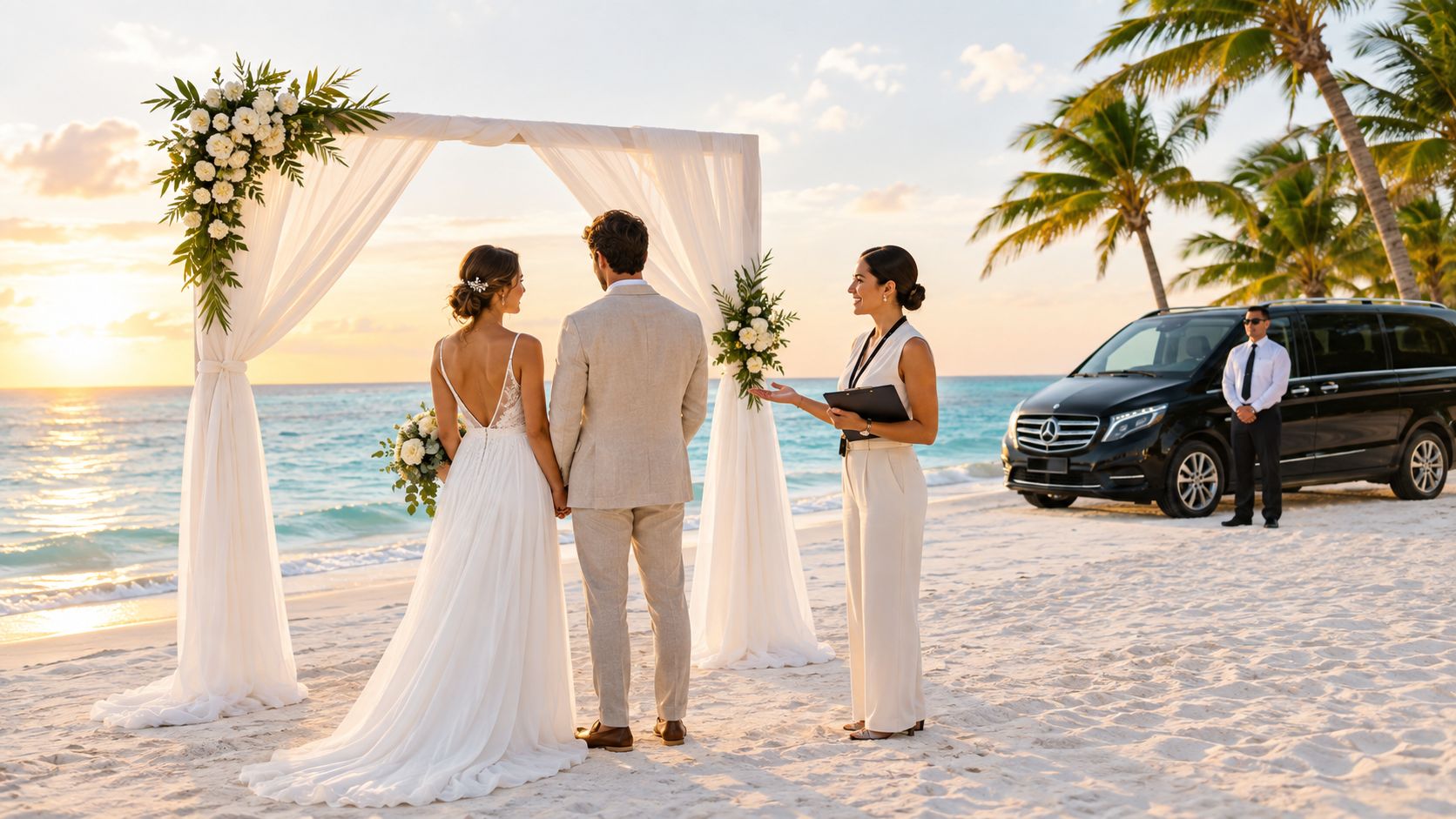
You're probably here because your version of a perfect wedding doesn't involve a ballroom, a seating chart, or a hundred moving pieces. It might be just the two of you. It might be you, your partner, and a small circle of family or friends. But once that intimate wedding lives in Riviera Maya, “small” doesn't always mean simple.
A couple lands in Cancun after a long travel day. One suitcase is delayed. Their photographer is heading to a beach access point before sunset. The officiant needs the final ceremony location confirmed. A dinner reservation is waiting later that night. Suddenly, one airport pickup affects the whole day. That's why a wedding planner for elopement matters so much here.
Table of Contents
- Introduction to Elopement Planning in Riviera Maya
- What a Wedding Planner for Elopement Actually Does
- Key Benefits of Hiring an Elopement Planner
- Why Riviera Maya Is Ideal for Your Elopement
- How to Choose the Right Elopement Planner
- How Private Transportation Keeps Your Elopement on Schedule
- Planning Your Effortless Elopement With Confidence
Introduction to Elopement Planning in Riviera Maya
Modern elopements aren't just about sneaking away. Historically, the word has been around for centuries, with one account tracing usage to around 1338 and noting that its meaning shifted by about 1800 toward couples secretly marrying instead. Another historical account places the modern secret-marriage idea around 1753 in England. The same history also notes that elopements gained momentum again during the Great Depression, when simpler weddings appealed to couples with tighter budgets, which helps explain why elopement planning today is a real service category instead of an improvised side project (history of elopement).
Today's destination elopement looks very different from the old stereotype. Recent trend coverage describes modern elopements as often involving 2 to 15 people, sometimes planned in 4 to 12 weeks, and increasingly built as multi-day itineraries instead of a single private moment (modern elopement trends). That's the version many couples bring to Riviera Maya.
A Riviera Maya elopement often includes more than vows. There may be an airport arrival, resort check-in, a legal appointment, hair and makeup, a ceremony at a beach or cenote, sunset portraits, and a quiet dinner after. Each part feels romantic on its own. Together, they form a chain. If one link slips, the whole day gets tighter.
Practical rule: In a destination elopement, transportation isn't a side note. It's part of the ceremony timeline.
That's also why couples often look beyond local inspiration and compare destination styles. If you're also weighing a seaside ceremony in the United States, this guide to plan your sunset elopement gives a useful contrast in how place shapes timing, privacy, and guest flow.
What makes Riviera Maya special is the mix of beauty and movement. You get beaches, jungle, boutique stays, and dramatic photo locations. You also get airport logistics, access rules, and travel time between stops. A good planner keeps those practical details invisible, so your day still feels light.
What a Wedding Planner for Elopement Actually Does
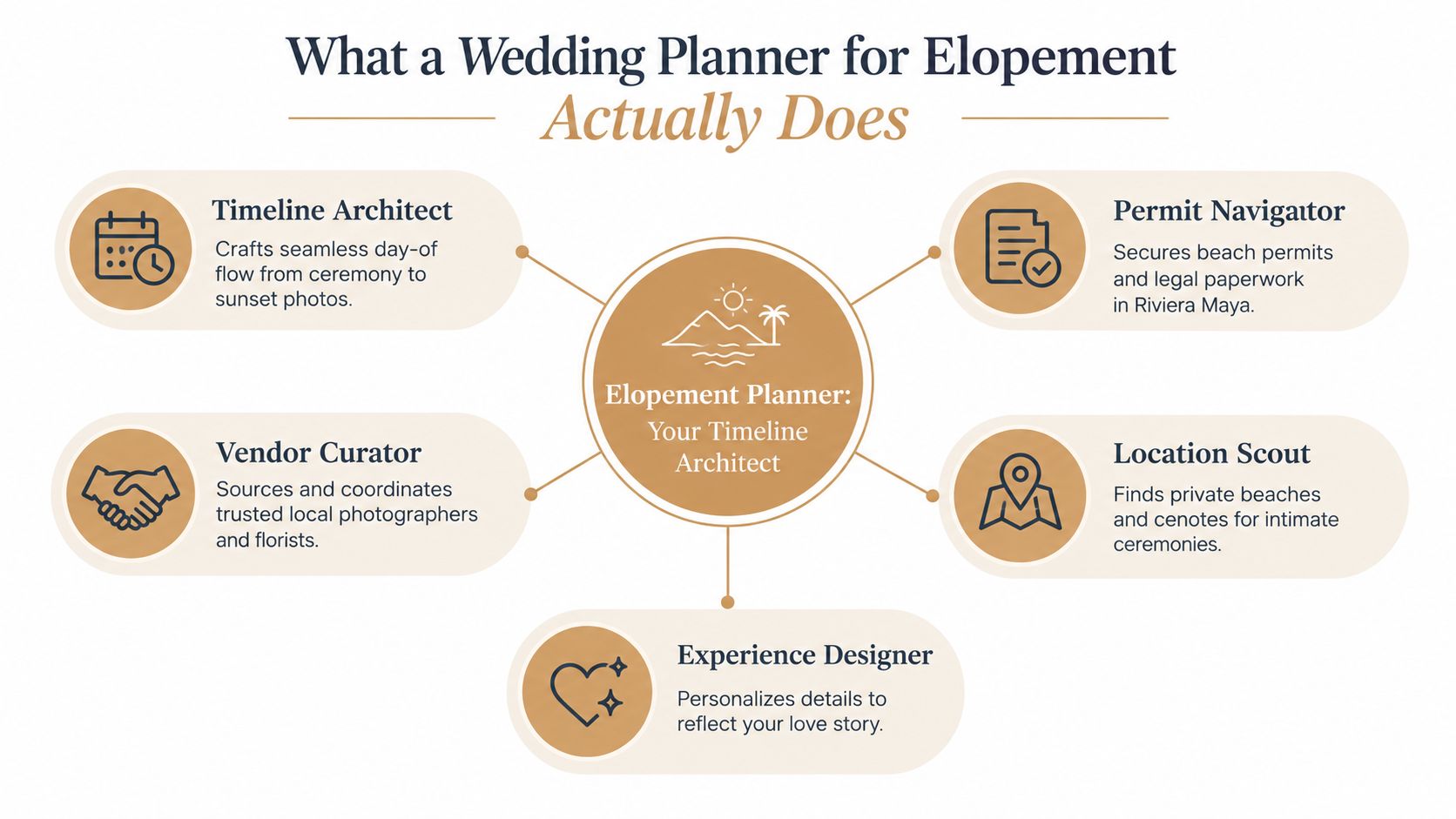
Many couples think a planner's job starts with flowers and ends with decor. For an elopement, that's too narrow. A wedding planner for elopement works more like a stage manager. They don't just make things pretty. They make sure each person, place, document, and vehicle arrives in the right sequence.
They build the day backward from the ceremony
An elopement planner usually starts with the anchor moment. Maybe that's exchanging vows at golden hour on a quiet stretch of beach. From there, they work backward.
They ask questions like:
- What light do you want: soft sunrise, bright daytime, or sunset tones?
- How do you want to feel: private and tucked away, or celebratory with a few guests?
- What must happen first: legal paperwork, beauty services, travel between properties, or family arrivals?
That turns a romantic idea into a real schedule.
According to expert elopement planning guidance, permits, marriage licenses, vendor coordination, timelines, and travel planning are core workstreams, which is why transportation should be scheduled as a dependency of the ceremony timeline, not treated as a separate booking (elopement planning guide).
They connect legal, creative, and travel pieces
Here's where couples often get confused. A planner for a large traditional wedding may focus heavily on guest management and venue production. An elopement planner handles a smaller event, but the job still spans multiple categories.
A planner may help with:
- Location scouting for beaches, cenotes, rooftops, or boutique venues
- Permit navigation when the ceremony site has access rules
- Vendor curation for photographers, florists, officiants, beauty teams, and musicians
- Timeline drafting so the ceremony, portraits, and dinner all fit naturally
- Travel coordination for airport arrival, hotel movement, and small group transfers
That's why some planners also use visual tools to organize inspiration and logistics. Couples who want to understand how planners present photo direction and gallery flow may find The Wedding Pics for planners helpful as a working example of how imagery gets organized behind the scenes.
A great elopement day feels spontaneous to the couple because someone else did the sequencing first.
They protect the feeling of the day
This part matters most. The planner's job isn't only to prevent mistakes. It's to protect emotional space.
If your ceremony is at a cenote with limited access timing, your planner makes sure you're not checking messages while getting ready. If your guests are arriving separately, your planner closes those loops so nobody calls you from the airport asking where to go. If your photographer needs you on-site before sunset, your planner works around that reality instead of hoping traffic behaves.
In other words, they don't just plan a ceremony. They manage a micro-event.
Key Benefits of Hiring an Elopement Planner
An elopement planner gives your day structure, so a small delay does not turn into a chain reaction.
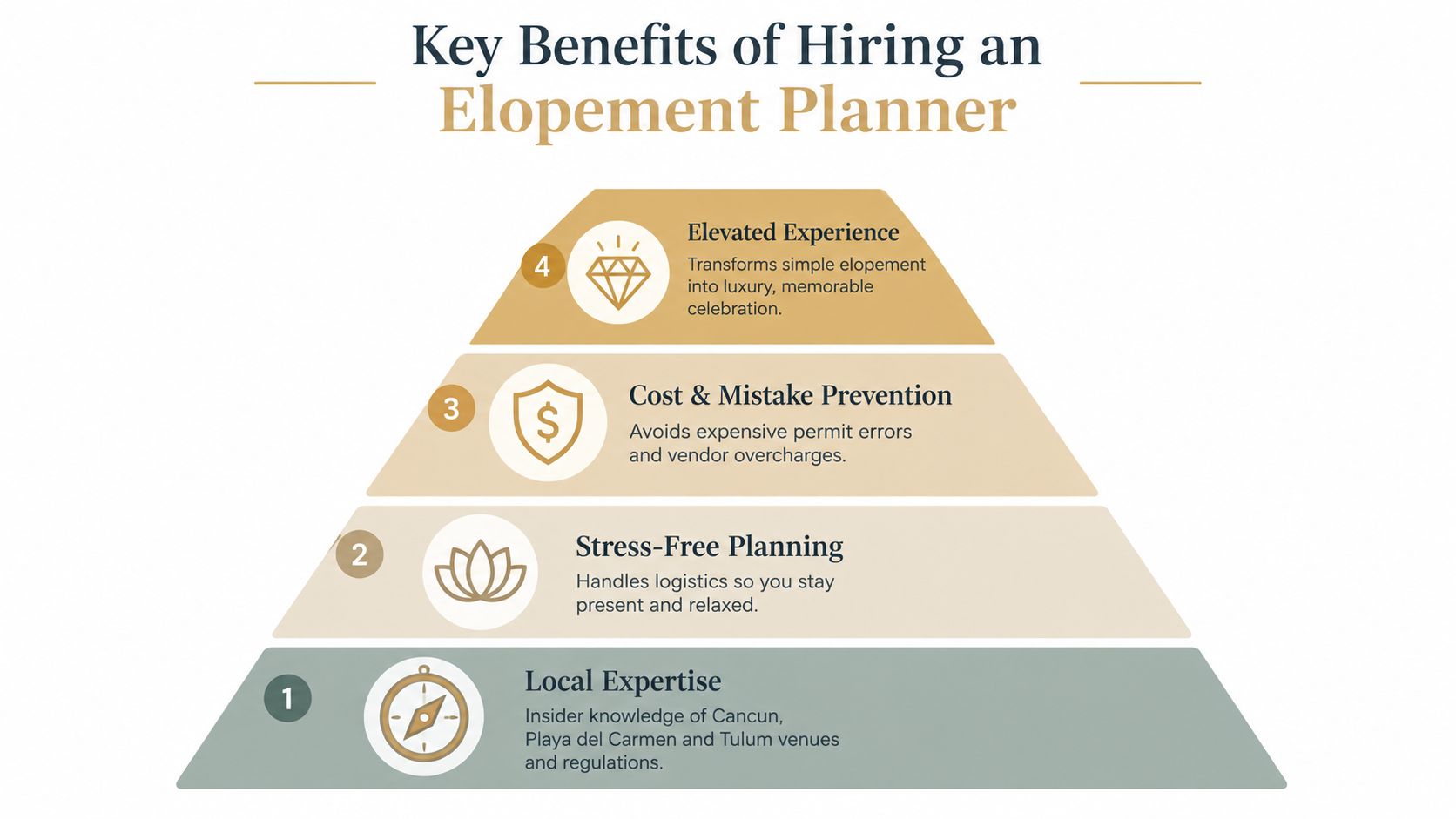
With a Riviera Maya elopement, the moving parts are small in number but tightly connected. Hair and makeup affects departure time. Departure time affects ceremony access. Ceremony timing affects portrait light. Dinner reservations depend on all of it. A planner treats those pieces like one timeline, not a stack of separate bookings.
They save you from building the whole plan from scratch
Online research makes destination elopements look simple because you usually see the ceremony, the flowers, and the sunset photos. You do not see the hours spent comparing site rules, checking travel times between hotels and venues, confirming who speaks with whom, and testing whether the schedule works in real life.
That matters more with 2 to 15 people than couples often expect.
A larger wedding can hide small mistakes because the event has more buffer. A micro-wedding does the opposite. If one car arrives late, everyone feels it. If a dinner start time is too tight after portraits, the evening changes shape fast. A planner shortens the learning curve and replaces guesswork with a plan that fits the place.
They catch timing risks before they become day-of stress
Many elopement problems are ordinary logistics wearing formal clothes. The issue is not that something goes wrong. The issue is that one late step pushes the next one.
A planner looks for pressure points early, such as:
- Travel gaps: airport arrivals, hotel pickups, and venue transfers need realistic timing, not optimistic timing.
- Access windows: beaches, cenotes, and private venues may allow entry only at certain times.
- Vendor overlap: beauty, photography, officiant arrival, and dining service all rely on the same clock.
- Group movement: even a handful of guests can drift off schedule if transportation and meeting points are unclear.
- Backup flow: weather changes may require a different order of events, not just a different location.
This kind of planning works like setting dominoes with space between them. The planner creates breathing room, so one touch does not knock over the whole line.
They protect the mood, not just the schedule
Couples often assume a planner is there mainly to organize vendors. In practice, they are also protecting your attention.
If your phone is buzzing with arrival questions while you are getting ready, you are no longer fully in the day. If your photographer is waiting at the ceremony site but one guest is still arranging a ride, the emotional tone changes. A planner closes those loops for you, so you can stay in the moment instead of managing updates.
That emotional benefit is easy to underestimate until the wedding day arrives.
They connect transportation to the timeline instead of treating it as a side task
This is one of the biggest advantages in a destination elopement. Transportation is not a separate booking that sits off to the side. It is a timed dependency inside the wedding day.
For example, if a private driver picks up the couple ten minutes late from a resort in Playa del Carmen, hair and makeup may still be fine. But ceremony access at a cenote can tighten. Portraits may start in harsher light. Guests traveling from another hotel may arrive out of sync. Dinner service can shift. One small delay starts echoing through the rest of the experience.
A planner sees that chain in advance and builds around it. They allow for loading time, traffic patterns, guest readiness, and the fact that small groups still need coordinated movement. Private chauffeured transfers help because they keep the couple and guests on a shared, predictable schedule instead of leaving key moments to taxis, app availability, or last-minute directions.
That is benefit. The day feels easy because the timing was handled as one connected system.
Why Riviera Maya Is Ideal for Your Elopement
Riviera Maya works beautifully for elopements because it gives you variety without forcing a full-scale resort wedding. You can choose a quiet beach in Cancun, a tucked-away corner near Playa del Carmen, a jungle-forward setting near Tulum, or a cenote that feels private and cinematic.
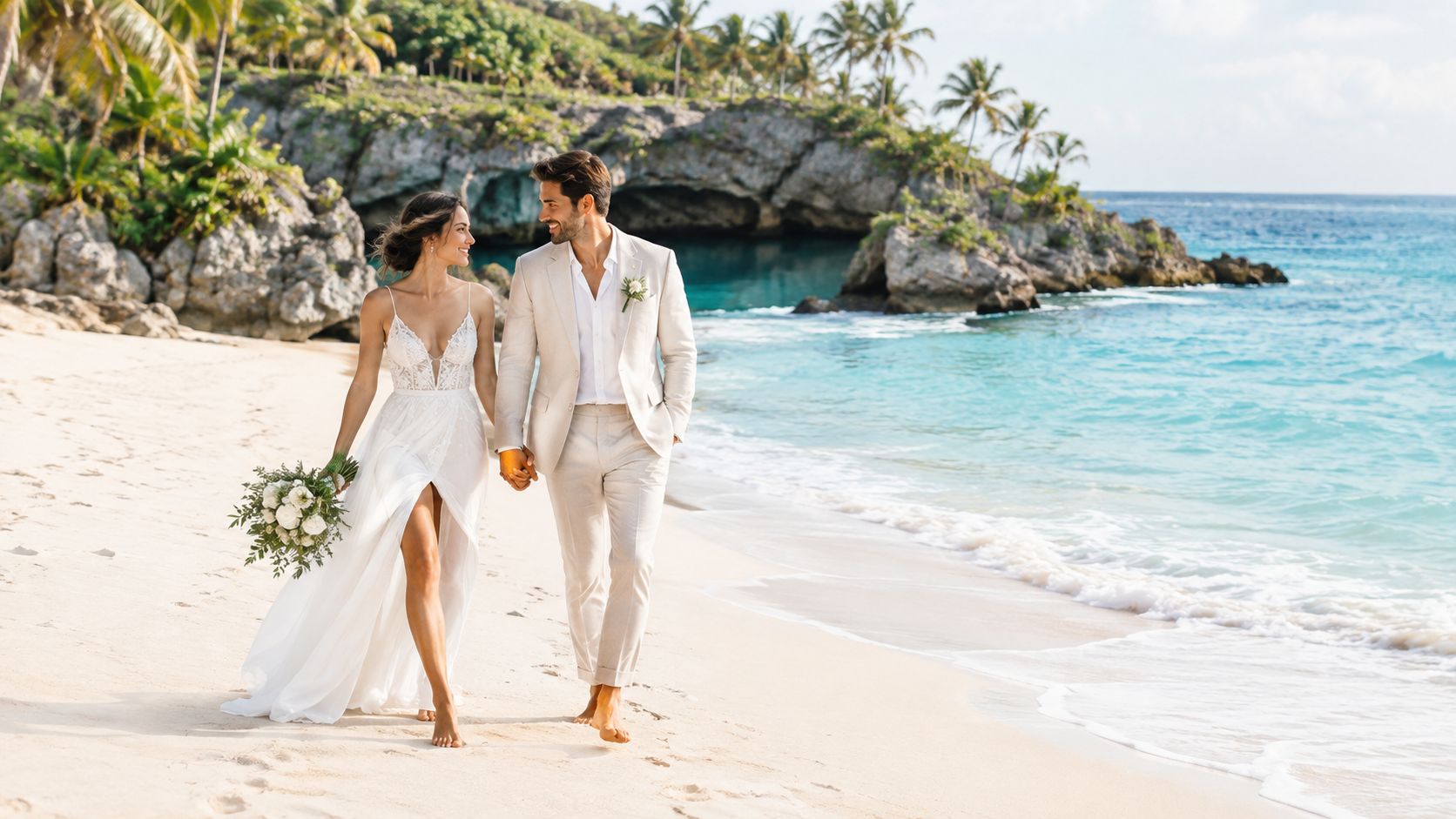
The backdrop options are unusually flexible
Some couples want barefoot vows and ocean air. Others want stone paths, tropical greenery, or a dinner that feels more like a private getaway than a reception. Riviera Maya can hold all of those moods.
That flexibility is why local scouting matters. A planner doesn't just ask, “Do you like the beach?” They ask what kind of beach, what kind of privacy, what kind of access, and what kind of light. They may also help pair your ceremony with a next-day outing or portrait session, which is where curated experiences like luxury private tours in Riviera Maya can fit naturally into a longer elopement stay.
The airport access is strong, but it needs coordination
Riviera Maya is also practical because it's served by a major international gateway. Cancún International Airport handled about 30.4 million passengers in 2024 and about 29.3 million in 2025, with 19.4 million international travelers in 2025 (Cancún International Airport overview).
That volume is good news because it gives couples broad flight access. But it also means arrival-day planning matters. High passenger flow changes how you think about bags, customs, pickup timing, and guest coordination.
Official Cancun airport transportation pages describe prepaid, zoned taxi and car services and state that transportation to hotels requires a reservation, with fixed fares shown by destination (Cancun airport transportation details). That's a useful clue for couples. Ground transport here often works best when booked ahead, not improvised after landing.
It rewards a local approach
Riviera Maya isn't difficult because it's chaotic. It's difficult because it's layered. Distances can look shorter on a map than they feel on a wedding day. Some locations are easy for two people but awkward for a small group. Some ceremony sites are gorgeous at one hour and crowded at another.
A local planner understands those texture differences. That's what makes the destination feel smooth instead of stitched together.
How to Choose the Right Elopement Planner
Your planner is not just hiring vendors. They are arranging a chain of timed decisions. In Riviera Maya, that chain often starts before the ceremony day, with airport arrivals, check-in timing, beauty appointments, portraits, and dinner all affecting one another. For a 2 to 15 person elopement, the right planner treats transportation as part of that timeline from the start.
Look for elopement-specific judgment
A planner for a large ballroom wedding can still be excellent and wrong for this job. An elopement in Riviera Maya needs someone who can keep the day intimate while also handling travel logic, access rules, weather backups, and small-group movement.
A good way to test this is to listen to what they ask you first.
If they begin with guest count, ceremony style, flight schedules, where everyone is staying, and what parts of the day cannot run late, they likely understand destination elopements well. If the conversation stays focused on decor upgrades and broad style language, they may be stronger with traditional weddings.
Ask questions that reveal how they think:
- How do you build the timeline around light, heat, and travel time?
- How do you handle different arrival flights for a small group?
- What is your backup plan if a beach location has access limits that day?
- Who tracks the movement from hotel to ceremony, portraits, and dinner?
- How do you prevent one late transfer from shifting the rest of the day?
Strong answers are specific. You want to hear process, sequence, and contingency plans.
Compare the service level, not just the title
Planner titles can sound clearer than they really are. One company's “coordination” package may include timeline design and vendor communication. Another may start only a few weeks before the date.
That is why scope matters more than the label.
| Planner Type | Best Fit | What to confirm before booking |
|---|---|---|
| Full-service elopement planner | Couples who want help choosing location, building the timeline, finding vendors, and organizing a multi-day experience | Ask whether they also coordinate arrivals, restaurant reservations, legal appointments, and guest movement |
| Destination wedding planner | Couples planning from abroad who need local contacts and remote planning support | Ask how much of their work is with small weddings, not only larger destination events |
| Month-of coordinator | Couples who have booked most vendors but need a professional to tighten the plan and run the final weeks | Ask whether transportation timing, contact sheets, and buffer planning are included |
| Day-of coordinator | Very simple elopements with few vendors and very little movement between locations | Ask who creates the actual timeline and who handles delays before the wedding day |
This comparison gives you a better filter than price alone. As noted earlier, cost ranges exist, but the bigger question is whether the planner's scope matches the number of moving parts in your trip.
Watch how they talk about timing
Timing reveals experience faster than a portfolio does.
An experienced elopement planner will not discuss airport pickup, beauty services, ceremony start time, portraits, and dinner as isolated bookings. They will explain how one affects the next. That matters even more in Riviera Maya, where a short drive on a map can feel much longer once luggage, hotel access, and a small group's different schedules are involved.
A useful comparison is a row of standing dominoes. If one airport pickup runs late and no buffer exists, hotel check-in tightens, getting ready starts late, first-look photos shrink, and dinner either shifts or feels rushed. A planner who understands micro-weddings plans against that chain reaction.
You can ask this directly: “If one guest lands late, what changes and what stays protected?”
The right planner should answer without hesitation. They should be able to tell you which pieces are flexible, which are fixed, and how private chauffeured transfers help protect the parts of the day that cannot slide.
Ask how early they start transportation planning
Transportation should appear in the planning conversation early, not after vendors are booked. General event transportation guidance recommends booking event transport months in advance, especially when schedules, group coordination, and fixed-time events are involved (practical transport booking timeline).
For an elopement, that does not mean every route must be finalized immediately. It means your planner should map the travel legs early enough to protect the ceremony timeline. This is especially important if your group is arriving on different flights, staying in more than one property, or attending dinners and excursions across multiple days.
Notice how they communicate
Good communication feels calming because it reduces uncertainty.
Look for these signs:
- Clear replies. They answer the actual question.
- Real examples. They can walk you through a sample day from pickup to dinner.
- Small-group awareness. They understand that 2 people and 15 people create different timing needs.
- Defined responsibility. They tell you what they handle, what vendors handle, and who oversees transportation timing.
By the end of the call, you should have a clearer picture of how your elopement would run. That clarity matters. A strong planner makes the whole trip feel organized before a single reservation is confirmed.
How Private Transportation Keeps Your Elopement on Schedule
Your ceremony is set for late afternoon. Hair and makeup begin at the resort. Your photographer is meeting you at a quiet beach access point. Two guests are arriving on an earlier flight, and your dinner reservation has a fixed seating time. In that kind of elopement, transportation is not a side task. It is part of the timeline itself.
A small destination wedding works like a row of standing dominos. If one pickup runs late, the delay reaches everything behind it. Getting dressed feels rushed. Portrait time shrinks. Sunset light disappears. Dinner starts with apologies instead of a toast.
Map the day in travel legs
A planner should break the itinerary into timed travel legs, not vague rides. Each leg has a purpose, a passenger group, and a latest safe departure time.
Airport to resort is one leg. Resort to a legal appointment is another. Then you may have hotel to ceremony site, ceremony to portraits, and portraits to dinner. For a two-person elopement, that may be simple. For a group of 8 or 12 spread across different hotels, it becomes a chain that needs clear timing.
That shift changes the questions you ask:
- What time does this vehicle need to arrive for the next part of the day to stay calm?
- Who should ride together so no one is waiting on the wrong people?
- Which leg needs extra cushion because access, traffic, or luggage may slow it down?
- What fixed-time moment gets affected first if a transfer slips?
Those are planner questions, not just driver questions.
Private transportation protects the timeline
Shared rides can work for a casual vacation. An elopement day usually needs more control than that. A private chauffeured transfer follows your schedule, your stop sequence, and your passenger list. That matters when your group is small but the day has fixed moments.
For Riviera Maya elopements, direct point-to-point transportation for time-sensitive wedding legs often makes the day easier to manage because each route is planned around the event itself, not around extra stops for other travelers. If one couple is heading to portraits while family goes straight to dinner, those should be treated as separate timeline needs, not one generic shuttle run.
Private service also helps on multi-day elopements. Guests may arrive on different flights. The couple may change hotels for one night. A welcome dinner, ceremony day, and farewell brunch may all happen in different places. One coordinated transportation plan keeps those pieces connected.
Buffer time belongs inside the schedule
Buffer time should sit inside each transfer, not outside the wedding day as a hopeful guess.
That means your planner and transportation provider should account for real friction points such as baggage claim, lobby meetups, beach access checkpoints, rain slowdowns, or a family member who takes longer to load into the vehicle. When those minutes are built into the plan early, a short delay stays small. When they are ignored, the whole day starts borrowing time from hair and makeup, portraits, or dinner.
A good transfer plan feels quiet because it prevents visible stress.
Your chauffeur should know more than the address
For an elopement, “pickup at 3:00” is not enough information. The driver or dispatcher should understand what that pickup supports in the wedding timeline.
Share details such as:
- Passenger grouping: couple, parents, guests, or vendors
- Items in transit: attire, flowers, camera gear, welcome bags, child seats
- Exact wait points: terminal exit, resort lobby, private villa gate, beach entrance, cenote access
- Stop order: legal appointment, first look, ceremony, portraits, dinner, brunch
- Main contact: planner, maid of honor, family member, or the couple
A wedding planner for elopement earns real value. They connect the schedule on paper with the movement on the ground, so your transportation supports the day instead of interrupting it.
Planning Your Effortless Elopement With Confidence
A calm elopement doesn't happen because the day is small. It happens because the moving parts were arranged in the right order. That's the value of a wedding planner for elopement in Riviera Maya.
Your next decisions should be simple
If you're ready to move forward, keep your first checklist short:
- Define the shape of the celebration. Is it just the two of you, or a small group spread across a few days?
- Choose the feeling before the location. Quiet beach, cenote privacy, boutique luxury, or a mix.
- Interview planners about timing, not just style. Their answer will tell you whether they understand destination elopements.
- Book transport early if the itinerary has fixed moments. Ceremony light, dinner reservations, and guest arrivals all depend on it.
- Share one master timeline. Planner, photographer, beauty team, and driver should all be working from the same flow.
Remember what “effortless” really means
Effortless doesn't mean unplanned. It means the planning was good enough that you barely felt it.
If your day includes airport arrival, a private ceremony, portraits, and a dinner with a few loved ones, then transportation is part of the wedding design. Treating it that way keeps the experience from becoming reactive. If you want a clearer sense of budget expectations, this guide on how much wedding transportation costs can help you think through the moving pieces before you lock your itinerary.
The best Riviera Maya elopements feel intimate, personal, and easy. Behind that ease, someone has already aligned the permits, timing, route, and people. Once that structure is in place, you get to do the part that matters. Show up, breathe, and get married.
If your elopement includes airport arrivals, ceremony transfers, or a multi-stop wedding weekend, Unique Private Transportation offers private Cancun airport transfers, point-to-point service, and coordinated chauffeur support across Riviera Maya. Their service fits the kind of timeline-driven planning this article describes, especially when a small wedding depends on reliable movement between hotel, ceremony, photos, and dinner. You can explore the options at Unique Private Transportation.