
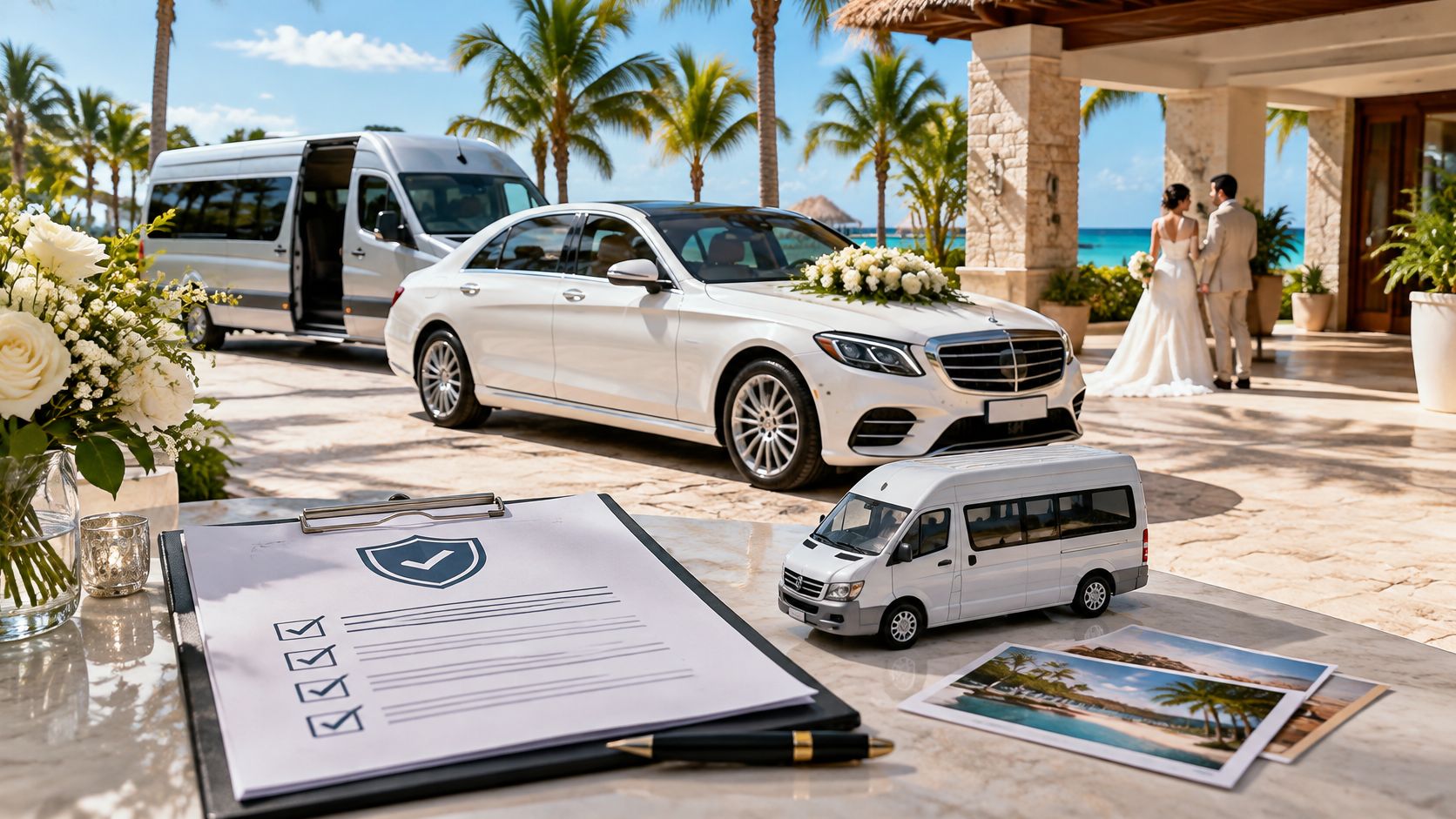
You've booked the resort, your guests are sending flight details, and a premium SUV looks like the simplest way to get everyone to the ceremony. Then someone asks whether your wedding insurance covers the car. The booking confirmation says insured, but it doesn't explain who pays if a passenger is injured, the vehicle is damaged, or a replacement driver arrives in a different van.
Wedding car insurance isn't a single policy. For Cancun airport transportation and wedding-day transfers, you need to separate the operator's driving liability from vehicle damage, rental-contract obligations, and your event coverage. The useful question isn't whether someone has insurance. It's whether the right policy covers the actual vehicle, passengers, driver, and journey you're buying.
Table of Contents
- Which Policy Covers a Wedding Car Transfer
- Liability Limits and Passenger Capacity Benchmarks
- What Wedding Car Insurance Costs to Carry
- Exclusions That Leave Couples and Guests Exposed
- Airport Transfer Fares and Terminal Pickup Rules
- How to Verify Coverage Before You Book
- Confirm Coverage Before You Pay a Deposit
Which Policy Covers a Wedding Car Transfer
A wedding car is covered for paid passenger work only when the applicable policy authorizes that use. A private insurance card isn't enough, even when the vehicle is a luxury SUV, classic car, or immaculate sedan.
Paid transportation creates a commercial exposure often described as hire or reward. A provider offering luxury transportation needs coverage appropriate to that operation, not just permission to drive the vehicle privately.
Coverage options for a wedding car transfer
| Coverage option | Who it protects | Passenger transport covered | Typical gap |
|---|---|---|---|
| Vendor commercial auto policy | Operator, passengers, and third parties, within policy terms | Yes, if passenger and chauffeur operations are explicitly named | Overflow vehicles and changed routes may not be listed |
| Private car policy | Vehicle owner and third parties, within policy terms | Often excluded for paid work | Hire or reward use can fall outside cover |
| Wedding or event liability policy | Insured event parties facing guest injury or property-damage claims | No automatic cover for vehicles from an outside provider | Rented vehicle damage is generally excluded |
| Rental company protection | Renter's exposure to covered damage to the rented vehicle | Only if the agreement expressly includes the intended use | Renter may owe indemnity above statutory minimums |
| Hired and non-owned auto cover | Business using vehicles it doesn't own | Only where written into the policy | Relevant coverage must be evidenced on the certificate and policy |
Liability isn't vehicle damage protection
The distinction is straightforward: liability coverage responds to covered injuries and damage suffered by others. It doesn't automatically pay to repair the insured car, replace a guest's luggage, or reimburse the renter for every charge under a rental contract.
The UK government's vehicle insurance guide illustrates this distinction: compulsory third-party insurance covers injury or damage caused to others, but not repairs to the insured vehicle itself. That's a useful explanation of coverage categories, not a statement of Mexican insurance requirements.
Say a chauffeured SUV strikes another vehicle while taking guests to a rehearsal dinner. The operator's applicable liability coverage is the starting point for claims from the other vehicle's occupants. Repairing the SUV requires a separate physical-damage analysis, while damaged belongings require their own coverage check.
Match the policy to the booking
For a chauffeured transfer, the operator's commercial policy should address the driving exposure. For a self-drive rental, the renter takes on a different set of responsibilities under the rental agreement, including potential damage charges and deductibles.
Don't assume hired and non-owned coverage solves everything either. It can address a business's liability when using vehicles it doesn't own, but it isn't a blanket promise to repair every borrowed or subcontracted vehicle.
Practical rule: Ask which policy responds to the specific loss, not whether the booking is insured.
A generic wedding policy can leave the highest-value rented asset outside its protection. Likewise, passenger insurance advertised with a transfer doesn't, by itself, establish the limits, exclusions, or vehicle-damage coverage.
For Cancun bookings, ask the operator or insurer to confirm Mexican territorial coverage and the requirements applicable in Quintana Roo. US or UK policy wording is no substitute. The confirmation should encompass the actual service, including airport arrivals, rehearsal dinners, ceremony transfers, and any additional guest movements.
Liability Limits and Passenger Capacity Benchmarks
Liability benchmarks by vehicle size and use
| Scenario | Liability benchmark | Practical note |
|---|---|---|
| Up to 15 passengers, US interstate | At least $1.5 million, according to LegalClarity's wedding-car booking guidance | US interstate reference for smaller passenger vehicles |
| 16 or more passengers, US interstate | At least $5 million under the same guidance | Vehicles designed for this capacity generally require a commercial driver's license with passenger endorsement |
| Transport provided for an event, Palm Beach County guide | $1 million auto liability, specified in the county insurance requirements guide | Procurement reference, not universal law |
| Certain non-transport vehicle use, Palm Beach County guide | $500,000 under that guide | Don't substitute this lower benchmark for the transportation requirement |
| Commercial auto policy, NAIC typical level | Around $1 million, described by the NAIC small-business insurance guidance | A typical level, not proof that a particular operation has enough coverage |
| Mexico, Quintana Roo | Obtain the applicable local requirement and actual policy limit in writing | Confirm with the local operator and insurer |
The US passenger-capacity thresholds above are jurisdiction-specific references. They aren't minimum coverage instructions for a Cancun wedding, and the Palm Beach County figures describe procurement requirements rather than a universal rule.
Their practical value is showing why vehicle size and service type belong in the insurance review. A sedan, SUV, passenger van, and coach shouldn't all be approved just because the same booking company supplies them.
Check each vehicle separately
Start with a vehicle allocation sheet. Record the assigned vehicle, approved passenger seating, driver, insurer, and applicable liability limit alongside each pickup.
A mixed fleet needs separate checks. A coach may raise licensing questions that don't arise for a sedan, while a replacement van may not appear under the same policy arrangement as the operator's own SUVs.
Approved capacity matters more than squeezing everyone inside. A child needs an appropriate seat arrangement, and luggage must fit without turning passenger spaces into makeshift cargo areas. If the group exceeds the approved seating configuration, request another vehicle rather than accepting an improvised solution.
Read the certificate as evidence, not a guarantee
A certificate of insurance should identify the named insured, policy period, insurer, coverage categories, and limits. Match the insured business to the company responsible for operating the transfer, not merely the name collecting your deposit.
Then establish how the booked vehicles are covered. Some arrangements require a vehicle schedule or policy endorsement to make that clear; a certificate alone may not answer the question.
- Check the liability structure. Ask whether bodily injury and property damage have separate limits or share a combined limit.
- Confirm commercial passenger use. A commercial policy for business errands isn't automatically suitable for chauffeuring paying passengers.
- Resolve subcontracting. Identify who supplies and operates a replacement vehicle before accepting its insurance documents.
For Mexico and Quintana Roo, leave the legal-minimum field unapproved until the local requirement is confirmed. Borrowing a familiar US figure creates paperwork that looks complete without establishing compliance.
What Wedding Car Insurance Costs to Carry
| Premium reference | Reported cost | What it describes |
|---|---|---|
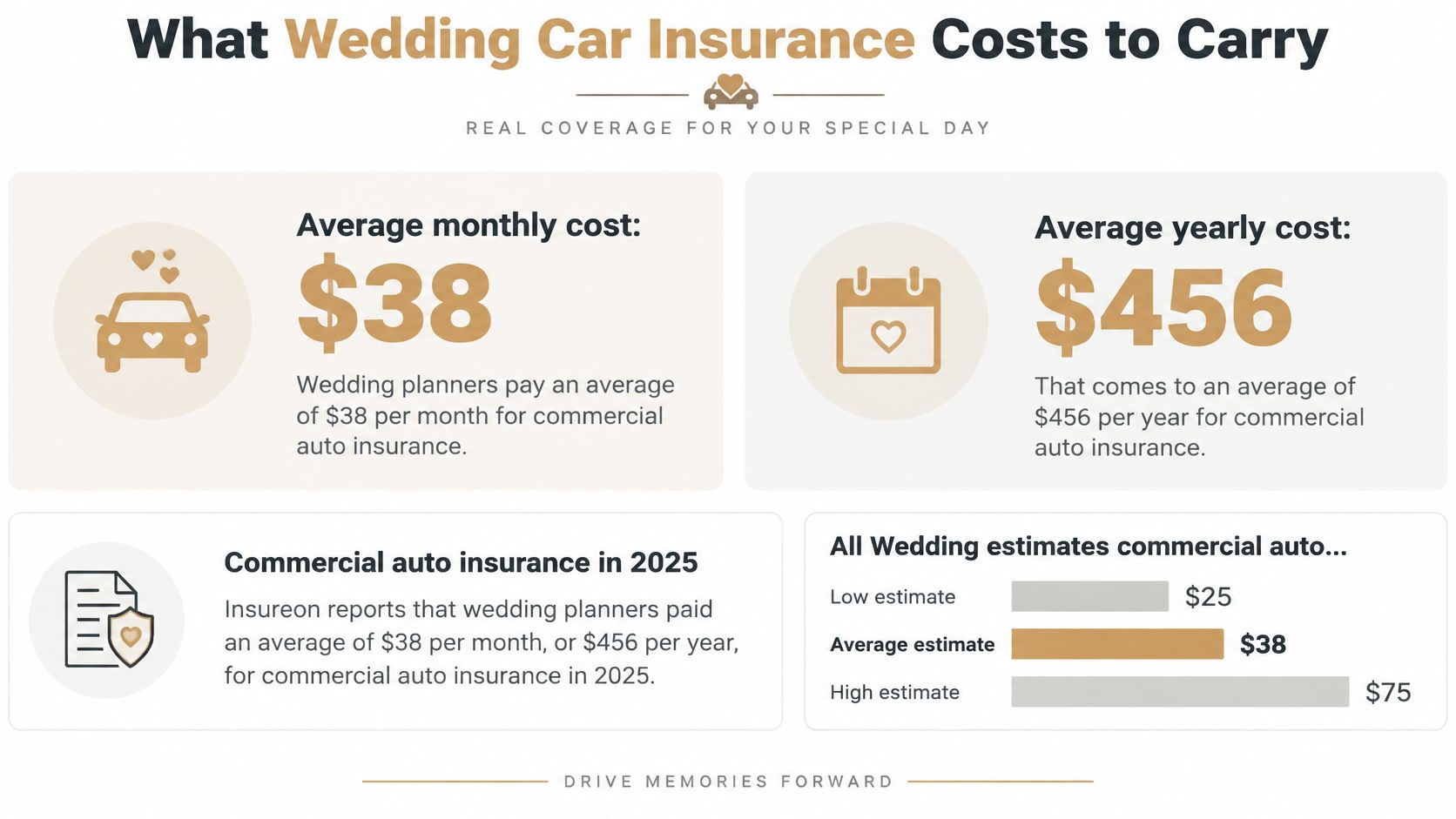
| Insureon wedding-planner customers | $38 per month, or $456 per year, in 2025, according to Insureon | Average commercial auto premium paid by wedding planners |
| All Wedding business estimate | $800 to $2,500 annually in 2026, according to All Wedding | Estimated commercial auto cost for wedding businesses |
These aren't equivalent quotes for a Cancun chauffeur fleet. They describe different business populations and estimates, so they shouldn't be treated as a price range an individual couple can expect to pay.
Compare the operation behind the premium
Vehicle count, passenger capacity, route territory, driver qualifications, and vehicle ownership all matter when comparing quotations. An operation using its own premium vehicles presents a different insurance arrangement from a planner occasionally hiring vehicles from outside suppliers.
A couple booking a third-party chauffeur usually pays a transfer fee, not the operator's annual insurance premium. Use these premium references to understand the business expense, not to calculate an insurance surcharge on your wedding booking.
Keep your wedding transportation budget separate from the operator's insurance comparison. Waiting time, additional stops, vehicle selection, and return journeys belong in the transport quote.
A cheaper premium can buy a narrower policy
I would compare annual cost per vehicle, liability limits, deductibles, and authorized passenger use before looking at the headline premium. That comparison only works when the quotes cover the same operation.
For example, a quotation excluding hired vehicles isn't an equivalent alternative to one covering overflow demand. Nor is a policy restricted to local routes equivalent to coverage supporting the full wedding itinerary.
An uncovered claim involving a hired or rented vehicle can exceed the annual premium. Saving on insurance doesn't help if the saving comes from excluding the work the operator performs.
When a provider's price looks unusually low, request the relevant declarations page and endorsements, not just the certificate. Ask the insurer or broker to explain any unclear restriction before you accept the quote.
Exclusions That Leave Couples and Guests Exposed
Buying wedding insurance doesn't establish that the wedding car is covered. Allstate's wedding insurance guidance explains that equipment rented from an outside provider is generally excluded, which makes a separate vehicle-coverage review essential.
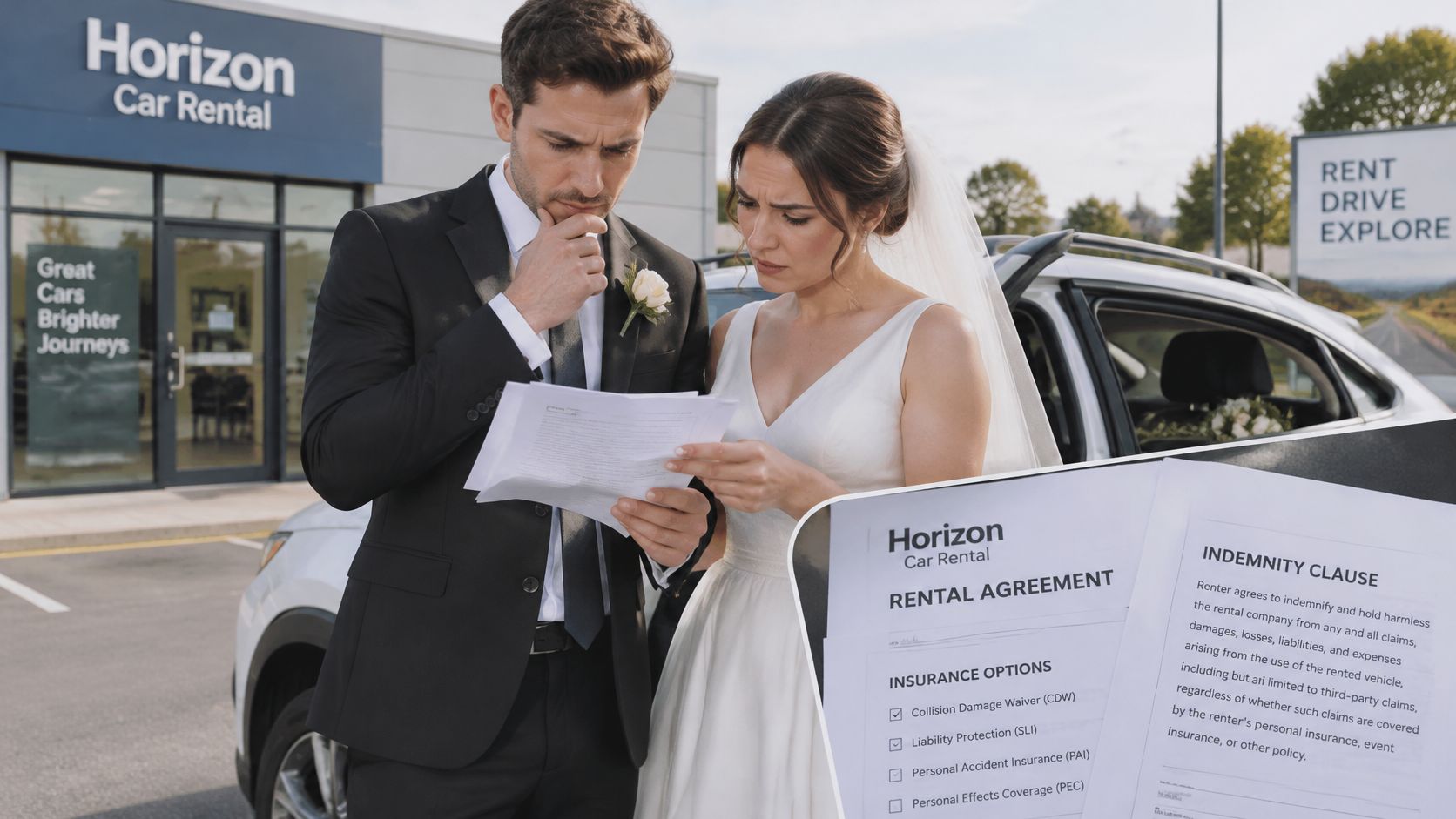
The contract can create exposure beyond the repair bill. Rental agreements may require the signer to defend and indemnify the rental company for certain claims, including amounts exceeding statutory minimum liability protection, even when another authorized guest was driving.
Read the exclusions against your actual plans
Don't ask whether a policy includes full coverage. Send the itinerary and intended use, then ask for a written response addressing these exposures:
- Self-drive use. Protection arranged for a chauffeur-operated service may not extend to a guest taking the wheel.
- Alcohol-related incidents. Ask how exclusions affect driving, passenger conduct, and contractual responsibility. Event alcohol coverage isn't a substitute for motor coverage.
- Specialty or luxury vehicles. Confirm the exact vehicle class is accepted, rather than assuming a general rental benefit includes it.
- Cross-border or ferry segments. Identify every segment requiring permission or separate coverage before adding it to the itinerary.
- Loss of use. Ask whether you can be charged while a damaged vehicle is unavailable, and whether any protection pays that charge.
Don't export assumptions from home
A US personal policy isn't proof of rental protection abroad. Allstate's rental-car insurance guidance explains that protection turns on the policy, vehicle, rental arrangement, location, and local rules; its New York discussion also shows why renters must ask what liability protection the rental company supplies.
That example isn't a statement of Mexican law. It demonstrates why a reassuring answer from a rental desk needs to identify the actual protection being supplied.
A generic wedding policy can create false confidence while leaving the highest-value rented asset uncovered.
Use the coverage-options table to identify the likely policy, then have the insurer confirm the scenario. A passenger injured while entering the car, damage to the rental itself, and a third-party collision aren't interchangeable claims.
Ask your personal auto or umbrella insurer about any relevant rental exposure separately. Before signing, obtain written confirmation of exclusions, authorized use, deductibles, and contractual charges from the provider or rental firm.
Airport Transfer Fares and Terminal Pickup Rules
Airport transfer fares by route
| Route | Private car reference | Public ADO coach reference |
|---|---|---|
| Cancun Airport to Hotel Zone | $29.99 route example in the airport transportation guide | No direct Hotel Zone fare supplied; confirm the onward connection |
| Cancun Airport, zone-based indicative range | Approximately $65–$120 per car in the same guide | Route-specific, not a matching zone-based fare |
| Cancun Airport to central Cancun | Request a destination-specific vehicle quote | About 120 pesos per passenger, listed by GetFromAirport |
| Cancun Airport to Playa del Carmen | $69.99 route example in the airport guide | About 208–270 pesos per passenger in the coach guide |
| Cancun Airport to Tulum | $127 route example in the airport guide | About 300–400 pesos per passenger in the coach guide |
These are planning references, not guaranteed current quotes or equivalent service packages. Private airport fares are commonly organized by route or zone, while the coach references are per passenger and denominated in Mexican pesos.
Ask whether the private price is per vehicle, which currency applies, and whether it covers the complete trip. A Hotel Zone reference won't establish the fare for a particular resort, additional pickup, or wedding venue.
Verify the pickup before leaving arrivals
Cancun Airport's transportation guidance says passengers generally need a prearranged reservation or authorized transportation voucher. It warns against unsolicited offers outside arrivals because unauthorized solicitors may be unlicensed or uninsured.
The same guidance identifies a windshield permit badge for legitimate airport vehicles and an airport identification badge and uniform for drivers. Check those details against your reservation rather than following someone who merely recognizes your hotel name.
A properly arranged Cancun car service should provide the meeting location, provider identity, and a contact method before arrival. For private transportation Cancun Airport bookings, those details make the service verifiable, not just convenient.
Give dispatch the correct terminal
Flight Centre's Cancun Airport guide describes four passenger terminals, with Terminal 1 primarily handling charters and Terminals 2, 3, and 4 serving scheduled services; it also reports a free inter-terminal shuttle at roughly 10–20-minute intervals.
Supply the flight number, arrival date, scheduled time, and terminal when known. Ask the operator to monitor the flight and send terminal-specific meeting instructions, rather than expecting guests in wedding clothes to solve a terminal mismatch.
A low airport fare isn't a complete comparison until it gets everyone, their luggage, and any child seats to the final address.
ADO services use fixed stops rather than hotel or villa doors. Add any onward taxi, waiting, and baggage handling to the comparison before choosing the bus.
For groups, a per-car transfer can be the lower total once onward travel is included, but calculate it rather than assuming. Cancun luxury airport transfers also offer a different operational benefit: keeping the wedding party together on a time-sensitive itinerary.
How to Verify Coverage Before You Book
Verify the operating arrangement, not just the document title. Commercial insurance can address business exposures that personal policies exclude, but you still need confirmation that the policy fits paid passenger transportation.
Work through the booking documents
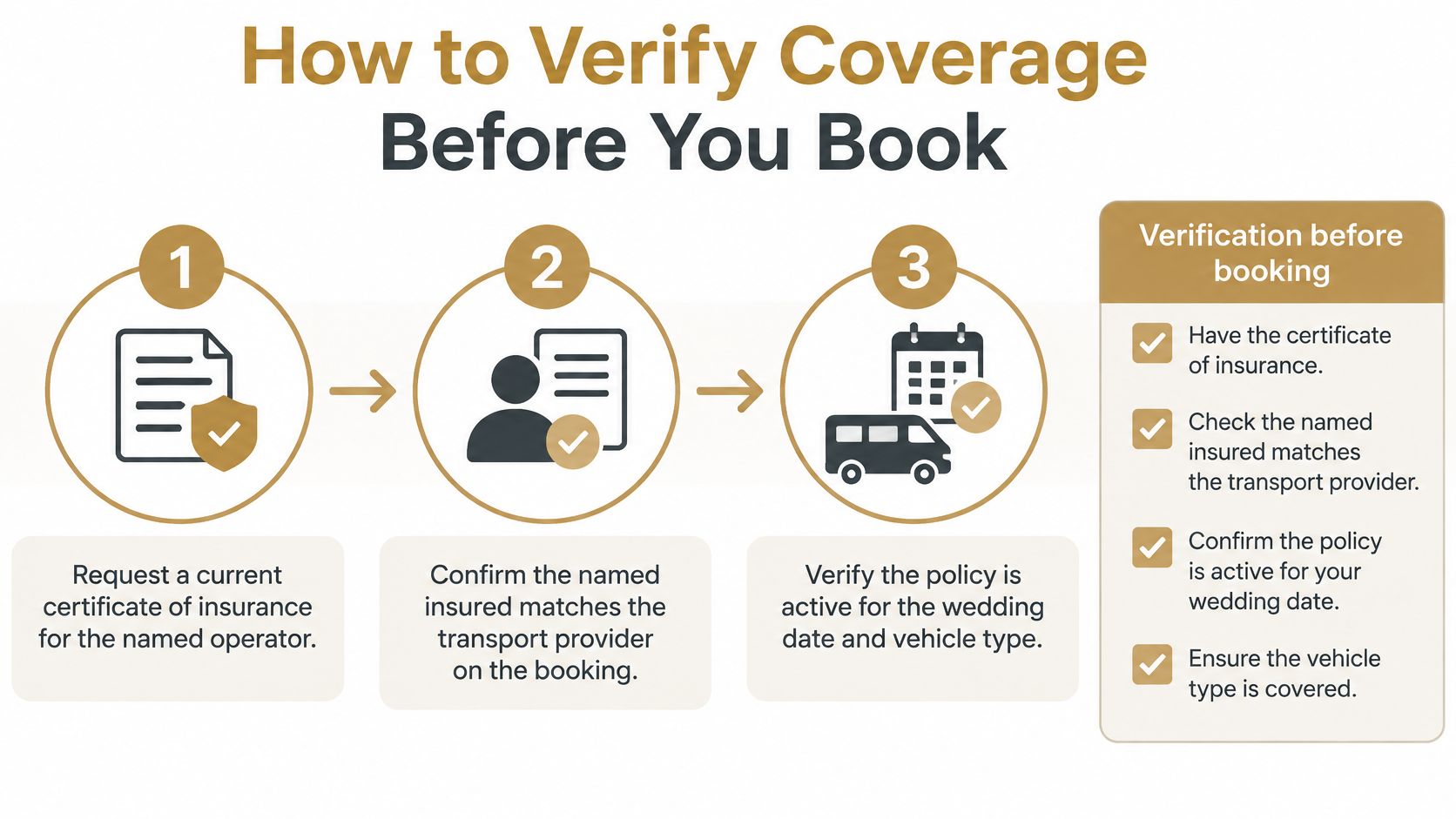
Request a current certificate of insurance for the named operator. Get it before paying, and retain the insurer or broker's contact details. A screenshot saying insured doesn't identify the applicable coverage.
Match the named insured to the transport provider. If the booking agent and operating company differ, establish their relationship. Otherwise, you may be reviewing insurance for a business that won't supply the vehicle.
Confirm commercial auto coverage authorizes passenger transport and chauffeur operations. Ask for the relevant policy wording or endorsement when the certificate doesn't establish permitted use. Business use alone isn't a sufficiently precise answer.
Compare the liability limit with local requirements and the event contract. Check bodily-injury and property-damage provisions separately where applicable. Ask whether the limit applies per incident and whether other restrictions affect the promised protection.
Match the vehicle list and approved seats to the passenger manifest. Include children and the intended child-seat arrangement. Request a revised allocation if luggage or equipment makes the booked configuration unsuitable.
Confirm dates and every route segment. Include airport-to-resort travel, ceremony transfers, intercity journeys, ferry connections, and any proposed border crossing. Don't assume an itinerary extension is automatically accepted.
Check subcontracted, hired, non-owned, and overflow vehicles. Ask who insures each replacement and whether the relevant protection includes the intended commercial service. Permission to subcontract isn't evidence that the replacement is insured appropriately.
Confirm additional-insured status when the venue or contract requires it. Ask for the relevant endorsement, not merely a note promising it later. The wording needs to satisfy the actual contractual requirement.
Get authorized-driver confirmation for self-drive bookings. List every intended driver and check eligibility restrictions. Informal permission from the primary renter doesn't establish authorization under the rental agreement.
Keep a usable incident file
Save the booking contract, insurance evidence, vehicle allocation, pickup instructions, and written clarifications together. Make the file accessible to the person coordinating guests, not just the person who paid.
If an incident occurs, obtain appropriate emergency assistance first, then preserve photographs, driver and vehicle details, receipts, and communications. AskLegally's guidance on how to document your accident insurance claim can help organize that material; follow the applicable insurer's reporting procedure and local requirements.
The common mistake is accepting a wedding policy as proof that the guest vehicle is covered. Approve the transport only when the evidence addresses the actual operation.
Confirm Coverage Before You Pay a Deposit
I would complete the verification checks before paying any deposit, even when the vehicle and schedule look ideal. Missing confirmation of paid passenger use, or a seating allocation below the group's needs, is a reason to pause the booking and choose another arrangement if the provider can't resolve it.
For a chauffeured airport transfer, assess the operator's driving coverage and operating arrangements. For a self-drive rental, review the renter's damage obligations and protection choices before accepting the keys. The same wedding itinerary can create very different responsibilities depending on who drives.
Request a written booking package
Send the provider your date, terminal when known, flight number, group size, luggage requirements, and complete route. For coordinated Cancun wedding transportation, include rehearsal dinners, guest shuttles, and late departures rather than treating them as informal extras.
Ask for:
- Insurance evidence. The operator's current certificate and written confirmation that the booked service is covered.
- Vehicle allocation. Approved passenger seating, child-seat arrangements, luggage capacity, and the process for substitutions.
- Route acceptance. Confirmation of all destinations and any unusual travel segments.
- A complete fare. The currency, vehicle basis, included waiting, additional-stop charges, and cancellation terms.
A provider's willingness to answer precisely matters more than reassuring language about premium service. Apply the same standard to every company, whether you're booking a simple arrival transfer or a bespoke wedding itinerary.
Keep those confirmations with the signed booking so they can be produced if the vehicle changes or a dispute arises. Don't let a deposit deadline replace the insurance review.
Unique Private Transportation offers chauffeured airport transfers, premium vehicles, and wedding transport coordination across Cancun and the Riviera Maya. Visit Unique Private Transportation with your flight details, guest count, and itinerary, then request a written fare, vehicle allocation, and confirmation of the coverage applicable to your booking before paying a deposit.