The first vehicle is due before the opening session, but three executives are still waiting at baggage claim, a speaker's flight has moved to another terminal, and the venue has one narrow loading zone shared by every supplier. In that moment, corporate event transportation services stop being a booking task. They become a live operating system, with people, vehicles, access points, schedules, and contingencies working together under pressure.
That distinction matters whether you're arranging a leadership retreat, a conference, or Cancun airport transportation for an international team. A polished vehicle helps, but reliable movement depends on how well the plan handles peak demand, luggage, curb access, flight changes, VIP priorities, and communication.
Table of Contents
- The Reality of High-Stakes Event Logistics
- The Global Scale of Event Logistics
- Engineering the Perfect Fleet with Peak-Window Planning
- Right-Sizing Your Vehicle Selection
- Elevating Experience with VIP and Concierge Services
- Navigating Air Transport Operations
- Building a Policy for Disruption Management
The Reality of High-Stakes Event Logistics
At 7:10 a.m., the first airport arrivals are ready to leave. The conference hotel expects the group before the opening briefing, and the event team has promised a controlled arrival rather than a queue of taxis. One chauffeur finds the correct terminal exit immediately. Another is delayed by a congested pickup lane. A third vehicle has enough seats but not enough cargo space for the group's cases.
The schedule doesn't fail all at once. It slips in small increments. A guest waits for luggage space, a second passenger boards at the wrong curb, and a driver calls the coordinator for directions that should have been confirmed earlier. By the time the last travelers reach the venue, the meeting has started late and the event staff are managing avoidable complaints instead of welcoming attendees.
Transport is part of the program
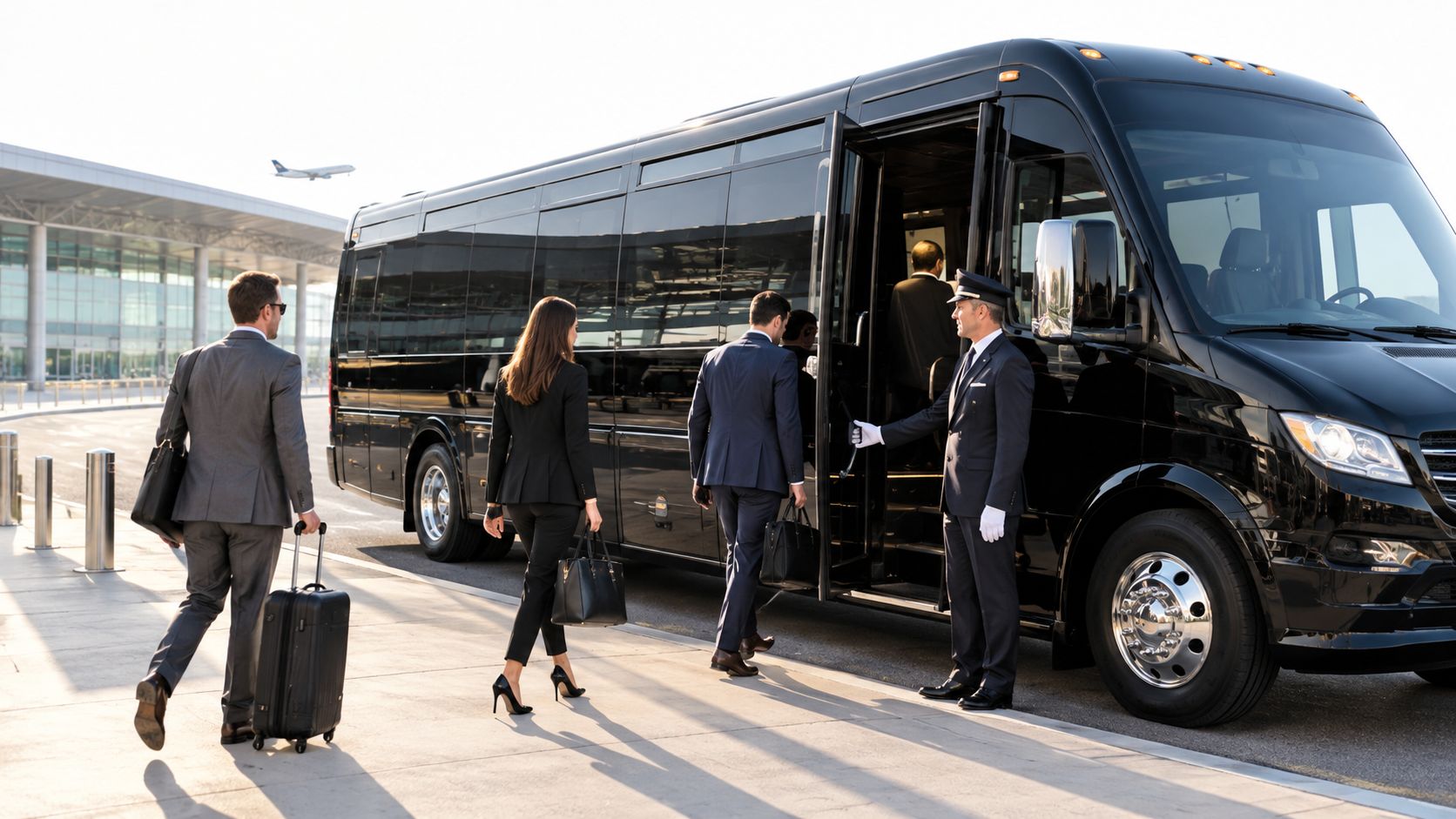
Transportation should be planned with the same discipline as the agenda. The transport team needs a master movement plan that connects flight arrivals, hotel check-in, venue access, executive movements, meal functions, and departures. It also needs clear ownership. Someone must decide when a vehicle leaves, which guests have priority, and who can authorize a reroute.
This is why a coordinated corporate transportation service should be evaluated on dispatch capability, communication, and operational control, not just vehicle photographs. A provider can have attractive vehicles and still create friction if drivers don't receive terminal details, loading instructions, or passenger status before the event.
Practical rule: Treat every scheduled movement as a timed operation with a responsible owner, a confirmed pickup point, and a fallback action.
Attendee identity can create another layer of complexity at high-profile events. A planner may need to know whether the right delegate has boarded without exposing unnecessary personal information or forcing staff to manage a manual list. A relevant example is Purple attendee authentication, which illustrates how controlled attendee verification can support access-sensitive event operations.
The best plans also account for what happens outside the vehicle. Chauffeurs need a recognizable meeting protocol, venue staff need a staging map, and event coordinators need a live contact path. That infrastructure turns transportation from an amenity into a dependable part of the attendee experience.
The Global Scale of Event Logistics
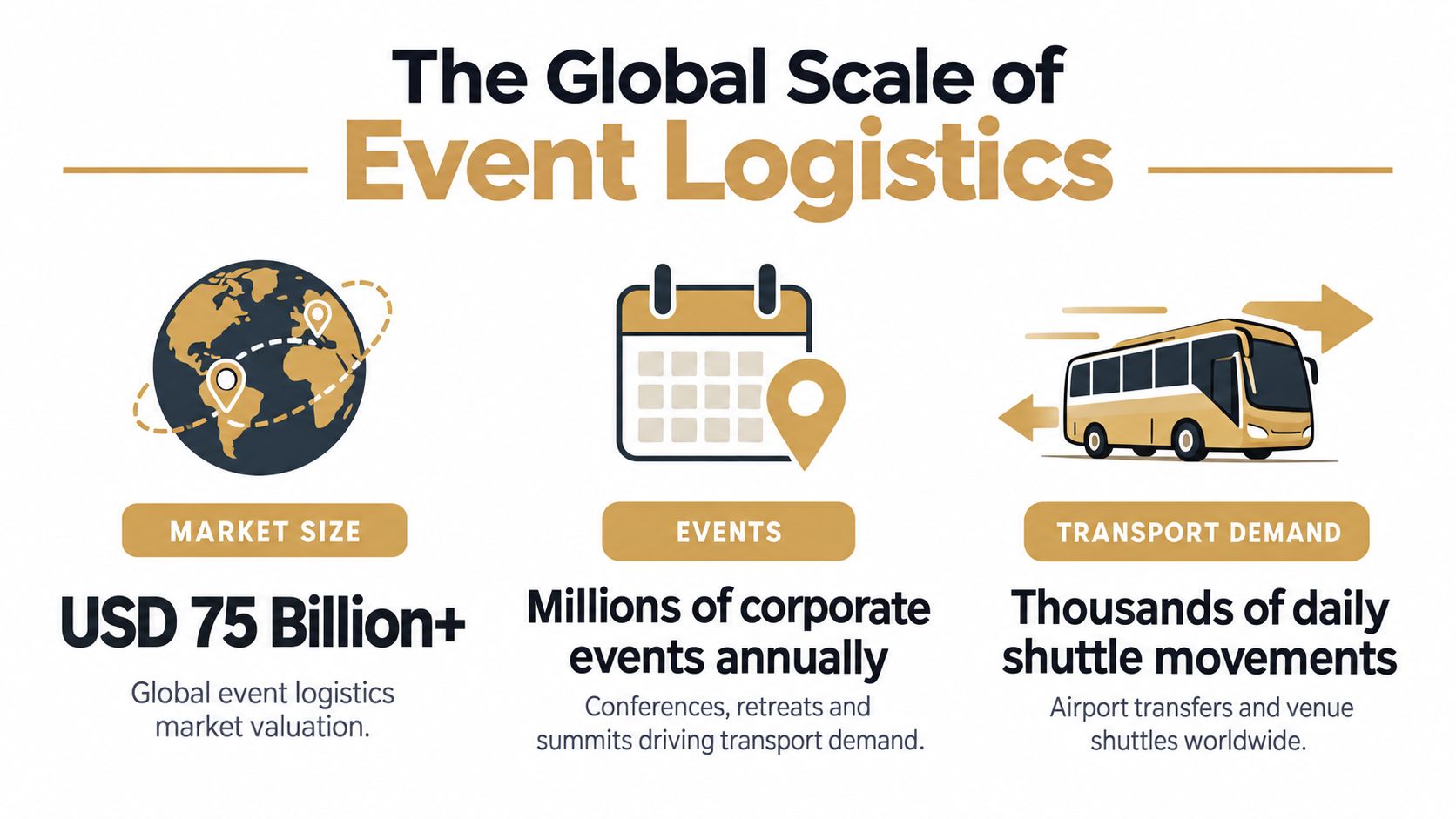
Corporate ground movement sits inside a much larger logistics economy. One market estimate values global event logistics at USD 75.16 billion in 2025 and projects USD 103.89 billion by 2031, with a 5.55% compound annual growth rate during 2026 to 2031. The same source assigns 77.60% of 2025 revenue to transportation services and estimates that North America held 37.75% of the market in 2025, reflecting the concentration of coordinated movement around major business-event destinations. These figures are reported in the event logistics market overview.
A separate market study uses a different market definition and estimates USD 77.5 billion in 2025, rising to USD 134.9 billion by 2035, with a 5.9% CAGR. It values transportation as the largest quantified service segment at USD 27.87 billion in 2025. The difference between the estimates is a reminder to compare methodology before treating market figures as interchangeable, but both point to the same operational conclusion. Transport is a central category in event delivery, not a minor add-on. The figures come from the corporate event transportation market analysis.
Why the economics matter to planners
The same study estimates that corporate events generated USD 566 billion, or 43.8%, of direct global business-event spending in 2025. That doesn't mean every event needs a large fleet. It does mean transportation decisions sit inside a substantial spending environment where missed transfers can affect meetings, speaker schedules, hospitality commitments, and the perceived quality of the entire program.
The market context supports a practical shift in procurement. Instead of asking only, “What does each vehicle cost?” planners should ask:
- What movement must never fail? Identify airport arrivals, executive transfers, venue shuttles, and departures that carry the highest schedule risk.
- Where does demand concentrate? A route with overlapping arrivals may need more dispatch capacity than a longer route with evenly spaced movements.
- Which service layer owns the exception? Define who handles flight changes, inaccessible loading zones, missing passengers, and vehicle substitutions.
A low quote can become expensive if the provider can't manage those details. Conversely, a carefully designed luxury transportation plan can protect the event's most valuable asset, the schedule.
Engineering the Perfect Fleet with Peak-Window Planning
Total attendance is a poor basis for fleet sizing. The operational question is not how many people attend across the day. It is how many people need to move during the busiest 60-minute window, when arrivals, departures, VIP transfers, and venue movements overlap. Industry guidance recommends sizing for that interval and adding a 10% to 15% capacity margin for loading inefficiencies, luggage, and no-shows. The planning method is detailed in this corporate event transportation guidance.
A practical sizing sequence
1. Build the movement grid. Put every required movement on one timeline. Include flight arrival banks, baggage collection, hotel departures, speaker call times, executive meetings, venue access windows, and return movements. Don't group all airport arrivals into a single vague line. A flight arriving at one terminal may require a different vehicle position and timing than a flight arriving elsewhere.
2. Find the overlap. Identify the single interval with the greatest simultaneous demand. A program with a large total attendance may have a modest peak if arrivals are spread out. A smaller program can create a severe bottleneck when several flights land together and the venue accepts vehicles through one constrained entrance.
3. Size for usable throughput. Count the passengers who must move in that interval, then compare them with practical vehicle capacity. A vehicle's published seating capacity doesn't account for boarding speed, luggage handling, wheelchair access, or the time needed to reposition at a crowded curb.
4. Add the operating margin. Apply the recommended 10% to 15% margin to the peak requirement, rather than to the total daily headcount. This protects the schedule from predictable friction without automatically purchasing a large fleet for quiet periods.
5. Test the venue. For events above 30 guests, industry guidance recommends contingency vehicles and explicit confirmation of loading zones and staging space. A vehicle that can't reach the correct curb at the required time isn't capacity. It's a theoretical asset.
The fleet should be engineered for the busiest interval, then tested against the real curb, not the spreadsheet.
Use live information without creating manual work
For airport-linked programs, collect full flight manifests, terminal information, arrival times, and passenger groupings before dispatch begins. Flight monitoring can help the team stage vehicles around arrival banks and adjust for changes without asking every traveler to call the coordinator.
Technology can add another control layer. For example, AI geofencing for fleet managers provides useful context for thinking about location-based fleet oversight. In practice, a geofence can support alerts around airports, hotels, venues, and restricted staging areas, but it shouldn't replace a human dispatcher who understands the event's priorities.
What doesn't work is treating the manifest as a static document. Assign a person to reconcile changes, confirm passenger status, and communicate dispatch decisions. A live plan is only useful when someone acts on it.
Right-Sizing Your Vehicle Selection
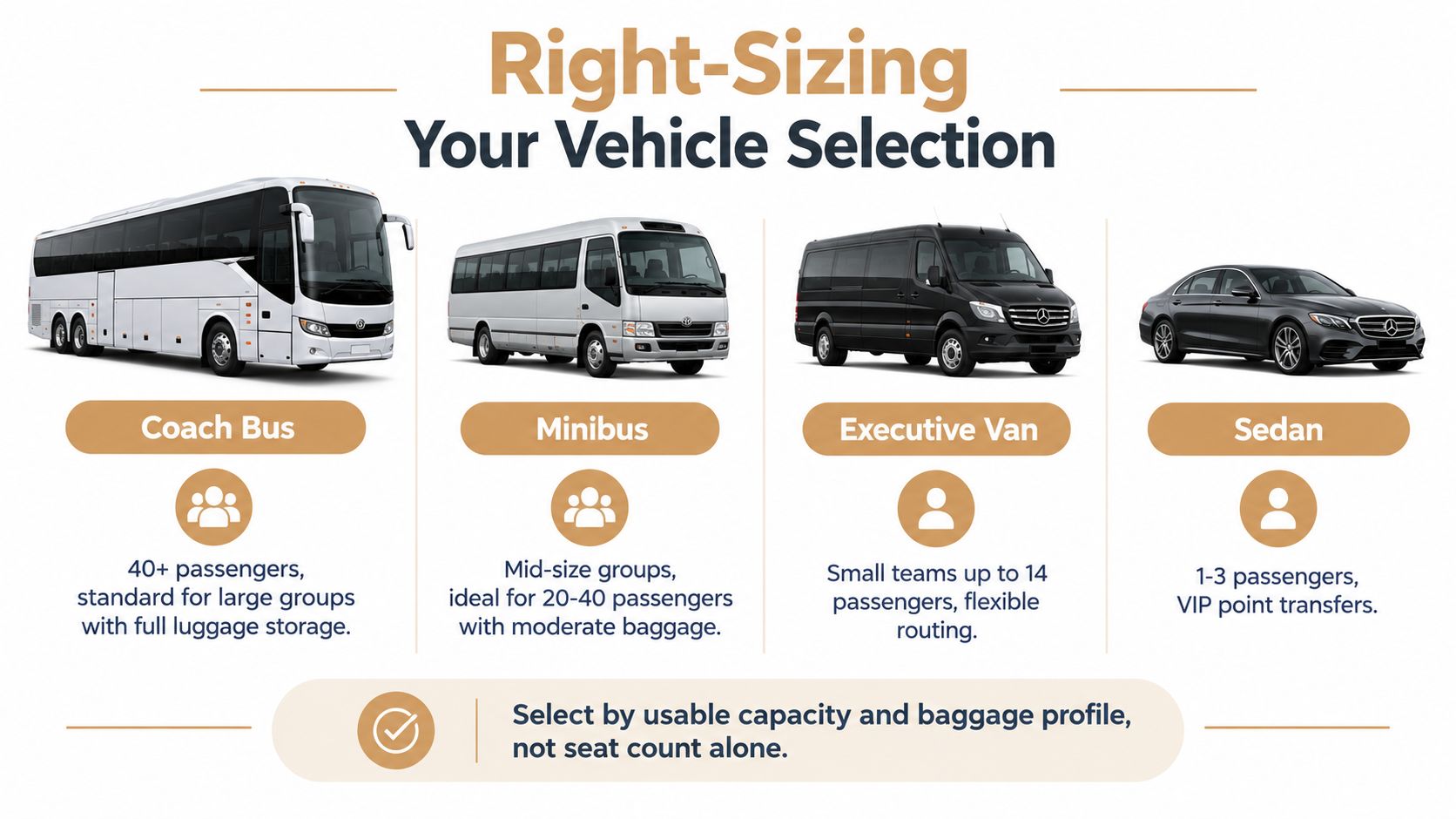
Seat count is only the first filter. Airport transfers often become volume-limited before they become seat-limited, because carry-ons, equipment, strollers, and checked luggage slow boarding and consume usable space. Planning guidance recommends comparing passenger load, total luggage volume, and boarding speed against the vehicle's real operating capacity before selecting the fleet. The same guidance describes large-group airport transfer planning.
Match the vehicle to the movement
| Vehicle type | Best operational fit | Main limitation |
|---|---|---|
| Coach bus | Groups of 40 or more passengers, particularly when luggage storage and consolidated movement matter | It needs suitable road access, staging space, and a workable loading zone |
| Luxury minibus | Groups of 15 to 25 people that need a more flexible movement than a full-size coach | Cargo capacity and boarding flow still need checking against the baggage profile |
| Executive van | Small teams, flexible routing, and short transfers between meetings or venues | It may require multiple vehicles when luggage volume rises |
| Private car fleet | Staggered arrivals, VIP movements, or travelers who need individualized pickups | More vehicles create more dispatch points and can increase curb activity |
The right choice depends on the movement pattern. A coach can simplify a large arrival bank by consolidating travelers, but it performs poorly when the venue has a narrow driveway or when guests arrive at widely separated times. Executive vans can maneuver more easily and support flexible routing, yet several vans may create a longer loading sequence than one properly staged coach.
Protect sensitive movements
Not every passenger should be treated as part of the general flow. Executives, speakers, security-sensitive guests, and travelers with accessibility requirements may need separate vehicles, different pickup points, or additional time. Planners handling confidential itineraries should review secure transportation for sensitive events as part of the risk assessment.
A common mistake is selecting a premium vehicle because it looks appropriate, then discovering that its cargo area cannot handle the group's cases. Ask for usable luggage capacity, loading photographs, access dimensions, and the provider's substitution plan. A smaller vehicle that loads quickly and reaches the curb reliably may outperform a larger vehicle that creates congestion.
Elevating Experience with VIP and Concierge Services
VIP transport starts before the chauffeur opens the door. The guest needs to know where to go, who will meet them, what happens with luggage, and how the itinerary will adapt if the flight or meeting changes. A premium vehicle can't compensate for uncertainty at the terminal.
Design the arrival sequence
Start with a named arrival protocol. Decide who monitors the flight, where the guest receives instructions, which team member confirms identity, and how the chauffeur communicates with the event desk. Meet-and-greet assistance can include terminal guidance, baggage support, and a clear handoff from airport staff to vehicle staff.
The service should reflect the guest's role. A keynote speaker may need a quiet transfer and a direct route to rehearsal. A senior executive may require a private vehicle and a flexible departure time. A larger leadership group may benefit from a dedicated coordinator who keeps multiple cars aligned without forcing the guests to manage the schedule.
Treat amenities as operational choices
Refreshments, cold towels, Wi-Fi, child seats, and preferred music can make a transfer more comfortable, but they need to be confirmed rather than assumed. Beverage preferences may involve dietary restrictions. Wi-Fi may matter because a guest needs to join a call immediately after landing. A child seat must be installed before pickup, not added while the traveler waits at the curb.
For multi-stop programs, an hourly dedicated chauffeur service can provide more control than a series of point-to-point bookings. It keeps the vehicle available while the guest moves between meetings, meals, venues, and airport departures. That flexibility is useful when the itinerary is likely to change, but it shouldn't be purchased for every traveler. Use it where schedule uncertainty or guest importance justifies the standby arrangement.
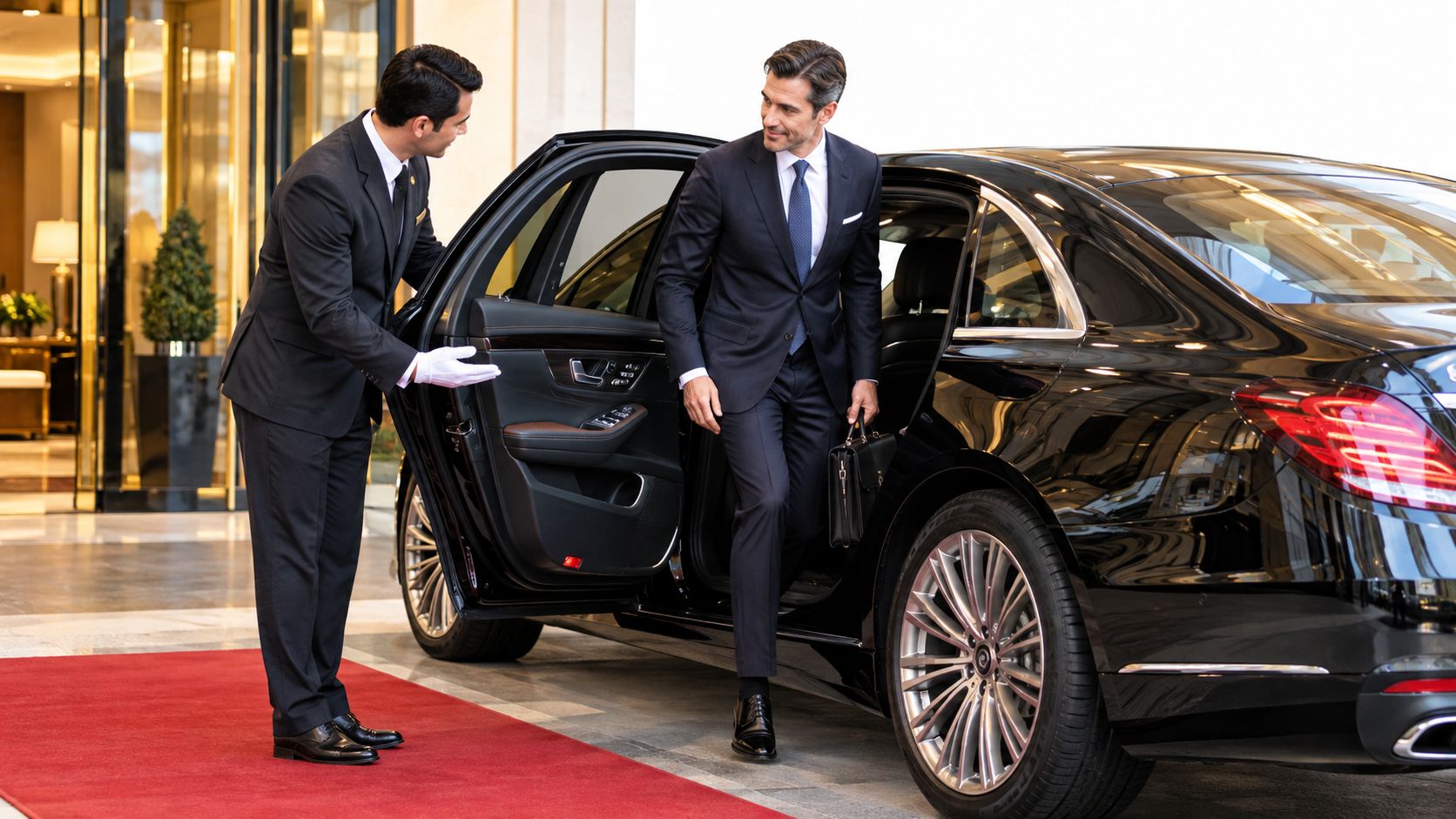
A well-run VIP layer also protects privacy. Keep passenger details limited to the people who need them, avoid announcing names in public pickup areas, and use discreet communication between the event desk and driver. The result should feel calm and personal, not overproduced.
Luxury transportation works when the service design removes decisions from the guest. It fails when the provider adds visible ceremony but leaves the traveler searching for the vehicle.
Navigating Air Transport Operations
Airport movement has two separate problems. The first is finding the traveler. The second is getting the traveler from the terminal to a vehicle through a controlled, often crowded environment. A provider that solves only the first problem hasn't completed the transfer.
At Cancún International Airport, one airport guidance page states that travelers who pre-book can be met outside the terminal, while travelers without a reservation may face a 30 to 40 minute wait for off-airport transportation. The same guidance says providers monitor flight changes, so passengers don't need to separately notify them when a flight is delayed or arrives early. Those details are covered in the Cancun Airport arrival instructions.
Build a flight-aware dispatch process
Give the transport desk the flight number, terminal, passenger name, vehicle assignment, and destination before arrival day. The dispatcher should monitor the flight, adjust the staging time, and keep the chauffeur informed. The guest should receive concise pickup instructions that explain where to go and what identifying information to look for.
For a corporate group, separate the manifest into arrival banks rather than sending one large list to every driver. That makes it easier to match a delayed executive with a vehicle that has remained available, while keeping other vehicles moving according to plan.
The physical pickup method matters as much as the software. A documented point-to-point transfer process should specify terminal exit, meeting location, baggage assistance, vehicle position, and escalation contact. For private aviation, a Universal Aviation arrival guide describes drivers waiting in front of the ASUR FBO entrance while staff escort passengers from the lobby entrance to the vehicle. That controlled handoff is explained in the Cancun FBO arrival and departure guide.
The operational lesson is simple. Flight tracking reduces uncertainty, but a precise meeting protocol converts that information into a successful pickup.
Building a Policy for Disruption Management
A booking confirmation is not a transportation policy. It tells you what should happen under normal conditions. Corporate event transportation services need a second document that defines what happens when a flight is delayed, a vehicle is unavailable, a passenger doesn't appear, or the venue closes its loading lane.
Industry coverage identifies approved providers, reimbursement rules, duty of care, cost containment, cancellation rules, and explicit disruption handling as core parts of a strong group-ground policy. The ground transportation policy discussion is useful because it treats transport as an operational and risk-management issue rather than a simple procurement category.
Write the exception rules before the event
Your policy should answer practical questions in plain language:
- Provider approval: Which companies may dispatch vehicles, and who can approve a replacement?
- Duty of care: What information does the transport desk retain, and how does it account for passengers during a disruption?
- Flight disruption: Who monitors changes, how are vehicles reassigned, and when does the team contact the traveler?
- Venue restriction: What happens if the planned curb is blocked or the driver can't access the loading area?
- Cancellation and no-show handling: Which movements can be released, and who records the decision?
- Reimbursement: When may an attendee arrange an alternative ride, and what documentation is required?
The policy also needs an escalation tree. A driver shouldn't have to negotiate with a venue manager while an executive waits in a terminal. Give the dispatcher authority to move the vehicle, split a load, or call a contingency provider within defined limits.
Balance consolidation with flexibility
Shuttles can simplify a group program, but consolidation isn't automatically efficient. The National Limousine Association reports that 63% of travel managers view shuttle or van service as more cost-effective than individual transport for group and project travel, while also describing demand connected to in-person meetings and sustainability goals in its event transportation coverage. That supports consolidation when arrivals align and the venue can handle the flow.
It doesn't justify putting every traveler on one schedule. Mixed arrivals, VIP privacy, accessibility requirements, and uncertain flight times may favor executive cars or a hybrid model. Use shuttles for predictable shared movements, then reserve private vehicles for exceptions that genuinely need flexibility.
A resilient transport plan doesn't eliminate disruption. It gives every likely disruption an owner, a decision rule, and a communication path.
Audit the plan after the event. Record where passengers waited, which vehicles loaded slowly, how often the manifest changed, and whether the venue access assumptions were correct. Those observations are more valuable than a generic satisfaction score because they improve the next movement plan.
Unique Private Transportation offers private Cancun airport transfers, point-to-point travel, dedicated chauffeur service, luxury tours, and coordinated corporate and event ground transport with live flight monitoring and concierge support. Review Unique Private Transportation to discuss a vehicle plan built around your peak movement window, passenger profile, airport operations, and disruption requirements.