
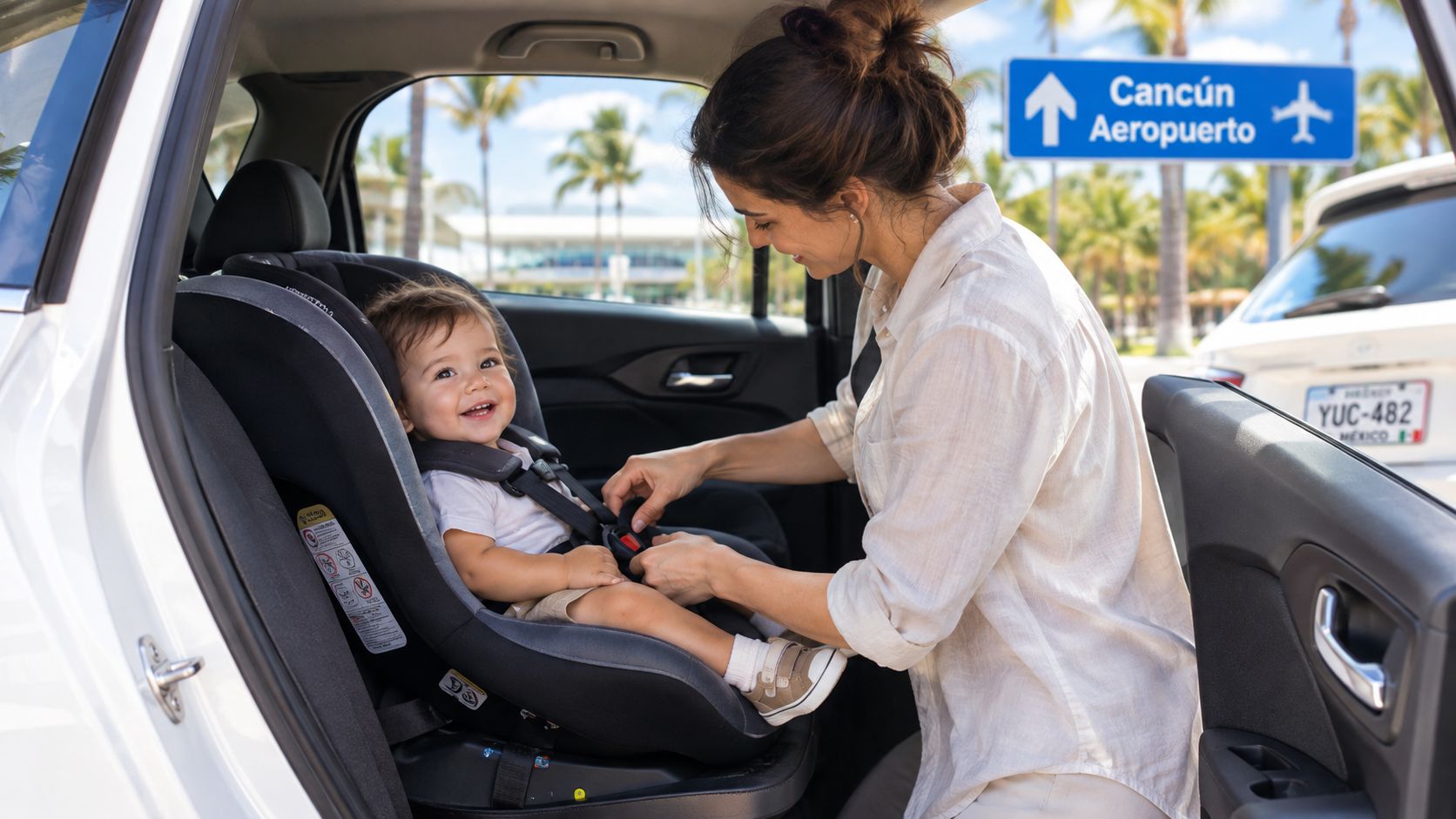
You've just landed at Cancun Airport with a sleepy toddler, a stroller, two bags that don't fit together, and a driver waiting at the curb. The seat in the vehicle looks fine at first glance, but you still don't know if it's the right size, the right type, or even the right way to install it. That's the exact moment where car seat laws in Mexico stop being a travel footnote and become the thing that decides whether your family ride is legal, comfortable, and safe.
Mexico did not always have one clear national answer for families. The big shift came with the 2022 General Law on Mobility and Road Safety, which brought child restraint systems into a broader federal road-safety framework aligned with World Health Organization best practices, alongside seat belts, helmet use, drink-driving controls, and speed management. Before that, enforcement was patchy and state rules often carried more practical weight than federal messaging. For parents, the takeaway is simple, child restraint use is not an optional add-on, it's part of the legal and safety baseline when you're moving a child by car in Mexico. The earlier reality also explains why this topic matters so much, a study of three Mexican cities found child restraint use among children under 5 ranged only from 7.9% to 17.4% (Advocacy Incubator).
That gap between law and real life matters most when you're tired, traveling, and relying on someone else's vehicle. A rental car, a hotel shuttle, a taxi, or a booked Cancun airport transportation service all create the same question, can your child ride in a properly fitted restraint right now, without improvising? The answer should be yes before you leave the airport curb, not after you're already on the road.
Table of Contents
- Why Car Seat Laws in Mexico Matter for Traveling Families
- The National Rule on Age, Height, and Seating Position
- How State and City Rules Build on Federal Law
- The Enforcement Gap Families Should Expect on the Ground
- Choosing the Right Seat for Your Child and Trip
- Booking a Cancun Airport Transfer With a Car Seat
- A Pre-Trip Checklist for Confident Family Travel
Why Car Seat Laws in Mexico Matter for Traveling Families
A family can land in Cancún with good intentions and still get the child seat decision wrong before the ride begins. A parent may have luggage in one hand, a sleepy child in the other, and a driver asking for a quick departure. Mexican child seat rules matter because that rushed handoff is exactly where safety and compliance can slip.
Safety is the reason the law exists
Mexico's 2022 mobility law folded child restraints into a national road-safety framework, alongside the wider rules that govern how people travel on the road. The reason is straightforward. Children do not fit adult seat belts the same way adults do, especially during hard braking or a crash. A belt that sits too high on the abdomen or too close to the neck can increase injury risk, which is why the law focuses on proper restraint use, not just the presence of a seat (MH Noticias).
For traveling families, that changes how the whole trip gets planned. The core question is whether the child, the seat, and the vehicle work together for the ride ahead. A hotel transfer, a rental van, a cancun car service, or a longer drive toward the Riviera Maya all need the same check.
Practical rule: if the belt fit is wrong, the trip is not compliant just because a child is seated.
Earlier research from Mexican cities shows how often families have had to rely on poor protection instead of proper restraint use (Advocacy Incubator). That matters for parents arriving tired, unfamiliar with local traffic, and trying to make a quick choice at the airport.
A better approach treats the car seat as part of the booking itself. That applies whether you are arranging private transportation Cancun airport options or planning to collect a rental car after landing.
The National Rule on Age, Height, and Seating Position
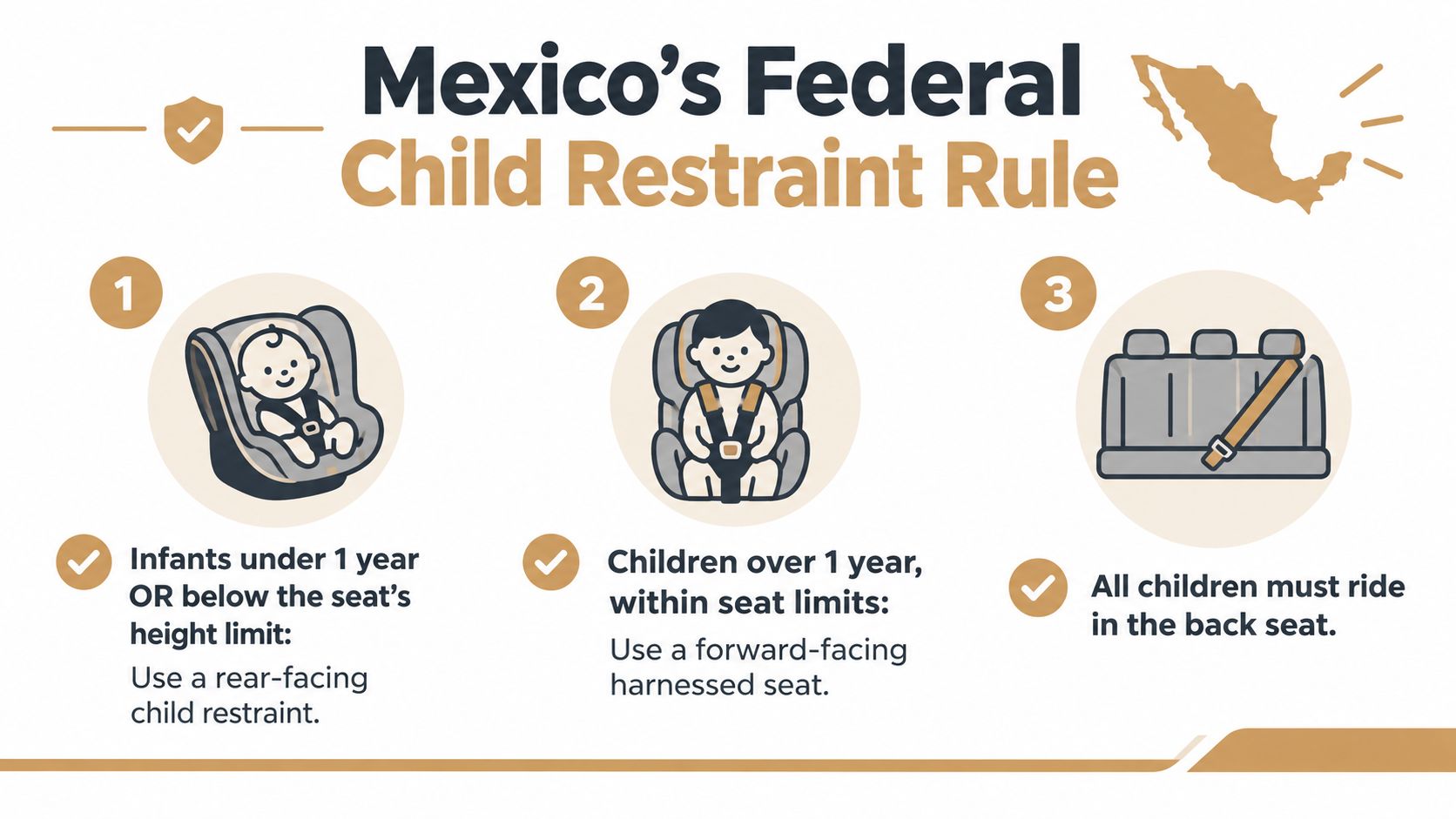
A child can be old enough for an adult belt and still not fit it safely. Mexico's federal rule treats that fit problem as the point of the law. Children must use a Child Restraint System until age 12 or 1.45 meters tall, and they must ride in the rear seats, as summarized by MH Noticias. The idea is simple, the seat belt should rest where it belongs, not high on the stomach or across the neck.
How that translates into real seating decisions
For an infant, rear-facing placement gives the head, neck, and spine better support in a crash. For a toddler, the next step is usually a forward-facing harnessed seat, as long as the child still fits the seat's height and weight limits. For an older child, the question becomes whether a booster is still needed so the belt lies correctly across the hips and shoulder.
Parents often get tripped up here. A child may seem ready for a belt because of age, but body size tells a different story. The law works like a fit check, not a birthday check.
That is why families should look at three things together, the child's measured height, the seat's label, and the position in the vehicle. If those three do not line up, the ride is not set up properly. The same logic matters whether you are heading from Cancun Airport to a hotel zone or taking a longer transfer along the coast.
If you want a quick reference for the broader paperwork side of road travel, World Driving Permit requirements for Mexico can help you separate document planning from child-restraint planning. The two are related, but they answer different questions.
Rule of thumb: the back seat is the default, the restraint type follows the child's size, and the adult belt only takes over when it fits correctly.
For families booking luxury transportation or a standard transfer, the vehicle description is only part of the story. A “child-friendly” ride works only when the installed restraint matches the child who will use it.
How State and City Rules Build on Federal Law
Mexico's federal rule gives families the baseline, but road checks happen under state and city traffic codes. That matters because a parent landing at Cancun Airport is not dealing with an abstract national rule. They are dealing with the local officer, the driver, and the vehicle that shows up.
Jalisco is a useful example. Its traffic code required children 12 and under to ride in the back seat and in a child restraint system, with infants 12 months old or under 13 kilograms riding rear-facing in the back seat, and booster use for children about 4 to 6 years old (GRS Pro Road Safety). That local history shows how child-seat rules were enforced regionally before the national law caught up.
What families should expect by region
Mexico City and Jalisco have long been more visible for enforcement and public messaging. Quintana Roo feels more travel-facing because of airport arrivals and resort traffic. Nuevo Leon often feels urban and checkpoint-oriented around Monterrey. Families should expect the same law to be handled with different levels of attention.
| State or City | Enforcement Intensity | Typical Fine Range (MXN) | Traveler Impact |
|---|---|---|---|
| Mexico City | Higher visibility | No fixed national fine, check municipal code before travel | Families should expect closer attention to child restraint use |
| Jalisco | Stronger roadside attention | No fixed national fine, check municipal code before travel | Highway travel with children needs careful seat planning |
| Quintana Roo | Tourism-focused | No fixed national fine, check municipal code before travel | Airport and resort transfers should be booked with restraint details in writing |
| Nuevo Leon | Urban checkpoint style | No fixed national fine, check municipal code before travel | City driving may bring more direct scrutiny of seating compliance |
Older state rules also help explain why travel guides often mention children under 12 or under about 135 cm in restraint planning. That wording is common in guidance, even when the legal text is broader. The mismatch confuses parents. A child can seem fine by age alone, while a local officer or a driver on a tourist route may still look at actual fit and seating position.
For parents using cancun airport transportation, the key question is simple. Can the booked vehicle meet the local rule without debate when you land? Written confirmation helps because it turns “we should have a seat” into a clear plan for the ride.
The Enforcement Gap Families Should Expect on the Ground
The gap between written law and road reality is the part most parents miss. English-language guides often say children under 12 or under 1.45 m should use an approved restraint and ride in the back seat, but field evidence on the Mexico, U.S. border found that 80% of inspected children were still inappropriately restrained (Johns Hopkins Bloomberg School of Public Health PDF). The rule is there, yet compliance on the ground can be uneven.
A useful habit is to confirm three things before the car arrives, the seat type, who installs it, and whether it is already in the vehicle. At Cancun Airport, that matters because a driver may say yes in advance, then arrive with a seat that does not match your child's size or your booking note. Parents should treat the restraint as part of the booking, not as a favor added at the curb.
Why that matters more at airports and checkpoints
Families cannot control whether every driver they meet understands child restraint rules the same way. A toll plaza, a hotel pickup, a random taxi, or a cross-city transfer may all involve different levels of attention to the law. The result is that parents need to treat the child seat as their own responsibility, even when the vehicle is someone else's.
A seat arranged in advance is safer than a seat hoped for at the curb.
The border evidence also explains why a polite promise is not enough. A driver may agree in English, nod at the terminal, and still not have the right anchor points, seat size, or installation knowledge once luggage is loaded. If you are landing late and everyone is tired, that is not the moment to solve the child-seat question from scratch.
Quintana Roo, Mexico City, and Nuevo Leon may feel more visible to drivers than quieter states, but no region guarantees that the vehicle arriving for you will be prepared in the way your child needs. A written transfer note helps because it tells the operator what was booked, for which child, and for which vehicle.
| State | Checkpoint Density | Citation Frequency | Average Fine (MXN) |
|---|---|---|---|
| Quintana Roo | Variable around airport and resort corridors | Inconsistent | Not fixed in the verified data |
| Mexico City | High visibility in urban traffic | Inconsistent | Not fixed in the verified data |
| Nuevo Leon | Frequent in urban and highway corridors | Inconsistent | Not fixed in the verified data |
Unique private transportation can help in a practical sense. The value is not a promise of perfect enforcement, it is knowing the vehicle and seat have been arranged before you reach the arrivals curb. When the transfer tracks the flight and prepares the car in advance, the child-seat question is settled before the ride starts.
Choosing the Right Seat for Your Child and Trip
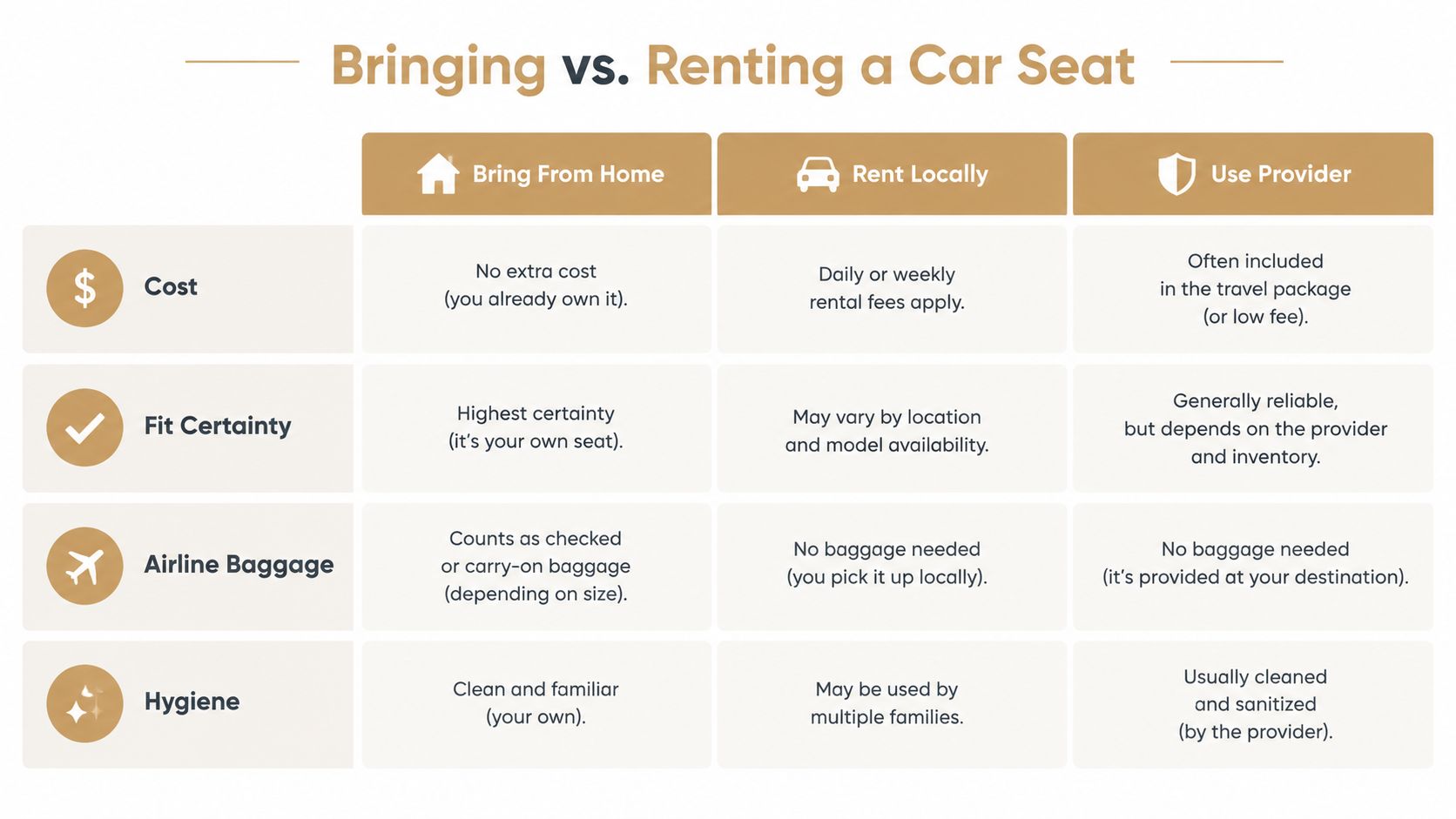
A lot of parents feel stuck between three choices, bring a seat from home, rent one locally, or rely on the transfer provider. The right answer depends on certainty, convenience, and how much control you want over fit. If the child will be in the seat for a long airport run or several days of regional driving, certainty starts to matter more than price alone.
Bring, rent, or book through the transfer
Bringing your own seat gives you the most control over fit and familiarity. Renting locally reduces baggage hassle, but you depend on the operator's inventory and condition. Booking through a provider can work well when the seat is reserved in writing and the driver is trained to install it correctly. For a family using luxury transportation, that last point is often the difference between a polished ride and a stressful one.
If you're also comparing seat design, it helps to read a consumer guide like choosing a car seat for your baby before you pack. That kind of prep is useful because not every “baby seat” is right for every child, and not every rental fleet labels seats clearly. A parent who already knows the difference between a rear-facing infant seat, a harnessed toddler seat, and a booster can ask better questions at booking.
Good booking question: “Which seat type is confirmed for my child, and who installs it?”
A simple five-step readiness check helps when you're deciding whether a child can move from booster to seat belt. The child should sit back against the seat, the lap belt should rest low across the hips, the knees should bend naturally at the seat edge, the shoulder belt should cross the chest and shoulder, and the child should stay in position without slouching. If any of those fail, the booster still matters, even if the child looks “big enough.”
For travelers whose plans involve a longer route, a hotel-zone hop, or a custom itinerary, matching the seat choice to the trip matters more than a generic age rule. That's also where a premium cancun car service can be simpler than piecing together last-minute local options.
For families comparing transfer styles, Unique Private Transportation's luxury private transportation overview is one useful way to see how booking structure, route planning, and family needs can line up before arrival.
Booking a Cancun Airport Transfer With a Car Seat
The easiest time to secure the right child seat is before your flight, not when you're standing in the arrivals hall. Cancun Airport's official transportation page says ADO bus service runs from the airport to Cancun, Playa del Carmen, Tulum, and Merida, and that buses stop at all airport terminals and operate daily (Cancun Airport transportation). That's useful for general movement, but it doesn't solve child-seat fit. Families who need a restraint should book a vehicle that confirms the seat in writing.
What to ask before you pay
Start with the child's category, infant, toddler, or booster. Then ask the operator to confirm the exact seat type, the installation method, and whether the seat will be ready in the vehicle at pickup. If you're using private transportation Cancun airport, ask for the seat brand or model, the vehicle type, and whether the driver or a trained staff member installs it before you enter the car.
The airport's taxi and car-service page says travelers can book online in advance with authorized transportation companies, and that this can offer discounts of up to 60% off regular rates while emphasizing licensed, bilingual service (Cancun Airport taxi page). That's helpful for planning, but the child-seat question still needs specific confirmation. If the reservation page doesn't mention the restraint, screenshot the booking note and keep the confirmation email with the seat request visible.
Most meet-and-greet services track delayed flights, which is important if you're landing late or with small children. A driver who waits inside the terminal with a named sign can reassign the pickup more cleanly than a random curbside exchange, and that reduces the chance of arriving to a vehicle without the seat you asked for. For a family with jet lag and luggage, that kind of coordination is often the difference between a calm exit and a scramble.
The provider should answer three questions clearly:
- Which seat is reserved? Infant, toddler harness, or booster.
- How is it installed? Ask whether it uses the vehicle's anchor points and who does the installation.
- What happens if it's unavailable? You want a fallback vehicle, not a vague apology.
If the arriving vehicle doesn't have the requested restraint, don't treat the ride as settled. Ask for a replacement vehicle or wait for the correct one. A family transfer is only useful when the seat is there before the door closes.
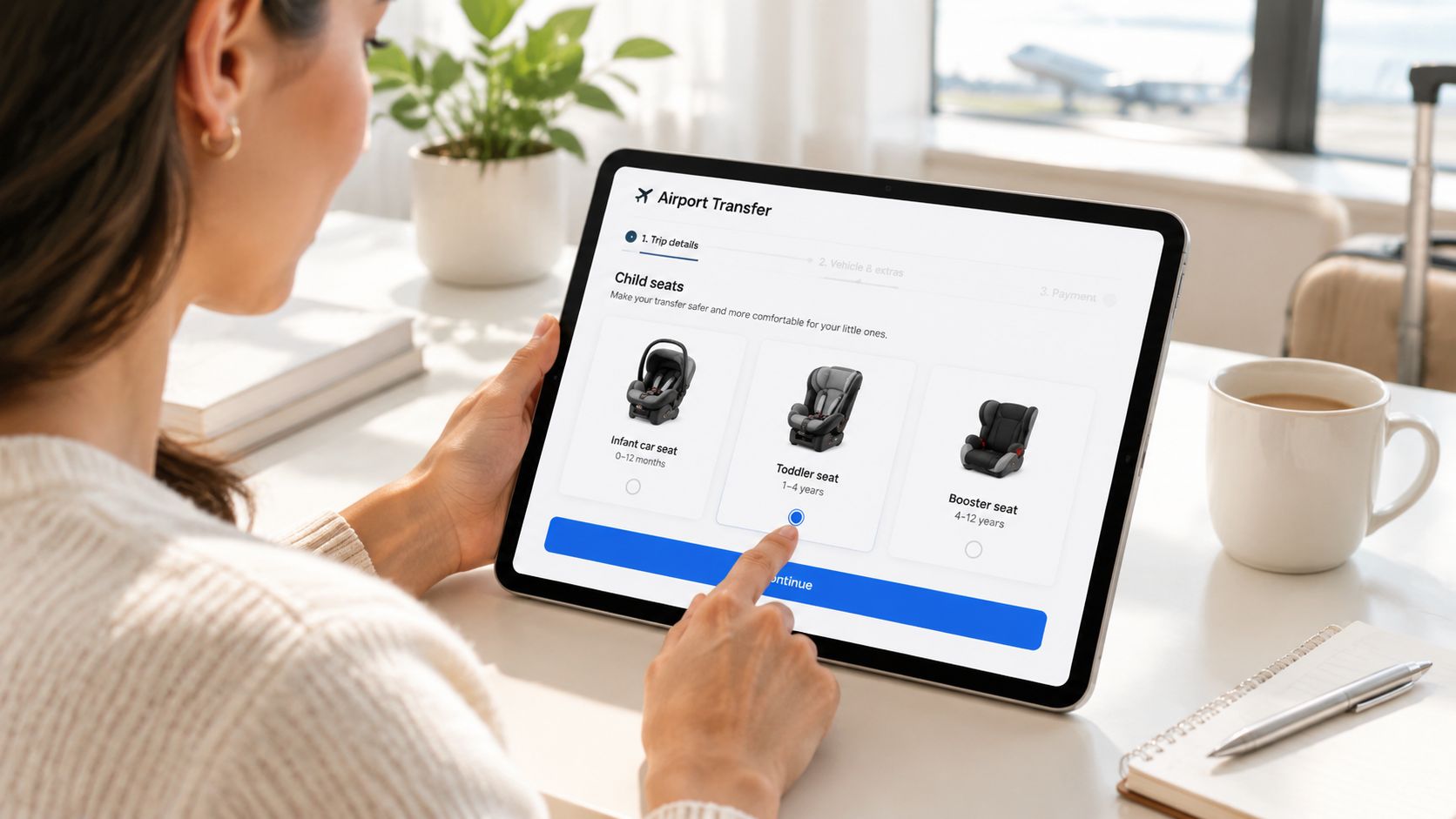
For parents comparing transfer styles and booking terms, what point-to-point transportation means helps explain why a direct airport-to-hotel or airport-to-home ride can be easier to control when a child seat is part of the reservation.
A Pre-Trip Checklist for Confident Family Travel
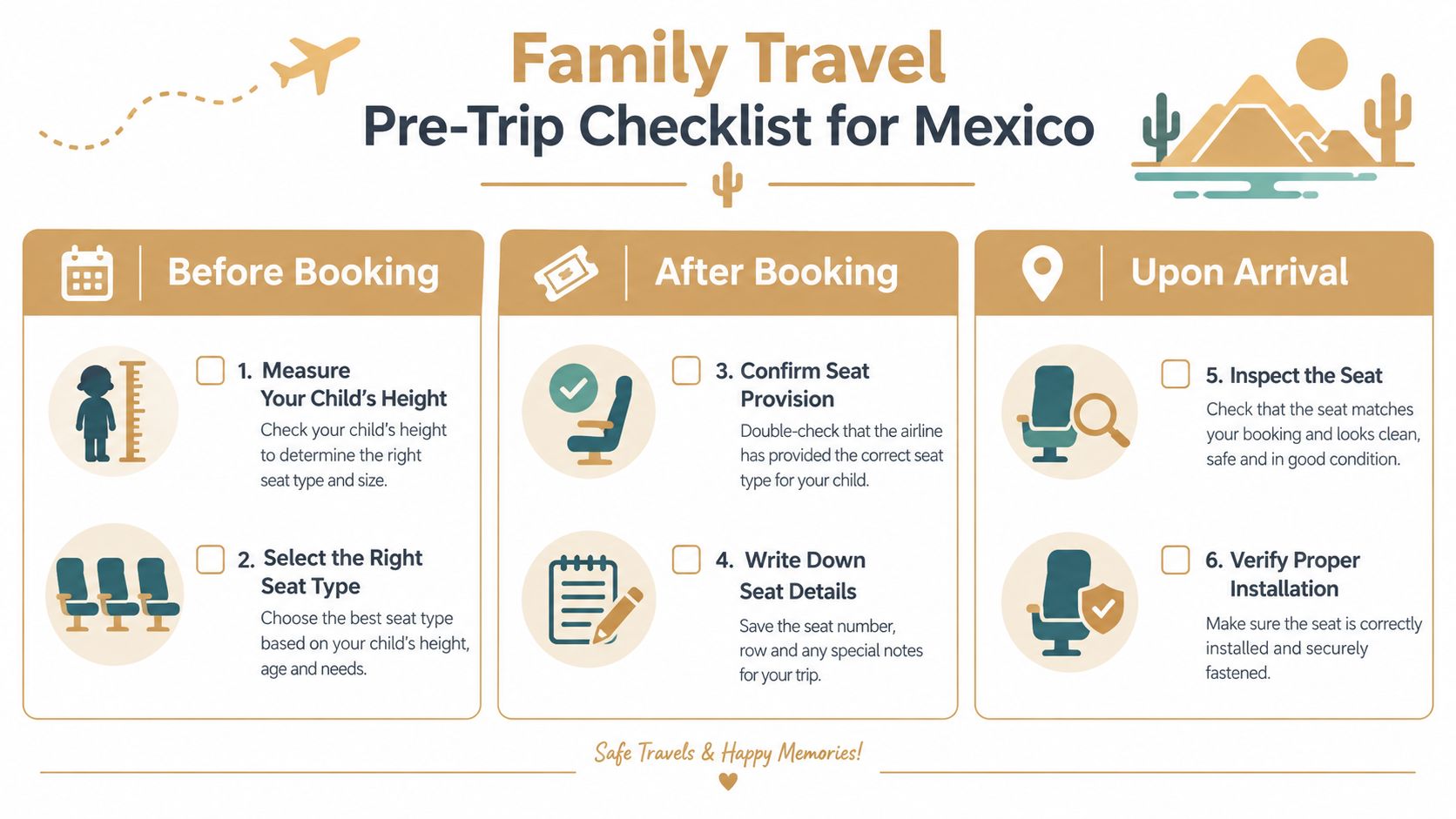
A calm family arrival starts before the flight, while you still have time to fix a missing seat or a bad booking. Treat the child restraint as part of the trip plan, the same way you would passports or hotel check-in. That mindset helps because Mexican rules set the standard, but Cancun Airport is where you find out whether the reserved vehicle matches the promise.
Before booking
- Measure the child first. Use height as your main planning marker, then compare it with the usual 1.45 m threshold used in road-safety summaries of the law.
- Choose the seat strategy early. Bring your own seat, rent locally, or reserve a transfer that confirms the restraint in advance.
- Match the choice to the trip. A short hotel ride, a long airport transfer, and a day trip outside the city do not call for the same setup.
After booking
- Request the seat in writing. Keep the email or message that names the child seat type.
- Ask how it will be installed. Confirm who fits it and how it is secured in the vehicle.
- Check flight monitoring. If your plane is delayed, a driver who tracks arrivals can adjust the pickup without confusion.
- Save the booking details. Keep the driver name, reference number, and pickup notes easy to reach on your phone.
If you are comparing transfer options, the services page for family airport rides can help you see how a child seat request fits into a direct booking. For parents juggling snacks, documents, and backup clothes, a practical bag guide for moms also makes it easier to keep the right papers close at hand.
Upon arrival
- Check the seat before you get in. Look for the right category and make sure the shell looks clean and intact.
- Check the fit points. The harness or belt path should match your child's size.
- Photograph the plate and driver ID. If you need to confirm the booking later, that record helps.
- Keep documents within reach. If someone asks about the child's restraint, you should not have to dig through luggage.
The best habit is simple, ask for proof before you board. That applies at Cancun Airport, on the road to Playa del Carmen, and anywhere else a child seat depends on the vehicle arriving exactly as promised.