

You've just landed in Cancún after a long international flight. Your phone is searching for a signal, your bags are somewhere beyond immigration, and several people outside the terminal are asking whether you need a taxi. You don't yet know which door, terminal, or meeting point applies to your reservation. That moment is precisely where a professional airport meet and greet service earns its place.
The right Cancun airport transportation service does more than send a vehicle to the curb. It coordinates the arrival, monitors the flight, explains the meeting point, helps bridge the terminal-to-vehicle gap, and gives you a clear escalation path if something changes. The difference between a smooth arrival and a frustrating one usually comes down to those operational details.
Table of Contents
- What Airport Meet and Greet Services Actually Do
- How the Service Works From Booking to Curbside
- Standard Inclusions and Optional Add-Ons
- Why Time Savings and Bilingual Support Matter
- Who Benefits Most From This Service
- How to Choose a Reputable Cancun Provider
- Planning for Infants, Accessibility, and Special Needs
What Airport Meet and Greet Services Actually Do
A tired traveler exits the arrivals area at Cancún International Airport with two suitcases, a stroller, and no reliable mobile connection. A standard taxi or rideshare arrangement leaves that traveler responsible for finding the correct pickup area, identifying the vehicle, and negotiating the next step. A proper meet and greet service assigns responsibility to the provider.
Airport meet & greet services begin before landing. The provider checks the reservation, confirms the arrival terminal and destination, watches the flight status, and sends instructions that identify where the representative will wait. After immigration and baggage claim, the representative meets the traveler at the agreed location, confirms the booking, helps with luggage, and guides the group toward the vehicle.
That process matters at Cancún because ordinary taxis aren't permitted to collect passengers curbside. The airport states that arriving passengers should use authorized transportation companies and arrange transportation in advance through Cancún International Airport's transportation guidance. The airport also warns travelers to ignore transportation solicitors outside the arrival terminals and confirm both the fare and confirmation number before traveling, as explained in its official taxi information.
The handoff is the product
A vehicle can be clean and comfortable, yet the arrival can still fail if the traveler can't find the driver. The service has to answer four practical questions:
- Where do I go? The message should name the terminal, level, door, and recognizable landmark.
- Who am I looking for? The representative should have a clear identification method and booking details.
- What happens if I'm delayed? Dispatch should rely on updated flight information, not only the original schedule.
- Who helps if I'm lost? The provider should offer a working telephone or messaging channel in English and Spanish.
That's why a private transfer differs from a curbside taxi. It's a planned terminal-to-vehicle handoff, not a car waiting somewhere outside.
How the Service Works From Booking to Curbside
A dependable arrival follows a defined sequence. You shouldn't need to improvise after landing.
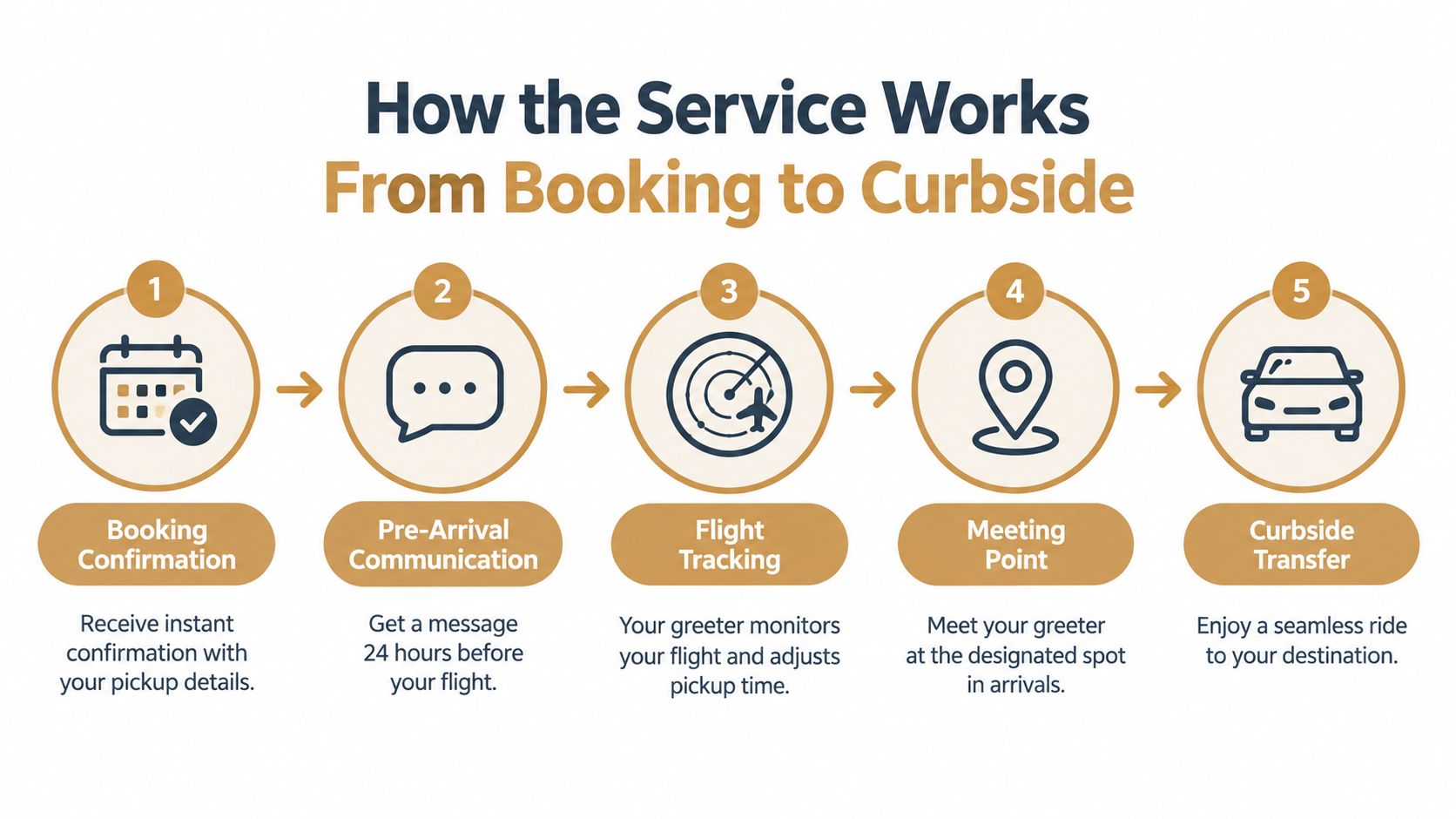
Five practical stages
Booking confirmation: You receive the pickup date, flight number, destination, passenger details, vehicle category, contact information, and meeting instructions. Check that your name and flight number match the airline record.
Pre-arrival communication: The provider confirms the plan before departure. This is the right time to report oversized luggage, an infant, a wheelchair, a service animal, a stroller, or a terminal connection.
Flight monitoring: Dispatch watches scheduled, estimated, and actual arrival times. Airlines experience delays that can spread through aircraft rotations, crew assignments, passenger connections, and airport congestion. Research on delay propagation identifies passenger and crew connectivity as important mechanisms, so the published arrival time shouldn't control the dispatch plan by itself. Research on airline delay propagation supports using live updates instead.
Meeting inside arrivals: After immigration and baggage claim, follow the terminal-specific instruction. The representative should identify you by name or booking reference and remain available through an agreed bilingual escalation channel.
Transfer to the vehicle: The representative helps organize luggage and guides you to the vehicle pickup area. If the vehicle is assigned to another terminal, Cancún Airport provides a free shuttle between terminals, so the plan should account for that movement rather than leaving you to solve it alone. Cancún Airport's transportation information also distinguishes private service from shared shuttles and ADO bus connections.
| Stage | What Happens | Traveler Action |
|---|---|---|
| Booking | The provider records the flight, destination, passengers, and vehicle needs | Submit accurate details |
| Confirmation | You receive meeting and contact instructions | Save the confirmation offline |
| Monitoring | Dispatch updates the pickup plan when the flight changes | Keep your phone available |
| Arrival | The representative meets you after the required airport procedures | Follow the stated terminal route |
| Handoff | Luggage moves with you to the assigned vehicle | Confirm your destination before departure |
Labeling your luggage also reduces confusion at baggage claim. For practical advice on choosing and using tags, the InchBug bag tag guide is useful, especially for families traveling with similar-looking suitcases.
If your itinerary includes several scheduled stops after landing, review how a point-to-point transportation service differs from a single airport transfer before booking.
Standard Inclusions and Optional Add-Ons
The phrase “luxury transportation” can hide important differences. One provider's base service may include terminal guidance and water, while another may charge separately for child seats, waiting time, Wi-Fi, or multi-stop travel. Ask for the inclusions in writing.
A typical private airport transfer may include:
- Flight monitoring: Dispatch follows the arrival and adjusts the pickup plan.
- Terminal meet and greet: A representative or chauffeur meets you at the agreed location.
- Luggage assistance: The team helps coordinate bags between baggage claim and the vehicle.
- Refreshments: Bottled water or other basic refreshments may be available.
- Comfort details: Cold towels can be included in a premium service.
- Passenger coverage: Confirm whether passenger insurance is included and what it covers.
- Bilingual support: English and Spanish communication should be available before pickup and during the ride.
Those items still need confirmation. “Included” can mean included for one vehicle class, one passenger group, or only when requested in advance.
Add-ons that need planning
Families should request the correct child-seat type, installation, and stroller capacity instead of asking for "a car seat." Pet-friendly vehicles require advance approval, particularly when a carrier or additional cabin space is involved. Celebratory beverages, welcome amenities, onboard Wi-Fi, preferred music, and snacks are also arrangements, not assumptions.
Hourly chauffeur service and multi-stop bookings are useful for corporate itineraries, wedding schedules, restaurant stops, or a private tour. They're different products from a direct airport ride, so the confirmation should state the service duration, route, waiting expectations, and vehicle category.
For groups, water and standard luggage assistance may be routine. Baby seats, pets, medical equipment, special accessibility arrangements, and unusual luggage generally require advance notice. A responsible provider will ask about those needs before dispatch, not discover them at the terminal.
Why Time Savings and Bilingual Support Matter
Airport curbside congestion isn't an abstract problem. A 2024 National Academies report found that private vehicles recirculated through the arrivals curb at 50% at Baltimore/Washington International Thurgood Marshall Airport, 43% at San Francisco International Airport, 30% at Seattle-Tacoma International Airport, 26% at Dallas Love Field, and 15% at Ronald Reagan Washington National Airport. The National Academies report on airport curbside operations connects this behavior with drivers circling or waiting because passengers aren't ready.
The lesson for Cancun airport transportation is straightforward. The chauffeur shouldn't sit at the terminal indefinitely, and the passenger shouldn't walk outside hoping to recognize a vehicle. Flight monitoring, baggage-claim timing, clear contact instructions, and a controlled approach to the pickup area reduce the uncertainty on both sides.
Cancún is also one of Mexico's principal international arrival gateways. Mexico's Tourism Secretariat reported that during January through April 2025, Cancún was among the airports receiving the highest numbers of foreign passengers, and the listed leading airports together represented 91.9% of total foreign passenger arrivals by nationality. The January through April 2025 tourism report.pdf) helps explain why bilingual coordination matters here.
English and Spanish support should cover the full journey, not just the sales conversation. It should appear in the confirmation message, the meeting-point instructions, the dispatch desk, and the chauffeur's live communication.
Practical rule: Time savings come from coordination, and coordination fails when the traveler and provider can't communicate clearly.
Hotels evaluating arrival service can also learn from these guest satisfaction tips for hotels, particularly the emphasis on clear expectations and responsive communication.
Who Benefits Most From This Service
Not every traveler needs the same level of help. A solo visitor with a small bag may need only a confirmed pickup and flight tracking. A family, wedding group, or executive delegation needs a more deliberate plan.
| Traveler | Main friction point | Useful addition |
|---|---|---|
| International leisure traveler | Jet lag, unfamiliar terminal, and language uncertainty | Bilingual arrival instructions and luggage assistance |
| Family with infants | Child seats, stroller storage, and multiple bags | Pre-fitted seats and a vehicle with suitable cargo space |
| Wedding planner | Several arrivals across different flights | Centralized confirmations and coordinated vehicles |
| Corporate traveler | A missed pickup can disrupt meetings | Live dispatch, direct support, and point-to-point scheduling |
| Luxury tourist | Regional travel requires comfort and flexibility | Hourly chauffeur service, Wi-Fi, refreshments, or a private tour |
Families need specifics
Parents shouldn't accept “family-friendly” as a complete answer. Confirm the seat type, installation, stroller capacity, luggage space, and whether the vehicle can accommodate a tired child without forcing last-minute rearrangement.
Groups need one operational contact
Wedding planners and event coordinators benefit from one dispatch contact, consistent driver instructions, and a passenger manifest that identifies each arrival. That structure prevents one delayed flight from confusing the rest of the schedule.
Business and luxury travelers need control
A corporate passenger may prefer a direct vehicle with no unnecessary stops. A luxury traveler heading toward Tulum, Chichén Itzá, or Isla Mujeres may need an itinerary that combines airport pickup, waiting time, luggage handling, and several destinations. A standard transfer and a private chauffeur aren't interchangeable.
For travelers comparing vehicle categories, destinations, and booking formats, this overview of Cancun car service options is a useful starting point.
How to Choose a Reputable Cancun Provider
Marketing language is cheap. Verifiable operating details are more valuable.
Start by asking whether the provider can explain its authorization, insurance, and operating credentials, including relevant SCT and SECTUR standards. Then ask what vehicle will arrive, how old the fleet is, how many passengers and bags it can carry, and whether the stated vehicle class is guaranteed or only an example.
Use this screening checklist
- Authorization: The company should explain its operating credentials without evasive language.
- Vehicle clarity: Confirm the actual category, passenger capacity, luggage capacity, and accessibility limitations.
- Bilingual staff: Ask whether English and Spanish support is available during the arrival, not only during booking.
- Written pricing: The confirmation should identify the fare, destination, passenger count, and any additional service conditions.
- Confirmation number: You should receive a reference number before traveling.
- Telephone support: A live or reliably monitored 24/7 contact channel matters when flights change.
- Secure payment: Use a secure online payment process and retain the receipt.
- Relevant reviews: Look for customer comments about Cancún arrivals, terminal handoffs, flight delays, and communication.
Ask the provider to describe the meeting point before departure. If the answer is only “the driver will be outside,” keep looking. The instructions should state the terminal, level, door or landmark, representative identification, and fallback contact.
A reputable provider should also explain what happens after a diversion, terminal change, missed connection, or long immigration delay. Cancún Airport's own guidance says passengers should use authorized transportation and avoid unsolicited offers outside the terminals. That makes pre-arranged private transportation cancun airport service with a written confirmation the safer operational choice.
Review the service details for Unique Private Transportation alongside other providers, then compare the actual inclusions instead of choosing based on the word “luxury” alone.
Planning for Infants, Accessibility, and Special Needs
A private transfer provider and an airline or airport don't perform the same kind of assistance. Airline or airport wheelchair assistance usually must be arranged through the airline, while a private provider coordinates the ground journey after the traveler reaches the agreed meeting point.
That distinction prevents a common failure. Booking a premium SUV doesn't automatically mean the vehicle can accommodate a wheelchair, a passenger who can't transfer from a chair, a medical device, or a large mobility aid. Confirm the vehicle access, transfer requirements, luggage space, stroller storage, child-seat type, service-animal policy, and boarding assistance in writing.
Assistance demand is substantial. Shannon Airport recorded 29,813 passengers with reduced mobility in 2025, representing 1.29% of its passengers, and reported that 95.5% of pre-notified passengers were met within 10 minutes, according to its 2025 accessibility compliance report. The practical conclusion is clear: advance notice gives the airport and the vehicle provider time to prepare.
Confirm these details before departure
- Infants: Seat type, installation, age or size suitability, and stroller capacity.
- Mobility needs: Whether the passenger walks short distances, transfers into a seat, or needs a fully accessible vehicle.
- Hidden disabilities: Quiet waiting arrangements, slower communication, and a designated contact person.
- Medical equipment: Dimensions, storage requirements, and whether it travels in the cabin or luggage compartment.
- Service animals and pets: Vehicle policy, restraint expectations, and cleaning requirements.
- Terminal changes: A revised meeting point and bilingual escalation plan if the arrival terminal changes.
Unique Private Transportation arranges cancun luxury airport transfers, private vehicles, live flight monitoring, bilingual coordination, luggage assistance, baby seats on request, pet-friendly options, and passenger insurance. If your arrival includes an infant, mobility requirement, medical equipment, or unusual luggage, Unique Private Transportation can review the handoff details before you travel so the vehicle and meeting plan match the actual need.