

You're checking the ceremony timeline, your family's flight details, and a photograph of the car you'd like to arrive in. Meanwhile, an airport pickup still says “meeting point to be confirmed.” On a destination-wedding morning, that unresolved detail can leave someone important waiting outside a terminal while everyone at the venue debates whether to delay the ceremony.
That's the risk to solve before choosing ribbons or leather upholstery. A wedding car for hire should come with an operating plan that explains who travels, where they meet, when they move, and who takes charge when something changes.
Table of Contents
- What a Wedding Car Booking Actually Involves
- Choosing the Right Vehicle for Each Wedding Role
- How Wedding Car Pricing Really Works
- Building the Day as a Sequence of Time Windows
- Child Seats and Passenger Safety Standards
- Contracts, Insurance, and What Happens When Things Go Wrong
- Your Pre-Booking Checklist and Final Walkthrough
What a Wedding Car Booking Actually Involves
Consider a planning scenario: relatives arrive on the wedding morning, their airport transfer runs late, and the same vehicle is supposed to collect the wedding party afterward. The delay now affects dressing, photographs, and ceremony arrivals. Nothing has broken down, but the schedule has no room to recover.
My recommendation is simple: don't attach a ceremony-critical journey to an uncertain flight arrival. Treat those movements as separate assignments unless the provider can demonstrate a workable recovery plan.
Map the journeys before requesting cars
A destination booking can include airport arrivals, hotel transfers, rehearsal-dinner travel, ceremony transportation, reception returns, and departures. Write down each journey separately, including the passenger group, luggage, pickup location, destination, and person responsible for confirming attendance.
For a straightforward transfer without intermediate stops, understanding how point-to-point transportation works helps you describe the service accurately. A car that drops you at the venue isn't necessarily reserved to wait through photographs.
For couples assembling their supplier list, Texas Old Town's guide to essential wedding vendors to book is a useful starting point. Assign transportation an owner just as deliberately as you assign catering or photography.
Make airport instructions specific
For Cancun airport transportation, “meet outside arrivals” isn't enough. Cancún International Airport has four separate terminals, and its complimentary inter-terminal shuttle connects terminals rather than taking passengers to hotels, according to the airport's terminal information.
Your arrival instructions should identify:
- The correct terminal: Record the airline and flight details, not just the arrival time.
- The meeting procedure: Explain how passengers recognize their representative and reach the vehicle.
- The final destination: Use the resort's full name and the correct entrance.
- The contact person: Give travelers someone to message if they can't locate the pickup.
Practical rule: Book transportation by journey and responsibility, not by the number of attractive vehicles in a brochure.
International couples, planners managing several hotels, and families carrying child restraints need this level of clarity. Styling comes after the movement plan works.
Choosing the Right Vehicle for Each Wedding Role
Choose the role first, then the vehicle. The couple's arrival car and a guest shuttle solve different problems, even when both fall under luxury transportation.
An executive sedan can suit a couple traveling without bulky luggage. An Escalade-style SUV is worth considering when clothing, easier access, or additional cargo space matters. A Sprinter-style van may suit the wedding party, while a motor coach deserves consideration for a larger guest block.
Those are selection examples, not promises about a particular provider's fleet. Ask for the actual vehicle configuration before approving it.
Right-size for the passengers and their belongings
Don't accept a seating figure without explaining what travels with the passengers. Formalwear, garment bags, strollers, mobility equipment, and airport luggage all affect whether a vehicle is suitable.
Ask the operator to confirm the usable passenger capacity with your actual load. A seat that becomes inaccessible after installing a child restraint isn't a usable place for another guest.
Vehicle Types by Wedding Role
| Vehicle Type | Typical Capacity | Best For |
|---|---|---|
| Executive sedan | Small passenger party, configuration-dependent | Couple's transfer or a discreet family journey |
| Luxury SUV, such as an Escalade | Small group, subject to luggage and restraint layout | Couple's arrival or family airport transfer |
| Sprinter-style passenger van | Wedding-party-sized group, layout-dependent | Bridal party movements and hotel transfers |
| Motor coach | Larger guest block, operator-confirmed | Consolidated guest shuttles between suitable venues |
| Vintage or specialty car | Vehicle-specific, often limited | A carefully scoped ceremonial arrival |
The capacity column is deliberately qualitative. The assigned vehicle's confirmed layout matters more than a generic category maximum.
Match the vehicle to the entrance
Ask the venue manager where passengers can disembark. A resort driveway, a restricted historic street, and a beachfront access point require different decisions.
Confirm turning space, vehicle-height restrictions, approved loading areas, and the walking route from drop-off to ceremony seating. Don't assume a chauffeur can drive onto a beachfront approach just because it appears accessible in photographs.
For guests with limited mobility, request details about step height, handholds, and space for their equipment. Don't substitute “large vehicle” for an accessibility assessment.
Fleet color and condition matter for photographs. Consistent vehicles can also make group identification easier, but visual consistency must never override safe seating or suitable access.
Choose a vehicle people can enter comfortably in their wedding clothes, not merely one that looks impressive with the doors closed.
For a Cancun car service, request photographs of the assigned vehicle's interior and luggage compartment alongside exterior images. That's a more useful approval process than selecting from a mood board.
How Wedding Car Pricing Really Works
A couple books a two-hour transfer and gets invoiced for four. The operator started the clock when the car left the garage, counted a photography wait as billable time, and applied a minimum buried in the confirmation email. That invoice shock is common, and it is preventable.
Zola puts 2024 wedding transportation spend at roughly $700 to $1,200 and notes that some operators impose a three-hour minimum even when the job runs shorter; treat that as planning context, not a Cancún quotation (Zola's wedding transportation guide).
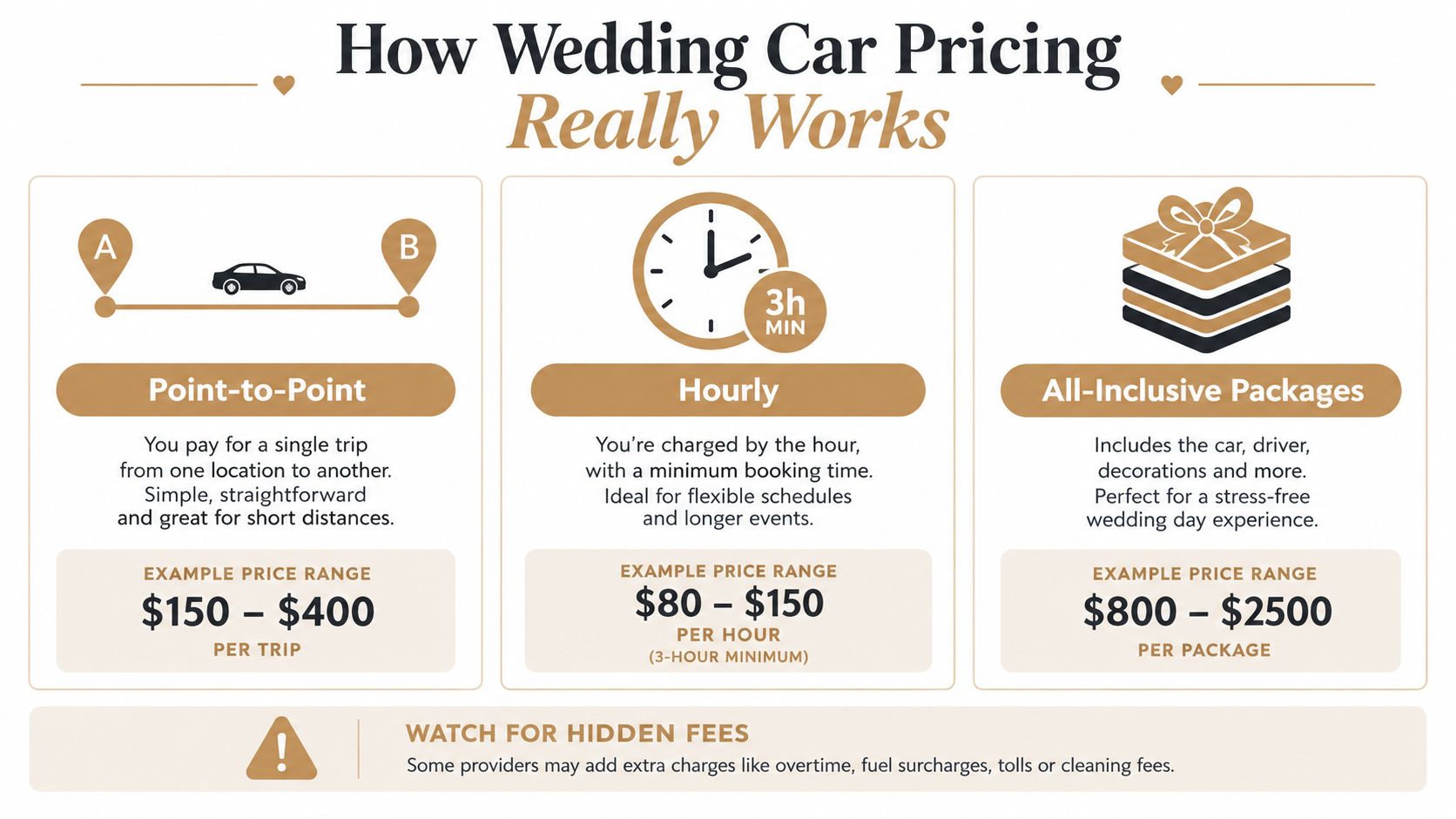
Every quote answers three questions: when billing starts, when it stops, and what counts in between. The graphic above sketches the three structures operators use, and each one hides its costs in a different place.
Point-to-point pricing covers a vehicle that collects, delivers, and finishes. Ask whether positioning miles, hotel access delays, and a photography stop sit inside or outside that figure. The moment you want the car in your portraits, it stops being a transfer and becomes an hourly booking you never agreed to.
Hourly blocks suit sequences like preparation, portraits, and ceremony arrival. Get the reserved-block total in writing, plus the overtime increment and who is authorized to extend it. Photography running long is the single most common reason a four-hour block becomes five.
Packages can simplify several movements, but "all-inclusive" means nothing without a written scope naming the routes, vehicle assignments, driver breaks, and return departures. Compare any package quote against the service details on the luxury transportation rates page before signing.
Send every bidder the same five questions
Copy these into your quote request so each operator prices the same assignment:
- When does the billing clock start: garage departure, arrival at the pickup, or passenger boarding?
- What is the minimum booking duration, and does positioning travel count toward it?
- How is waiting billed, in what increments, and who can authorize an extension on the day?
- Which of these appear on the final invoice: gratuity, service fees, fuel surcharges, holiday premiums?
- What does an extra stop, a later airport collection, or an added pickup window cost?
Providers apply these charges differently, which is exactly why the questions matter. A defined scope is what you are buying, not a starting number. The cheapest per-mile figure loses every time it excludes half the assignment.
Building the Day as a Sequence of Time Windows
At 3:12 p.m., the first shuttle is still idling outside the wrong hotel entrance, the photographer wants five more minutes, and the best man has sent the driver a new pin. That is how a Riviera Maya timeline fails: three small delays landing on the same vehicle.
Start with the venue's required arrival deadline, not the ceremony's advertised start. Your coordinator must allow guests to unload, walk to their seats, and settle before proceedings begin.
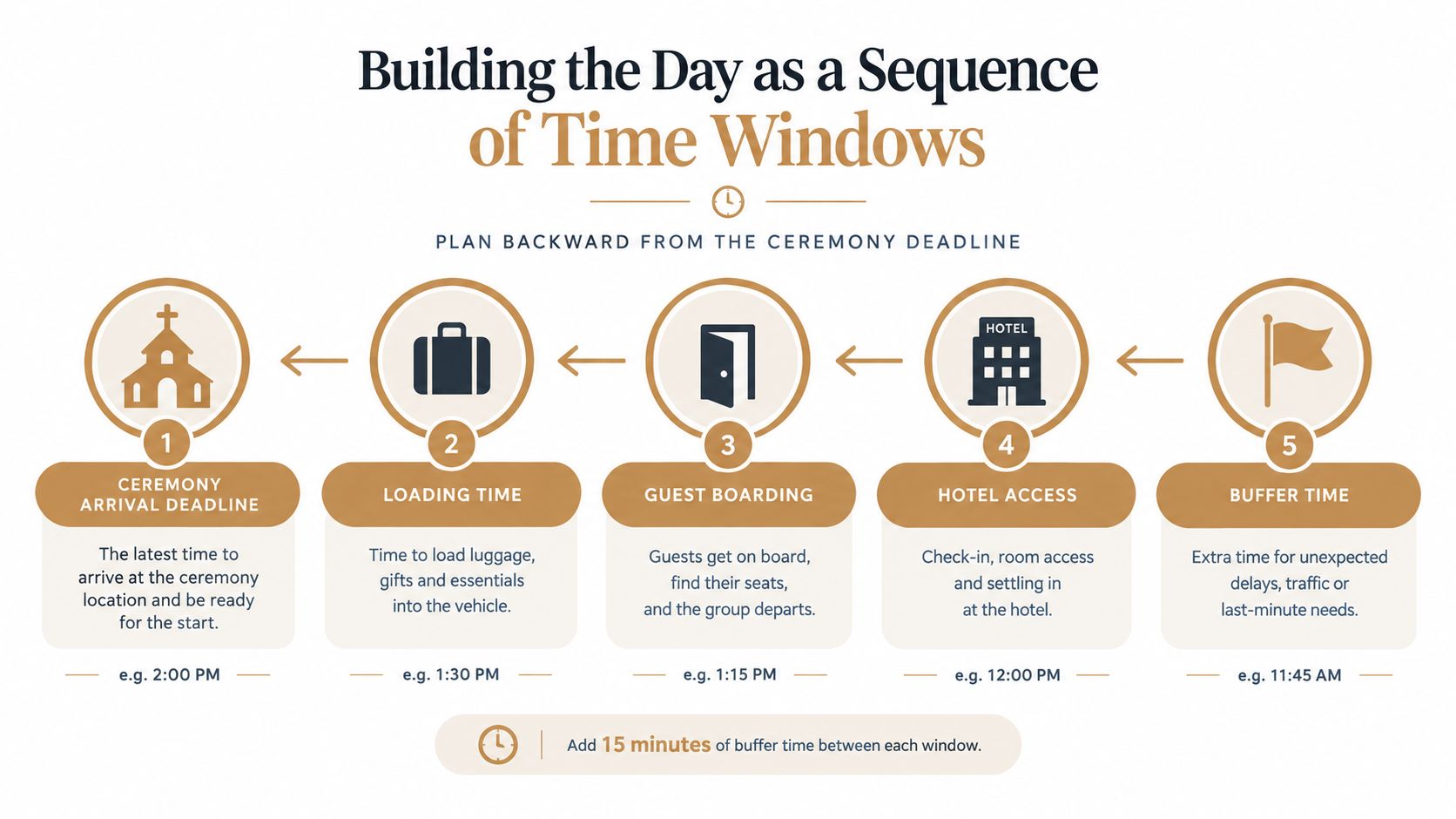
For an illustrative 4:00 p.m. ceremony, make dispatch prove the run backward: beach arrival by 3:30, wedding party departure 3:05, guest boarding closes 2:50, shuttle leaves the resort zone 2:35, airport recovery held outside the rotation. Those are example windows, not a universal script. Ask for calculations using the actual lobby entrance, speed bumps, security gates, loading time, and whether the driver can legally wait where guests expect to find the vehicle.
| Movement | Window to establish | Release condition |
|---|---|---|
| Guest shuttles | Boarding opens, boarding closes, venue arrival | Hotel marshal reconciles the passenger list |
| Wedding party | Collection, photography arrival, ceremony arrival | Photographer and coordinator agree the departure |
| Couple | Private collection and final venue approach | Coordinator confirms the arrival route is ready |
| Late arrivals | Separate recovery movement | Dispatcher confirms the revised assignment |
Get Spliced's stress-free wedding day planning template can organize the wider day; transport needs its own manifest with passenger names, pickup entrance, destination, boarding needs, and the one person allowed to release the vehicle. Freeze that master before dispatch. After the freeze, changes route through the named coordinator, never through guests texting drivers from the beach.
If one vehicle must stay across portraits, ceremony, and the first hour of reception, scope it as dedicated chauffeur service and put the reserved period beside each stop. Standby is a billed window, so treat it as excluded unless the agreement says otherwise.
Judge the operator on the first missed window. A strong dispatch answer names the backup car, the new departure time, and who tells the venue.
Keep uncertain airport arrivals outside ceremony-critical vehicle rotations. For private transportation Cancun airport bookings, arrange terminal-specific collection instructions and a separate plan for passengers whose flights disrupt the original schedule.
Child Seats and Passenger Safety Standards
The riskiest moment for child passengers is the curb at pickup. The vehicle arrives with a seat rated for a different size, the driver improvises the installation, and the departure window starts slipping while a coordinator decides whether to send it anyway. A "baby seat requested" note in the booking resolves none of this.
Correctly used child restraints cut fatal-injury risk by 71% for infants and 54% for toddlers in passenger cars, while restraint misuse is estimated at 46%, per NHTSA's child passenger safety guidance. Counting supplied seats proves nothing. The check that matters is whether each restraint matches the child and is installed correctly.
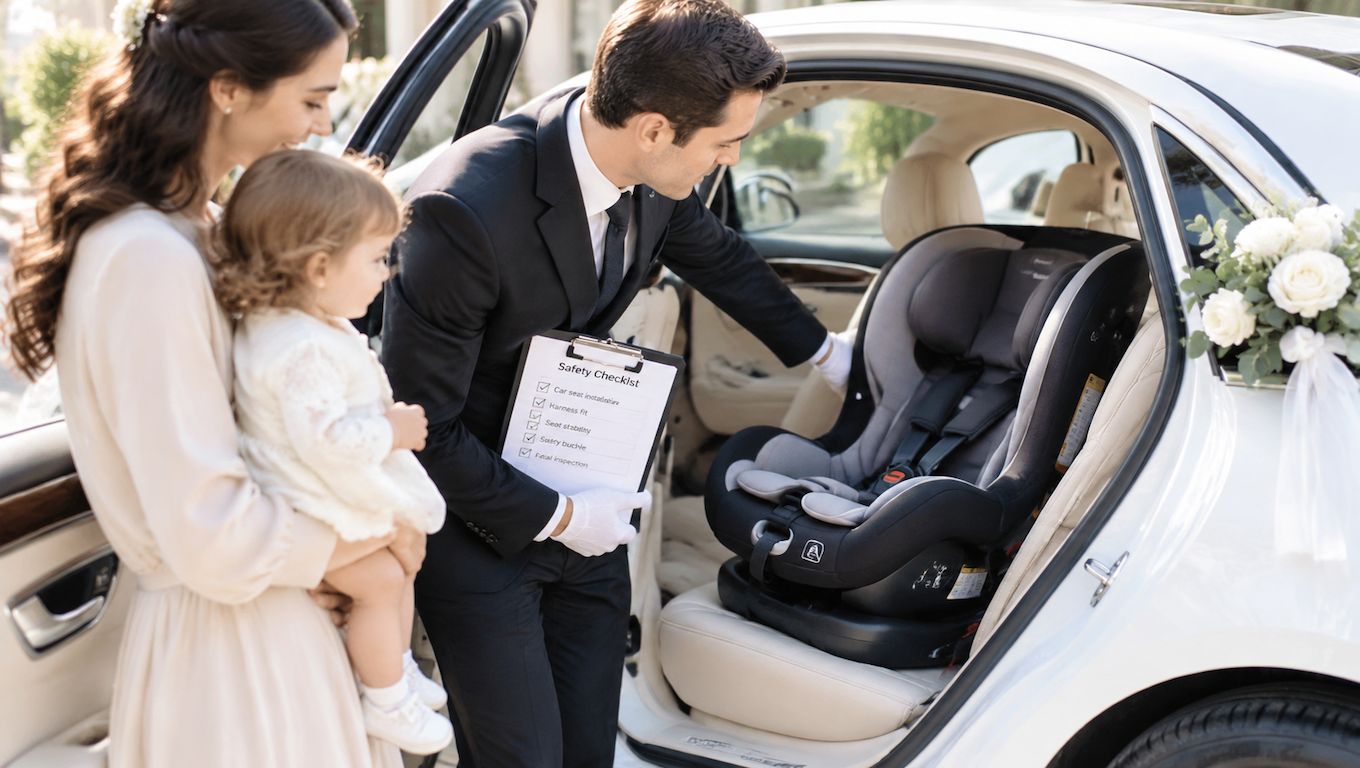
Run restraint approval as three checkpoints, each with a named owner and a deadline.
- At booking: send each child's age, height, and weight, and require the operator to name the proposed restraint with its manufacturer limits. Match rear-facing, forward-facing, or booster to both child and vehicle. Never approve a smaller car on the assumption that someone squeezes beside an installed seat.
- Before dispatch: require installation per the restraint instructions and the vehicle manual, and have the operator confirm the assigned vehicle fits passengers plus correctly installed restraints. If it doesn't, change the vehicle assignment. Do not improvise at the curb.
- At collection: allow time for a visual check of installation, belt routing, harness position, and harness tightness before departure. Children ride in the rear seat.
Destination weddings add a second problem: restraint approval is jurisdiction-specific. Ask whether the supplied seat is approved for use where the vehicle operates, and confirm local age and size thresholds rather than assuming your home-country rules apply. Bringing your own restraint? Send its details before travel so the provider can confirm the vehicle accommodates the intended installation.
Record all of it on the trip manifest: each child's requirements, the exact restraint model, the vehicle assignment and seating position, who checked installation before dispatch, and who verifies fit at collection. Then tell dispatch that safe boarding is a release condition. A late pickup never turns this into a rushed handover the driver can skip.
Contracts, Insurance, and What Happens When Things Go Wrong
The failure-response plan is more important than the arrival photograph. A distinctive vintage car may be a poor ceremony-critical choice if the operator has no suitable replacement available.
That doesn't mean rejecting specialty vehicles. It means separating their visual appeal from the operator's ability to recover the journey when a driver is unavailable, a vehicle fails, or access changes.
Independent vendor guidance recommends asking what replacement vehicle and response time are guaranteed after a breakdown, rather than accepting a general reassurance (Bouquet Casting's questions to ask wedding vendors).
Put the recovery promise in writing
The contract should identify the vehicle's make, model, year, and confirmed passenger capacity. If the agreement allows substitution, define acceptable alternatives and the person authorized to approve them.
Request evidence of commercial passenger insurance applicable to the booked service. Ask the provider to explain the coverage and relevant limitations; a statement that the company is “fully insured” isn't a substitute for documentation.
The operational clauses should specify:
- Backup arrangements: Where a replacement comes from and whether it can carry the entire assigned group.
- Response commitment: When the operator must acknowledge a problem and provide replacement transportation.
- Communication channel: Dispatch contact, escalation contact, and the method for notifying the coordinator.
- Financial treatment: Grace periods, waiting charges, overtime authorization, cancellation terms, and refund or compensation provisions.
- Driver requirements: Who verifies credentials and who assumes the assignment if the original driver becomes unavailable.
Refund and compensation rights should be explicit contractual terms, subject to applicable law. Don't assume a full refund or reimbursement for a replacement booking will follow automatically.
Decide who acts when the driver doesn't arrive
Give the coordinator authority to contact dispatch, approve an acceptable substitution, and activate the recovery plan. Guests shouldn't be negotiating separate replacements while the couple is preparing for the ceremony.
Require dispatch to communicate the revised vehicle identity, meeting point, and expected arrival. If traffic, weather, or venue restrictions change the route, the coordinator should receive the revised plan and pass on only the instructions guests need.
Before signing, ask: Where is the replacement vehicle? Who can authorize it? What happens to the bill if you fail to provide the booked service?
If the answer is “we'll sort it out,” the agreement isn't ready for a deposit.
Your Pre-Booking Checklist and Final Walkthrough
A complete booking should survive a handover to someone who wasn't involved in the sales conversation. Before paying, make sure the following are documented.
- Vehicle and capacity: Approve the assigned configuration, luggage provision, access requirements, and permitted substitutions.
- Pricing and minimums: Obtain the total scope, exclusions, booking minimum, extension rules, and change-approval process.
- Timing and manifests: Confirm movement windows, passenger lists, release authority, and dispatch checkpoints.
- Safety and safeguards: Verify restraint arrangements, insurance documentation, recovery commitments, and cancellation terms.
Reconcile before the wedding
A week before, review flight details, hotel names, venue entrances, passenger changes, and accessibility needs with the provider. Resolve discrepancies in the master document rather than leaving them scattered across messages.
The day before, freeze the dispatch version, confirm driver assignments, and circulate the coordinator's contact details. Ask dispatch to acknowledge the final schedule and backup contacts.
Walk away from a provider who can sell a vehicle but can't explain who will deliver the service. For Cancun luxury airport transfers and ceremony transportation alike, the booking is complete only when the operating details are clear.
Unique Private Transportation offers chauffeured airport transfers, point-to-point journeys, and wedding transportation coordination across Cancún and the Riviera Maya. Visit Unique Private Transportation with your flight details, hotel list, passenger needs, and venue schedule to request a transport plan and a written quote.