
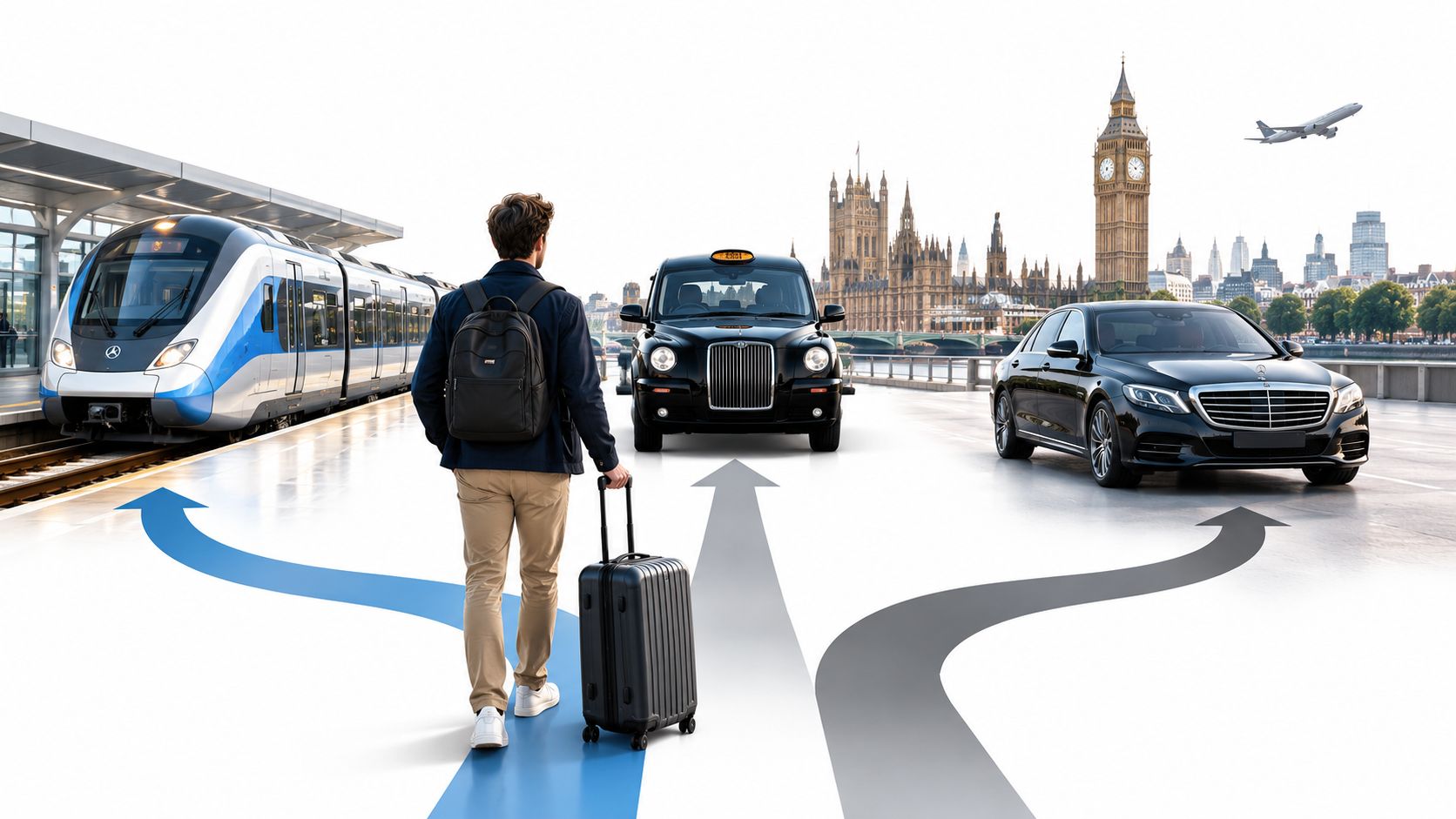
You've landed at Heathrow with a suitcase, a hotel address, and a schedule that doesn't leave much room for a wrong turn. A train may be the quickest way to a nearby station, but the full trip could involve a long walk, a change, and a final ride with your luggage. A car may take you door to door, but traffic can make its arrival time hard to predict.
That's the everyday puzzle behind airport transportation in London. Heathrow, Gatwick, Stansted, Luton, and London City sit in different parts of the region, and the best option depends on more than the airport name. Your destination, arrival time, luggage, group size, budget, and accessibility needs all matter. The practical approach is to compare the whole journey, not just a train's scheduled travel time or a car's quoted fare.
Table of Contents
- Why London Airport Transportation Needs a Plan
- London's Airport Network at a Glance
- Rail and Express Services Compared
- Private Transfers and Chauffeured Cars
- Taxis and Ride-Hailing Options
- Booking Tips and Timing Strategies
- Choosing the Right Option for Your Trip
- Final Recommendations and Key Takeaways
Why London Airport Transportation Needs a Plan
A traveler landing at Heathrow and heading to a hotel near Paddington faces a different decision from someone arriving at Gatwick for a stay in south London. The first traveler may be able to take a direct rail service close to the hotel. The second might find that a taxi or pre-booked car is easier once the final destination and luggage are factored in. The airport is only the starting point.
London's airports also serve a wide range of itineraries. A solo traveler with a small bag may value a frequent, lower-cost rail option. A family arriving after a long flight may care more about avoiding several changes with children and suitcases. Neither choice is automatically right for everyone, and the cheapest ticket doesn't always produce the simplest trip.
Think door to door, not station to station
Compare the full route from the arrivals hall to your accommodation. A scheduled train time doesn't include walking to the platform, waiting, handling bags, changing services, or completing the final leg. For a road journey, think about where the vehicle collects you and whether traffic could affect the trip.
This broader comparison helps prevent a common planning mistake: choosing a mode based on a single attractive number. A fast train can be a good fit if it brings you near your destination. If it leaves you with a complicated interchange or a long onward journey, a different option may be more comfortable even if its quoted journey time looks longer.
Practical rule: Choose the route that works for your arrival, luggage, and final address, not the route that looks best in isolation.
Plan around your arrival conditions
Arrival time matters because your actual departure from the airport may be later than your flight's landing. You'll need to taxi to the stand, leave the aircraft, clear border control where applicable, collect your baggage, and reach the pickup point or station. Disruption can also change which route makes sense, so keep an alternative in mind if your connection is time-sensitive.
A useful plan starts with three questions: Which airport are you using? Where exactly are you going? What will make the journey difficult, such as bulky bags, limited mobility, children, or a late arrival? Answer those first, then compare rail, taxi, and private-car options against the same needs.
London's Airport Network at a Glance
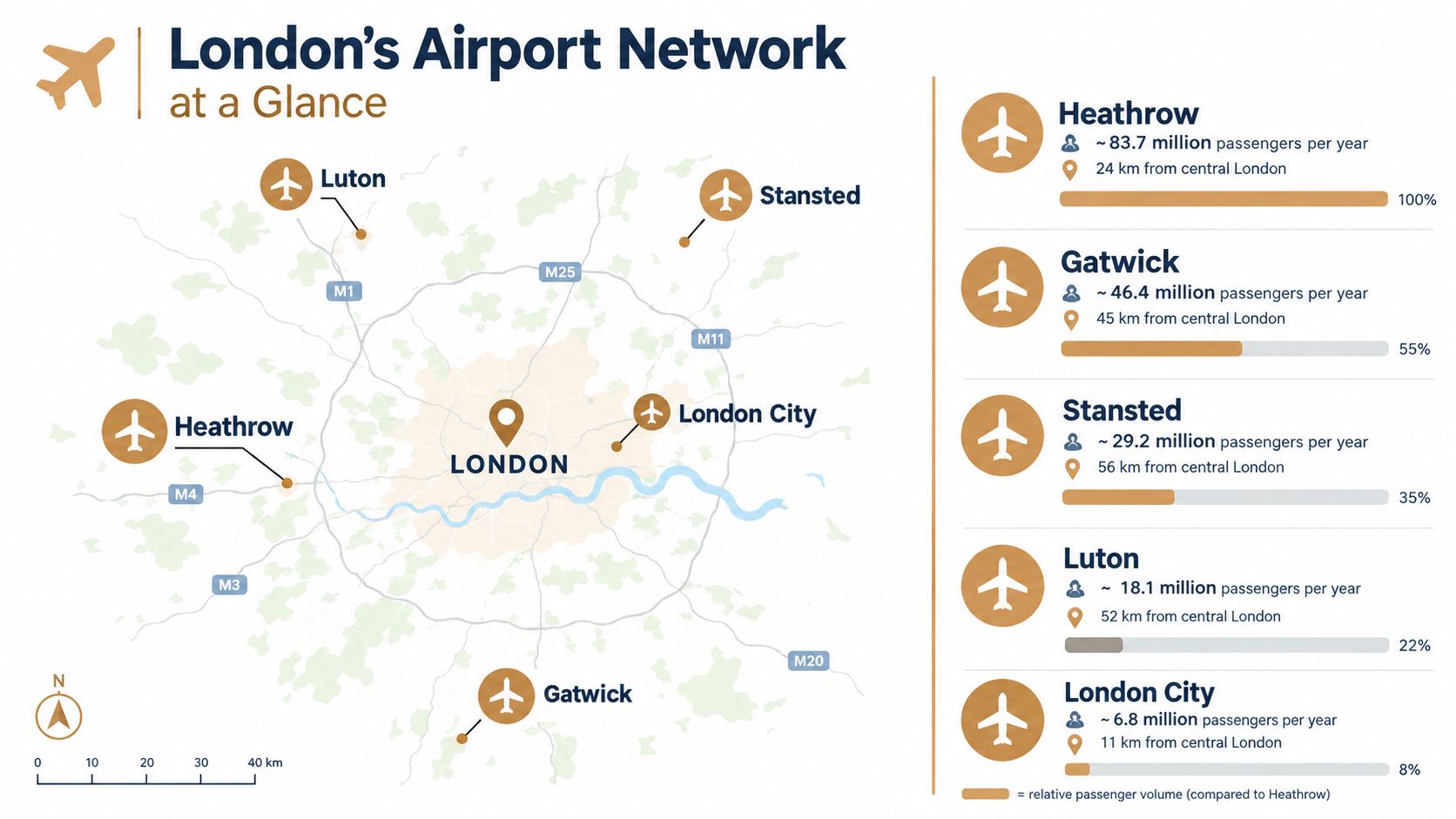
London is a multi-airport market, not a city with one central gateway. Heathrow lies west of central London, Gatwick is south, Stansted is northeast, Luton is northwest, and London City is closer to the eastern side of the city. That geography affects road distance, available rail connections, and how much of your journey takes place beyond the airport.
The scale is substantial. In 2024, London's airports handled approximately 178 million passenger arrivals and departures across roughly 1.08 million aircraft take-offs and landings. Heathrow accounted for 47% of passenger movements and 44% of aircraft movements; Gatwick ranked second, with 24% of both passenger volume and flight activity, according to the London Assembly's overview of the capital's airports.
Why the airport changes the answer
Heathrow's position and passenger volume make it a major starting point for journeys into London, but its transport choices won't automatically suit someone landing elsewhere. Gatwick has its own rail and road connections. Stansted and Luton serve different parts of the region, while London City's location can make it convenient for some east London destinations. The right comparison begins with the airport you're using, then narrows to the destination.
The airport's scale also affects how you plan around busy arrival periods. Large waves of passengers can mean more people reaching platforms, taxi ranks, and pickup areas at similar times. A route that looks straightforward on paper may feel less simple if you're navigating it with several bags or coordinating a group.
Use the airport's location as your first filter
Start by marking the airport and your destination, rather than assuming that every route leads into the same central point. Ask whether your accommodation is near a major station or whether a transfer is needed after the train. If the final leg includes another service, consider how manageable that change will be with your bags and companions.
London's airport distribution is also why “the best airport transfer” can't be answered with one mode. Your first useful decision is airport-specific. Your next is whether rail, a taxi, or a pre-arranged vehicle best matches your whole itinerary.
Rail and Express Services Compared
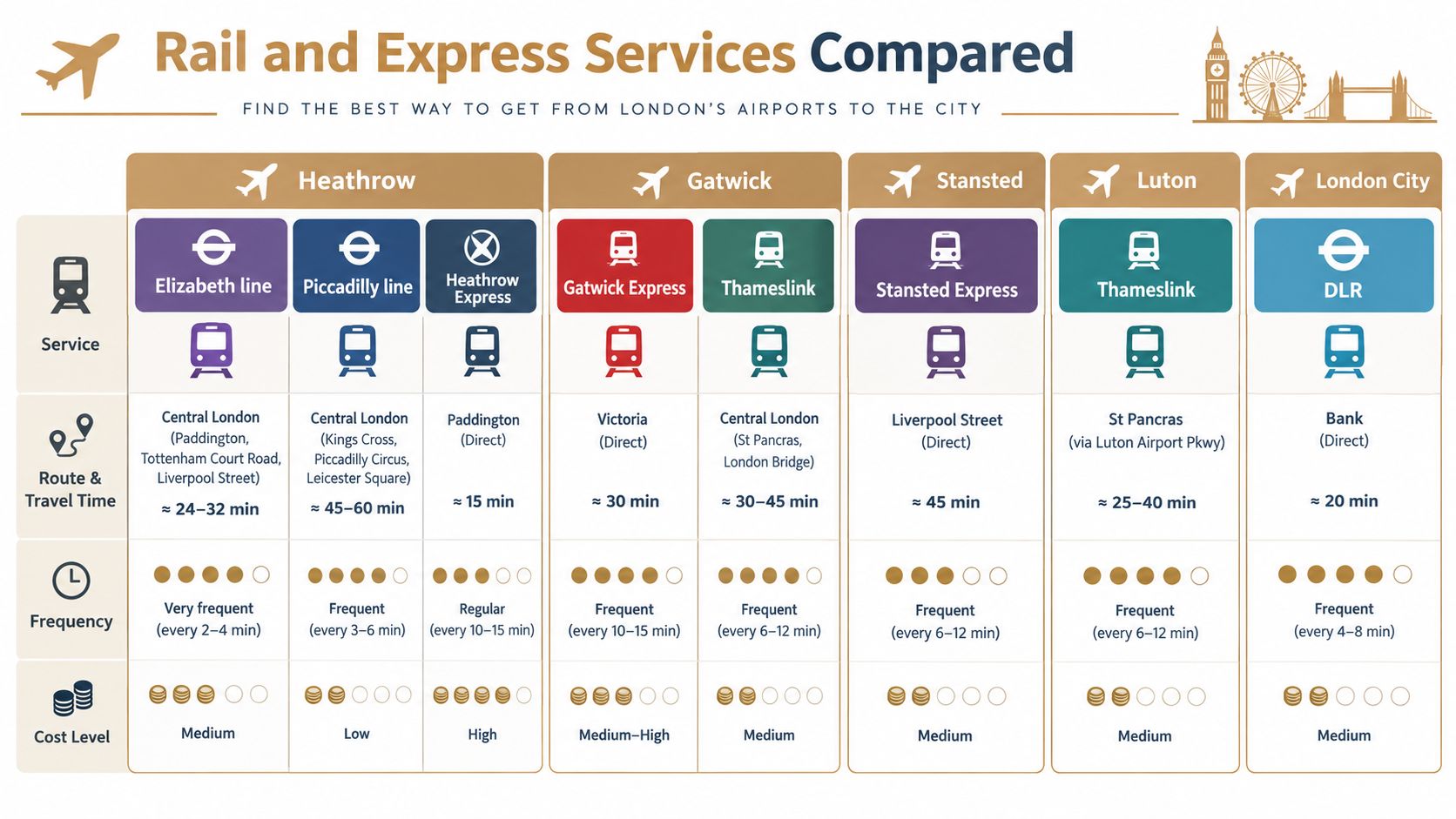
Rail can be a strong choice when a service takes you near your destination and you can manage the walk, platform access, and luggage. The details differ by airport, so don't assume that a fast express train is always the best fit or that every rail journey ends at your hotel.
At Heathrow, the Elizabeth line reaches Paddington in approximately 28 minutes, Liverpool Street in 39 minutes, and Canary Wharf in 45 minutes. Those figures exclude walking and interchange time. Services run every 15 minutes to Terminals 2–4 and every 30 minutes to Terminal 5. The Piccadilly line takes approximately 50 minutes to central London, with higher frequency and lower cost, while the Heathrow Express provides non-stop trains to Paddington several times per hour. TfL's London airport travel information sets out these options and journey details.
Match the service to your destination
| Airport | Rail options to consider | What to check before choosing |
|---|---|---|
| Heathrow | Elizabeth line, Piccadilly line, Heathrow Express | Whether the destination is near a stop, and how much walking or changing comes after the train |
| Gatwick | Gatwick Express, Thameslink | Which service best connects with your destination and onward route |
| Stansted | Stansted Express | Whether the arrival station works for your accommodation or requires another connection |
| Luton | Thameslink | How the full route from the airport to the rail service and onward destination fits your needs |
| London City | DLR | Whether the DLR connection is convenient for the final address |
For airports beyond Heathrow, check current operator information for routes, service frequency, fares, and planned works before travelling. This guide doesn't assign unverified journey times to those services. A route's name alone won't tell you how convenient it will be for your particular hotel or meeting.
Include the accessibility chain
Accessibility isn't just a question of whether a station advertises step-free access. Consider the entire chain: assistance from the terminal, lifts, the platform-to-train gap, luggage handling, ticketing, transfers, and what you'll do if a lift or connection isn't available. Evidence submitted to the UK Parliament describes barriers that can include poorly designed interchanges, step gaps, unclear public-transport fares, and inconsistent service for passengers with disabilities or heavy luggage in London and South East airports (written evidence on airport accessibility).
Before travelling, check with the relevant operators about assistance and accessible routes. If a trip depends on several transfers, identify a workable alternative rather than assuming every connection will be straightforward. The nominally cheapest public-transport route may not be the lowest-friction choice when stairs, bags, and assistance coordination are part of the journey.
Private Transfers and Chauffeured Cars
A private transfer is most useful when the journey has more moving parts than a train ride and a simple change. A driver can meet you at an agreed point, take your group and luggage directly to the destination, and avoid asking tired travelers to find their way through multiple connections. For families, groups, passengers with limited mobility, or anyone carrying bulky equipment, that convenience can justify a higher fare than rail.
The broader travel picture supports treating roads as a major part of airport access. UK Civil Aviation Authority data for 2024 reports that approximately 39% of airport passengers used private cars, 28% used rail or metro, 24% used taxis, and 8% used buses. The surface-access analysis shows why airport transport planning is a multimodal question, not a contest between a taxi and a train.
What you're paying for
A well-organized private transfer should make the handoff clear. Confirm whether the driver meets you inside arrivals or at another designated point, how you'll identify one another, and what happens if your flight is delayed or your baggage takes longer than expected. Ask whether the operator monitors flight status and how long the driver will wait under the booking terms.
Vehicle size matters just as much as the service description. Make sure the chosen car can take the travelers and their luggage comfortably. For groups, one correctly sized vehicle may be simpler than splitting everyone across separate cars, but only if there's enough space for both passengers and bags.
Compare the full cost and convenience
Rail generally suits travelers who can reach their destination easily from a station. A private car can be a better fit when the group would otherwise need several tickets, onward transport, or help managing bags and children. It doesn't remove traffic risk, so don't confuse door-to-door convenience with a guaranteed arrival time.
For travelers comparing chauffeured options, the service details matter more than labels such as “executive” or “premium.” Review the pickup arrangements, vehicle capacity, waiting policy, and cancellation terms before booking. A dedicated chauffeur service is one example of the kind of arrangement travelers may consider when they need a driver for a planned itinerary rather than only a single airport ride.
Taxis and Ride-Hailing Options
Taxis and ride-hailing can bridge the gap between public transport and a pre-booked private car. They offer road transport and, in many cases, a direct trip to your accommodation, but how you get the vehicle and what you pay can vary. At an airport, follow the official signs to the licensed taxi rank or the designated app pickup point rather than accepting an unsolicited offer inside the terminal.
London's taxi and private-hire options aren't all the same. Black cabs use official ranks and can be hired directly where available. Minicabs and app-based services generally require a booking, with the pickup location and fare terms determined by the operator or app. Check the specific airport's instructions before you set off, because the pickup point may not be directly outside the arrivals doors.
Consider fare certainty and waiting
A metered fare can change with the journey, while a booked ride may provide a fare estimate or a fixed price depending on the provider and terms. App-based prices can vary with demand, and availability can be less predictable during busy periods. Read the booking details before confirming, especially if the journey is long or your flight arrives at an awkward time.
A taxi rank can be convenient when you want a vehicle without arranging one in advance, but queues are possible. Ride-hailing gives you booking updates, yet you'll need to find the assigned pickup area and connect with your driver. A pre-booked private transfer, by comparison, can make the meeting plan clearer, but it requires advance coordination.
Choose based on the moment
A taxi may suit a traveler with manageable luggage who wants an immediate door-to-door option and accepts variable road conditions. A rideshare may work well if you're comfortable following app instructions and reaching the designated pickup point. For a group, compare the vehicle capacity and total fare, not just the price shown for a single passenger.
Late at night, after a tiring journey, or when travelling with children, certainty about the pickup process can matter as much as the vehicle itself. Use only licensed or properly booked services, and confirm the driver and vehicle details through the official channel. If no suitable vehicle is available or the price is higher than expected, check whether a rail alternative is still running before deciding.
Booking Tips and Timing Strategies
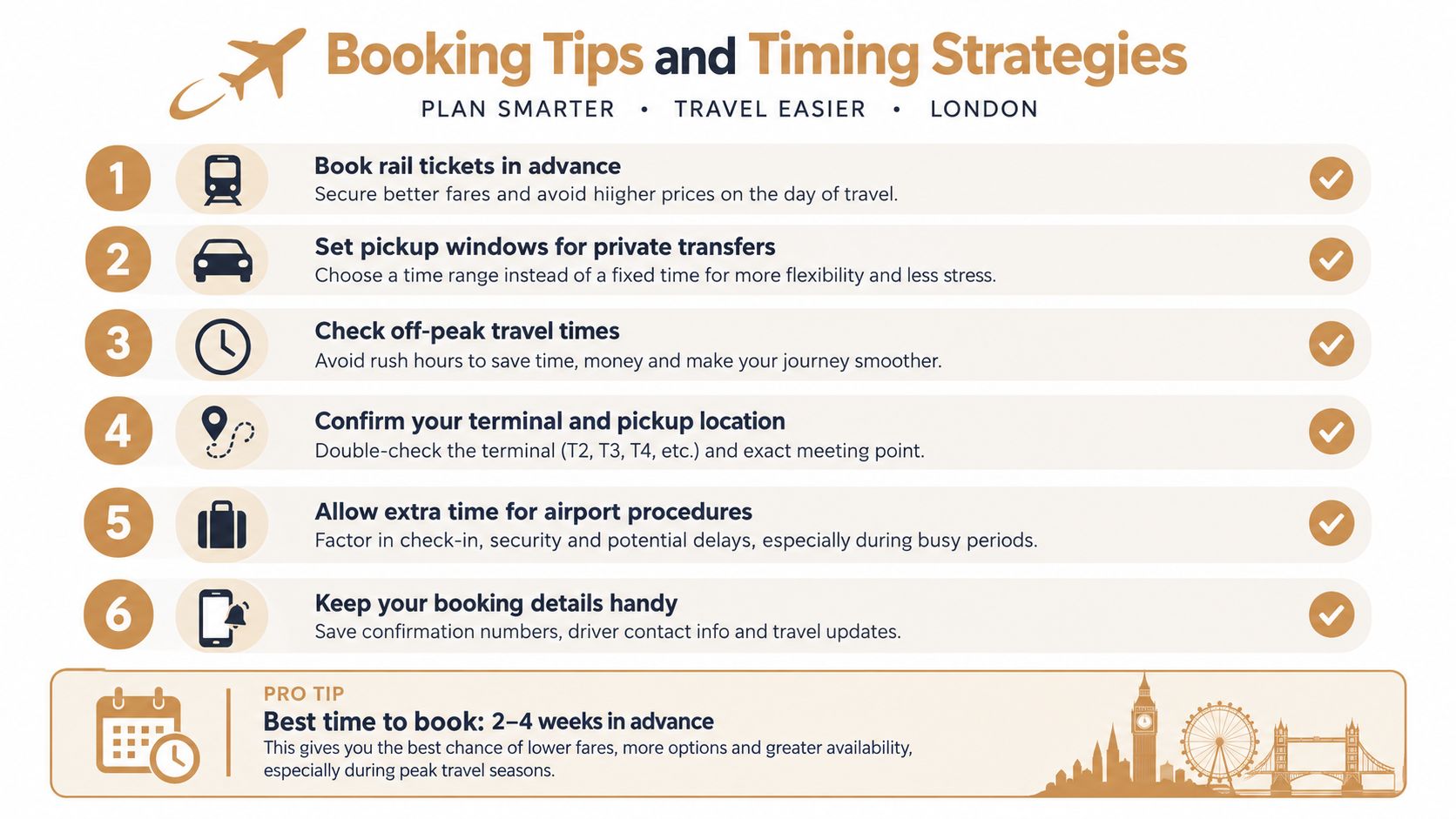
A flight's landing time isn't the same as the time you'll be ready to leave the airport. The aircraft may need to taxi to its stand, and you still have to disembark, clear border control where applicable, collect baggage, and reach the station or pickup area. Build your plan around that sequence rather than setting a car pickup for the moment the plane touches down.
Disruptions can also change the best route. London City Airport's cancellation rate reached 2.44% in the first half of 2026, reported as 71% higher than the same period a year earlier, illustrating that flight and rail disruption can affect an itinerary; see the London airport disruption coverage. Check current airline and transport-operator updates before departure, and keep an alternative route in mind.
Set a pickup window that reflects the arrival process
For a pre-booked car, understand how the operator handles flight changes, delays, and time spent at baggage claim. Share the correct flight details, confirm the terminal and meeting point, and ask what to do if you can't find the driver. If you're delayed after landing, use the operator's official contact method rather than leaving the pickup plan uncertain.
For a taxi or rideshare, check the airport's instructions for where to join the rank or meet the driver. Don't assume an app pickup is curbside at the terminal. Allow time to walk to the designated area, particularly if you have children, mobility needs, or several bags.
Make disruption planning part of the booking
- Check the whole route: Review the airport service, any interchange, and the final leg to your destination.
- Look for planned works: Check the relevant rail and airport operator updates close to travel, then identify a road alternative if a key connection is affected.
- Keep a backup: Save the address, pickup instructions, and transport operator's contact details somewhere accessible.
- Compare total exposure: A pre-booked vehicle may offer a known pickup arrangement, while public transport can require additional tickets or a change of plan if disrupted.
A fixed-price option can help with budgeting, but compare its terms with the alternatives rather than assuming it's always cheaper. Factor in the cost and inconvenience of a missed connection, an extra journey, or getting stranded with luggage. For a reference point when comparing a premium vehicle booking, review the provider's luxury transportation rates alongside the service inclusions and cancellation terms.
Choosing the Right Option for Your Trip
There isn't one best mode for every traveler or every airport. The useful choice is the one that fits your destination, bags, companions, schedule, and access needs. Heathrow and Gatwick alone handled about 127.3 million passengers in 2025, with 84,481,178 terminal passengers at Heathrow and 42,775,241 at Gatwick, approximately 71% of the passenger traffic shown for London's major airports in the Heathrow annual accounts. Those volumes reinforce why it's worth planning around the airport and arrival conditions rather than relying on a generic city-transfer answer.
Recommended Transport by Traveler Type
| Traveler Type | Best Option | Why |
|---|---|---|
| Solo business traveler | Rail or express service, if it reaches a convenient station | A direct connection can avoid road traffic and work well with light luggage. Choose the service based on your final address and schedule. |
| Family with children | Pre-booked private transfer or taxi | A door-to-door ride can make it easier to keep the group and bags together. Confirm vehicle capacity and any required child-seat arrangements in advance. |
| Budget-conscious backpacker | Public transport | Rail or metro can suit travelers with manageable luggage and time to make a connection. Check the entire route, not only the first train. |
| Large group | Right-sized private vehicle or a coordinated taxi plan | Compare total capacity and how the group will travel together. A single suitable vehicle can simplify the handoff, if it can fit everyone and their bags. |
| Luxury traveler | Pre-booked chauffeured car | Advance coordination, a clear meeting point, and a vehicle chosen for the itinerary may matter more than finding the lowest fare. |
| Passenger with accessibility needs | The route that confirms the full accessibility chain | Check terminal assistance, step-free access, transfers, lifts, and a backup plan. A taxi or private transfer may reduce the number of connection points, but confirm the vehicle and assistance details. |
Check the trip against your real constraints
Before you book, decide what you can be flexible about. If the budget is tight and you're carrying little, a public-transport route with a manageable final leg may be the clearest choice. If you're travelling with children or several bags, convenience may outweigh the cost of a road transfer. If you need a step-free route, verify it with the relevant operators instead of relying on a general station description.
Be precise about your destination, too. “Central London” isn't enough to judge whether a train is convenient. A station close to one hotel may be far from another, and an extra connection can change the experience of the journey. A point-to-point transfer is one way to describe a direct trip between a chosen pickup and destination, but the right option still depends on your particular route and requirements.
Final Recommendations and Key Takeaways
Use rail or an express service when it takes you close to your destination, you can manage your luggage, and the remaining journey is straightforward. Check the full route before you buy, particularly if you need to change services or travel onward from a major station. A scheduled train time is only one part of the door-to-door trip.
Choose a taxi when you want an on-demand road option and are comfortable with the pickup process and variable traffic conditions. Consider a pre-booked private transfer when your group, luggage, accessibility needs, or arrival circumstances make a clearly arranged handoff more valuable. Whatever you choose, verify vehicle capacity, meeting instructions, and fare terms before travelling.
Keep the decision simple
- Start with the airport and destination. Heathrow, Gatwick, Stansted, Luton, and London City serve different parts of the region.
- Count every leg. Include the walk to the station, any transfer, and the final journey to your accommodation.
- Match the mode to your group. A solo traveler with light luggage has different priorities from a family or a group with bulky bags.
- Check access and disruption. Confirm assistance, step-free routes, service updates, and a backup plan.
- Set the pickup for when you'll be ready. Coordinate around terminal exit time, not flight landing time.
The most dependable choice isn't always the fastest service on a timetable or the lowest price on a screen. It's the option that still works when you account for the whole route, your luggage, your companions, and the possibility that plans change. Confirm your arrival details and onward connection before you fly, then keep the pickup instructions and backup option close at hand.
Unique Private Transportation provides chauffeured airport transfers, point-to-point travel, and bespoke tours across Cancun and the wider Riviera Maya, with live flight monitoring and concierge coordination. If your next trip takes you to Cancun, compare the vehicle, pickup plan, and service details you need, then visit Unique Private Transportation to plan your ground transportation.