
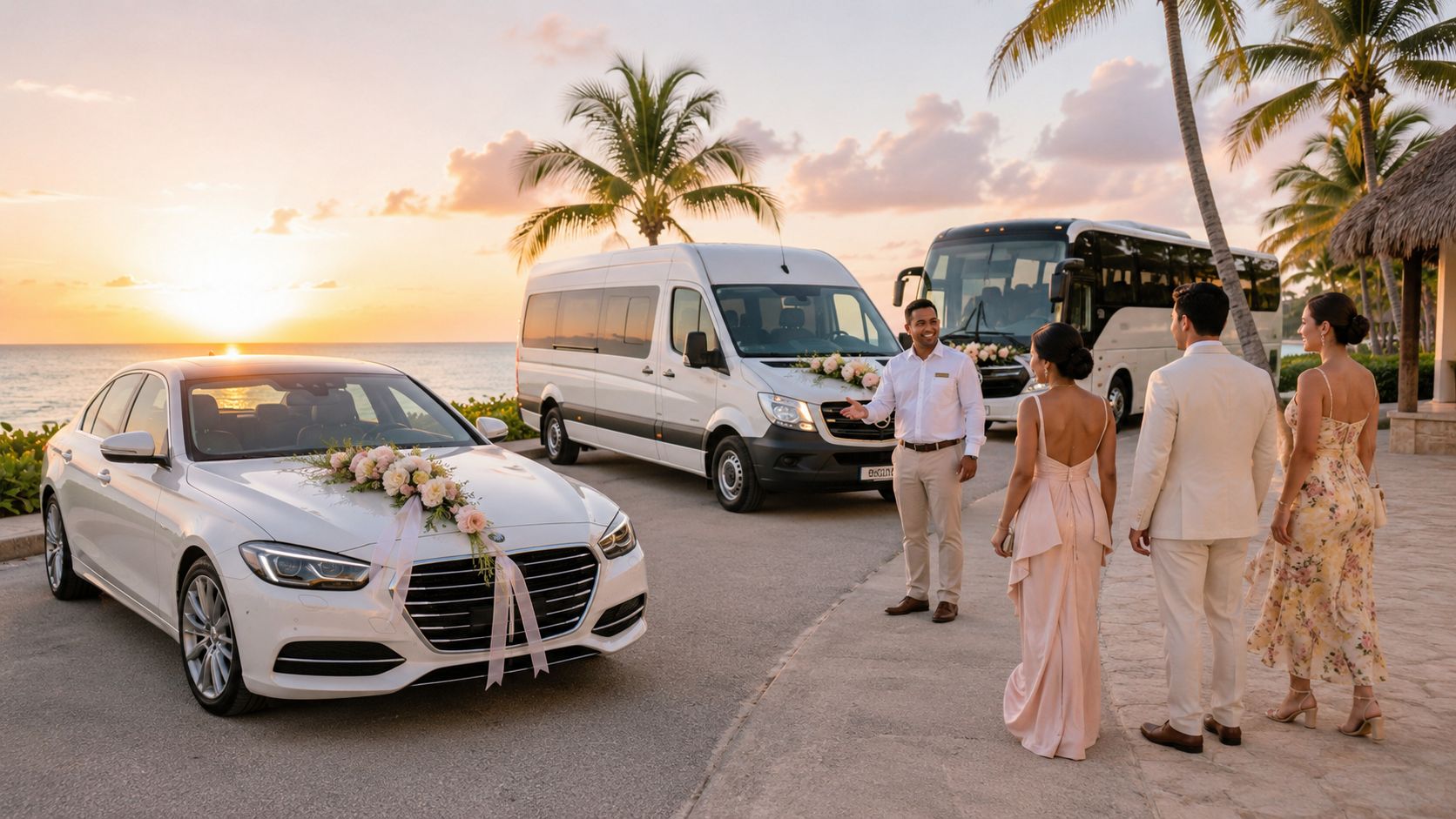
You're standing in the lobby, watching three texts come in at once. One guest landed early, another is circling baggage claim, and the bride just asked whether the driver for the rehearsal dinner knows the hotel back entrance. That's cancun wedding transportation in real life, not a neat booking line on a spreadsheet, and it works only when someone treats it like a choreography problem, not a car problem.
In Cancún, the airport sets the tempo. Cancún International Airport handled 29,345,538 passengers in 2025, down from 30,411,520 in 2024 and below its 2023 peak of 32,750,411 (El Economista). That kind of volume is exactly why wedding groups need private transportation Cancun airport service that's already organized before anyone clears customs. If you're planning a weekend with guests spread across the Hotel Zone, Playa Mujeres, and the Riviera Maya, the transport decision you make months ahead will decide whether the wedding feels smooth or chaotic.
Table of Contents
- What Cancun Wedding Transportation Really Involves
- Regulatory and Compliance Basics for Wedding Cars in Cancun
- Vehicle Options for Wedding Guests and the Wedding Party
- Building a Wedding Day Transportation Timeline
- Multi-Vehicle Coordination and Cost Logic
- Service Features That Make the Day Run Smoothly
- Locking In Your Cancun Wedding Transportation Plan
What Cancun Wedding Transportation Really Involves
A proper wedding weekend in Cancún is rarely one vehicle doing one job. It's usually multiple arrivals, multiple hotel clusters, and multiple time-sensitive moments tied together by one transport plan. If forty guests land on three overlapping flights, then split between the Hotel Zone and Riviera Maya resorts, while the rehearsal dinner sits in Playa Mujeres and the ceremony is at sunset, you don't need “a shuttle.” You need sequencing.
The real job is coordination
The hardest part is not the ride itself. It's the handoff between airport, hotel, salon, photo stop, venue, and late-night return. Guest luggage has to move cleanly, ceremony timing needs a buffer, and the couple's vehicle can't be trapped waiting for a cousin who's still in the arrivals line.
That's why luxury transportation for weddings is really about control. It keeps guests moving in waves, keeps formalwear out of the sun, and keeps the bride from spending her afternoon hunting down a missing driver. If you want a broader planning lens, the guide on effortless destination wedding planning is useful because it treats the weekend as a chain of decisions, not a single event.
The transport plan sets the weekend rhythm
If the airport wave lands smoothly, the welcome dinner starts on time. If hotel pickups are staggered correctly, the ceremony buffer protects hair and makeup. If the return vehicles are assigned before the reception begins, no one ends up waiting outside a villa with heels in hand. That's why I never treat unique private transportation as a last-minute add-on.
The internal planning lesson is simple, and it matters more than vehicle branding. Choose the transport structure first, then build everything else around it. The rest of the weekend, from the rehearsal dinner to the farewell brunch, inherits that decision.
For couples comparing providers, the operational model matters more than a glossy fleet gallery. A service built around luxury private transportation in Cancun should be able to explain how it handles multi-stop guest movement, not just how the vehicles look in photos.
Practical rule: If your transport plan cannot name the airport wave, the hotel cluster, and the ceremony buffer, it is not finished.
Regulatory and Compliance Basics for Wedding Cars in Cancun
Compliance is not a side detail in Cancún, it's the thing that determines whether your transport provider can protect your guests if something goes wrong. Legitimate operators should be able to show the paperwork without hesitation. If they stall, dodge, or try to move the conversation back to price, walk away.
What legitimate operators should have ready
A compliant ground transport operator should be able to provide insurance certificates, driver IDs, vehicle registration, and clear proof of operating authority. In Mexico, transport service also sits inside the broader framework of federal and state oversight, so a real operator should know how its permits line up with SICT requirements and local authorizations. Hotels often steer guests toward vendors they already recognize because they want predictable access, orderly pickups, and fewer disputes at the curb.
The airport side matters too. A transport guide for Cancún Airport says taxis must be pre-booked or arranged at official counters inside the terminal, and street taxis are not allowed to pick up passengers directly outside. It also lists a typical Hotel Zone fare of US$25–35 and about 30 minutes of travel time, which is exactly why many wedding planners prefer prearranged service for predictability rather than improvisation (Cancún airport transport guide).
What to verify before you sign
Ask for the permit number, the insurance details, and the exact vehicle assignment before you pay a deposit. Get the terms in writing, especially for no-shows, breakdowns, and replacement vehicles. If the operator won't send a formal contract, that is a problem.
Do not book cash-only pickups off the airport curb for a wedding group. If there's a dispute, a delay, or an accident, you want a paper trail and an accountable company, not a memory of who said what.
This also affects liability when a vehicle breaks down on the way to the ceremony. If the provider is compliant, insured, and properly documented, the response is clear. If not, the couple ends up managing a logistics mess they never should've had to touch.
Vehicle Options for Wedding Guests and the Wedding Party
The right vehicle depends on the job, not on vanity. A couple going to portraits needs a different ride than a guest shuttle carrying luggage and gift boxes. In Cancún, the best cancun wedding transportation plan usually uses several vehicle types at once, each with a narrow role.
Match the vehicle to the task
Sedans are for the couple, parents, and VIPs who need a quiet cabin and a clean arrival. They work best for short, polished transfers inside the Hotel Zone and for timing-sensitive movements between the resort, a photo location, and the reception. Executive SUVs do the same job with more space for dresses, garment bags, and soft luggage.
Mercedes Sprinter vans and similar passenger vans are the workhorses for bridesmaids, groomsmen, and family groups. They're the right size when people are moving together with makeup kits, welcome bags, and formalwear. Minibuses and motor coaches belong with full guest shuttles, especially when airport arrivals are spread out and luggage space matters more than showroom polish.
Specialty vehicles have their own uses. Classic cars are for photos. Golf carts are for short resort hops. SUVs are better on rougher access roads and tropical garden venues than a big coach that can't turn or park cleanly.
Vehicle classes for Cancun wedding transportation
| Vehicle Class | Passenger Capacity | Best Use Case |
|---|---|---|
| Sedan | 2 to 3 | Couple, parents, VIP arrivals, photo transfers |
| Executive SUV | 4 to 6 | Private movement with luggage, quiet rides, resort-to-venue hops |
| Mercedes Sprinter van | 12 to 14 | Wedding party, salon runs, rehearsal dinner groups |
| Minibus or motor coach | 28 to 45 | Guest shuttles, airport waves, welcome dinner transfers |
| Specialty vehicle | Varies | Photos, short resort circulation, rough-access venue roads |
One thing I tell planners constantly, do not force a giant coach into a job better suited to three smaller vehicles. It looks efficient on paper and messy on the ground. For context on how providers package fleet options, the rates page for luxury transportation shows how vehicle class and service length shape the final plan.
Building a Wedding Day Transportation Timeline
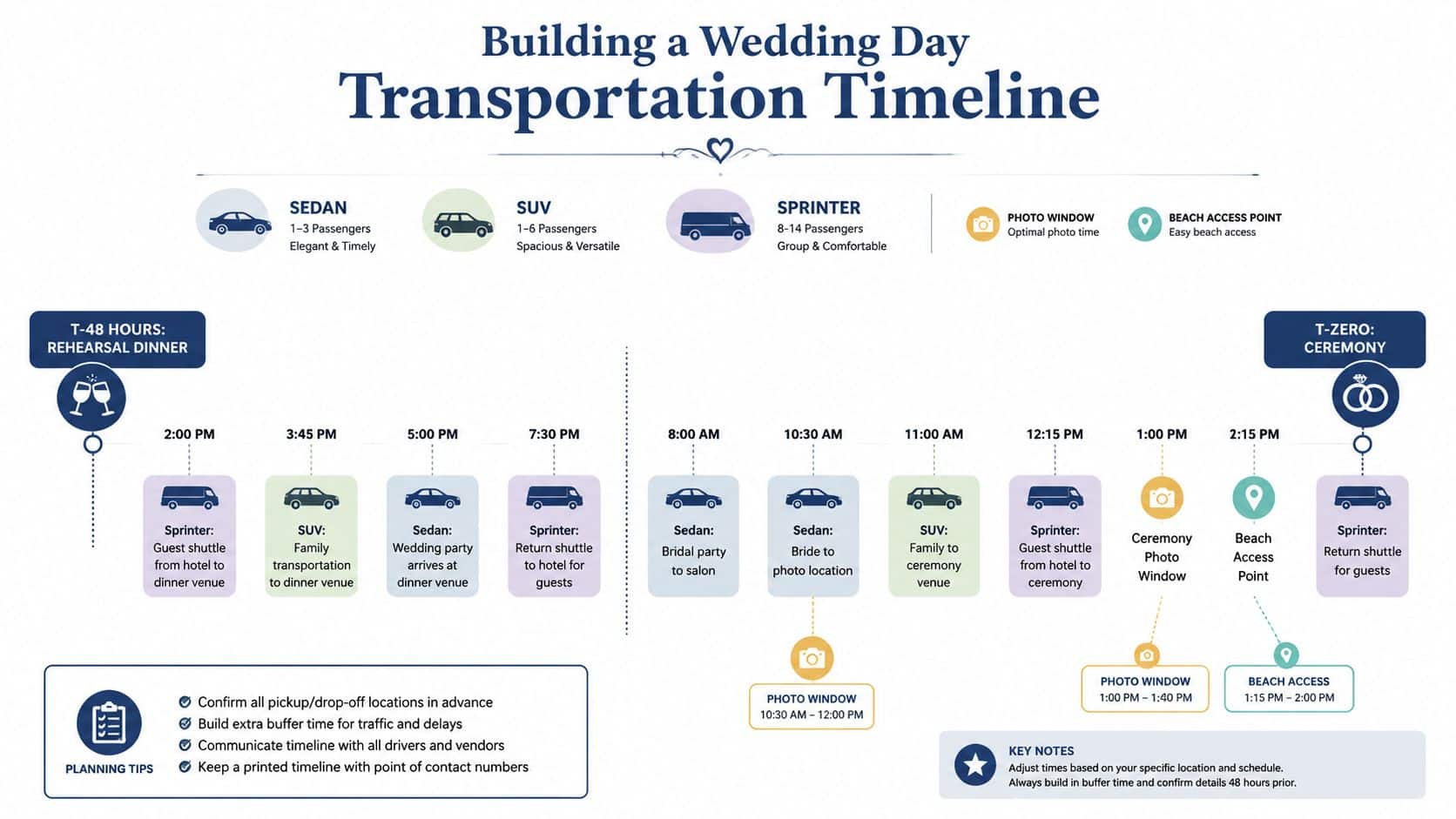
The ceremony clock controls everything. If the couple is marrying at 4:00 p.m., the vehicle schedule has to work backward from that hour and protect the parts of the day that get lost first, hair, makeup, photo windows, and guest settling time. A good private transportation Cancun airport plan doesn't just move people, it buys calm.
A ceremony-day sequence that actually works
Start with the bridal party. A 1:30 p.m. pickup from the Hotel Zone gives enough runway for wardrobe adjustments and travel without compressing the afternoon. A 2:15 p.m. family shuttle from the all-inclusive in Puerto Juárez keeps older guests from arriving drained or late. A 2:45 p.m. transfer for guests staying in the Riviera Maya cluster keeps that longer drive from colliding with the couple's final prep.
Then protect a 3:15 p.m. buffer for hair-and-makeup overruns. That cushion is not a luxury, it's what keeps one delayed guest from dragging the whole ceremony into stress mode. By 4:45 p.m., the transport plan should be ready for the post-ceremony photo loop, and by 5:30 p.m., cocktail hour shuttles to the reception villa need to be in motion.
Two rules that prevent day-of chaos
First, do not stage vehicles haphazardly at the curb. Keep them near loading docks or approved waiting points so drivers aren't blocked into double-parking problems. Second, respect local traffic reality. On Kukulkan Boulevard, I plan with a 15-minute rule, meaning I expect minor delay and never build a ceremony pickup schedule that collapses if one vehicle slips a few minutes.
Every wedding on the Riviera Maya runs better when the driver arrives early, the vehicle is staged out of sight, and the planner knows the exact load order.
The rehearsal dinner needs the same discipline, just with less pressure. Guests who arrive in different waves should be grouped into the right ride the moment they land, not after they've wandered the terminal looking for each other.
Multi-Vehicle Coordination and Cost Logic
The instinct to rent one huge coach is understandable, and usually wrong. For destination weddings, three to five smaller vehicles usually beat a single oversized bus on guest experience, timing flexibility, and total logistics spend. You can send the right vehicle to the right arrival wave instead of dragging a half-empty coach through the day.
Why arrival waves beat a single oversized bus
In Cancún, flights don't land in one neat block. Guests arrive by loyalty tier, by airline, by hotel zone, and by how much time they're willing to wait. If you sort them by those realities, the dispatch plan becomes simpler. The first wave can go in a sedan or SUV, the family cluster can move in a Sprinter, and the larger guest wave can load into a coach once everyone's bags are down.
The cost logic backs that up. Independent planning data for Cancún wedding transportation shows private transfers around USD 130 to 180 per vehicle, coach buses around USD 800 to 1,400, and multi-vehicle weddings around USD 3,000 to 8,000 (Miles Charters). That range matters because vehicle class and time on duty do not scale neatly. A coach waiting idle between the airport and the reception eats money fast.
Use the right vehicle for the right wave
- Airport arrivals: Put early and late arrivals into separate runs if their hotels are different.
- Hotel clusters: Group by zone, not by sentiment. Friends can ride together later.
- Ceremony timing: Keep the couple in a small private vehicle so they're never tied to guest boarding delays.
- Late-night return: Use the smallest fleet that clears the venue without leaving stragglers behind.
The deadhead issue is real too. If you send a coach back to the airport mid-day, then pull it out again for the reception transfer, you've paid twice for a vehicle that spent too much time empty. That is bad logistics and worse guest experience.
For planners comparing service models, the fleet discussion at Unique Private Transportation helps frame the question around dispatch strategy, not just vehicle size. The right answer is usually the one that wastes the least time.
Wedding Vehicle Cost Comparison in Cancun
| Vehicle Class | Capacity | Per-Trip Rate (USD) | Per-Guest Equivalent | Best Fit |
|---|---|---|---|---|
| Private sedan | 2 to 3 | 45 to 70 | Lowest for a small VIP group | Couple, parents, quick resort transfers |
| Sprinter van | 14 | 120 to 180 | Strong value for a small group | Wedding party, family cluster, salon runs |
| Full-size coach | 28 to 45 | 900 to 1,400 | Best when many guests move at once | Airport wave, welcome dinner, large shuttle runs |
Service Features That Make the Day Run Smoothly
A wedding transport provider in Cancún earns its keep in the details you never see when the day goes well. The driver meeting guests at the terminal, the flight tracker catching a delay, the bilingual dispatcher answering a WhatsApp message at night, those are the things that separate a real operator from a generic shuttle service.
The airport handoff has to be exact
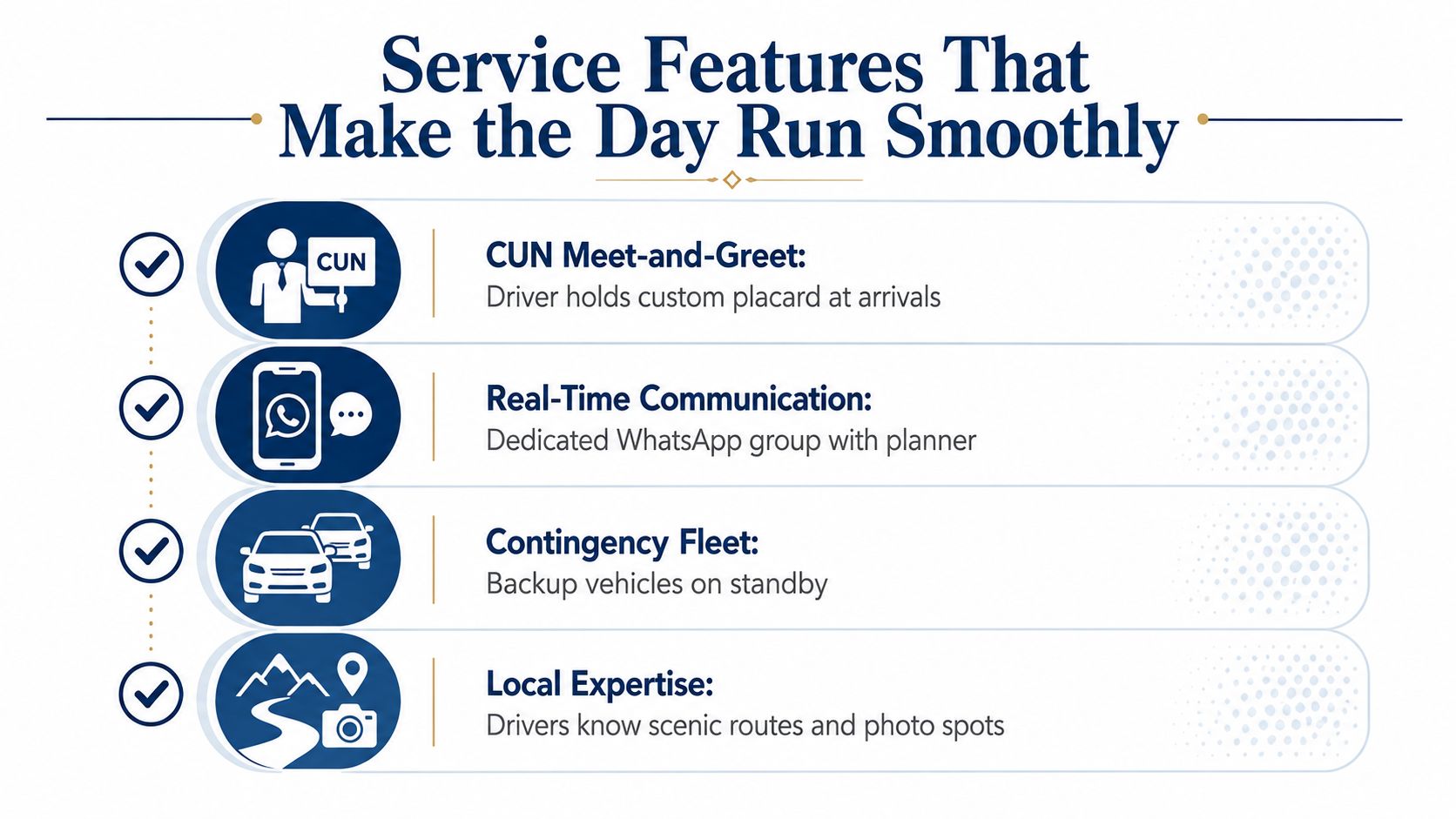
At CUN, meet-and-greet should mean a real person with a custom placard in the right terminal meeting point, not a vague promise to “wait outside.” Independent wedding transport guidance for Cancún says groups should be routed to fixed post-customs meeting points at Terminal 2 and 4 near Welcome Bar, and Terminal 3 near Margaritaville Bar, then consolidated into preassigned vehicles with a named driver and signboard (Social Car Cancun group transportation guidance). That setup cuts confusion, especially when guests are tired, carrying luggage, and trying to sort themselves after the terminal exit.
A good operator also tracks flights and gives a grace window when arrivals move. That matters for airport-side handoffs because most wedding guests are not local commuters, they're international arrivals who need reliable point-to-point movement. ASUR reported 1,402,782 international passengers in August 2025 and about 13.7 million international travelers year-to-date around that period, which shows how dominant air arrivals are in this market (The Cancun Sun).
The communication stack should be boring
Boring is good. I want a centralized confirmation sheet with guest names, hotel, passenger count, mobile number, accessibility needs, child-seat needs, assigned vehicle, and arrival status. That format matches the Riviera Maya planning guidance that recommends tracking exactly those fields, because wedding transport is a logistics job, not a casual ride list (Riviera Maya transportation guide).
I also want a single point of contact for day-of changes. One phone number. One WhatsApp thread. One dispatch source. That way the planner isn't chasing the driver, the driver isn't chasing the venue, and the guests aren't getting three different answers.
A good provider should also be able to handle child seats, boosters, and accessible van requests without drama. I'd also expect beverage options, welcome amenities, and a bilingual chauffeur. For weddings with mixed language groups, I prefer an English-Spanish driver as the baseline, with Portuguese added when the guest list calls for it.
The service page for dedicated chauffeur is worth reviewing if you want to understand how a provider frames point-to-point support, wait time, and multi-stop movement for a wedding weekend.
Locking In Your Cancun Wedding Transportation Plan
The booking call should end with a one-page operating agreement, not a vague promise that “everything will be fine.” Start by confirming licensed fleet status, insurance certificates, and the correct permits before you talk about vehicle styling or special requests. If the operator can't prove compliance, the rest of the conversation doesn't matter.
The checklist I use before I approve a plan
- Confirm the fleet: Make sure the vehicles are licensed, insured, and available on your wedding dates.
- Lock the guest manifest: Share flight numbers, hotel clusters, luggage counts, and accessibility or child-seat needs.
- Define pickup windows: Put ceremony-day transfers into 15-minute blocks so no one is guessing.
- Assign the chauffeurs: Get bilingual coverage and name the driver or dispatch contact for each vehicle.
- Set the contingency plan: Reserve backup vehicles for the bride, groom, photographer, and any critical vendor who cannot be late.
You also need to pin down payment terms, currency, cancellation triggers, and overtime policy before the deposit leaves your account. If the plan is in pesos or USD, write that down. If weather changes the schedule, or a vendor no-shows, define who makes the call and what happens next.
Make the terminals and the meeting points part of the agreement
For airport work, I want the meeting signage and terminal plan written clearly. If guests are coming through CUN, the operator should know where the airport handoff happens and how the driver will identify the group. That should be part of the booking sheet, not a day-of guess.
The cleanest transport plan is the one both sides can defend on the wedding morning. The planner can check it in one minute, the driver can execute it without improvising, and the guests can move without waiting in the sun.
If you want a transport team that handles cancun wedding transportation as a coordinated guest movement plan, not just a set of point-to-point transfers, review what Unique Private Transportation offers for airport arrivals, wedding weekends, and private chauffeur service. Bring them your guest list, hotel zones, and ceremony timing, and ask for a plan built around your actual arrival waves.